


Likes
Comments
Share


@Jupiter401
Follow
Just got the girls in the coco with the floraflex drip shields. I have on girl in regular roots organic soil and some m3 super soil mixed in. They are under my DIY citizen cob led. Consists of 4-citizens clu048 -1818 90cri cobs running at 1050ma. Later in bloom I'll probably bring in my other DIY that consists of 2-citizens clu058-1825 90cri cobs running at 2.4 amps. Im hoping to really push these girls but this is only my second run with coco and advanced. We shall see!

Likes
12
Share


@420DeepGrow
Follow
Gracias al equipo de Sweet Seeds y XpertNutrients sin ellos esto no sería posible.
🍁💐 Permanent Jealousy XXL Auto:
Autofloreciente de tamaño extragrande que nace de la unión de dos genéticas excepcionales: Permanent Marker, ganadora de múltiples premios, y nuestra exquisita Jealousy Z XL Auto (SWS108). El resultado es una planta de gran tamaño, vigorosa y productiva, con cogollos densos cargados de resina, ideal para extracciones. El perfil terpénico de Permanent Jealousy XL Auto es complejo y cautivador, con matices cítricos, mentolados y amaderados. Prepárate para una experiencia sensorial única con un efecto equilibrado que te proporcionará euforia tranquila, felicidad y creatividad.
📆 Semana 1
Esta semana ha sido un poco complicada para el desarrollo de la planta debido a las condiciones climáticas. El tiempo no ha acompañado demasiado y, aunque las temperaturas no han sido las más adecuadas, he hecho todo lo posible por mantener un ambiente lo más estable posible.
A pesar de estos contratiempos, la planta comienza a mostrar signos de adaptación. El crecimiento ha sido algo lento, no tan rápido como me habría gustado, pero tengo confianza en que mejorará en cuanto el clima se estabilice un poco.
Seguiré muy pendiente de su evolución en los próximos días. Espero que las cosas mejoren pronto y podamos ver un progreso más notorio. ¡Vamos que se puede! ☀️

Likes
23
Share


@RadDad
Follow
I've let our girl blue grow for an extra week and I think our base is looking really strong. It's time for topping to creat the base of our manifold.
To do this were going to use he Nebula's Manifold technique by Nubula Haze from GrowWeedEasy.com. I'm in no way affiliated with the site or Mrs. Haze but I have found her website to be a great place to start my cannabis growing journey. I've done so much more research now but it did start for me back in 2020 at GrowWeedEasy.com
Anyway I've got some video that will explain the method as I top the plant but basically what we're going to top down to the 3rd node and then clean all the extra growth off. This should leave only two growth tips and their fan leaves. Check out the photos and videos for more details.
Feeding and light schedules continue as normal.

Likes
7
Share


@Mrg7667
Follow
Lowered the lights a good 8-10inches just because i realized i could get them closer without burning! Going for around 6-7 inches above canopy getting the temp in the high 70s low 80s om top canopy. All pheno are getting very unique and super resinous! I have a slight lnat problem going to spray this week when i get paid

Likes
10
Share


@PolezGardn
Follow
week four flower everything looks fine so far :D
I water them with 1.5l every 48h
the light I use was set to 100% and it hangs 80cm away from the tops

Likes
14
Share


@eldruida_lamota
Follow
Vamos familia tercera semana de floración de estás Tropical Zmoothie de SeedStockers.
Que ganas tengo de ver el progreso de esta variedad, las plantas están sanas, se ven con buen color.
La cantidad de agua cada 48h entre riegos.
Esta semana añadimos nutrientes de la gama Agrobeta.
Las plantas están bastante bien ya llevan unas semanas en 12 horas de luz 12 oscuridad.
Estas próximas semanas veremos como avanzan.
Mars hydro:
Code discount: EL420
https://www.mars-hydro.com/
Agrobeta:
https://www.agrobeta.com/agrobetatiendaonline/36-abonos-canamo
Hasta aquí todo, Buenos humos 💨💨.

Likes
45
Share


@SherbGrows
Follow
Time for another update!
During Week 9
Light defoliation on bottom canopy
Added 1 heaping tbsp of GEO Bloom dry amendment 3-12.5-9 with regular PH'd water
Watering every 3 days with 1/2 liter of water or more. Trying to keep soil moist without drying out. Seems to be improving the plants
Plan week 10
Installing ViparSpectra XS2000 light to help with better light coverage in the 4x4 tent
Going to keep RH around 45% and keeping up with airflow
Planning to put in dehumidifier in upcoming week if necessary
Weaning down on light defoliation at this point.
Happy with how these girls are doing! Hoping the new light set up with the ViparSpectra XS2000 will make a difference in yield this far into flower. Trying to combat a little bit of light burn happening at the moment as well.
Thanks for checking in! See you next week

Likes
22
Share


@Silverback_Guerilla
Follow
3/30:
I flushed all three #9's with about 12 gallons each with warm filtered water and Sledgehammer. One of them is suddenly ready to harvest..the other one in a 5 gallon pot is a day or two behind, and Sooperrunt still has another week to further fatten her enormous cola. I may have to try and squeeze her into the tiny tent with the other two slowpokes in a few days.
4/1:
I moved one of them into the tiny tent along with a #6 to be in the dark. I'm tired from harvesting other plants and have a lot of outdoor gardening to do as well, so she may sit in the dark for a couple of days.
4/4:
I'm gonna harvest the middle-sized one tomorrow, but Sooperrunt will get a drink of water and another few days.

Likes
4
Share

@Flavors
Follow
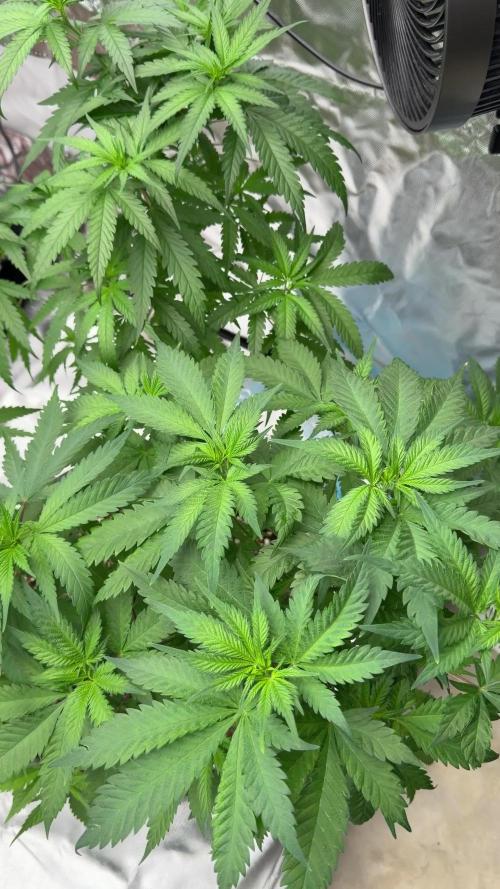
🌱 Sticky Broccoli – Grow Diary 🌱
Week 9 | Late Vegetative Stage | Coco + Perlite
This week included topping, lollipopping, and continued LST ✂️🌿
Final structural work is coming together as the plant nears flower transition.
Topping has created multiple strong main colas 🚀
Lower growth was lollipopped to focus energy on the upper canopy.
LST continues to spread the plant evenly under the future canopy 🌐
Light penetration has improved significantly.
Canopy is now wide, flat, and well-organized.
Airflow through the plant has increased 🌬️
Foliage remains healthy green with no deficiencies 💪
Plant is handling training with minimal stress.
Roots fully established and supporting vigorous growth ?
Watering steady with slight runoff 💧
📈 Focus next week: finalize canopy, install/adjust SCROG, and prepare for flip to flower 🌸🔥


Likes
42
Share


@Hashy
Follow
Grow diary 11 stage 8
Day 71 to 80
She just doing her thing. Because of the o.g the light is a bit to far away but this will be the next plant into the finishing tent and will get plenty more light for final days.
The two plants growing gorilla have been decimated by slugs. Next time I'm clearing more of an area around the plants and using slug pellets and tape. Never had a slug problem like this before.


Likes
9
Share


@Herbz_Unkraut
Follow
another resin monster from seedstockers, with a very special scent, full of flavors! grinded it smelled like peppermint, and vaped it has a great sweet creamy taste!
Processing
Likes
10
Share


@BodyByVio
Follow
This week I top all 8 Green Poison ( 4dwc and 4 coco ) clones. They look healthy and happy and few days later I already start to low stress training (LST) them.
Likes
26
Share


@Mrs_Larimar
Follow
2024-08-31
They may have stopped to stretch,
iam not sure, but i think so, you can see how the buds are forming, and they
are already purple, thats fun
leaves are changing color
thats the tribute to the last 2 days where it was very hot and sunny, and tehy needed lots drinks
and the big growth costed some leaves too.
but anyways, not a Problem at all
the Girl in the garden has more yellow leaves.
BREEDER INFORMATION
The cross of Frisian Dew with DucksFoot created Frisian Duck. It has such name due its characteristic leaf shape that looks like a duck's traces.
The plant has a good growth in greenhouses and outdoors and also indoors. The strain is easy to grow and suit for begginers. It is harvested at the start of October outdoor and after 8 weeks of flowering indoor. The plant reaches 1.5 m indoor or 2.5 m in height outdoor. It demonstrates purple colors during a blooming and looks like a christmas tree. Frisian Duck develops compact buds.
The strain has spicy aromas and tastes of pine, citrus and fresh wood.

Processing
Likes
4
Share


@Ogbangbang2981
Follow
I never thought I'd say it but i think when it comes to my indoor C4 vs my outdoor C4 Indoor takes the prize, I mean that's only for now lets see what happens in the upcoming weeks. I'm sticking to my bat turd mix and all sun, I shift her around during the heavy showers, yea it rains out here. I don't feed no store bought nutrients all from nature same goes for my indoor ... if you look closely you'll see that I lst her it's only because of her mutation.
Likes
64
Share


@MadeInGermany
Follow
Hi everyone :-)
This week will be a short update because there is not much to report :-)
It is developing well ;-) and will have some time to grow 👍
Strain
Blue gelato 41 clone from mother (Barney's Farm)
☝️
Genetics: Blueberry x Thin Mint Girl Scout Cookies x Sunset Sherbert
👍
Vega lamp: 2 x Todogrow LED Quantum board 100 W.
💡
Flower lamp: 2 x Todogrow LED Cxb 3590 COB 3500 K 205 W.
💡 ☝️
earth:
Canna Terra Professional +
☝️
Fertilizer:
Canna Terra Vega, Canna Terra Terra Flores, Rizotonic, Cannazym, CANNA Boost, Pk 13/14, Canna Cal / Mag, Canna Ph - Grow, Canna Ph-Flores
☝️🌱
Water:
Osmosis water mixed with normal water (24 hours stale that the chlorine evaporates) to 0.2 EG. Add Cal / Mag to 0.4 Ec Ph with Organic Ph - to 6.0
💦 💧


Likes
10
Share

@Ruthlez
Follow
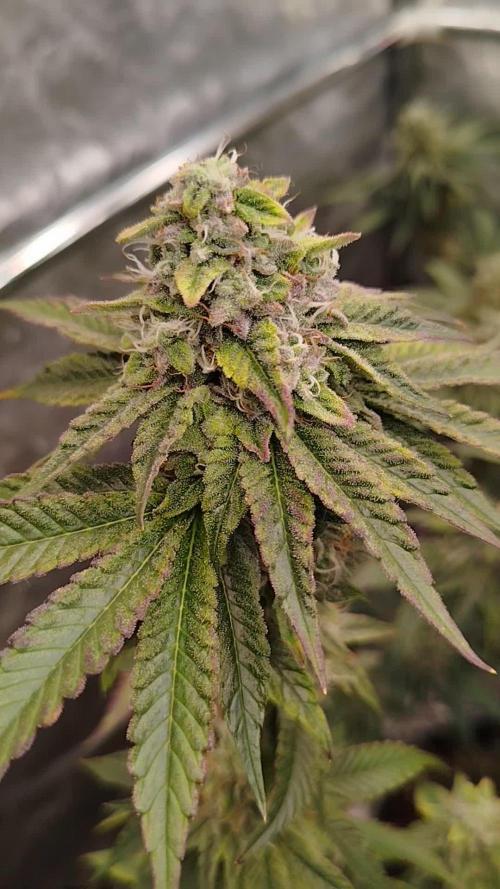
Start der Blütewoche 6 🌱
Diese Woche gibt es nicht viel zu berichten.
Alle 4 Pflanzen legen ordentlich an Masse zu und werden von Tag zu Tag Giftiger 🤩
Auf der Geruch hat extrem zugenommen.
Ich musste bei jeder Pflanze die zu Äste zusätzlich am Hauptstamm fixieren, da das Gewicht der Knollen ordentlich nach unten drückt.
Diese Woche bekommen sie noch Nährstoffe nach Plan, ab nächster Woche beginnt der flush.