





@RussianGrower
Follow
Hello to you from Russia, my friends from around the world. I thank all those who follow my progress and support me. Good luck! It's time to update my 13-week diary. I plan to make a harvest in a week, the plants are already fully talking about their ripeness. In General, things are going well for me, but due to weather conditions, the trip to the guerrilla cannabis plantations is postponed indefinitely. But I don't have to water them. Soon I plan on growing a new diary when the postal service delivers me new seeds and fertilizers for clones.


shorts_status_processing


@MadeInGermany
Follow
Hi everyone :-)
This week she was repotted, just like the other Wonder Pie Phenotype from the GHSC Cup in the other diary :-).
I am excited to see how it will develop with canna bio in contrast to Grennhouse Feeding 😊👏🏻.
I wish you all a nice weekend, stay healthy 🙏🏻 and let it grow 👏🏻😎




@wolfvb
Follow
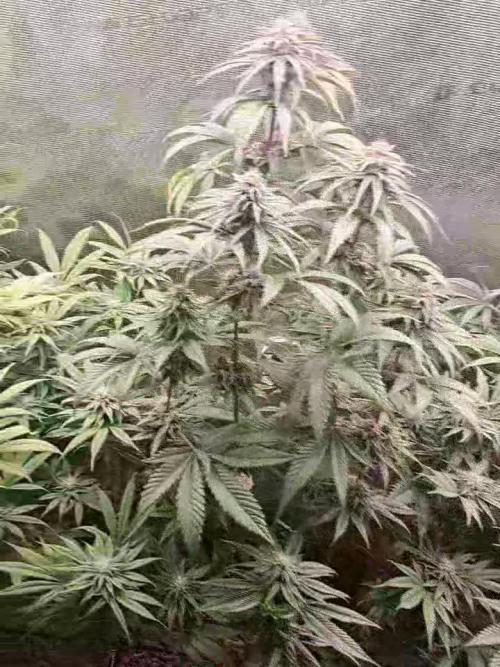
Smoke Report: man this girl was so sweet I loved her more than her sister this one test more like the Resin I pressed from her sister same flavor profile, smooth sweet and a bit of spicy, enjoyed growing here and smoking her so much that I all most forgot to finish the diary I just smoke her up jar after another 😅



@Grow4ever
Follow
Blüte geht voran. Die Raubmilben Amblyseius (Neoseiulus) cucumeris sind schnell da gewesen 🙏 Ich hoffe, sie halten den Thripsbefall bis zum Ende der Blüte unter Kontrolle. Bisher kann ich noch nicht viel zu den Terps sagen, sehr dezent alles. Zudem haben die Pflanzen die Tage zum ersten Mal einzeln einen Fermakor-Hydrolysat als Blütenbooster in sehr gering konzentrierter Dosis erhalten. Danke geht hier nochmal raus @yan420 Ich verspreche mir durch die direkte Verfügbarkeit der Nährstoffe P und K und den Aminosäuren einen metabolismischen Boost.
Bin auf die Endergebnisse wie immer sehr gespannt


@Olduffybastard88
Follow
Really up with the bio bozz fees was showing signs off under feeding there hungry girls ans just keep guzzling away I'm.so happy how these f1 are turning out there bigger and better than I ever expected tbh so over the


@Ultraviolet
Follow
You don't become confident by shouting affirmations in the mirror, but by having a stack of undeniable proof that you are who you say you are, outwork your self-doubt.
Nitrogen fixation is a chemical process by which molecular nitrogen (N2), which has a strong triple covalent bond, is converted into ammonia (NH3) or related nitrogenous compounds, typically in soil or aquatic systems but also in industry. The nitrogen in air is molecular dinitrogen, a relatively nonreactive molecule that is metabolically useless to all but a few microorganisms. Biological nitrogen fixation or diazotrophy is an important microbe-mediated process that converts dinitrogen (N2) gas to ammonia (NH3) using the nitrogenase protein complex (Nif).[2][3]
Nitrogen fixation is essential to life because fixed inorganic nitrogen compounds are required for the biosynthesis of all nitrogen-containing organic compounds, such as amino acids and proteins, nucleoside triphosphates and nucleic acids. As part of the nitrogen cycle, it is essential for agriculture and the manufacture of fertilizer. It is also, indirectly, relevant to the manufacture of all nitrogen chemical compounds, which include some explosives, pharmaceuticals, and dyes.
Nitrogen fixation is carried out naturally in soil by microorganisms termed diazotrophs that include bacteria, such as Azotobacter, and archaea. Some nitrogen-fixing bacteria have symbiotic relationships with plant groups, especially legumes.[4] Looser non-symbiotic relationships between diazotrophs and plants are often referred to as associative, as seen in nitrogen fixation on rice roots. Nitrogen fixation occurs between some termites and fungi.[5] It occurs naturally in the air by means of NOx production by lightning.[6][7]
All biological reactions involving the process of nitrogen fixation are catalyzed by enzymes called nitrogenases.[8] These enzymes contain iron, often with a second metal, usually molybdenum but sometimes vanadium.
Green clover (Fixation)
White clover (Fixation)
Red Clover. (Fixation)
Yellow Clover. (Fixation, deeper roots)
Sweet Thai Basil. (Terpenes)
Italian Basil. (Terpenes)
Chamomile.(Oil production)
Borage.(Pest attraction taste)
Lavender.(Pest attraction smell)
Marigold(Pest attraction visual)
Mycorrhizae are beneficial associations between mycorrhizal fungi and a plant’s root system. Mycorrhizal fungi spores germinate in the soil, creating filaments (hyphae) that penetrate the root cells, thus establishing a symbiotic relationship. This collaboration leads to the development of both intra-radical and extra-radical networks of filaments, enabling efficient exploration of the soil for enhanced access to nutrients and water. Consequently, these vital resources are transferred to the plant, resulting in numerous benefits for crop cultivation.
Various mycorrhizal products are available in diverse formulations (powder, granular, and liquid), concentrations, and qualities. Ongoing advancements in products, technologies, and research are reshaping our understanding of mycorrhizae. Despite these positive developments, certain misconceptions persist. In the following discussion, we aim to clarify the truths and dispel the myths surrounding mycorrhizae products.
MYTH #1
A HIGHER NUMBER OF MYCORRHIZAE SPECIES MEANS BETTER RESULTS.
Contrary to common belief, having a higher number of mycorrhizae species in a product does not translate to better results; in fact, it often yields the opposite outcome. A plant can sustain only one association with a particular mycorrhizal fungi species. Introducing multiple species creates competition among them, which is not advantageous for the plant. The initial colonizer does not ensure the highest success; instead, it gains precedence. It is recommended to select a product with a concentrated presence of a single mycorrhizae species known for its effective performance, rather than opting for a product with multiple species at lower concentrations.
MYTH #2
ECTOMYCORRHIZAE ARE EFFECTIVE FOR CANNABIS PLANTS.
Although ectomycorrhizae can colonize five to ten percent of plant species, cannabis is not among them. Ectomycorrhizae do not penetrate the root cells; instead, they develop around the roots and on the exterior. For cannabis plants, it is essential to seek out endomycorrhizae. Endomycorrhizae are capable of colonizing 70% to 90% of plant species, including cannabis. Unlike ectomycorrhizae, endomycorrhizae penetrate the root cells, forming structures like arbuscules for the exchange of nutrients and water with the plant.
MYTH #3
WHOLE INOCULANT (PROPAGULES) PERFORM BETTER THAN ONLY VIABLE SPORES.
The propagule count specified on most mycorrhizae products indicates the presence of spores (viable and unviable), hyphae, and root fragments. However, it is crucial to note that only viable spores, those with the capacity to germinate, can successfully colonize a plant’s root system. Spores are to mycorrhizal fungi what seeds are to cannabis plants—a fundamental component enabling fungi reproduction. Consequently, even if a mycorrhizal product boasts millions of propagules, its effectiveness hinges on the presence of viable spores. Without viable spores, the product will not contribute to plant development. Therefore, the genuine value of a mycorrhizal inoculant lies in the quantity of viable spores it contains, as only viable spores can efficiently initiate symbiosis.
MYTH #4
ALL METHODS OF APPLICATION YIELD IDENTICAL RESULTS.
To establish the symbiosis, mycorrhizal fungi spores must be close to the plant roots. The optimal recommendation is to directly apply mycorrhizal inoculant to the roots, either in powder, granular or slurry form. This method ensures maximum proximity between the spores and the roots, facilitating a rapid establishment of symbiosis. Particularly with crops like cannabis, which have a short growing cycle, employing this technique is the most effective way to obtain optimal benefits. Alternatively, techniques such as blending the inoculant with the soil are effective, but there may be a delay in the establishment of symbiosis. This is because the roots need to grow and come into contact with the dispersed spores throughout the growing media.
MYTH #5
MYCORRHIZAE CAN ONLY BE GROWN ON LIVING PLANTS.
While the predominant method for commercially producing mycorrhizae involves growing them on the root systems of living plants (in vivo production), it is not the exclusive nor the optimal technique. In fact, this production approach has notable drawbacks that the “root organ culture” method just does not have (in vitro production). In vitro production occurs in meticulously controlled, aseptic laboratory conditions, allowing for the consistent generation of products that are viable, highly concentrated, species-specific, and free from pathogens. Achieving such precision and quality is impossible when relying on the cultivation of mycorrhizal fungi on plants exposed to external conditions.
In conclusion, it is crucial to take all these factors into consideration when choosing the appropriate product for your crop to fully harness the wide array of benefits provided by a high-quality mycorrhizal product.
STRONGER PLANT – Stress resistance.
FASTER GROWTH – Improve plant structure and shorter veg time.
INCREASE YIELD – Overall more biomass.
IMPROVED QUALITY – Increase cannabinoids and terpenes content.


@CrowMaster
Follow
All looking good…this room is 3weeks behind my other room/diary….seen running these cuts for more then a year know what to expect…hunted this cut of apple fritter from x2 packs of Clearwater seeds checks all the boxes looks smell yield


@DogterB
Follow
Week 10 (1/12-18)
Day 65 (1/12)
She's getting closer and closer. When I scope her, she's mostly cloudy, with just a few ambers scattered in. I'll check her again later in the week. Her pot was still fairly heavy this morning, so she's set for the day.
Day 66 (1/13)
She was ready for a drink today. I watered her with some molasses and Mammoth P added in, pH'd to ~6.5. When she's ready again, I'll feed her one last time then it will be water only (maybe some molasses) until I chop her.
Day 68 (1/15)
Well I put the little clip on microscope on my phone and checked her trichomes. To my surprise, there seems to be a good amount of amber now. I think I'm going to call it. I'll cut her lights today and give her 48 hours in the dark, so will chop her down on Sunday (day 70). I'll give her a big drink of cold water and put some ice around her stem when I shut her down. I dry in paper bags and my last plant dried pretty quickly, as I didn't give her any water for awhile before chopping. I'd rather have a longer drying period, so I will water her up before she goes into the dark. Her last feeding was day 62 (1/9), so I'm hoping it has been long enough to work the nutes out by the time she's done.


@Blaze_With_Haze
Follow
This week i‘ve started to feed my little girls with nutrients again. The ladies doing a great job and started to produce some purple buds with frosty trichomes.


@Sublyme_ness
Follow
Stretchy. Long to first node.
Quite slow to grow at first but picking up pace.
Stem resisting let and would snap if u tried to bend too much...
Thrips about. Neemed.
Keep on Truckin



@Jardin33ro
Follow
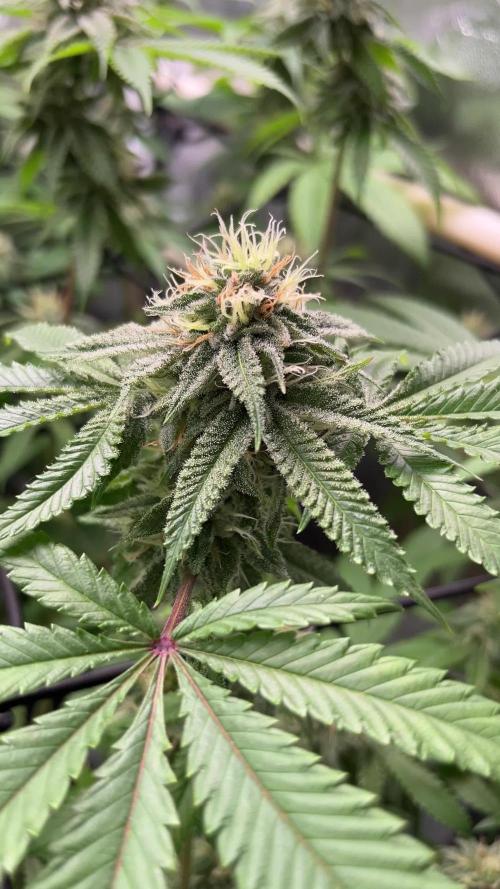
Buenas! Todos los sabados comienza otra semana, normalmente subo los martes. Pero me estoy haciendo un tiempito hoy para contarles como vienen los 4 clones de toronjaz-Blacktuna.
Esta semana ya se nota el engorde de la flor, ya los calices comienzan a tomar volumen. En cuanto a la resina, se ha formado bastante, en casi todas hasta hojas satelite. Mejoramos el color de las hojas, ya que veniamos alimentando muy de a poco y en estas semanas ya podemos apretarlas un poco. Seguimos igualmente de a poco, controlando de no exceder, siempre prefiero que falte a que se exceda.
En estas fechas comienza a elevar la temperatura, por lo que sin aire acondicionado en la pieza se puede llegar a complicar. Seguimos, cultivando y aprendiendo. Saludos, que tengan buenos humos 😮💨

shorts_status_processing


@NorCalCloset
Follow
At 91 days from seed, 36 days into bloom, she is drinking about 2 liters (1/2 gal) per day. It has been a little warm in the tent which has caused her to drink more. Since she is drinking more than normal, the tips of her leaves look a little burnt. I think my nutrient levels would be fine if she weren't drinking so much. It's only slight burn though so she'll be fine. She still smells great but is actually one of the less pungent plants I've grown. So it’s a nice smell but its not overpowering. It looks like its going to be a bountiful harvest. I upped the terpinator added to the minimum recommended dose suggested by the manufacturer. Not much to do but wait and watch her put on weight.


@InsideAz
Follow
Added a second scrog net for the taller plants last Friday. Constantly defoliating to increase light penetration but not trying to stress the plants. (Selective leaf picking)
Plants loved the tea I have them last week. Visual improvements in every plant 2 days later.
Top dressing later this week on 9/29:
5 tablespoons Gaia green 444
5 tablespoons Gaia Green 284
15 tablespoon Wiggle Worm Earth Worm Castings
Light increased to 75%


@Bread_n_Buds
Follow
Here we are again ready to start again, always under the sign of Zamnesia, we make our fantastic plants and we show you what we are capable of. We have 5 autoflowering strains and 5 photoperiodic ones and now we present them to you.
The fourth autoflowering that we present to you is our version or rather of Zamnesia forgive me if I start to feel at home, it is the Northern Lights. Here we are talking about a classic of classics naturally in the Zamnesia version as I said above with the right ruderalis it really promises big harvests in a short time. There is great competition on this plant and I have grown some very good ones let's see what the home one is like.
To explain my germination method which is a combination of experiences acquired in the field and readings of the right advisors, I have chosen to divide it into phases so whoever wants can follow them and understand better step by step.
- Preparatory Phase ---- Check the average temperature in the room, humidity status to understand if it is the case to start or wait, I decided for the end of August because the temperatures start to drop towards the 22-25 degrees recommended for germination.
Then another thing more or less credible depending on the sensitivity is the control of the lunar phases. I believe in it a lot, it is a method that ancient farmers used to understand when it was best to plant depending on the attraction of the moon. To make my life easier I use a simple app that advises you on the right time to plant, harvest and put in the jar (depending on the lunar phases).
- Phase 1 --- Soaking in water. There are many authoritative friends who advise against this method due to the risk of drowning, but I have always been fine and I follow the rule if it opens in water the seed is almost certainly healthy and will come out of the ground 90% normally.
- Phase 2 --- Opening the seed in water. As soon as the seed opens and the root comes out a little, you have to be very very careful not to leave the seed in the water open for too long. This is why there is a risk of drowning. So as soon as the root comes out, it must be planted. Do not wait for it to stretch out a lot, you can wait a little longer in the absorbent paper, but not in water.
- Phase 3 --- In the meantime, while I soaked the seeds, I prepared my pots: I use small biodegradable pots (choose the ones with holes underneath for drainage). A few hours before working with the opened seeds, I moistened the soil with water adjusted to the right pH (5.8 - 6.2) and Plagron Power Roots. The small root is now open and we can make a little hole with a toothpick, widen it and insert the seed. Not too deep with the root facing downwards. From Serious Seeds we learned the dome technique: if you put a small dome of soil on the seed the water will settle on the sides avoiding overwatering problems.
- Phase 4 --- The plant emerges from the soil. So far I have not put the light, now I turn it on at minimum after half a day of soil to give direction to the seedlings. The first week the light will be gradually brought from 40% to 60% to go to 70% - 75% in the remaining weeks of veg. During the first week maximum, I keep the cycle of 24 hours to avoid stretching. Be careful not to exceed the first week at least with photoperiodic plants.
- Germination % --- In water 20/20 seeds have opened for good luck I'm waiting to talk when they come out of the ground but it seems that we are going towards an excellent percentage of germination..."Not too bad"...
- Soil and Food --- The soil used is entirely organic in its entirety and is the Plagron Promix that will be used with the 100% organic pack provided by Zamnesia complete with all the main fertilizers for your plant buy it at the link --
https://www.zamnesia.io/it/11457-plagron-easy-pack-natural.html
// Strain Description // Born from the rib of a classic, Northern Lights Automatic is a weed from the past, but with a futuristic update. This feminized version sees Northern Lights hybridized with a ruderalis to create an extra sweet variety, that all fans are sure to love. Growers can expect abundant results in just 9 weeks, from seed to harvest! -
- Get a seed of this fantastic strain --- https://www.zamnesia.io/it/3324-zamnesia-seeds-northern-lights-automatica-femminizzata.html
- Soil and Fertilizers entirely organic --- https://plagron.com/en
- Growbox --- https://www.secretjardin.com/
- Music and sound --- I made my girls listen to 432hz frequencies and music from www.radionula.com
- Z --- You can find these seeds, much more from the world of cannabis, mushrooms and an incredible series of accessories and gadgets on the reference site not only mine but of many growers ----
https://www.zamnesia.io
shorts_status_processing


@BigBudWolf
Follow
BLUE CUSH
35 Days from sprout.
Light training. Leaf tucking and pony tailing. Pony tailing seems to help with the side branching.
She is genetically a small plant I believe, but she might be smaller then expected.. Possibly due to lower RH early on. Otherwise she seems to be doing ok.
Attempted a layer of clay pellets after soaking in PH'd water for 16 hours, to combat the gnats from reaching the soil. I feel like sand may have been a better choice and removed the clay before feeding again. There are so few gnats that its not much of an issue, but I'd like to eliminate the threat before flowering really kicks in.
shorts_status_processing


@eldruida_lamota
Follow
Que hay familia, de nuevo hemos acabado con la segunda semana de crecimiento y llevan un gran ritmo, su crecimiento se va viendo día tras día, están bastante sanas el alimento lo están aceptando muy bien.
No es nada nuevo es la primera variedad que cultive en indoor allá para el 2010, con lo cual siempre que e podido e puesto algunas critical en mi armario.
.
Vamos con parámetros, ya está segunda semana baje un poco la humedad pero poco , anda entre 60/70% la temperatura está entre 22,24 grados, el led es increíble , y como siempre el ph , ya que es de lo más importante,está en 5,8/6,0.
.
AgroBeta:
0,8 ml x L Piramid , vía radicular.
0,6 ml x L Growth black line , vía radicular.
0,1 gr x L Cancerbero , vía radicular.
0,1 ml x L Tucán , vía radicular.
0,1 ml x L Flash Root , vía radicular.
0,4 ml x L Great Green , vía foliar.
0,05 ml x L Gold Joker, vía radicular.
.
así concluye esta segunda semana y estoy bastante contento con el resultado hasta ahora, buenos humos fumetillas.


@Kratomizer
Follow
Everything looks good. Humidity has been way too high.
I started flushing the plants.


@xTherapy_Growingx
Follow
I’ve changed to a 12/12 light cycle, removed a few big fan leaves, and tied 2 of the plants tops down..


@Growyourownathome2x2
Follow
Friday the 19th of May Day 23 of 12/12 recently started with the new nutrients mills part A and mills part B ppm 870 all in full flower now still not impressed with the front left plant but what can you do il be happy with a small yield from that one hopefully the quality is as good as my last grow 🍁😎 also need to upgrade my light been using cheap lights for awhile now and the grow is better each time so I’d like to see what I can do with a well known light from a good company