


Likes
Comments
Share


@SonomaSungrown
Follow
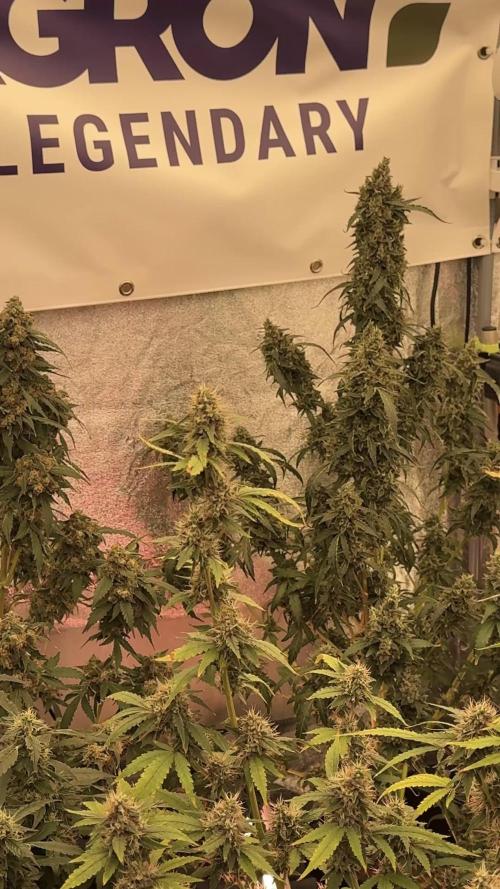
The girls just keep on cooking...and things are starting to get really bushy.
I'm hoping that we're close to finished on the vertical growth front.
Chem Brûlée just keeps getting bigger and bigger, but she seems to be spreading OUT faster than she is growing UP at this point (she's already 56" call).
Pineapple Meatball is just a straight up bush.
French Macaron is 62" tall and VERY thick on the vegetation front, but not as WIDE as the chem brûlée.
7/13
Sprayed with light neem/castille spray


Likes
4
Share

@DogDoctorOfficial
Follow
🚂 8×8 Adventure – Week 12
🌸 Cash Express – Pheno A
💨 She's Moving Fast — And Now She's Starting To Talk
Hello everyone, and welcome back to another chapter of the 8×8 Adventure! 🌱💚
And Cash Express Pheno A...
Well...
She's moving.
And she's moving FAST.
😂🚂💨
Last week we talked about letting the plants do their thing.
This week?
Cash Express seems to have taken that as a personal challenge.
Because she's definitely doing her thing.
She's developing.
She's progressing.
She's putting on flowers.
She's changing.
And now...
she's starting to smell.
A LOT.
👃🌸😂
And that's when you really start paying attention.
Because there is something special about reaching the stage where the plant doesn't just look like it's flowering...
you can actually start experiencing the flowering process with another sense.
The aroma is becoming part of her story.
And I'm very curious to see where this girl is going.
────────────────────────
🌱 The 8×8 Adventure — Same Room, Different Stories
For anyone discovering this diary now, welcome to the 8×8 Adventure.
This project is all about putting different genetics and phenotypes into the same general environment and allowing each one to show us what she naturally wants to become.
Twelve plants.
Different genetics.
Different phenotypes.
One room.
One 12/12 lighting strategy.
One irrigation system.
One general nutritional approach.
One lighting ecosystem.
One grower.
And somehow...
twelve completely different stories.
That's what makes this project so much fun.
Because even when the environment is shared, the plants don't read the same script.
Some are compact.
Some are tall.
Some are incredibly frosty.
Some develop unusual structures.
Some move slowly.
And some...
like Cash Express Pheno A...
suddenly decide:
"Right.
Let's get moving."
😂🚂💨
And she's certainly moving now.
────────────────────────
🚂 She's Picking Up Speed
This week, the biggest thing I'm noticing is simply progression.
She's moving quickly.
The flowers are becoming more established.
The plant is changing noticeably.
And the whole structure is beginning to look increasingly like a proper late-flowering plant rather than a plant that's still deciding what she wants to become.
There's momentum.
And I really like seeing that.
Because this is the stage where the plants start revealing more of their final personality.
Earlier in the cycle, we were mostly watching architecture.
Stretch.
Branches.
Canopy.
Training.
Structure.
Now?
The flowers are becoming the main event.
And Cash Express is starting to put some serious effort into that part of the story.
────────────────────────
🌸 Maybe Not The Prettiest Girl...
I'm going to be honest.
😂
She may not be the prettiest girl in the room.
And that's okay.
Beauty is subjective.
And when you've got twelve different plants sitting beside each other, there are always going to be some that immediately grab your attention more than others.
Cash Express Pheno A isn't necessarily the girl that makes you stop from across the room and say:
"OH MY GOD!"
😂
But then you look closer.
And you start seeing her.
Her structure.
Her flowers.
Her individuality.
Her little peculiarities.
And suddenly you realize:
She's got charm.
She's got character.
She's got her own kind of beauty.
And that's actually something I really appreciate.
Because not every phenotype needs to be conventionally beautiful to be fascinating.
Sometimes the unusual ones are the ones you remember.
And Cash Express is definitely becoming memorable.
────────────────────────
✨ Beauty Is Not Always About Perfection
That's one of the things this entire project keeps teaching me.
If I judged every plant purely by appearance...
I'd miss half the story.
Some plants are extremely symmetrical.
Some are incredibly frosty.
Some have perfect-looking flowers.
Some have crazy structures.
Some are compact.
Some are stretched.
Some are simply...
different.
And Cash Express Pheno A falls into that last category for me.
She's not necessarily the picture-perfect princess of the tent.
But she's interesting.
She's unique.
She's developing quickly.
And now she's giving us something else to pay attention to:
her aroma.
And honestly?
I'll take interesting over predictable any day.
😂🚂🌸
────────────────────────
👃 Oh... Now She's Starting To Smell
This is the part that has really caught my attention.
She's starting to smell.
And not just:
"Maybe if I put my nose close enough..."
No.
She's starting to make herself known.
😂👃💨
The aroma is becoming noticeable enough that I find myself paying attention whenever I'm around her.
And that's exciting.
Because aroma development is another piece of the phenotype puzzle.
The visual appearance tells us one thing.
The structure tells us another.
The flowering speed tells us another.
And then the plant starts telling us something through its aroma.
Now I'm curious.
What is she going to smell like as she continues developing?
How much stronger will that expression become?
What kind of character is going to come through?
And where is all of this going?
I don't know.
But I'm very interested in finding out.
────────────────────────
💡 Still Under The Same Lighting Experiment
And just like everyone else in the 8×8, Cash Express Pheno A is still experiencing the upgraded lighting environment.
Future of Grow supplied us with two additional Black Series 600W fixtures for this experiment.
The additional fixtures initially pushed the available PPFD higher than we wanted.
So we brought the output down.
We're currently running around:
🔌 59% power from the plug
with approximately:
☀️ 1,500 PPFD across the upper canopy.
And Cash Express is right there underneath all those photons.
She's not receiving a special lighting treatment.
She's not getting a secret little VIP setting.
She's getting the same general room environment as the other girls.
And yet...
look at how differently she's expressing herself.
That's the fun.
Same light.
Different plant.
Different response.
────────────────────────
☀️ Photons In — Cash Express Out
This is one of my favourite parts of the experiment.
We provide the photons.
The plant decides what to do with them.
And Cash Express seems to have decided:
"I'm going to turn these into flowers...
and then I'm going to make the whole room smell."
😂💨🌸
Fair enough.
That's a pretty good use of photons.
The upper canopy is receiving strong light.
The lower portions naturally receive less depending on plant height and structure.
And the plant itself decides how to position its leaves and flowers within that three-dimensional environment.
We're not trying to force every plant into exactly the same shape.
We're watching how each phenotype uses the space.
And Cash Express is certainly using hers.
────────────────────────
🥥 Nutrition — A Small Step Back For The Whole Room
The nutritional program has also been adjusted slightly this week across the entire room.
Terra Bloom has been reduced from:
🌸 2.3 ml/L
to:
🌸 2.0 ml/L
This brought the EC down slightly to:
⚡ ~2.05 mS/cm
The rest of the current recipe remains:
🌱 Pure Zym — 1 ml/L
🌿 Power Buds — 1 ml/L
🍯 Sugar Royal — 1 ml/L
⚗️ pH Plus — 0.03 ml/L
🍋 Lemon Kick — 0.03 ml/L
🌸 Terra Bloom — 2.0 ml/L
Again, this is a room-wide adjustment.
We're not trying to micromanage every plant individually.
We're allowing the whole room to progress together while watching how each phenotype responds.
And Cash Express?
She's moving beautifully.
────────────────────────
💧 Still Providing — Still Watching
The current irrigation is around:
💧 1.4 L per plant / 24 hours
And the rest of the room remains under the same general environmental strategy.
We're not making dramatic changes.
We're not trying to force her into another stage.
We're simply continuing to provide consistency.
Because at this point...
the plants are doing most of the work.
Our job is becoming increasingly simple.
Observe.
Maintain.
Provide.
Document.
And let them finish their stories.
────────────────────────
🌡️ Week 12 – Current Room Conditions
The current room conditions are approximately:
🌸 Flowering: Week 12
💡 Light schedule: 12/12
☀️ Upper-canopy PPFD: ~1,500
🔌 Future of Grow Black Series output: ~59% from the plug
🌡️ Day temperature: ~27°C
🌙 Night temperature: ~25°C
💧 Relative humidity: ~60%
⚗️ pH: ~6.04
⚡ EC: ~2.05 mS/cm
🌡️ Solution temperature: ~25.2°C
🌱 Substrate temperature: ~26°C
🌬️ CO₂: ~693 ppm
🌱 Pot size: 15 L
💦 Irrigation: ~1.4 L/plant/24h
Same room.
Same environment.
Same general nutrition.
Same lighting philosophy.
Same irrigation.
Different Cash Express.
And she's certainly giving us something to watch.
────────────────────────
🌿 The Plant Doesn't Need Us To Make Her Interesting
This is another thing I really like about this stage.
We're not doing anything special to make Cash Express interesting.
She's doing that herself.
We're not training her into some crazy shape.
We're not manipulating her to create a particular appearance.
We're not forcing her to behave differently.
She's simply progressing naturally.
And the more she develops...
the more personality becomes visible.
That's exactly what I wanted from the 8×8 Adventure.
I wanted to see what these individual phenotypes would do when given the same general opportunity.
Cash Express is giving us her answer.
And I like the answer.
────────────────────────
🌸 The Flowers Are Becoming Serious
The flowering structure continues developing.
The flowers are becoming more substantial.
The plant is clearly moving forward.
And this is the part where I start getting excited about the next few weeks.
Because once the plant gets into this rhythm...
you can almost feel the momentum.
Every week starts bringing more visible change.
The flowers become more defined.
The plant becomes more obviously floral.
The aroma develops.
The overall structure starts looking increasingly mature.
And Cash Express?
She's entering that stage now.
She's not finished.
Not even close to writing the final chapter.
But she's definitely moving.
And moving quickly.
────────────────────────
🔬 Her Uniqueness Is Becoming More Obvious
This is another reason I'm glad we're documenting her individually.
If you put Cash Express Pheno A beside another phenotype and simply called them both "Cash Express," you'd miss a lot.
This girl has her own expression.
Her own pace.
Her own structure.
Her own visual personality.
And now...
her own aroma is starting to become part of the picture.
That's what phenotype hunting is about.
You don't just want to know:
"What strain is this?"
You want to know:
"What does this individual plant do?"
And Cash Express Pheno A is slowly but surely answering that question.
────────────────────────
📸 The Camera Sees What The Eye Sometimes Misses
One of the things I love about documenting these plants every week is that the camera gives me another way to compare their development.
Standing in the room, sometimes the changes don't feel enormous.
Then I look at photographs from a few weeks ago...
and suddenly:
Whoa.
She's changed.
The flowers are more developed.
The structure is different.
The plant has progressed.
And that's why these weekly photographs matter.
They're not just pretty pictures.
They're a timeline.
They're evidence of the journey.
And Cash Express is building a pretty interesting timeline.
────────────────────────
💨 The Smell Is Becoming Part Of The Story
This deserves another mention because it's something I really noticed this week.
She's starting to make herself known.
😂💨
And I think that's a beautiful milestone in a flowering plant.
The visual side has been there for weeks.
Now the aromatic side is beginning to join the conversation.
And that makes me even more curious.
Because we don't know yet how strong this expression will become.
We don't know exactly where the aroma is going to develop.
And I'm not going to pretend I know what the final result will be.
We're going to find out.
That's the fun.
Let the plant show us.
────────────────────────
🚂 Cash Express Is Moving Fast
If I had to summarize this week in one sentence, it would probably be:
"She's moving."
😂🚂💨
She's moving quickly.
She's developing.
She's becoming more floral.
She's becoming more aromatic.
And she's becoming increasingly interesting.
Maybe she's not the prettiest girl in the room.
But she's certainly one of the girls I want to keep watching.
Because there's something happening here.
And I want to see where it goes.
────────────────────────
🧠 Same Environment — Different Result
This is probably the biggest lesson of the entire 8×8 Adventure.
We can standardize the environment as much as possible.
We can standardize the lighting.
We can standardize the irrigation.
We can standardize the nutrition.
We can monitor temperature.
We can monitor humidity.
We can monitor CO₂.
And still...
the plants will express themselves differently.
That's genetics.
That's phenotype.
And that's exactly why I wanted twelve individual diaries.
Cash Express Pheno A is giving us another piece of that puzzle.
She's fast.
She's unique.
She's aromatic.
She's got charm.
And she's becoming increasingly interesting as the weeks pass.
────────────────────────
🔭 Looking Ahead — Where Is She Going?
Now I'm genuinely curious.
Because the next stage should be very interesting.
She's moving quickly.
She's starting to smell.
The flowers are developing.
The plant is becoming increasingly mature.
So where does she go from here?
How much more will those flowers develop?
How much stronger will the aroma become?
How will the final structure evolve?
What kind of expression is hiding underneath all of this?
I don't know.
And I don't want to guess.
Let's just watch.
Let's document.
Let's photograph.
Let's smell.
😂💨
And let's see what Cash Express decides to become.
────────────────────────
❤️ Final Thoughts — Give Her The Spotlight
Week 12.
And Cash Express Pheno A is moving.
Fast.
She's not necessarily the prettiest plant in the room.
And I'm perfectly comfortable saying that.
Because beauty isn't a competition.
And this girl has something else.
Charm.
Character.
Uniqueness.
Personality.
And now...
aroma.
She's starting to smell.
She's developing quickly.
She's becoming increasingly floral.
And she's giving me another reason to stop beside her and take a closer look.
She's not trying to be somebody else.
She's just being Cash Express.
And honestly?
That's exactly what I want.
This project isn't about finding twelve identical plants.
It's about discovering twelve individual expressions.
And this one is giving us a very interesting one.
So let's make her shine.
Let's give her the spotlight.
Let's appreciate the flowers.
Let's appreciate the structure.
Let's appreciate the weird little details that make her different.
Let's appreciate the aroma that's starting to fill the air.
And most importantly...
let's see where this girl goes.
🚂🌸💨
She's moving.
She's moving fast.
And I'm enjoying the ride.
────────────────────────
🙏 Thank You
A huge thank you to Zamnesia for these Cash Express genetics and for giving us the opportunity to explore these individual phenotypes throughout the 8×8 Adventure.
Thank you to Plagron for supporting the nutritional side of the journey and helping us continue adjusting the flowering program as the room progresses.
A massive thank you to Future of Grow for the Black Series lighting and especially for providing the two additional Black Series 600W fixtures we're testing in this room.
Having more lighting capability, controlling the output and watching how these different plants respond has been one of the most interesting parts of this experiment.
Thank you to Lumiflora for bringing additional lighting deeper into the canopy and helping us think about the plants as three-dimensional structures.
Thank you to TrolMaster for helping us keep the environment under control behind the scenes.
And, of course...
thank you to everyone following this crazy 8×8 Adventure on GrowDiaries.
Every week we discover something a little different.
A different shape.
A different rhythm.
A different colour.
A different flowering structure.
A different personality.
And now...
a different smell.
😂💨🌸
Cash Express Pheno A may not be the prettiest girl in the room.
But she's certainly got something.
She's unique.
She's charming.
She's developing quickly.
And she's starting to make herself known.
So let's keep watching.
Let's keep documenting.
Let's keep learning.
And let's give this girl the spotlight she deserves.
Because sometimes...
the most interesting plant isn't the one that immediately catches your eye.
Sometimes...
it's the one that makes you come back for another look.
Cash Express Pheno A?
She's becoming that girl.
🚂🌸💚
Until next week...
Keep moving, beautiful girl.
We're watching.
Growers Love & Happy Growing! 🌱💚

Likes
72
Share


@DreamIT
Follow
🐩👤Sirius Black👤🐩 by 🌍🌱WeedSeedsExpress🌱🌍
👤 22.3 ...
👤 23.3 ...
👤 24.3 ...
👤 25.3 beautiful plant, large and vigorous, I hope it takes a dark / red color, it would be fantastic. but I'll try with other seeds eventually 😀 the lamp is really cool, the plants look just fine under Viparspectra
👤 26.3 ...
👤 27.3 All very well, I can't wait for it to start releasing perfumes
👤 28.3
__________________________________________
👀Are you looking for a good lamp to start?👀
Viparspectra in my opinion has something more than the others, take a look at their site.
➡️ http://bit.ly/pro-seriesproductspro-series-p1500
⏩Use " GDVIP " for an extra discount💯
____________________________________________________________________________________
📜👀 A look at the details of what I'm growing 👀📜
🐩👤Sirius Black👤🐩 by 🌍🌱WeedSeedsExpress🌱🌍
📋 Details 📋
⚧ Gender
▪️ Feminised
➰ Genes
▪️ 70% Indica / 30% Sativa
🎄 Genetics
▪️ Sirius Black
🚜Harvest
▪️ 450 g / m²
🌷Flowering
▪️ 63 - 70 days
✨THC
▪️ 25.0%
✅CBD
▪️ 0.5%
🏡Room Type
▪️ Indoor
🌄Room Type
▪️ Outdoor
🕋Room Type
▪️ Greenhouse
🎂Release Year
▪️ 2020
____________________________________________________________________________________
👀📷 Follow the best photos on instagram 📷👀
https://www.instagram.com/dreamit420/
🔻Leave a comment with your opinions if you pass by here🔻
🤟🤗💚Thanks and Enjoy growth 💚🤗🤟

Likes
10
Share


@NewNewbie
Follow
Final weeks are here, going lower on the nutrients and checking trichomes. Girls are looking good, but the temps are too high and im still afraid to turn on the humidifyer, because im afraid the vapor will increase humidity in some spots to budrot levels.
Processing
Likes
23
Share


@eldruida_lamota
Follow
Como estamos familia, a día de hoy, viernes, llevamos exactamente 7 días en la fase de floración y todas ellas están marcadas por su sexo.
Todo va sobre ruedas, tenemos mínimas de 20,5 y maximas de 28,5 grados. la humedad no supera nunca el 60%.
Altura mínima lemon kush 25cm.
Altura maxima northern light xl 42cm.
•las power plant xl Han pegado un estirón serio, están empezando a ensanchar bastante.
•una marea verde desde semilla, con tan solo 5 semanas de crecimiento y un solo trasplante desde que se germinó, para controlar un mal crecimiento.

Likes
58
Share


@Kynareth
Follow
buds are getting fat and smell is more intense now. the watering level is low and the leaves are yellowing so i won't refill it because the plant is near to harvest. I recorded a microscope video to see trychomes (sorry for my bad pulse) but enought to see that buds aren't ready to harvest, maybe the next week.

Likes
53
Share


@Roberts
Follow
Merlin Mintz Autoflower is doing good. She had got her first lst, and selective defoliation today. Her root tips were pruned. She is looking good, and ready to go. Thank you Aeque Genetics, Athena, and Spider Farmer. 🤜🏻🤛🏻🌱🌱🌱
Thank you grow diaries community for the 👇likes👇, follows, comments, and subscriptions on my YouTube channel👇. ❄️🌱🍻
Happy Growing 🌱🌱🌱
https://youtube.com/channel/UCAhN7yRzWLpcaRHhMIQ7X4g
Likes
9
Share


@BelgianBudtender
Follow
Hey farmers,
It's day 107 and I'm going to call it done, there's a few amber trichomes and she could probably go ANOTHER week but I need my flower tent.
This plant went way overtime, and I made a lot of mistakes, but she smells great and one thing is for sure, I'll have a ton of weed in a few weeks.
So, this week I flushed and next week I will harvest, the next update to this diary will be post dry, but before cure. As tradition, I'll have a sneaky taste before putting her in jars.
For my next cycle I will be upgrading my lights to Mars Hydro FCE 3000, going from 150w to a whopping 300w. I'll probably get a 3x3 in the near future, too.
As always, stay safe and happy farming!

Likes
14
Share


@Ganja_Victoria_Aus
Follow
I am starting this second mandarin becasue of the first one. It looks like not moving. Lucky 🍀 i got room.





Likes
Comments
Share


@LokalGrenz
Follow
Added some cal mag to the ro water besides that everything looking good so far
Added bloom 6/25

Likes
43
Share


@Johnny2Fire4U
Follow
Fed nutes and hit em with some microbial as well. Watering every other day. Gave the lower fan leaves a trim on a few of them just to see how it effects the top. All in all a good week.

Likes
7
Share


@DeepRootsGrowTrees
Follow
ELEPHANT AUTO / SSSC
This lady grow with no issues she's not big in stature but she makes up for that with a plant that's as thick as a elephant and hopefully as strong! She produces trichome covered buds that have a distinct aroma to them! She's Easy to grow and doesn't get to tall if you need to grow in a smaller space! Additionally if your a medical grower she's a strain you might want to add to your garden of ladies!! Stay Growing!!!
Thank you for stopping by and taking a look it's much appreciated!!
I want to say thank you to SSSC for hosting the video contest!!! Growers appreciate 🙏 your growers support and putting on the contest for us to showcase your genetics!!!!
ELEPHANT AUTO / SSSC

Likes
19
Share


@adam_pawloski87
Follow
This week went real well! All 5 of the Twenty20 Ogreberry Autos and the 1 Fastbuds Bruce Banner have successfully germinated and sprouted up from the soil!! This upcoming week we will start giving these girls a heavy feeding of nutrients PH d at 6.5 an see how they react , most likely will love it!! Temperature an humidity has been on point, through out the day we reach 70-75 degrees an a nice humidity of 65%which is always nice ! Hope you all enjoy an keep them eyes peeled for next week !! Peace, love, an positive vibes to all you Growmies out there! If any questions please feel free to ask , more then happy to help! Cheers everybody to another great grow!!!


Likes
Comments
Share


@TTerpz
Follow
Start of week 3
Update 2/27: they have been fed with a dose that was cut in half (fox farm dirty dozen)
Likes
7
Share


@Salokin
Follow
Hi growmies,
The plants are in full flower now and have been defoliated after the hst of last week and seems like she has recovered. I had removed the filter and vent from the box and have the vent suck the air out of the box into the carbon filter, which gave me another 10 cm to play with. The plant consumes around 2 l of nutrient solution in 24 hours. This whole experience is howling me that I have to change the system in the box as I loose to much height with the grow table and the rockwool blocks. Will probably run a 20 l DWC in it, that I am currently working on.
Likes
44
Share


@SooSan
Follow
12/12 + 35 jours
Vu qu’il y a 16 plantes mais que sur growdiaries on ne peut mettre que 8 variétés j'ai divisé en 2 diaries pour le bas de la tente
1️⃣
🏠 90x60x90
☀️ FC-E 4800 => puissance a 20%
🍁
1x Black Bomb / Philosopher Seed
2x Amnesia Lemon / PEV Seeds
1x Blueberry / PEV Seeds
1x Blueberry / 00 Seeds
1x Wappa / Paradise Seed
1x Dark Phoenix / Green House Seed
1x Quick Sherbet / Exotic Seeds
1x Mango Cream / Exotic Seeds
1x Banana Frosting / Sensi Seed
1x Hindu Kush / Sensi Seed
3x Fast Mix / Sweet Seed
📎 https://growdiaries.com/diaries/122084-grow-journal-by-soosan
📎https://growdiaries.com/diaries/124052-grow-journal-by-soosan
2️⃣
🏠 30x60x50
☀️TS1000 => puissance a 50%
🍁 4x Quick Sherbet - Exotic Seed
📎 https://growdiaries.com/diaries/122080-grow-journal-by-soosan


Likes
50
Share


@AsNoriu
Follow
Day 77. Girls down !
My friend is very proud of this one !
Will update with harvest result and maybe taste review later. Have two same running at mines, so will be good comparison.
Day 82. She is still on the racks, but beauty is insane !!!
Happy Growing !


