


Likes
Comments
Share


@ethnoGrow420
Follow
o Added a PK booster this week
o Defiliated at end week 13
o 1.00 VPN
o feeding twice a day


Likes
24
Share


@Ultraviolet
Follow
Hi, thanks for taking the time.
"I want happiness"
Remove the "I" that's ego. Then remove "want", that's desire. Only thing left is happiness.

Likes
13
Share


@Sativa974
Follow
Dos si dos 33 naissance le 7 février, passage en floraison le 24 avril.
Plante vigoureux tige forte tout va bien pour le moment...rempotage une semaine avant le passage en floraison dans un pot de 30 litre, mélange de batmix, humus de lombric,terre et guano chauves-souris. Arrosage seulment à l'eau du robinet, que j'ai laissé reposer 24heure,arrosage entre 2 et 3 jours environ 2.5 litre d'eau.

Processing
Likes
24
Share


@Guerilla_Jack
Follow
Its end of six week of veg... plants looks ok..last week I tied them down.now I do scroog and some cleaning.i think three more weeks and then
I will switch them to flower..I add terpinator to nutritions.this is new for me.we will see ... nice green day to you all people💚


Likes
20
Share

@BUZIMAN
Follow
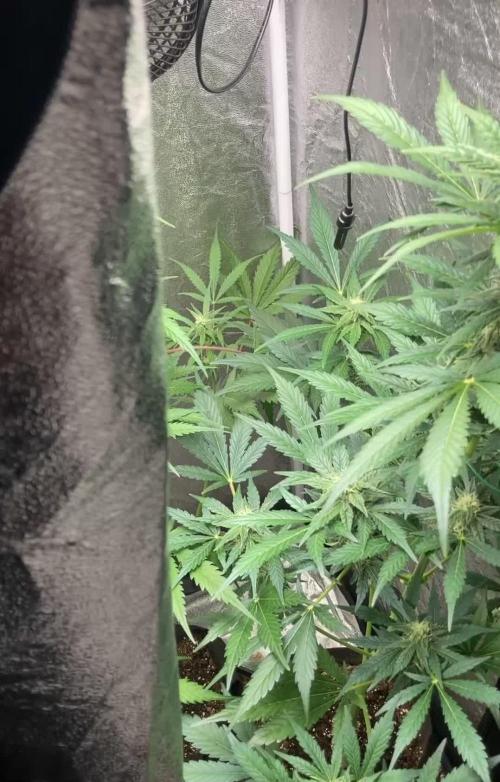
It’s growing good & start to smell😎
💦1 Liter per day of mix
📏 1,13 meter
⛅️ 27,5 celcius 45%rH
💡 70% Light power
💚💛❤️
Likes
78
Share


@AsNoriu
Follow
Day 162. One more girl chopped, so it's 2 X Incredible Bulks, 2x Gorillas and one Cookie, wich went crazy colours ...
I'll give them all time till frost and then harvest. No HERMIES seen in left strains, no bud rot too, hope UK weather will give me couple weeks...
Happy Growing !
Likes
29
Share


@THCeitor
Follow
Ya estamos a medio camino del proceso, las plantas se ven sanas y con una leve ventaja de la Red Strawberry Banana #2, la cual muestra una floración mas adelantada que la #1 como muestran los videos. Se nota un tono purpura mas oscuro en la R.S.Banana #2 y un tono mas claro en la R.S.Banana #1, la cual muestra un tallo de gran proporción quizás por un leve exceso de Nitrógeno.

Likes
15
Share


@BushDoctor740
Follow
Day 15 things are moving along just fine light intensity still set at 30 percent and raised to the ceiling.The seedling did not make it so replacing with another strain as I would like to have 6 plants in this grow.Not watering much as I’ve kept humidity high and the girls are not drinking much.Day 20 I did some LST on two of the Runtz that are a bit stronger and taller than the rest
Likes
6
Share


@I_Identify_As_A_Dan
Follow
Week 8 for GMO 8 Auto by atlasseed
Shes been bulking up nicely especially the smaller plant. I thought id add some picture of the sister GMO ive also got going in a bigger 25L pot for you guys to see the size difference between the two plants. The bigger one will be going outdoors today to make room for the other plants going into flower. Still only got fed twice this week with a bit of (WCA) Water Soluble Calcium & (FFJ) Fermented fruit juice for its last few weeks of life now.

Likes
24
Share


@Rit031
Follow
This week still raining.........
Fertilizer this week
1) Monopotassium phosphate (KH2PO4) 45.7 grams with 500 ml of water + Mono-ammonium phosphate (NH4H2PO4) 45 grams with 500 ml of water. Mix both together and use only 5 ml per liter of water.
2) General root stimulants 1 ml per liter of water.
3) 4 eggs mixed with 1 tablespoon brown sugar + 4 tablespoons curd. Mix together.then lived it for 1week .Then used 2.5 ml per 1 liter of water.
4) Calcium nitrate {Ca (NO3) 2} 3.5 grams, mixed with 1 liter of water, set aside. Prepare a mixture of 3.5 grams of magnesium sulfate and 3.5 grams of boric acid mixed in 1 liter of water. Then mix all 2 liters of liquid The ratio used to put plants is 3-5 ml per 1 liter of water.
5) EDTA chelate 1 ml per 1 liter of water.
6) 0.5 grams of amino acids per 1 liter of water.
7) Bat manure.


Likes
67
Share


@XII_XII_MrGreen
Follow
She definitely outgrew the rest😯.. Love to see the fast development like Sweet Seeds describe😃.
Let the (Red?) Buds come 😁😂🤪
See y'all next week right 🆗🆗🆗🤙🏻


Processing
Likes
14
Share


@SunshineBud
Follow
Man p4 is coming on strong after knocking of the longstanding p1 Queen of the crop. Crazy, I thought plant 3 was goin to be lucky to survive and she kicks booty! Another video up there 12 days in December cuts off about an hour ago.
I have to say this week went pretty uneventful other than getting everything potted into their final 3ga pots. I'm trying to get the plants up to around 12" before flipping but getting anxious about it.
If plant 3 wasn't so dang little I'd probably had flipped the ladies already... But they're still a bit short. I'm finding overcoming impatience is the biggest lesson I'm learning.
Below is the transcribed daily notes you can find in the images above:
12/24 Measurements good, 3 still looking slow.
12/25 (Fed w/) 2 tsp/ga Big Bloom / 2 tsp/ga Grow Big 1/4 tsp/ga Clean kelp. Trimmed suckers off p2 repotted #3 1225 ppm tds, 4.43 ph out.
12/26 Humidifier wonky, got soil warming up to transplant but think maybe wait as soil still a little moist. Trimmed suckers off 4, rinsed all w/ph balanced H2O.
12/27 Humidifier ran out
12/ 28 Repotted 1/2/4 fed w 2tsp ga grow big/big bloom, 1/4 tsp clean kelp. trimmed 2x suckers off 1 b4 I thought about stress f/ potting. 1295 TDS ppm
12/29 trimmed 2 browning suckers f/ P3
12/30 cut low brances/suckers messed up leaves/babvies on P2

Likes
13
Share

@Bncgrower
Follow
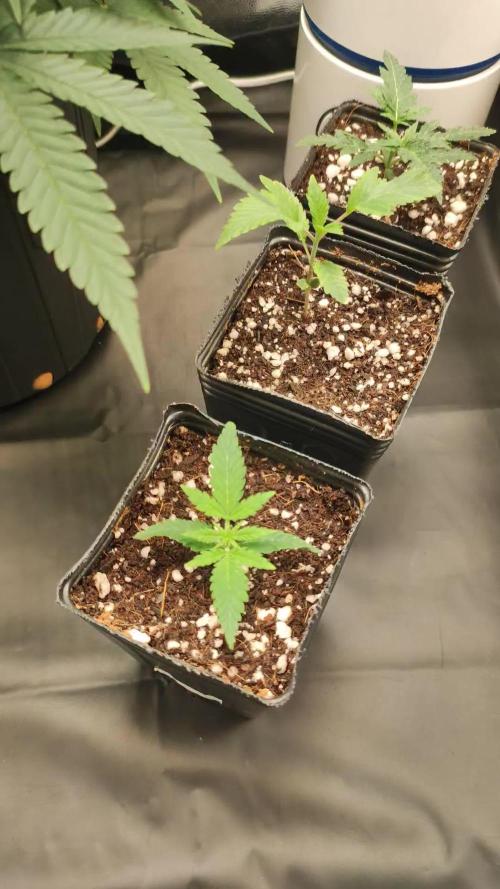
Everything is going very well as expected, good progress. I had the transplant on the last day of the first week..✌️🌱
Likes
17
Share


@Agrocann
Follow
After ~ 30 hours the small root emerged from the seed.
After 48 hours the small root become big and I managed to brake the tip of the root.
After 48 hours from seedling the new baby has emerged :)

Likes
27
Share


@ohserp
Follow
Flowering time! These girls have been giving me nothing but ease so far. A little bit of defoliation here and there for the next weeks focusing on maximizing the bud potential. Hope fully I get some monsters!


Likes
2
Share


@Fonzy21
Follow
Per me sta venendo su una meraviglia.. Sono molto fiducioso nel gran quantità di raccolto che mi darà e soprattutto della qualità...
A
S

Likes
2
Share
@Wierie
Follow
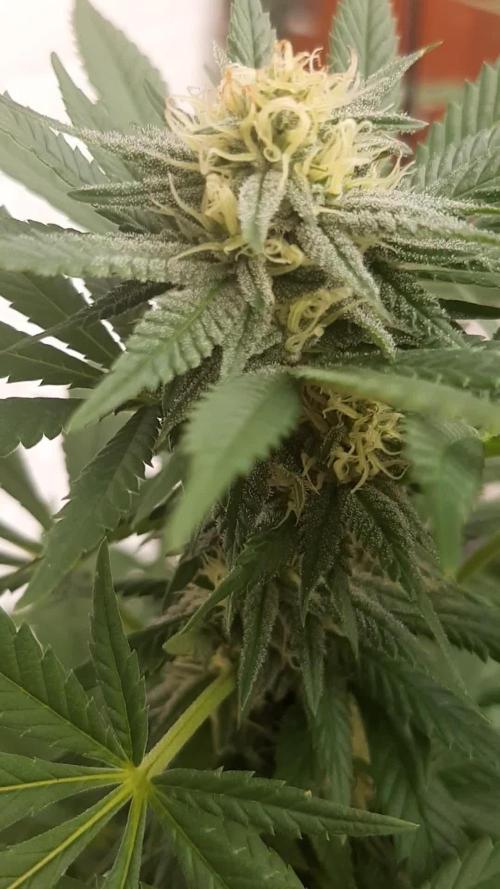
Last week i stripped some more leaves of and small buds from the lower parts of some branches...
It was gettin very leafy ...
Did the leaf strippin in 2 days with 24 hours in between..
Also did this technique where u twist the branch til u hear a snap... did this on all the lower branches ..
Gave her canna cure for the leafes and to make sure there are no bugs...
Also there was some wind and it knocked the buds around a bit, so she got some bruised white hairs here and there...
Solved the problem by giving some support with wire
Stil 5 drops of power buds
5 drops of sugar royal
And the basic pokon nutrition...
Mixed with 0.5 liters of mineral water
I think we are goin into week 4 of flower now...
Doin fine.. cya next week friends 👍🌴

Likes
11
Share


@TechDCo
Follow
Week 1
27/01/2025
TF and MS
Feed HydroSol: Increased to 8ml/5L
28/01/2025
TF and MS
Light Increased: 313watts
DLi: 35
Rapid Growth has started again.
Feed Increased: HydroSol 10ml/5L
HP 12%: 1ml/5L
Uploaded today's pictures and yesterday's for comparison on how HydroSol is doing?
I topped MS. Hopefully by doing this now TF will catch up but that's not why I topped her. She's known for being bushy; so will be good to bring her up to her second level before branching. Giving the rate she is growing; we haven't to worry about stunting Growth.
H202 is also know to to cause mutations at high levels. I tried to start this diary with HP 12% from seed and it worked until micro-organisms in the air and water; what distillation has missed the "vocs" the cardon didn't catch. Caused them to later on because of free radicals and this is why high levels of HP can cause mutations and cancer when it steals atoms by ripping them apart. "Call the bomb swaddles" when mixed correctly or 'incorrectly 💣 lol
28th Today
Little VT of the 5L jerry can starter pots (DiY)
I think this process is allowing for optimization of Air/feed pks.
I'm at least 2-3weeks ahead from a normal grow because of this style growing.
I know, I know, I lost 3weeks from the first failed attempts. But it's okay 👍 I'm okay with that. Now I know and it's logged in the dairy for future reference I can quickly glance over before I start another one. Like hey 👋 "Time is valuable, read ya diaries" honestly, I don't have dementia i have human forgetfulness/error.
Its still in the experimentental phase.
Took tf out the propagator
31/01/2024
Nothing much to see
I've did everything for TF and still looking droopy. Exactly the same as MS.
I think she'll grow out of it!
01/02/2025
I know, I know what ya thinking, it looks like spider mites on MS only leaf but honestly I think its of the h202. I deffolled her only leaf. Sprayed it with h202 and no reactions happen. No mites.
The Future TF is looking much more lively.
Oh well. No speed-run this time round!
I shouldn't of took 4wks off from growing. Rhythmic nature of thing and getting in the swing off it. It's easy to do but I am always in two minds with everything I do. I can't help but cause "Self sabotage' every time I get to ahead of myself, by running my mouth 💯 blah blah blah; always beside myself.
Aye' they say "God is next to Cleanliness" if that's true it'll be impossible for me to be beside myself haha 😄
Its all fun and games 🎮 🙃
01/02/2025
Midday
Light Increased: 560watts (max) for this power supply. I disconnected the 1200watts one for each light is 600watts. It's currently half-power with 600watts max for two lights at 300watts each. Better than having mishaps with the full power supply 1200 being turned up accidently say in a not ventilated enough little tent. I'd rather pass on that anxiety 🙃
Plants: Under jerry cans with dli at 20.
This should by dinfintion let them gather themselves for 3days; while the sun is blazing outside the can. Even though I could lower the light. I think the high light intensity outside the cans the plants know.
Midday VT
MS looks likes shes a clone 😳 👀 but she ain't!
One day I will get these protocols right. But atm ; atlas, it's all in jest n fun!
MS defiantly looks like a clone but she's not; i have taken pictures since she hatched everyday
03/02/2025
Midday
Freaky Pablo and The future 2 germinated
Sprayed with weak solution of Hydroclonic Acid + h202 very mild.
Now the fun begins!
