Likes
34
Share
@MrJoint
Follow
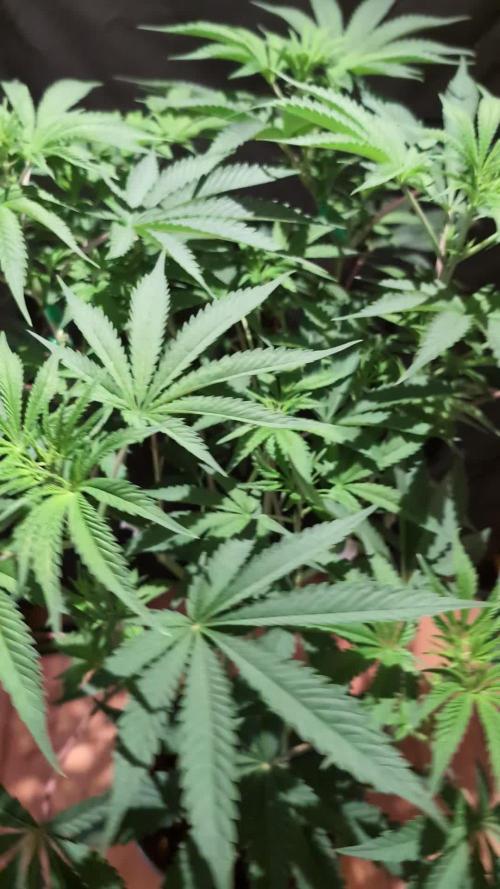
✌️🎃 Thank you for checking my cultivation. 🌺 They seem to have liked defoliation.
Likes
8
Share
Que pasa familia, vamos con la cuarta semana de vida de estas Purple Lemonade FF de Fastbuds. Vamos al lío, las plantas se trasplantaron en macetas de 7 Litros, con tierra top crop y plagron mezclada con un poco de coco. El ph se controla en 6.5, la temperatura la tenemos entre 24/22 grados y la humedad ronda el 70%. El ciclo de crecimiento puse 20h de luz, el foco está al 50% de potencia. - os dejo por aquí un CÓDIGO: Eldruida Descuento para la tienda de MARS HYDRO. https://www.mars-hydro.com Hasta aquí todo, Buenos humos 💨💨💨
Likes
3
Share
Likes
4
Share
@shwable
Follow
Hello and welcome to week 5, everything looks fine so far... I almost topped the CP1 a second time by accident. When I tried to bend the stem a little more it just snapped clean and I applied tape and stabilized the branch. I hope it recovers and it's looking quite good ;)
Likes
3
Share
*Sorry for lack of photos in this first week* Hi there, welcome to the first week of the Fastbuds Gorilla Cookies grown under the ts1000! You may see another plant in the tent, that is also Fastbuds but their new for 2022 Cherry Cola Auto strain. I'm going to try my very best with these plants, currently at seelding stage receiving around 270 ppfd each and dli is around 20 for 24hours of light. When the plants are bigger will increase the amount of light.
Likes
11
Share
Great week! She has been gaining all week, and is going to make some great colas 💪 I upped her nutrients again this week and still she looks like she could use more. I’ll be going to a regular feed, and the light feed schedule with her for the time being, no more straight water until I can see she’s producing and getting all she needs. Temps have been very high where I am, which in turn causes the tent to run a little hotter, especially with the two lights now. Hovered around 82-83 degrees for most of the week, and then came down a bit once the heat broke. No need to fill RH at the moment, tent is a nice 55%
Likes
3
Share
sorry about week 7 being so late. but shes growing great shes taller then 12 inches shes only that tall now due to the LST to open up her canopy. been a very hot summer but she has adjusted to the environment very well. she has alot to grow still ill be sure to update week 8 on time happy growing everyone🙏🌱🌞
Likes
Comments
Share
Likes
74
Share
@Mr_Maes
Follow
This week we will see the colas and buds really dense up. We are about 2 weeks away from harvest now. Next week I will start my flush.
Likes
34
Share
Welcome: thanks for dropping by. Drop a like so I can check out your grows, or not, I'll leave it down to you. So, the fun begins with Kosher Cake. Have 6 in the ground FB seeds in the ground only 1 kosher. The 2 Strawberry Gorillas are still not there with germination. Have started these on the 3 nutes above. These are best known as Voodoo Juice, tarantula and Piranha. These versions are from the ppl who hold the pattens and make a lot of ANs formulas. They have just improved upon most of the AN line up but they kept these the same. As they are tried and tested. Going to be running this lady on the full 19 Terra Power Line up. You can check these out on led-grower.eu/terra-power/ and read up on them for yourself. I'll be adding what's in them as for these 3 if you are interested look up Voodoo, T&P. Hopefully soon you'll be able to click on them and look em up when they join GD in the next wk or so. Happy with how the nutrients are holding a stable PH at 6 and these aren't even their PH perfect nutrients. So no PH - + needed. Sprayed each plant expect 1 gorilla zkittlez, for that 1 I used ANs line. These recommend 1ml/l for seedlings, AN I used 1.5ml/L. I use to use 2ml/L but they are seedlings so it's enough. Just a waiting game now. Will update as soon as these ladies start a popping. I laid a damp towel around the pots hopefully it'll up the RH. (Don't soak the towel it needs to be able to dry easily and in turn increase RH) Sprayed each 5 plants with this line up to start them off. As soon as leafs show I'll start them on a very very light feed. Will feed again in 2 days with the same mix. Another 100ml 1ml/l of each 3ml/l total 627ppm 6ph 21c temp. Have the smart intake fan at no 4 on 100% of the time. If I can't get desired RH after a day or 2 I'll turn the intake fan on 20/20 on/off and it'll make the RH be above 70% by doing this alone in a small space like 70x70. I really don't think I'm gonna have an Issue with low RH, but I have a feeling I'm gonna pay to have a low RH environment. 30/4/22 VD1. Have started her on jungle juice trio and a mix of terra Power enzymes and all there bud/resin enhancers will be used in conjunction with half strength recommend jungle juice dose. The feed is so low I've made up a 1l mix and that will do this and the 2 banana purple punches also. And I'll move that up to 1ml/L x3 of the jungle juice products next week. But for this week what's up above will be given every 2 days or when needed. 1/5/22 Slow growth on VD2. She's the runt most are reaching 2.5cm 3+ nearly on 2. Let's see what happens she's out of the ground and showing fan leafs, yday she had a crusty head. So all in all, going well. 6-8 FB seeds are up and thriving. 2/5/22 She's picked up fine. Got some height to her. Will continue the same course and watch her grow. Will update once more on on size and daily pics. 4_5_22 All Jungle juice&Terra Power grows are showing deficiency signs. I'm going to push up the EC this week I think. I do not want to stall them but I really think EC will be high in jungle juice because of the micro it has SO MANY TRACE nutrients it's crazy and it sends the EC sky high but there's so much of little bits of this and that I really think it can handle a higher EC. I'm going to 2x it or up it by a 1/3 for their watering 2moro as they were only fed yday. I've added biobizz calmag to help as my tap water is lacking cal mag when it comes into summer or so it stays on our water reports. It drops by 20%. 6/5/22 So, it's begun. I've created a negative pressure environment, 1st time, let's see if it makes an impact. On wk 3 onwards I'll be running the intake extraction for 5mins every 30mins and I'll have 2 co2 bags up. If the RH becomes a problem or temp I'll put the extraction/intake back on 100% of the time. The extraction fan/intake is set at a ratio of 2 to 1. (100% extraction 50% intake) making a negative pressure environment, best way to show you have done this, the walls in your tent should bow in lightly. Same Day. Okay, so this my last update. Going to run fans the same right up until flower and then I'll be sealing up my tent and adding 2 co2 bags. And will be adding a dehuimifier and setting at 45% And it checks every 30mins and if it's gone up it'll turn back on and bring down to 45 or set RH, so no co2 will escape. The temp will be bordering 30-33c and then when they go into their rest window they'll be transferred to to a negative pressure environment with low temps and 45-50%RH. I'll only be able to do this for the 3 weeks of pre flower. And maybe some more, it depends how hard the dehuimifier will be working, but i want dense buds and only way to improve that is by introducing Co2 and then a negative pressure cold environment for terps. Then I'll be putting them back into full negative pressure environment and the Co2 will be useless, again all depends how it's gonna affect my bottom line. That and I only have 2 intake fans. I'll be going into detail about my Co2 adventures the week before I'll be prepping them to be able to withstand high temps, so I'll gradually bring up the temps the last wk of veg 28c max and that way when I push it to 30-32c in pre flower she won't stress as much Thanks for reading, this will be it as for updates for this week other than her final 7th wk day. Will adjust EC 5th higher or so. gottagrowsometime
Likes
35
Share
I looked at the trichomes every 2 days this week. There are still some clear ones but they look cloudy overall. The OG Kush begins to have many amber ones. I started to flush too soon and the plants are now struggling a bit. I will harvest everything next week! The final grow area is around 1,1m x 1,1m.
Likes
2
Share
Α,α (alpha) and Ω,ω(omega) Here we grow again. LAST GROW. 344g+280g+445g+255g=1324g dry bud. Yielding 1,324 grams of dry cannabis using a 600W light in a 4x4 tent is exceptionally efficient. This breaks down to roughly 2.21 grams per watt, far exceeding the standard indoor benchmark of 1.0 g/W and outperforming elite professional targets (1.5–2.0 g/W). For carbon and energy efficiency, this output drastically lowers the carbon cost per gram compared to typical indoor grows. Achieving 1,324 grams (47.2 ounces) of dry cannabis from a 600W light in a 4x4 tent is exceptional, yielding roughly 2.21 grams per watt. This is an elite-tier result that reflects world-class photosynthetic conversion, highly optimized canopy light distribution, dialled-in CO2 supplementation, and precise environmental control. Growing 1.3kg of dry in a 2x2 with 1 plant is just being silly and not understanding how carbon and energy conversion works towards mass. Took 6 years and 10,000+ Hours to break the 2 grams-per-watt barrier not exactly 600W, in honesty, though—even with modern, high-efficiency LEDs—is an incredible feat that requires hitting the absolute genetic ceiling of the cultivar and maintaining flawless environmental parameters for the space. Photosynthesis is the literal conversion of light energy (photons) into chemical energy (carbohydrates). Leaf temperature, driven by radiation from fixtures and mitigated by latent heat of vaporization (transpiration), dictates metabolic rates. If your room's thermal dynamics are off, enzyme activity inside the plant stalls, grinding growth to a halt. Anyone else pretending to have done so with nothing but Plagron nutrients at 75F is telling porkie pies *cough*, otherwise known as a liar, liar with a bum that's on fire, but it seems that's the new norm these days on GD. *cough cough*. Using copper and zinc plates in the plant medium to form a natural earth battery to assist with Electrochemical Reactance. The moist soil acts as an electrolyte, while zinc serves as the anode and copper as the cathode. Zinc is a highly reactive metal and oxidizes, losing electrons into the soil. These electrons travel through an external wire to the copper plate. The moisture and dissolved salts in your plant medium allow charged ions to move freely between the plates, completing the circuit and generating a small direct current (usually between 0.8 and 1.1 volts). This micro-current subtly alters/the Electrical Conductivity (EC), allowing more effective breaking apart of chemical bonds in the soil (electrolysis), making soil nutrients like phosphorus, calcium, and potassium more accessible to roots. Buried the zinc plates around the sides of the plant pot's root zone and the copper plate in the middle. Ran an insulated copper wire above ground to connect the zinc plate to the copper plate, creating a closed loop. Making sure the soil remains perfectly moist and contains everything it needs; entirely distilled water or bone-dry medium will prevent ion exchange and block the current. Leave that up to the rhizosphere. Currently testing new parameters for a couple of weeks. Seeing what she can do with a new and upgraded ducting closed loop and double the water capacity. Also added 6kg of inoculated biochar along with a slew of small improvements. Keeping an eye on. Zinc toxicity vs. consumption, given how sacrificial zinc is. Want to make sure the biochar stabilizes first. A Synganic closed-loop bioengineering-logic grow room merges synthetic inputs (precision minerals/chelated nutrients) with an organic living soil matrix (microbial life/bio-stimulants), managed via automated, data-driven automation. Master Operating Procedure (MOP): The system balances a sterile environment with a thriving, dynamic rhizosphere, merging the biological resilience of living organic soil with the high-precision chemical control of modern Controlled Environment Agriculture (CEA). Synganic blends a biologically active living soil or microbe-rich substrate with targeted, low-dose mineral or synthetic fertigation to optimize both metabolic yield and secondary metabolite expression (terpenes/flavonoids). What else is alive! Eisenia fetida (Red Wigglers) will continuously process organic matter into plant-available nutrients and aerate the media. Stratiolaelaps scimitus (Hypoaspis mites) provides excellent biological control against fungus gnats and pupating thrips. Armadillidium vulgare (Pillbugs) excel at breaking down tough, woody organic matter and toxic heavy metals. New "Closed-Loop Sealing" Isolates the internal microclimate from external weather, vectors, and pests. Air is scrubbed 264nm UV-C, recirculated, and enriched rather than openly exhausted. Operational Parameters (MOP Framework). Microbes act as biological buffers for the mineral inputs, preventing salt toxicity and ensuring continuous nutrient availability. Precise management of Vapour Pressure Deficit (VPD) day and night to force optimal stomatal conductance without stressing the biological media. Strict clean-room protocols prevent pathogen intrusion while maintaining non-sterile, highly active beneficial bacteria and fungi populations in the root zone. Looking at a grow room as a closed-loop system changes everything. You aren't "growing a plant"; you are managing a mass and energy balance equation where the plant is a biological transducer. Every watt of light introduces sensible heat. Every drop of water turns into latent heat via transpiration. When a deficiency appears, a grower flushes or adds a bottle of "magic" additive. A master looks at the HVAC duty cycle, realizes the dew point spiked, the stomata closed, and calcium transport stalled due to lack of transpiration, not lack of nutrients. Protocol-driven logic can be automated, replicated, and optimized. Legacy growing and anecdotal habits fail the moment the room moisture volume changes. ADD CALMAG! Comprehensive Substrate Composition: Because why not. 1. Substrate Base & Aeration Media Expanded Clay Aggregates (Hydroton Pebbles) Coir Chunks & Horticultural Coco Coir Sphagnum Peat Moss Horticultural Perlite Horticultural Vermiculite Horticultural Pumice Volcanic Basalt Rock 2. Mineral Amendments & Soil Conditioners Agricultural Gypsum (Calcium Sulfate) Wollastonite (Calcium Silicate) Dolomitic Limestone (Calcium Magnesium Carbonate) Basalt Rock Dust (Trace Mineralizer) Azomite (Micronutrient-Rich Volcanic Ash) Glauconite (Greensand) Crushed Seashells (Calcium Carbonate Source) Pyrolyzed Carbon Feedstocks (Biochar & Horticultural Charcoal) Shungite (Carbonaceous Mineraloid) 3. Organic Nutrient Amendments Steamed Bone Meal (High Phosphorus) Dehydrated Blood Meal (High Nitrogen) Fish Bone Meal (Phosphorus & Trace Calcium) Cold-Processed Kelp Meal (Ascophyllum nodosum) Dehydrated Moringa Oleifera Powder (Botanical Nutrient) Spirulina Powder (Arthrospira platensis / Cyanobacteria Nutrient) Marine Crustacean Biomass (Shrimp & Crab Chitin) 4. Biological Inoculants & Organic Acids Mycorrhizal Fungi Inoculant (Endomycorrhizae / Ectomycorrhizae) Vermicompost (Premium Worm Castings) Humic & Fulvic Acids (Concentrated Humates) Soil-Plant-Atmosphere Continuum (SPAC): An ecological concept referring to the pathway of water moving from the soil, through the plant, and into the atmosphere. Humidity of the air dictates the moisture in the medium, which dictates the rate of pull from the terracotta stakes 15 in total. Terracotta (unglazed, low-fired clay) is highly porous, acting as a breathable, permeable membrane that transports water based on the moisture gradient between the potting medium (soil) and the surrounding air. White terracotta and brown terracotta often have different pore sizes and overall porosity, primarily driven by differences in clay composition, impurities, and firing temperatures. While both are considered porous, brown terracotta often has higher iron content and impurities that behave as fluxes, affecting how the pores form during firing, while white terracotta is generally derived from more refined clays, with smaller pores making it more suited to pure water. This mechanism is driven by capillary action and evaporation. When the surrounding soil is dry, the terracotta acts as a wick, pulling water out of the pot and into the soil. If the soil is very saturated, the terracotta absorbs water from the soil and allows it to evaporate from its outer surface, increasing the drying rate of the soil. Terracotta tends to keep the potting mix at an optimal saturation point, wicking up more water when the outside surface evaporates water into the air. The greater the difference in moisture between the soil and the outside air, the faster the water transfers through the ceramic. In low humidity and hot weather, the evaporation rate from the terracotta surface is high, creating a rapid drying effect. Newer terracotta pots often have a denser, lighter-toned structure that is less porous than traditional, red-orange terracotta, slowing down the moisture transfer rate. Over time, dissolved salts from fertilizer or tap water build up and block the pores, reducing the permeability of the clay. Water is all that is used or needed, thanks to the biochar and the massive storage bank of nutrients. Just waiting until something creeps up. Clay pot irrigation (Ollas), an ancient farming practice, utilizes this property by burying unglazed jars in the soil, allowing water to slowly seep into the surrounding soil only when the soil dries out. Remember to clean terracotta stakes in mild acid after each grow. Submerge the stakes in a solution of 1 part distilled white vinegar to 3 or 4 parts water. Let the stakes soak for 20 to 30 minutes. You will hear a fizzing sound as the acid reacts with and dissolves the mineral salts. Use a stiff-bristled brush or an old toothbrush to scrub away the loosened residue. Rinse the stake thoroughly in clean water to wash away any leftover vinegar. BOOM good for next grow! Indigenous Amazonians created, or at least significantly enhanced, the fertile, dark soil known as Terra Preta de Índio (Portuguese for "Indian Black Earth") by incorporating biochar and other organic materials into the soil. This anthropogenic (human-made) soil technique, which dates back roughly 2,500 to 8,000 years, allowed ancient civilizations to flourish in regions with naturally poor, acidic, and nutrient-poor tropical soils. Electrical Conductivity refers to how easily a material or solution allows electrons or ions to flow continuously when an electrical potential is applied. Electrochemical Reactance is the opposition to alternating current (AC) caused specifically by the temporary storage of energy in electric or magnetic fields, rather than energy being lost as heat. Reactance does not directly alter a material's intrinsic electrical conductivity. Instead, it dictates how the system stores and releases energy over time, which creates a temporary barrier to current flow in AC circuits. Together with resistance, reactance makes up total impedance. Electrical impedance (the combination of resistance and reactance) in the rhizosphere dictates how easily ions and water move into plant roots, directly impacting the Electron Transport Rate (ETR). High impedance restricts ion mobility, leading to nutrient deficiencies that decrease ETR and stunt overall plant growth. Electrolysis in the rhizosphere can reduce the direct ATP energy cost for a plant by electrochemically altering soil chemistry, changing pH gradients, and splitting or reducing compounds so that nutrients become easier to absorb or break down. Electrolysis uses an external electrical voltage to drive chemical reactions (like splitting water or reducing ions). This external electricity performs thermodynamic work on the soil solution. Rather than directly fueling plant enzymatic machinery or lowering biological ATP synthesis costs inside root cells, electrochemical reactions alter surrounding nutrient forms (e.g., changing pH, altering redox states, or breaking tight mineral bonds). By electrochemically making mineral ions more mobile or bioavailable, the plant may spend less root exudate carbon or membrane-transport ATP trying to scavenge locked nutrients, though the plant's baseline respiration and ATP costs for active uptake still apply. Laws of math are conceptual, laws of math are universal, the laws of math are invariant, and the laws of math are exceptionless. The laws of mathematics are the foundational rules that govern structure, quantity, space, and change. Unlike the laws of physics, which describe how our specific universe behaves, mathematical laws are absolute truths independent of physical reality. Think of electricity like highway traffic to easily understand the difference between the movement, the road, and the speed. •Electron Flow is the traffic (the cars moving). •Electrical Conductivity is the highway (how wide and smooth the road is). •Electron Transport Rate (ETR) is the speedometer (how many cars pass by per second). ETR stands for Electron Transport Rate. It measures the speed at which electrons are moved through the thylakoid membranes in a plant's chloroplasts during the light-dependent reactions of photosynthesis. Mass is effectively "congealed" energy. Energy is just numbers. Energy isn't a physical "substance" you can hold or touch. It is essentially an abstract, calculated number that we assign to a system to predict how it will change, interact, or move. A numerical label we attach to matter to track how it behaves. ATP (adenosine triphosphate) is the primary energy carrier in cells, including plant cells. It powers various cellular activities like nutrient uptake, protein synthesis, and cell division. Without ATP, the plant's metabolic machinery would grind to a halt, regardless of the presence of nutrients, oxygen, or carbon. Nutrients, like nitrogen, phosphorus, and potassium, are essential for building plant tissues and various molecules. They are incorporated into proteins, nucleic acids, and other vital compounds. While crucial, their uptake and utilization rely on ATP-driven processes. Oxygen is vital for cellular respiration, a process that generates ATP. While plants can produce ATP through photosynthesis, oxygen is essential for maximizing ATP production in mitochondria through oxidative phosphorylation. Carbon is the backbone of all organic molecules, including carbohydrates synthesized during photosynthesis. It's the fundamental building block of plant structures and fuels. However, its incorporation into organic molecules is also ATP-dependent. We don't grow we facilitate energy conversion. Everything is energy. Energy is represented by numbers. Numbers are frozen music. Music is moving sacred geometry of the Uni-verse.
Processing
Likes
15
Share
@MG2009
Follow
Top dressed with Budswel guano 0-0.7-0,watering in with protilizer mychorihiza.
Likes
8
Share
Eccoci di nuovo qui!!! Super eccitato per questa nuova collab con Anesia Seeds, team davvero al top, che mi ha dato l’opportunità di testare questa nuova genetica e di condividere i progressi con tutti voi!!! Come sempre partiamo nei bicchieri per poi travasare.. Questa volta verrà svolto tutto sotto la Lumatek Zeus 465 ProC, mi aspetto molto da questo ciclo!! Settimana pazzesca!!!! Piante davvero incredibili!!! Grazie a tutti per il supporto ❤️🍀🔥
Likes
4
Share
Que hay familia, vamos con la octava semana de floración de estas Runtz de Zamnesia y empezamos con riegos intercalados cada 48 horas controlando siempre el Ph, que ahora mismo lo dejamos en 6.5 . Temperatura y humedad dentro de los parámetros correctos. Seleccioné de las 5 plantas, 3, tienen un buen color, se ven bien sanas, todo normal hasta ahora, van madurando y están produciendo una tricomada bastante seria, están increíbles, ya entramos en la recta final, aunque no me de tiempo acabarlo para el concurso, acabar acabaremos el diario, esta semana ya están solo agua, y puede que las aguante una semana más. Hasta aquí todo, buenos humos 💨💨💨.
Likes
1
Share
Switches to 12/12 a couple days ago, no signs of hairs but I think I’m abit eager if I’m expecting them this soon and tips on helping an organic soil flip to flower? I think I might be okay but any suggestions could help in case
Likes
41
Share
HLG 350R hanging with the Mars Hydro UR45 -added a clone of a Malt Milkshake -clones I took from these plants, majority have rooted so far and transplanted
Likes
52
Share
@DevilsBud
Follow
New week for the purple berry Kush There doing great like every bean coming from @spliffseeds 👌🏻 Will be updating Tru the week
Likes
7
Share
Gorilla Glue #1 - Harvest Comment - I Am Very Satisfied With What I Got, I got 3 ounce 7 grams - I Uses Advance Nutrients PH perfect In veg then I switch to the iguana juice organic juice for the flowering stage. I notice a much more slower growth when I switch to organic nutrients.00