


Likes
Comments
Share


@3lementa1
Follow
I put the White Widow sprout and the biggest of the 3 others into a DWC bucket.
I put the peat pellet into a rock wool cube, jammed it to the bottom of the net pot, and covered the top with LECA. There is one air pump running 2 lines with one going to each bucket.

Likes
121
Share

@Schnabeldino
Follow
📅 Week 10 | 🌼🌸🌺 Flower – Woche 4 🌼🌸🌺
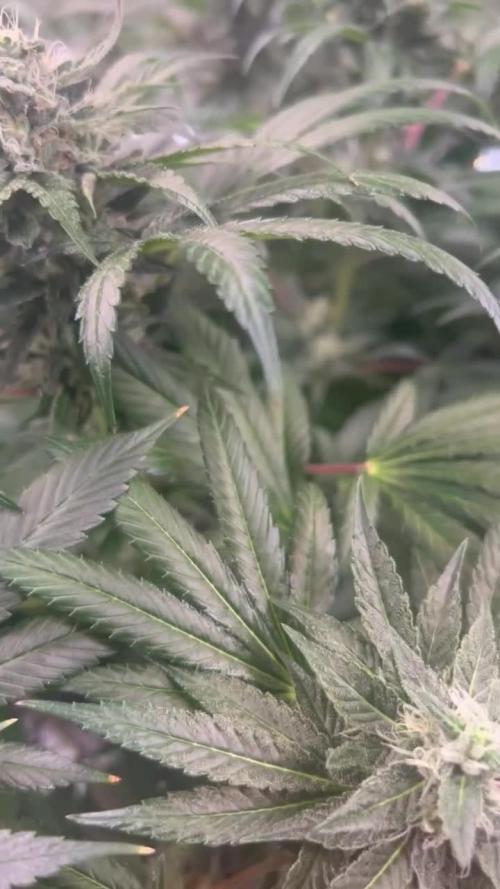
🔸Our Lady 💃 continues to dance through the flowering phase – and how! The buds have grown significantly in volume and now appear more compact and firm. The white pistils are slowly turning orange, a clear sign that ripening is progressing. The trichomes are now ubiquitous – a glittering carpet of resin covers the flowers and gives them that coveted “frosty look.” The sugar leaves are also covered with crystals and have an intense aroma – a foretaste of what is to come. 🍬✨
🔸The plant continues to receive Big Bud from Advanced Nutrients, which it acknowledges with a significantly increased thirst. I now water every two days.
📈 Current Conditions
🌡️🔆 = 27-28°C
🌡️🌜 = 21°C
💨 VPD = 1.4
💨 Humidity = 55%
🔦 PPFD = 900 µmol (12/12)
🔦⌚ DLI = ~38
🛠️ Setup (unchanged)
💡 Lights: 2 x Sanlight Evo 4-120 @ 90%
⛺ Tent: 120 x 120 x 180
🍯 Pot Size: 15 liters
🌱 Medium: Bio-Bizz Light Mix
💊 Nutrients: Advanced Nutrients
💧 Water: Tap water (EC 0.5)

Likes
20
Share


@MeaCulpa
Follow
Hey everyone,
so far everything is fine.
“Iris” is weakening. But she did that from the start.
I don't have much hope for her either. But let's see.
Have a nice weekend everyone.

Likes
101
Share


@Ferenc
Follow
Day 80, 2nd of December 2020:
Hi there! Ladies are cool everything is alright. In one week buds strated doubeling and the developement is dope haha.
The 2 Zamnesia ladies are pretty Gelato is so nice bushy and the smell is great as well.
Kalini Asia will be a green pheno I think and she my be hermied a bit on me.... I am still waiting to see I see some strange develepement lets say.
Sweet Seeds girls are dope unfortunately Red Mandarine and Tropicanns poison don't show any sign of colouting yet but it is okay even if they green phenos.... It may happen in the end of the flowering cycle let's see.
Basically that's all I wanted to share.
Oh yes... this one:
All good the lamp is now on 11 hours and off 13 hours. Every week 15 minutes was taken off and after 4 weeks here we go. Strated 12/12 and now 13/11 wanted try to imitate the nature as the light days are getting shorter.
Fertilization has changed no more epsom salt from this week and I will stop giving nitrogen as well from next week.
Great job Sweet Seeds and Zamnesia! Nice genetics :) Lovely plants!


Likes
52
Share


@Salokin
Follow
The High intensity was to strong (clearly my fault) in the beginning which stunted her overall stretch, she however still delivered super dense, terpene and trichome loaded buds.

Likes
9
Share


@Mr_nugs_lover_David
Follow
I'm so sad just because I cannot get a lot of jars full of this wonderful haze man! Damn I love her aroma to pieces her terps are just awesome suuper sweet but you still can feel the sativa haze smell,but it's got a lot of berry and fruity smell tho,thank god I have this wonderful strain in Photoperiod version and I'll be able to grow her,definitely love this strain,I'll add her to my Photoperiod abd automatics list,AWESOME STRAIN! can't wait to smoke this,100% organic pure and clean free of any chemical sh%t thank you guys hope you like my work 💚✌️🌱💛❤️

Likes
4
Share


@805homegrown
Follow
Apple fritter and wilson! Zero are 7 weeks from popping the seed's in ro water ph to 6.2 and mystery mix, Geist grow are 4 weeks from popping the seed's same process as above.
Blumat watering system
3x3 area for growing 4 plants in 4 10gallon fabric pots in living soil top feed with compost tea and foliage spray (LABS) lactic acid bacteria. 2 x TS1000 and I use pod tech to feed my worms with down to earth amendments.


Likes
6
Share

@viejo
Follow
May 18th
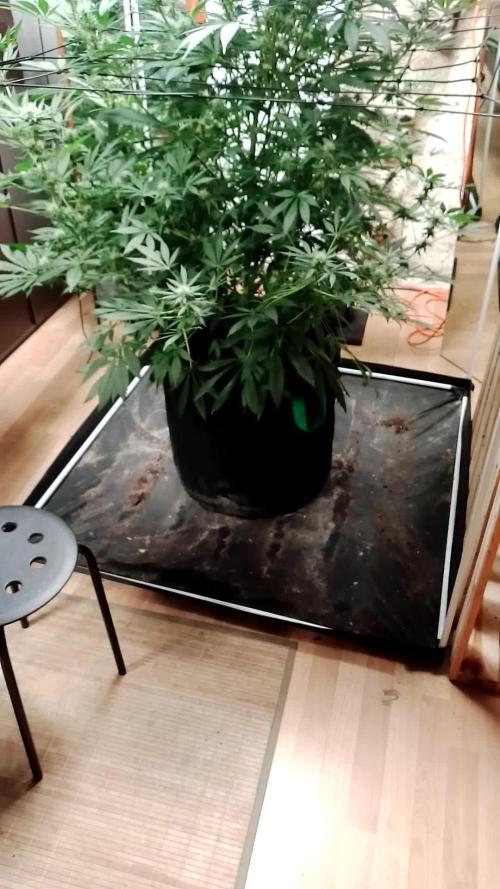
Time for low-stress drastic measures. Her height has now reached the point where all google inquiries suggest she's sure to become badly light stressed if left to her own devices. We're flying too close to the sun, folks.
I'm not convinced heat is an issue, as there's great ventilation in the room and two fans blowing constantly, but something had to be done about the diminishing distance to the light. We're down to 20cm~ from the tip of the main cola, to 25cm~ after pulling her to the side a little with some trusty red string. Somehow there's no sign of stress on the leaves, but they say this usually shows up after the damage has been done, so we'll so how things pan out. I'll keep pulling her further away as needed. Hardly ideal, but not exactly unexpected.
I've also ripped out some mosquito netting that was blocking some of the airflow from the window the extractor fan vent tube leads to. It was all gummed up with dust and cobwebs. Since removing it the airflow from the room is venting outside much more smoothly, lowering the humidity of the room by a few points. I've even seen it reach as low as 55%, which is a new low. Previously the humidity wouldn't go lower than 69%, which is a funny number I admit but I'll take a number without meme-connotations in favor of a lessened likelihood of bud rot any day.
I've doubled the dose of top-max from 1lm/l to 2ml/l. Bio-biz suggest 4ml/l at this point, so we're playing it safe.
Fingers crossed as always.
Likes
18
Share


@Grower_Of_Persia
Follow
week intel:
we reached the peak of flowering stage and need to cause a little more e.c stress from this week so e.c stress is twice a week
i reduced the amount of Nitrogen and calcium and stopped feeding silicate in other hand i raised the amount of base nutrient and booster
short story version: more K & P - less N
stresses :
a little E.C stress around 1.6 and 1.7 twice a week from this week
feeding:
i feed them 3 times this week with this order :
day 1 : i feed them high with base nutrients(calcium & micros (half dose) + Bloom) about 822 ppm - 1.6 e.c to cause a little stress.
day 3 : i feed them low dose of Top-Max + B-52 around 525 ppm - 1 e.c to let them recover a little but not fully recover still a little stress will caused.
day 5 : i feed them high dose of Feeding Booster around 850 ppm - 1.7 e.c to cause e.c stress again
guide of the week :
from this week we can cause more E.C stresses.
e.c stress if done correctly is one of the very few ways to increase quality in all aspects ( color , aroma , taste , bud structure , resin contents ) but if you over do it , listen carefully brother : it can reduce quality in every aspect so always look for signs and never reach the red line.


Likes
29
Share


@Smokwiri
Follow
Almost finished, flushing
10% discount on Zamnesia seeds with code GROWITGD
Likes
17
Share


@CanabisLoverHobbyGrower
Follow
Well what an eventful week, after trying to get her to bounce back, the smoothie has been put out into my outdoor grow house, if she finishes I'll take it as bonus buds, had to weigh up the pros and cons and figured giving the zkittles all that free space and concentrate on her would be best,.. first run on autos so you live and learn,.. zkittles is now on a adjusted week 9 feed, dropped the bio grow by half and just knocked the others down a little but, don't want to go through the same thing again with her,... she looks well though, what do you guys think?.. 🤔 day 56, roll on next week 👌👍🤞
Processing
Likes
10
Share


@Dunk_Junk
Follow
9cm growth this week.
She is very short, very bushy. Not sure what I've done wrong... 😞


Likes
19
Share


@Naujas
Follow
I think it will be really big :) a few leaves are a little brown, I don't know why, but it's not spreading.:) She's a real lady, she keeps getting taller :) like with high heels:)
Likes
25
Share


@pifflestikkz
Follow
Day 22
25/07/24 Thursday
Still no Feed/water since Tuesday.
Been a humid and overcast two days so not as much evaporation as normal.
All plants happy and healthy 💚
Video updates
Day 23
26/07/24 Friday
De-chlorinated watering pH 6 with 5ml calmag to 5L water.
Watered each with 250ml and had small run off.
I will continue to feed/water with small run offs to help prevent salt build ups.
Video update.
Day 26
29/07/24 Monday
Nice feed today, using de-chlorinated tap water pH 6.
They each had 300ml with small run off.
All looks incredibly happy and healthy!
The Auto Kabul that was mutated and twisted has pulled herself through and is just a bit shorter than the others.
Day 28
31/07/24 Wednesday
End of week😁
De-chlorinated water pH 6 today with Plagron pk13-14 5ml to 5L
Plagron power buds 5ml to 5L
Used 300ml of the 5L solution.
I will be using these on water days from now on as they are advised to be used every irrigation.
We'll see how they perform 💪💚


Likes
51
Share

@Dunk_Junk
Follow
Well she grew another 13cm this week!!!!!!! She is above the lights now 😏
Her flowers are developing nicely! So are the trichomes! So is the smell 😁
Likes
7
Share


@Greenislandfr
Follow
7e semaine de floraison,
Application du propolix contre le début du botrytis qui a commencer semaine dernière, la gorilla a du être infecter depuis que le tronc c'est fendu en deux. J'ai pourtant pris les precaution nécessaires, pour l'instant aucun autre départ de botrytis ca a l'air sous contrôle le produit a l'air efficace, j'ai acheter un ventilateur uniquement pour elle j'espère l'aider et non propager le fleau sur mes autres plant..

Likes
241
Share


@Tropicannibis_Todd
Follow
💩Holy Crap We Are Back At It And Loving It💩 👉WE R ALMOST AT THE FINISH LINE👈
Growmies we are at DAY 63 and there just killing💀it👌
👉We are in full on flowering , gotta say the pink to redish hairs have gone away which is a bummer 😕 but the frost 🍦 is strong 💪
So Shit , I gave them just a tad to much nutes on the first few feeding 👈 But I have since fixed it
So I'm still doing some low stress training 🙃 and some defolation 😳
Lights being readjusted and chart updated .........👍rain water to be used entire growth👈
👉I used NutriNPK for nutrients for my grows and welcome anyone to give them a try .👈
👉 www.nutrinpk.com 👈
NutriNPK Cal MAG 14-0-14
NutriNPK Grow 28-14-14
NutriNPK Bloom 8-20-30
NutriNPK Bloom Booster 0-52-34
I GOT MULTIPLE DIARIES ON THE GO 😱 please check them out 😎
👉THANKS FOR TAKING THE TIME TO GO OVER MY DIARIES 👈
Likes
26
Share


@Greenfingers1988
Follow
My girls are verry happy😄the 2 strawberry pie 's are littlebit late.but now are the 2 girls are flowering😋🍭🍬