


Wall of Green method cycle documentation




Outdoor
Room Type
Wall of Green
weeks 1-8
2.5 liters
Watering
Start at Harvest
1
Week 1. Flowering1mo ago
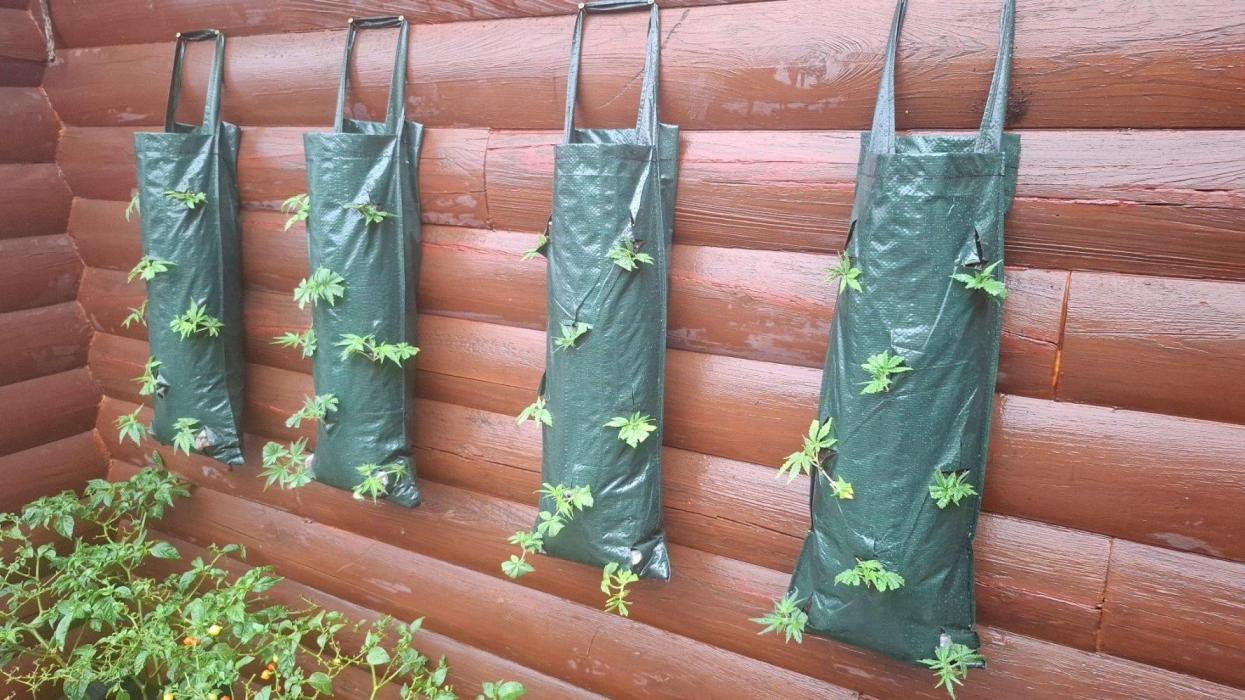
5 cm
Height
12 hrs
Light Schedule
31 °C
Day Air Temp
No Smell
Smell
25 °C
Night Air Temp
Nutrients 1

Alga Bloom
2 mll
DutchGlobalCitizen Wall of Green Method (WOG) — Official Technique Description
The Wall of Green Method (WOG) is a compact, high‑density plant layout in which multiple small root zones are positioned close together to create a uniform vertical green wall. By grouping plants tightly and guiding the canopy into a flat vertical plane, WOG maximizes light efficiency, space usage, and canopy uniformity.
This method is designed for growers who want a predictable, structured canopy with minimal horizontal spread and maximum vertical density. The result is a visually distinct “wall” of foliage that captures light evenly across its entire surface.
Core Principles
High‑density root placement
Multiple small root zones are arranged in close proximity to encourage vertical canopy formation rather than outward bush growth.
Uniform vertical canopy
Plants are guided upward into a single flat plane, forming a continuous wall of foliage.
Optimized light distribution
The vertical surface ensures consistent light exposure across the entire canopy, reducing shadow zones and improving efficiency.
Space‑efficient layout
Ideal for small grow areas, tents, or limited horizontal space where vertical canopy control is preferred.
Intended Use
WOG is suitable for:
Small indoor grows
Vertical grow setups
Multi‑plant layouts with limited root volume
Growers seeking predictable canopy structure
Documentation‑heavy cycles (GrowDiaries, Reddit, blogs)
Outcome
A dense, uniform, visually recognizable Wall of Green that maximizes light usage, improves canopy consistency, and provides a clean, repeatable grow structure.
Origin
Developed and documented by DutchGlobalCitizen based on St. Eustatius.
Cycle Details
This diary will include weekly updates featuring photos, canopy development, and full grow‑cycle documentation.
48 clones in 6 strawberry 8‑hole grow‑bags.
I have been thinking about this method for years and am convinced it must work given enough TLC.
We will see…
8 likes
comments
Share
Used techniques
Wall of Green
Technique
2
Week 2. Flowering1mo ago
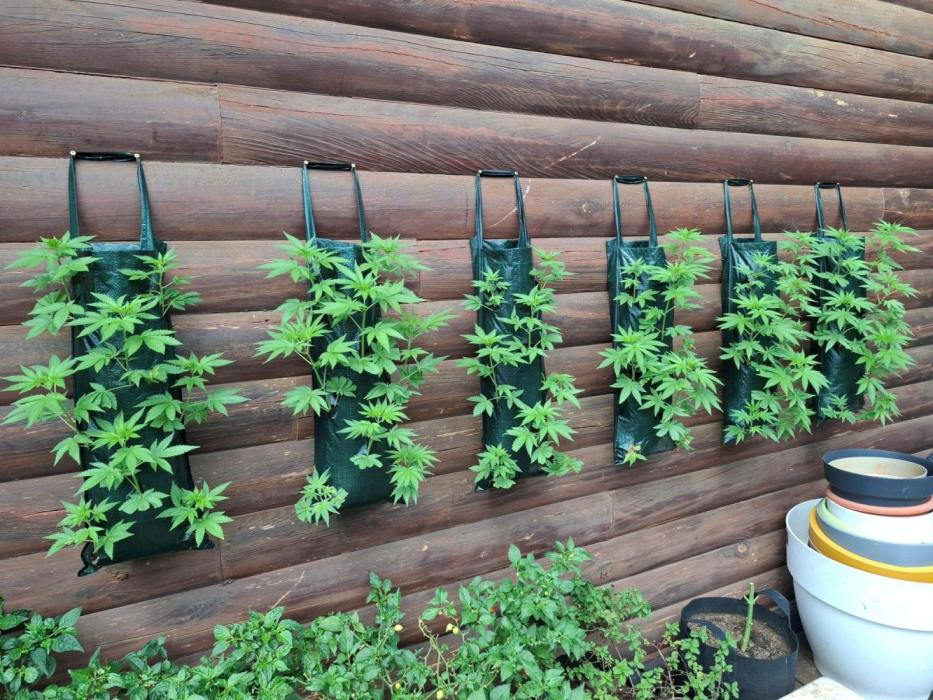
15 cm
Height
12 hrs
Light Schedule
31 °C
Day Air Temp
No Smell
Smell
25 °C
Night Air Temp
2 liters
Watering Volume
Nutrients 1
Alga Bloom
2 mll
DutchGlobalCitizen The Wall of Green now consists of 48 clones spread across six strawberry grow bags, each containing eight planting pockets.
The clones have rooted successfully and are showing vigorous new growth throughout the wall. Development remains fairly uniform, and the plants are beginning to establish themselves in their individual positions.
Based on their current progress, I expect another week or two of vegetative growth before the stretch and flowering phase begin in earnest.
One early lesson involved irrigation. As the root systems developed, the amount of water and nutrients had to be increased to ensure the lower clones within each bag received their share. Daily irrigation has gradually been increased to 2 liters per bag.
10 likes
2 comments
Share
Used techniques
Wall of Green
Technique
3
Week 3. Flowering1mo ago
45 cm
Height
12 hrs
Light Schedule
31 °C
Day Air Temp
No Smell
Smell
25 °C
Night Air Temp
2 liters
Watering Volume
Nutrients 3
Alga Bloom
3 mll
Max Yield
2 mll
Max Yield
2 mll
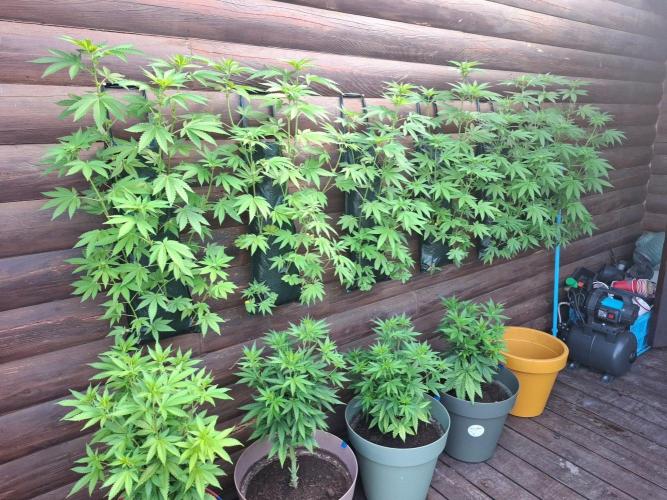
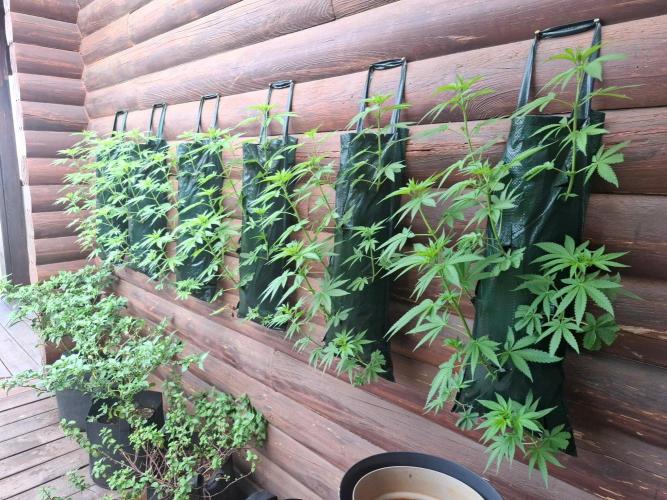
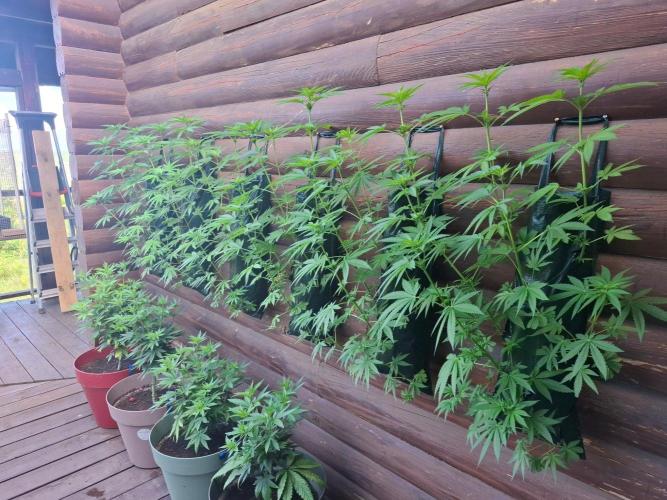
DutchGlobalCitizen The clones have settled in nicely and continue to show healthy, vigorous growth. Across the wall, the plants are naturally finding their place in the canopy as they reach for the available sunlight.
The first flowers are now starting to appear, marking the beginning of the flowering phase. The Wall of Green is beginning to take shape, and the overall canopy remains uniform.
11 likes
comments
Share
Used techniques
Wall of Green
Technique
4
Week 4. Flowering1mo ago
50 cm
Height
12 hrs
Light Schedule
31 °C
Day Air Temp
Weak
Smell
25 °C
Night Air Temp
2 liters
Watering Volume
Nutrients 2
Alga Bloom
3 mll
Max Yield
2 mll
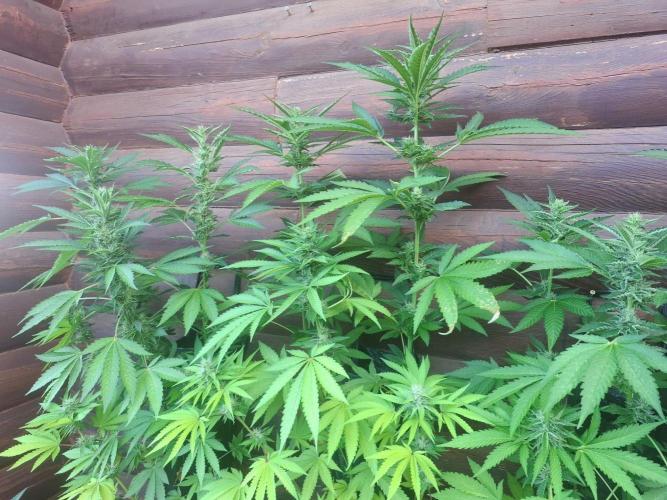
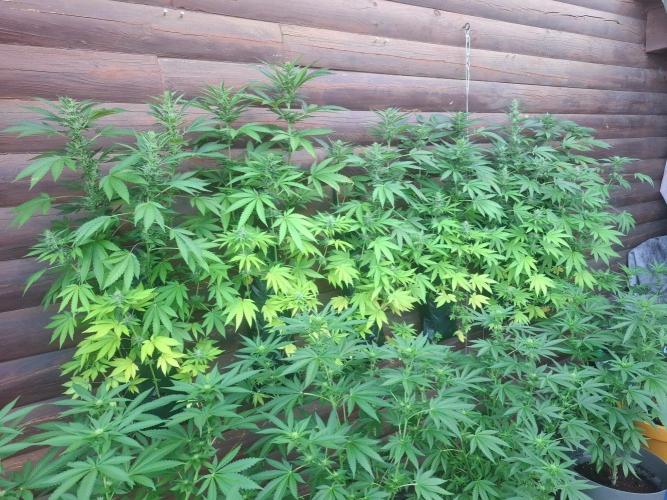
DutchGlobalCitizen The first real buds are beginning to take shape across the canopy. Flowering is now clearly underway and the tops are starting to gain some definition.
Resin production is already surprisingly heavy for this stage. Under the right light, some of the young buds show a faint bluish shimmer from the developing trichome coverage.
The mother plants have also been moved into flower and are positioned in front of the Wall of Green. At this point they are roughly three to four weeks behind the cloned wall in development, which should make for an interesting comparison later on.
8 likes
comments
Share
Used techniques
Wall of Green
Technique
5
Week 5. Flowering25d ago
55 cm
Height
12 hrs
Light Schedule
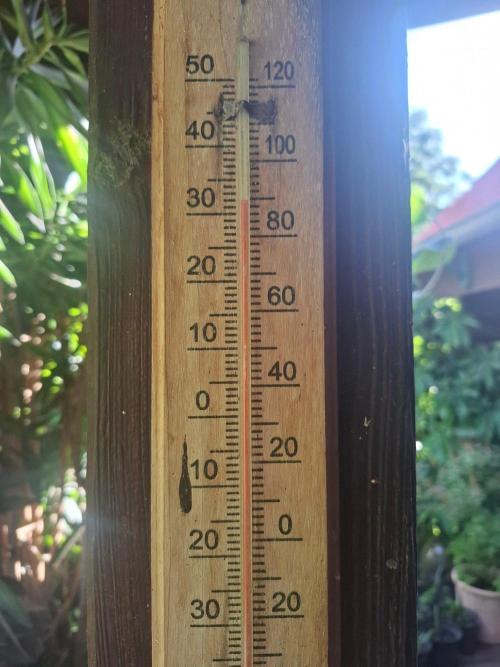
32 °C
Day Air Temp
Weak
Smell
27 °C
Night Air Temp
2.5 liters
Watering Volume
Nutrients 2
Alga Bloom
3 mll
Max Yield
2 mll
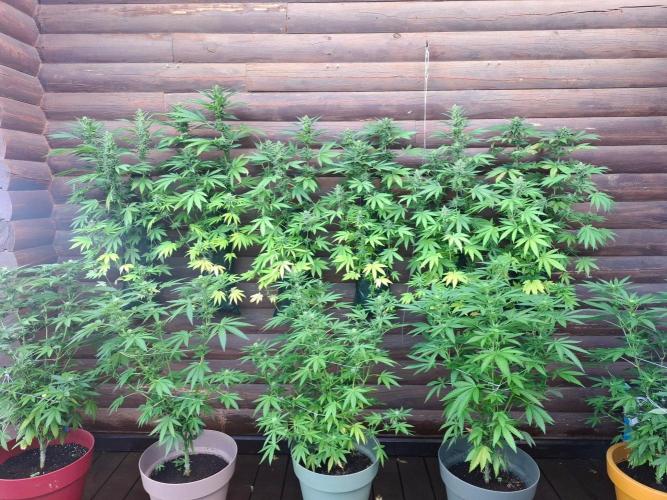
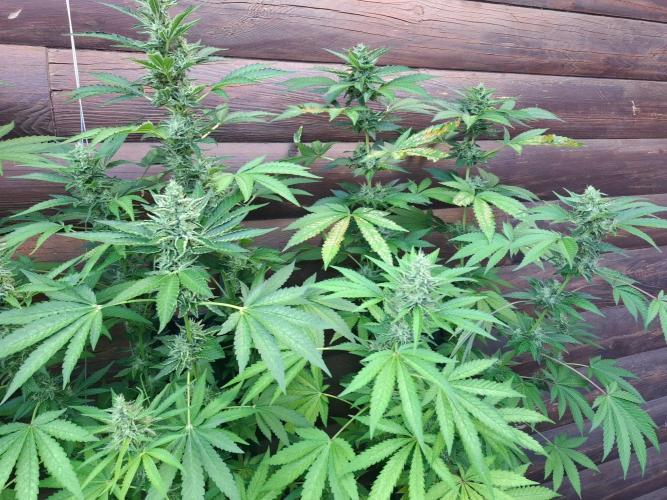
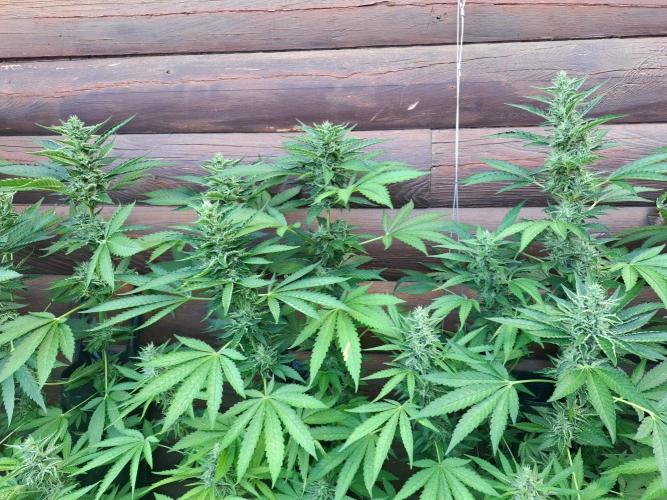
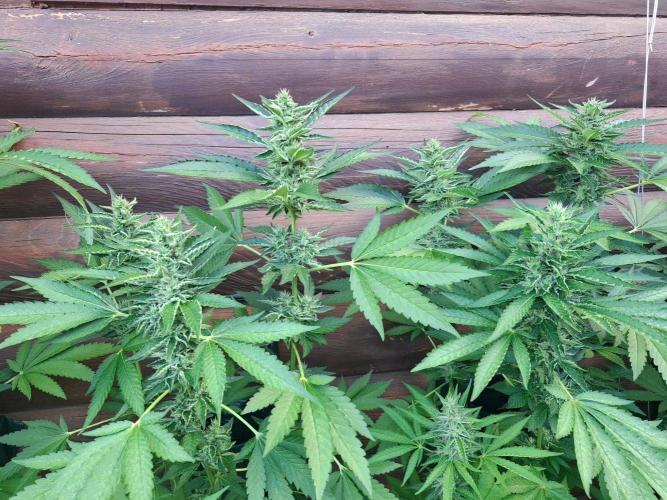
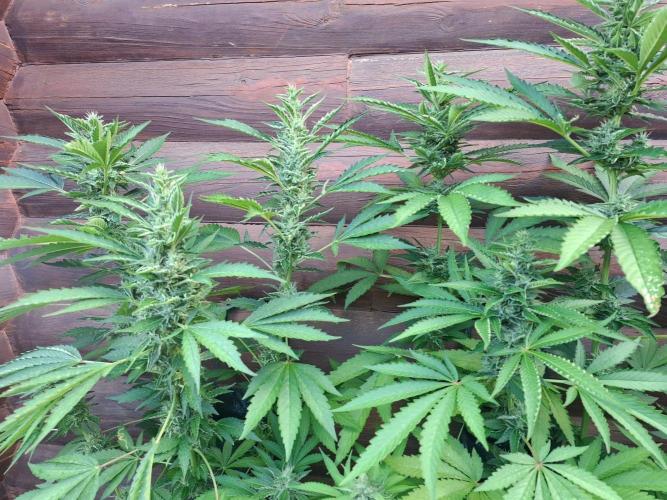
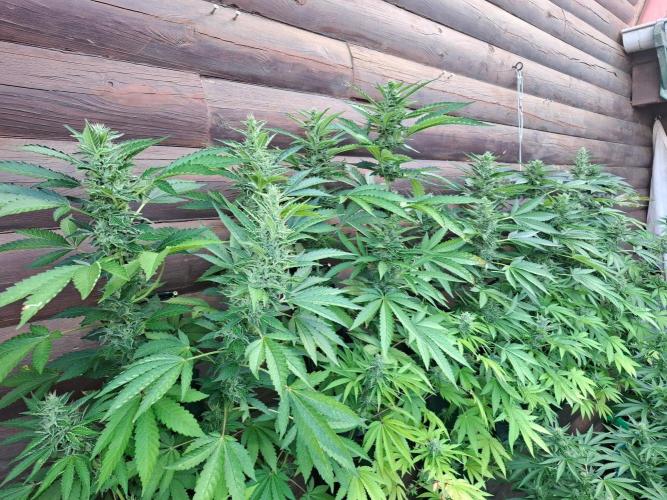
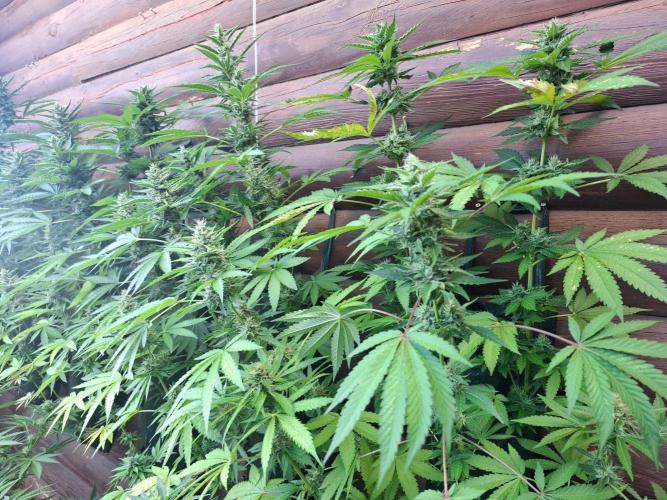
DutchGlobalCitizen Buds continue to bulk up and flower development remains vigorous across the canopy. The wall is filling in nicely now, with individual tops becoming more defined each week.
A storm passed through during the week and managed to split one of the mother plants. Fortunately the damage was limited and the affected branches were secured with twine for support.
One thing that continues to stand out is how little maintenance the setup requires. Apart from daily watering, the plants are largely left to their own devices. No training, no trimming, just natural growth toward the available sunlight.
As the plants continue to gain size and flower mass, daily irrigation was increased from 2 to 2.5 liters per bag.
For the Nerds:
Each mother plant pot has a small piece of tape on one side. This makes it easy to rotate the pots 90 degrees every three days, helping to maintain more uniform growth. Without regular rotation, the plants would gradually become lopsided as they follow the sun.
16 likes
1 comment
Share
Used techniques
Wall of Green
Technique
6
Week 6. Flowering17d ago





55 cm
Height
12 hrs
Light Schedule
32 °C
Day Air Temp
Normal
Smell
27 °C
Night Air Temp
2.5 liters
Watering Volume
Nutrients 1
Alga Bloom
3 mll
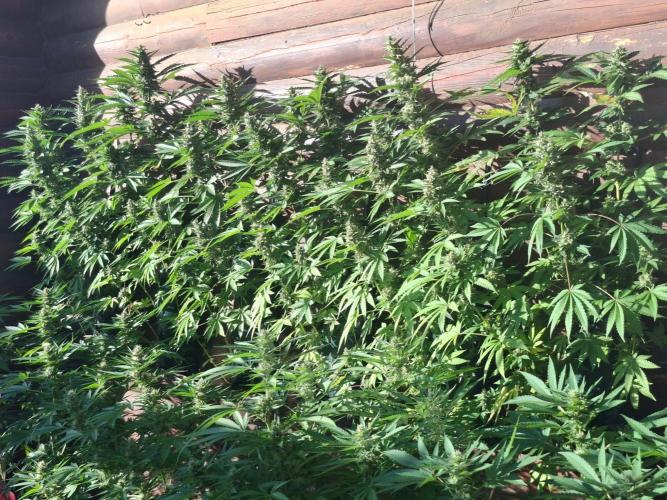
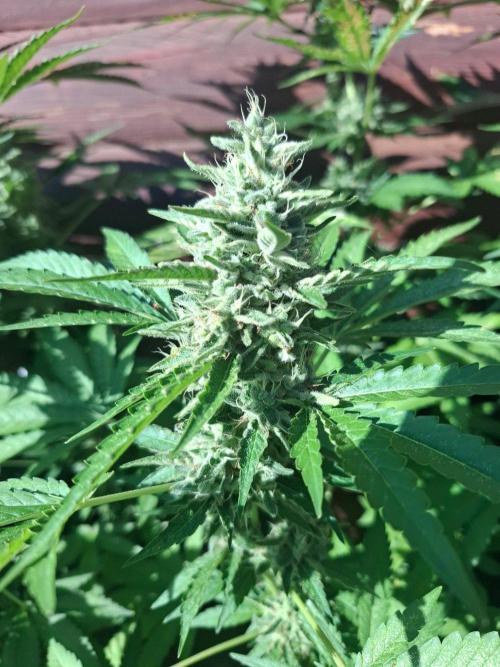
DutchGlobalCitizen Another week of flowering completed and the Wall of Green concept continues to develop exactly as intended.
What stands out most at this stage is that the garden is no longer presenting itself as a collection of individual plants. The canopy is increasingly behaving as a single productive flowering wall, with dozens of active bud sites occupying the same vertical plane.
Visible Wall of Green Advantages:
Uniform Flowering Surface
One of the most obvious observations is the consistency of the canopy height. Instead of a few dominant tops overshadowing the rest of the garden, the majority of flowering sites receive similar light exposure due to the wall layout.
Maximized Use of Vertical Space
The wall is being utilized from end to end. Rather than spreading plants horizontally across a floor area, the productive zone is concentrated into a vertical flowering surface.
High Number of Primary Bud Sites
A large number of tops have developed into productive flowering sites. The focus of the layout is not creating one giant cola, but creating many productive colas that together form a continuous harvest zone.
Efficient Light Distribution
The even canopy structure allows light to reach a much larger percentage of the flowering tops compared to traditional bush-shaped plants where only a handful of upper branches receive maximum intensity.
Reduced Empty Space
One difference that becomes obvious when comparing this grow to many conventional grows is how little unused area exists along the flowering wall. Nearly every section contains active flower development.
Current Plant Condition
Bud stacking continues across the entire wall.
Trichome production is increasing steadily.
Most pistils remain white, indicating further swelling is still expected.
Flower sites continue to develop from top to bottom along many branches.
No major signs of stress are visible.
Overall canopy health remains strong.
Interesting Observation
An unexpected benefit of the Wall of Green layout is visual uniformity. While individual plants display natural variation, the wall itself appears remarkably consistent. The eye is drawn to the flowering surface rather than to individual plants.
This may be one of the most important differences between Wall of Green and many traditional grow styles. The objective is not producing a few showcase colas. The objective is transforming an entire growing area into a productive flowering wall.
Looking Ahead
The structure is now clearly established. The next stage will be continued calyx swelling and flower density increases. If development continues at the current pace, the coming weeks should reveal the full production potential of the wall.
For now, the Wall of Green is doing exactly what it was designed to do:
Create a uniform flowering wall containing as many productive tops as possible within a limited growing space.
24 likes
7 comments
Share
Used techniques
Wall of Green
Technique
7
Week 7. Flowering11d ago



55 cm
Height
12 hrs
Light Schedule
32 °C
Day Air Temp
Normal
Smell
27 °C
Night Air Temp
2.5 liters
Watering Volume
Nutrients 1
Alga Bloom
3 mll
DutchGlobalCitizen Another week has passed and the Wall of Green continues to challenge my original expectations.
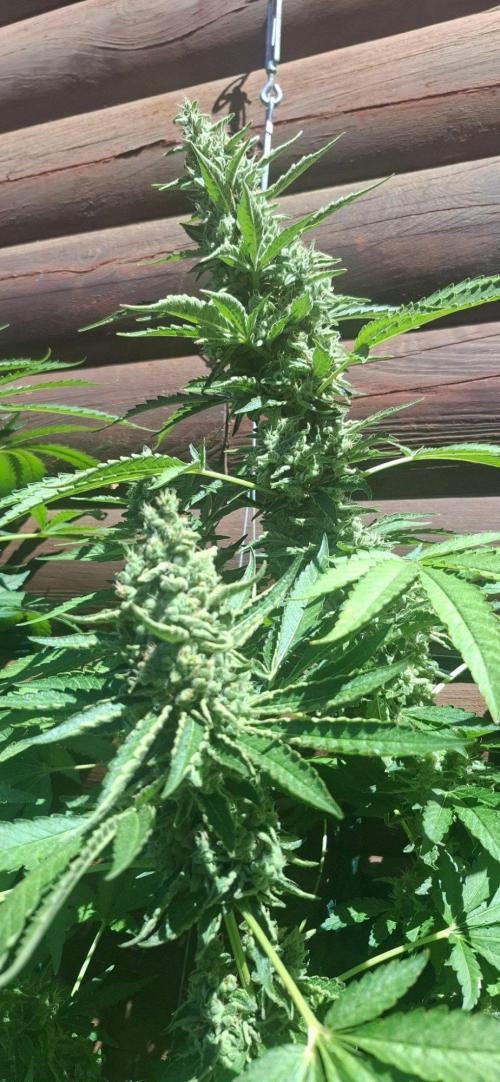
The plants are now well into flowering and the most noticeable change this week is the continued swelling of the buds throughout the canopy. What stands out is not necessarily the size of any individual top, but how much flower development is occurring along the entire length of the stems. Many branches are forming long, continuous colas rather than isolated top buds with large empty internodes between them.
The canopy remains remarkably uniform considering the plant density and the limited root volume available to each clone. Bud sites continue to stack and fill in, while overall plant health remains good. Some tops are slightly ahead of others, but the canopy is still functioning largely as a single flowering surface, which was one of the primary goals of the Wall of Green concept.
This run continues to support one of the central observations of the experiment: the plants appear to be using available canopy space extremely efficiently despite being grown in very small individual root zones.
Observation: Root Volume vs Canopy Efficiency
This week's observations further reinforce a question that has been developing throughout the grow.
Each strawberry grow bag contains roughly 10 liters of substrate shared between 8 clones, resulting in approximately 1.25 liters of growing medium per plant. Conventional wisdom would suggest that such a small root volume should result in heavily limited plant performance.
Yet the plants continue to produce larger and more complete colas than originally expected.
At the start of the project I expected yields in the range of approximately 15-20 grams per plant. As the grow progressed, expectations were revised upward to around 25-30 grams per plant. While final results remain unknown until harvest, the visual development continues to exceed those original assumptions.
The reason for this performance cannot yet be determined with certainty. However, the possibility remains that in a high-density Wall of Green system, canopy efficiency may play a much larger role than root volume alone.
In simple terms:
This shouldn't really be working this well, yet the observations continue to suggest otherwise.
Environmental Observation
Another possible factor discussed this week concerns the placement of the strawberry bags.
Unlike many outdoor grows that place containers against concrete or masonry surfaces, these bags are positioned against a wooden log-home wall. Wood stores and radiates less heat than concrete, potentially resulting in lower root-zone temperatures and more stable growing conditions within the small volume of substrate.
Whether this contributes meaningfully to the unexpectedly strong performance remains unknown, but it is an observation worth documenting for the final analysis.
Looking Ahead
The buds continue to build mass and there are still plenty of white pistils visible across much of the canopy, indicating that the plants are not yet finished. The coming weeks should reveal how much additional swelling and density can still be achieved.
For now, the Wall of Green remains on track, and perhaps more importantly, it continues to produce results that challenge several of the assumptions I had when this experiment began.
As always, thanks for following along.
16 likes
1 comment
Share
Used techniques
Wall of Green
Technique
8
Week 8. Flowering7d ago




60 cm
Height
12 hrs
Light Schedule
32 °C
Day Air Temp
Normal
Smell
27 °C
Night Air Temp
2.5 liters
Watering Volume
Nutrients 1
Alga Bloom
3 mll
DutchGlobalCitizen Week 8 marks an interesting turning point in the project.
At this stage, the question is no longer whether the Wall of Green concept works. The canopy answered that question weeks ago. The focus has now shifted toward preserving quality as the plants approach the finish line.
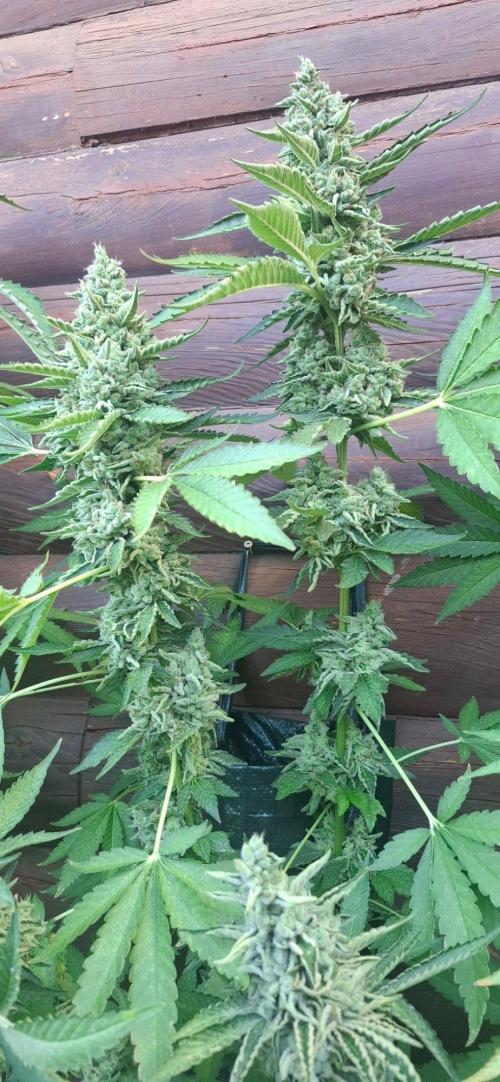
The wall has reached a mature form. Buds continue to swell, more pistils are turning orange, and several colas have developed into long, heavily stacked structures. What stands out most is how efficiently the available space has been utilized. Many of the main stems now carry productive flower sites from top to bottom, leaving surprisingly little unused space between buds.
One observation continues to challenge my original expectations.
Each strawberry bag contains approximately 10 liters of substrate shared by eight clones, leaving roughly 1.25 liters of root volume per plant. Based on conventional assumptions, I expected considerably smaller flowers. Instead, several colas have developed far beyond those expectations.
This does not explain why it is happening, but it continues to support one of the most interesting observations of the entire run:
This should not be working this well, yet the observations suggest otherwise.
Whether the explanation lies in canopy efficiency, environmental conditions, root-zone temperatures, genetics, or a combination of factors remains an open question. What can be observed is that the plants continue to perform remarkably well despite the very limited root volume available to each clone.
Ironically, the success of the canopy has created a new priority.
The flowers are becoming larger, denser, and heavier every week. Several colas now require support, and some are beginning to lean under their own weight. Dense flowers are exactly what every grower hopes for, but on Statia they come with an additional challenge.
Tropical humidity, frequent rainfall, and large compact colas are not always friendly companions.
As a result, monitoring has become a major part of the weekly routine. The largest flowers receive extra attention during inspections, not because of any confirmed problems, but because dense buds naturally deserve closer observation under local conditions.
The most important observation of Week 8 is therefore somewhat unexpected:
The Wall of Green itself is no longer the experiment.
The canopy has already proven capable of producing uniform, productive, flower-packed plants. The challenge now is ensuring that these increasingly large colas safely reach the finish line while maintaining quality.
The wall keeps delivering.
Now it's time to keep watching.
The better the canopy performs, the more important the monitoring becomes.
As always, thanks for following.
14 likes
3 comments
Share
Used techniques
Wall of Green
Technique
9
Week 9. Harvest2d ago
Happy Harvest Day!


10/10
Rated
Hundreds of growers have gone before me in describing Godfather OG. Her taste, aroma and vigor have already been documented extensively. I have little to add that would be useful.
Instead, during a few days of flu in week 6, I smoked one joint too many, poured myself a glass and picked up a pen
---------------------
Good Evening.
Gather, Good Growers, and Glorify the Great Green Giant of the Genetic Gospel.
Godfather OG.
A Gargantuan Genetic Godhead, Gifted to the Grateful and the Greedy alike.
A Glorious Green Goliath Gracing Gardens with Gargantuan Growth, Generous Glands, and Gravity-defying Goodness.
Generations of Growers have Gazed upon lesser Genetics and Gone,
"Good."
Then Gazed upon Godfather OG and Gasped,
"Good Grief."
For Godfather OG does not merely Grow.
Godfather OG Generates.
Godfather OG does not merely Flower.
Godfather OG Gestates Greatness.
Godfather OG does not merely Produce Trichomes.
Godfather OG Generously Gifts Galaxies of Glittering Glandular Glory.
Gaze upon those Glorious Green Garlands.
Gawk at that Gleaming Frost.
Get a Grip, for Gravity itself Grows Nervous beneath such Greatness.
Gossip Grows.
Growers Gather.
Garden Geeks Generate Graphs, Guidelines, and Grandiose Guesses regarding Grams.
Godfather OG Gives no Guarantee.
Godfather OG Gives no Guidance.
Godfather OG Grins.
For Godfather OG knows that Good Intentions become Great Expectations, and Great Expectations become General Disappointment.
Yet Godfather OG, the Gracious Green Gangster, Generally Delivers.
Gas.
Gravity.
Giggles.
Gluttony.
Long, Golden, Glorious Glances at Absolutely Nothing of Great Importance.
Governments have Generated less Discussion.
Generals have Guided fewer Followers.
Gurus have Gathered fewer Devotees.
Girls have Ghosted Men for Lesser Obsessions.
And Still Godfather OG Goes On.
Growing.
Glistening.
Gathering Ground.
Granting Growers Glorious Stories they will Greatly Exaggerate for Generations.
Perhaps Godfather OG is not the Greatest Genetic Gift ever Given.
Perhaps such Glorification is Grossly Gratuitous.
Perhaps this entire Grandiloquent G-Driven Gospel is Growing Ridiculous.
Good.
Great, even.
Because Godfather OG was Never meant to be Reasonable.
Godfather OG was meant to be Legendary.
And Legends, Good Friends,
Grow.
Go Forth.
Grow Generously.
Gather Good Friends.
Give Thanks for Great Genetics.
And should the Garden Gods Grant you Godfather OG, Greet it not as a Plant...
...but as a Guest of Honor.
Show more
Translate
Spent 57 days
Ger Veg Flo Har
150 g
Bud wet weight per plant
36
Plants
2 m²
Grow Room size
Normal
Difficulty
Height
Day air temperature
Light schedule
Night air temperature




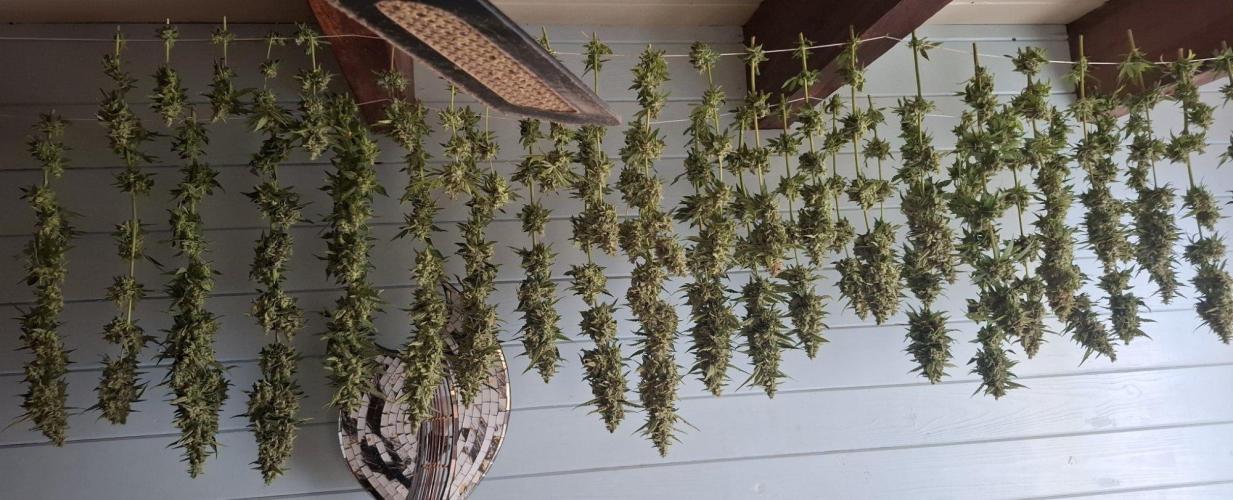

DutchGlobalCitizen With the plants entering their final stages, inspections were increased significantly.
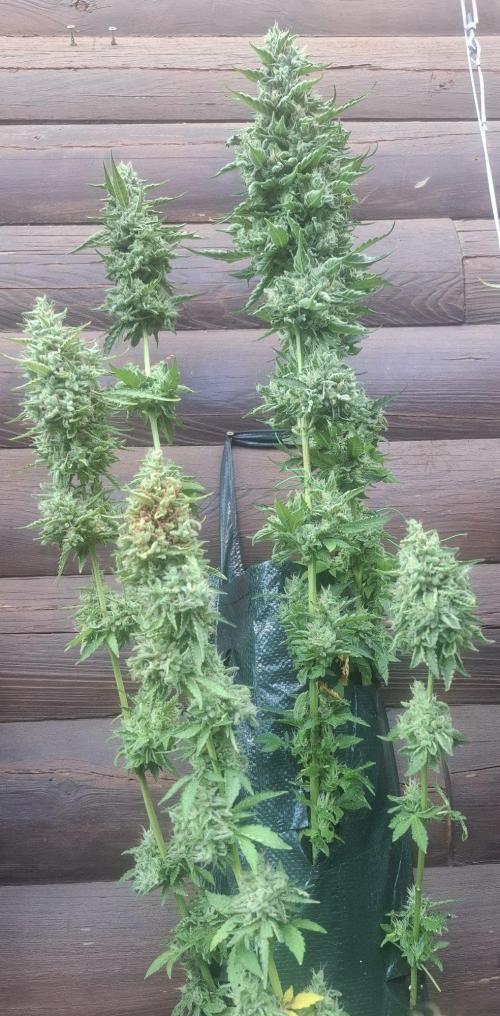
The Wall of Green canopy had developed exactly as hoped. Dense flowers, large colas and a surprisingly uniform wall of bloom were visible across nearly the entire setup. While these characteristics were highly encouraging, they also increased the need for caution under tropical conditions.
During these final inspections, a small number of suspicious spots were identified. Nothing dramatic, but enough to raise concerns about potential quality loss if flowering was extended further. At this stage, the Wall of Green concept had already demonstrated what it needed to demonstrate. The question was no longer how much additional weight could be added, but how much quality could be preserved.
The decision was therefore made to harvest.
The final wet harvest weight came in at approximately 5.4 kilograms.
One thing that became immediately obvious during harvest...
Production was distributed across virtually the entire wall.
There were very few unproductive or empty areas within the canopy.
Multiple productive stems emerged from nearly every planting pocket.
Yield was not concentrated in a small number of exceptional plants but spread across the system.
Large numbers of medium-to-large colas were visible throughout the wall.
Flower production extended along much of the main stem length rather than being limited to the top cola.
After defoliation, surprisingly little space appeared wasted on excessive side branching or non-productive growth.
One of the biggest surprises was how much flower mass became visible after harvest preparation. The actual distribution of buds along the stems proved more impressive than many individual cola photographs had suggested during flowering.
A second unexpected observation was simply how comfortable the harvest process turned out to be. The vertical layout placed most of the work at a convenient height. With relatively few side branches and most production occurring directly on the main stems, trimming and harvest preparation involved far less bending and awkward positioning than I am accustomed to.
Acknowledgements
This run also benefited from some products that deserve mention.
Plagron Lightmix proved to be an excellent substrate throughout the grow. Given the limited root volume available to each clone, substrate performance was particularly important. The plants established quickly, maintained vigor and showed little sign of stress despite the unconventional setup. While many factors contributed to the outcome, Lightmix may well have been one of the key ingredients behind the success of this Wall of Green experiment.
Bio Nova X-Cel was used during the early stages to support root development in the clones. It fit seamlessly into the feeding program and helped the young plants establish quickly, providing a solid foundation for the cycle that followed.
Plagron Alga Bloom formed the backbone of the flowering nutrition program. Easy to use, reliable and consistent throughout bloom, it allowed the plants to perform without unnecessary complexity.
Godfather OG itself also deserves some recognition.
Throughout this project the focus was often on the Wall of Green methodology rather than the cultivar. Nevertheless, Godfather OG consistently displayed strong vigor, excellent cloning consistency, heavy resin production and a remarkably uniform growth pattern. Under tropical outdoor conditions, it proved itself to be a dependable and highly productive variety.
Final Thoughts
The harvest is complete, but the evaluation is not.
The final conclusions regarding dry yield, canopy efficiency, root development, plant density and the overall performance of the Wall of Green system will be reserved for the Final Dry Weight Update.
Only after drying, weighing and examining the root zone will it be possible to determine what this experiment truly achieved.
For now, the scissors are down, the flowers are hanging, and the waiting begins.
Final Dry Weight Update: Coming Soon.
12 likes
2 comments
Share
Equipment Reviews


16 comments
Sort by
popularity
popularity
newest
oldest

Hawii_ReLoaded commentedweek 21mo ago
Love this method 💚🤩
likes 3

Reudiger_Grower commentedweek 617d ago
cool idea looks really nice 😁🤙
likes 2

Bread_n_Buds commentedweek 617d ago
Very nice job !
likes 2

Jomme commentedweek 616d ago
interesting growing method, impressive... 😊 it's nice to have a wall of weed leaves like that. good luck! I'm following
likes 2

Condocannibus commentedweek 83d ago
Shaping up beautifully
like 1

MADMANk commentedweek 87d ago
I've honestly considered doing this in a grow tent and seeing if it could out do the record on yield from a 3x3/2x2ft tent! This is super cool to see done and so well! 💖✌️💚
like 1

Raffael commentedweek 86d ago
Richtig geile Idee 🙏
like 1
Condocannibus commentedweek 711d ago
Looks amazing. Nice work
like 1

Vash_XDC commentedweek 612d ago
but it's fantastic! I had never seen this technique!!
like 1

Patricia_Zamnesia  commentedweek 613d ago
Wow, I love this method of growing, looks fantastic, and your plants seem to like it a lot to 😍💙!
like 1

Thundrfuk commentedweek 613d ago
Sweet... Nice cultivating friend! Pays off to put our knowledge into action. Thanks for the follow, following back. Sending positive vibes.
like 1
Condocannibus commentedweek 614d ago
Looks great 👍 keep yp the good work
like 1

PropogateThePlanet commentedweek 214d ago
Very cool method indeed. Super interested to see how this turns out. 🍿🥤🌳
like 1

Systemfehler commentedweek 92d ago
ist das Schimmel auf Bild Nummer 7,vorne Links
likes

DutchGlobalCitizen commented2d ago
@Systemfehler, It looks like it, hence the trigger to harvest.
likes

the end.
Enjoying this diary? Follow for more updates!

Prefer the old Diary view?
Go back to the old Diary view