


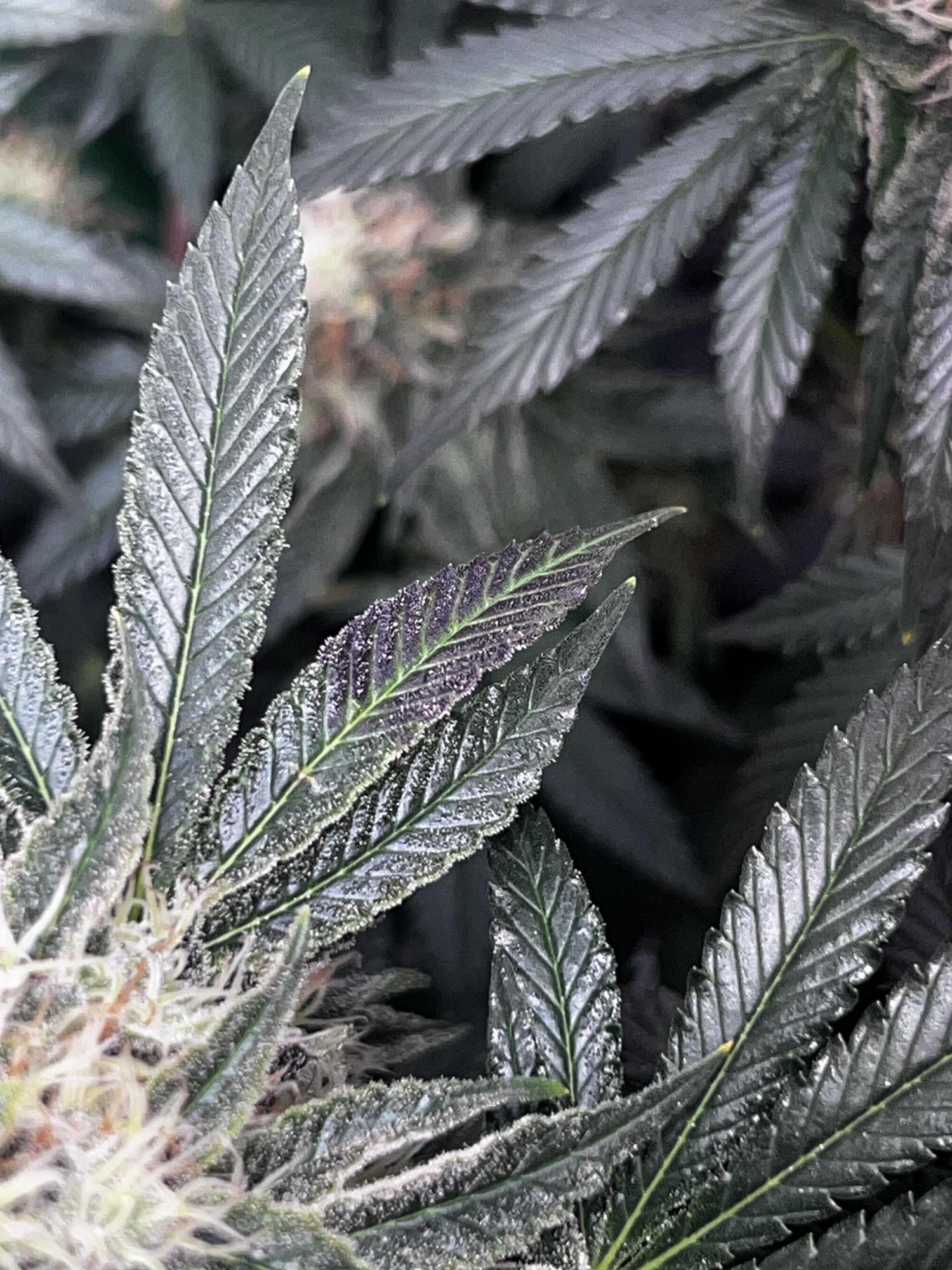
What’s this dark coloring?

ohcibistarted grow question 8mo ago
One leaf, well on fact just one finger has this darkish coloring. It doesn’t look to different from typical end of life leaf coloring it’s just exceptionally dark. It’s the only stress sign and it looks fine from below. It also feels healthy. Not limp, not dry. Anything to worry?
likes

RasendeRollo92answered grow question 8mo ago
Hi,
Da du bereits im fortgeschrittenen Stadium mit deiner Pflanze bist, würde ich mir da keinen Kopf machen. Meist kommen diese leichten violetten Verfärbungen im späten Stadium altersbedingt & sind unbedenklich. Wärst du am Anfang der Blüte, und hättest auch rote Stiele, hättest du sehr wahrscheinlich eine Nährstoffsperre… hier liegt es am Alter, oder Temperaturen
00110001001001111Oanswered grow question 8mo ago
I think it's two things in this case.. too much N causing lush/glossy foliage, and a plant that also turns purple in flower or due to cold temperatures (most often during dark cycle).
1 like
Complain

wolfvbanswered grow question 8mo ago
Salam ohcibi! 👋 That is a beautiful, frosty sugar leaf! You are doing a fantastic job, Habibi. ❄️
Since you are in Week 12, let's look at this through the lens of Modern Engineering to put your mind at ease. 🛠️
What you are seeing on that single leaf finger is called Anthocyanin Expression. Anthocyanins are the natural pigments in the plant that create purple, blue, red, and black colors.
Here is the engineering breakdown of why it happens right at the end of the grow:
The "Sunblock" Effect: In late flower, the plant's metabolism begins to slow down as it finishes its life cycle. The chlorophyll (which makes the leaf green) starts to naturally break down and fade away. As the green fades, the dark purple/black anthocyanins underneath are finally revealed.
Temperature Triggers: This process is rapidly accelerated if your "lights-off" temperatures drop below 18°C (65°F). The cold signals to the plant that "autumn" is here, causing it to push heavy dark colors. 🍂
The Verdict:
You have absolutely nothing to worry about! The leaf feels healthy, supple, and isn't crispy or mushy. This is not a mold issue or a nutrient deficiency. It is simply your plant showing off its beautiful genetics and entering its natural "fade" before harvest.
Keep doing exactly what you are doing, she is almost ready! 🚀
Happy Growing! 💚
1 like
Complain

Gnrlymsntrp81answered grow question 8mo ago
Stop giving Nitrogen, only PK. Dark green, shiny leafes and claws show there is too much N. Will result in harsch smoke.
1 like
Complain

Green_Clawsanswered grow question 8mo ago
Hey there, fellow gardener! It’s a pleasure to connect with someone who clearly has a keen eye for detail. Looking at those frosty sugar leaves, it’s obvious you’ve been putting in the work—that trichome production is stellar! 🌿
What You’re Seeing
Honestly, you can breathe a sigh of relief. Based on the deep, dark pigmentation isolated to those specific areas, you’re likely looking at Anthocyanin accumulation.
This is essentially the plant’s "sunblock" or a response to environmental shifts. Since the leaf feels supple and healthy rather than dry or brittle, it’s almost certainly not a pathogen or a deficiency. When a plant is deep into the flowering stage, it focuses its energy on the buds, and certain "fingers" of a leaf can "fade" or change color more rapidly than others based on light exposure or micro-climates in your tent.
Potential Causes & Adjustments
While it looks mostly like a natural "fade," here are a few things to keep in mind:
Temperature Fluctuations: If your "lights-off" temperatures drop significantly (especially below 16°C), the plant will ramp up purple and dark pigments.
Fix: Ensure your day/night temp swing is no more than 8-10°C.
Phosphorus Sequestration: Occasionally, very dark purple/black spots can indicate a slight P-uptake slowdown due to cool roots.
Fix: Keep your root zone slightly warmer than the ambient floor temp.
The Power of Microbes
To ensure this doesn't turn into actual stress and to maximize that end-of-life terpene profile, lean into your microbial allies. Microbes are the "secret sauce" for nutrient bioavailability:
Phosphorus Solubilizing Bacteria (PSB): Use strains like Bacillus megaterium. They break down locked-up minerals in the soil, ensuring the plant has all the energy it needs to finish strong without discoloring from stress.
Mycorrhizae: If you aren't already, ensuring a robust fungal network helps the plant manage "stress" much better by regulating water and nutrient flow at a cellular level.
Microbial Teas: A light compost tea with a bit of unsulphured molasses will feed the existing colony, keeping the pH stable and the plant's immune system "primed" against actual pathogens like mold.
The Verdict...
You’re doing great! This looks like a beautiful, natural expression of the plant's genetics. As long as the texture remains healthy and it doesn't spread rapidly in a "burnt" or "mushy" fashion, stay the course. 🛡️
Keep up the fantastic work, and may your harvest be heavy and flavorful! 🥂✌️ 💚
1 like
Complain

Ultravioletanswered grow question 8mo ago
No worries so late in the game, good sign that there is efficent metabolism happening, a combo of genetics and environment. Nitrogen is required by the roots to convert sugar into energy, if there is no Nitrogen in the medium the plant can dump its nitrates which are no longer required by the plant and "dumps" it in the soil to feed Micros. In a perfect world you want to have as much nitrates out your plant as possible come harvest so its a good sign. Chlorophylls main purpose is photosynthesis. Anthocyanins main purpose is defense.
3 likes
Complain

Similar Grow Questions


Solved

BudmanFlyingjoint
what's going on?
First photo was on 21/3/2024, 2nd on 25/3/2024, 3rd on 26/3/2024 Leaf kind of necrosis. New sprouts under fan leafs show green and yellow both bright.
Leaves. Color · Pale
Leaves. Color · Dark-purple
Leaves. Color · Mottling
3y ago
2

Solved

SaiMutsu
Weird splotchesNot sure what this could be, I'm thinking phosphorous deficiency, the dots are weird though.
Leaves. Twisted
Leaves. Color · Dark-purple
2y ago
1
1
Solved

2Dawg_Plant
Is this Amnesia Auto Healthy?Is this normal for Amnesia Auto's? Still new to this growing hobby so your thoughts and suggestions are much appreciated
Leaves. Color · Dark-purple
4y ago
1
3
Solved

Labthecoast
Deficiensia o exceso?Good afternoon, I can't find the point to this, several stems are well purple and dark red, some middle leaves are yellowing and maybe have some spots, then the upper leaves start to turn purple/violet at the edges. I'm leaving photos, thanks for your time.
Leaves. Color · Red or pink
Leaves. Color · Dark-purple
6y ago
3
3
Solved

nopes
Yellow and purple leafe tipsThe tip of the leaves on the Quick One are turning yellow and then into a deep dark purple, is this supposed to happen or are the in trouble?😰
She is in her second week of flower, looked overall healthy so far, any idea on wahts happening?
Week 6
Leaves. Color · Dark-purple
2y ago
3
4
Solved

Magruder
Purple leavesHi all, got some purple on my upper leaves and just wondering what you think? Ph is 6.5 to 6.7.
Leaves. Color · Dark-purple
7y ago
4
12

Solved

Poz83
Why is has my plant gone purple when flushing for harvestSo I have been flushing Blueberry Cheese for 9 days now, buds arent compact so thinking maybe this is an autoflower? Anyways, since flushing the stems, buds and leaves are going purple and my PPM and EC is still very high in run off. Any Advice pleaseBuds. Other
Leaves. Color · Dark-purple
Plant. Stem · Red or purple
5y ago
3
4
Solved

KevinC
Fan leaf colour?I have 2 plants both (Blue Gelato 41) in the same conditions and feed schedule.
Why is the colour different between the 2.
Genetics?
The green fan leave branch leaves are pointing up.The purple fan leave branch leaves are slightly droopy (horizontal)
Air circulation?
Genetics?
Leaves. Color · Dark-purple
6y ago
2
2
Solved

TheHighentist
Leaves on 1/6 plants are changing colorOne of my ladies is acting different to the 5 other ladies.
So i wanted to check with the forum, if i should worry.
As seen on the pictures, top leaves egde turned red/purple and some even a bit yellow.
Light stress? Or just getting closer to getting ripe?
Leaves. Color · Dark-purple
4y ago
4


Solved

Walleyeguy
Spots on lower leaves. Edges.I have spots on lower leaves. Already trimmed some off. Thinking it's cal as I'm growing in coco. But as I switched to 12 and 12 could use some advice.
Seem to be mostly on edges and tips of leaves ( where lights hitting ).
Week 5
Leaves. Color · Dark-purple
6y ago
3
2
Solved

smalltime
Dark bluish leaf tipsIs this dark bluish tint to the leaves an issue? It is only on the the main stalk, She otherwise seems very happy.Week 4
Leaves. Color · Dark-purple
5y ago
2
1
Solved

Dankbudz84
Phosphorus deficiency using canna coco on all autoI have the entire canna line except boost, I have a phosphorus deficiency (dark leaves with a dark blue tint on new and old growth. Which synthetic bottled nute would be recommend to fix this or do I add more a+bmy ec currently at 1.35 and Ph 5.9. Do you seen any other deficienc
Leaves. Color · Dark-purple
5y ago
2
Solved

HAN_GROWER17
Carencia o sobre fertilizaciónWhat could this color be due to?
Leaves. Color · Dark-purple
6y ago
1
Solved

Kripoulas
Purple stems, droopy leaves and yellow leaf tips. What's the deal?What could be causing this unfortunate event? Deficiencies or lights? Over watering? How can I rescue this fellow plant? Thank thy 🙌
Ps. This shot was right after a nutrient watering.
Ps2. How can I add my diaries to my questions?
Leaves. Tips · Burnt
Leaves. Dropping off
Leaves. Color · Dark-purple
6y ago
3
3
Solved

sugar_leaf_daddy
Short LSD auto with deep purple coreend of week 4 and almost no space between internodes, feeding her the same as the other cultivars germinated around same period, same medium, distance from light, same intensity... what am I doing wrong?
What about this dark purple core development? HELP!!!!
Leaves. Color · Dark-purple
Plant. Spaces between nodes
4y ago
3
4