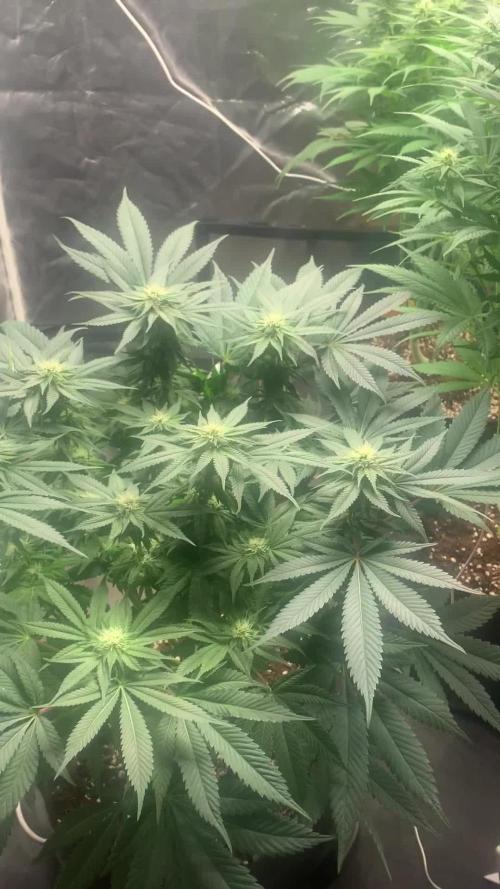
Likes
Comments
Share


@johdlong
Follow
Lots of bud swell was seen this week. Hermie pods were developing on the lowers of all plants and were picked off daily, it will likely be seeded, but hopefully not too many. I have been seeing less pods each day, but I can tell they are still developing. The trichomes are really starting to pile on. A suspected nitrogen deficit has popped up on a couple of lowers, but it isn't too much of a concern yet. I used some "BAB," and I plan on another light bokashi topdressing within the next week. High humidity is returning this week, so I'll have to manage that before it becomes a problem.

Likes
28
Share


@Weedman46
Follow
Day 25 of flowering looking nice no problems as of yet knock on wood plant on the right I think looks better it has gotten more defoliating and training they are about 2in shorter than I expected but my light is only 200 watts so it doesn't get down through the canopy very well and I don't want to grow a bunch of trim bud


Likes
7
Share


@Waisgrower
Follow
Primer dia desde cambio de fotoperiodo, recien se pueden ver los primeros pistilos indicando el sexo de nuestras plantas🌱. En unos dias se veran las primeras preflores que nos indicaran que partio la floracion🌺. Muy contento con los resultados obtenidos hasta ahora con tan solo 4 semanas de vegetacion, hemos llenado el espacio super rapido🔥. Se pretende sacar este cultivo en menos de 3 meses, asi como vamos se cree lograrlo!.
Las proximas lavores a realizar sera desfoliacion a los 21 dias de floracion ✂️.
Iluminacion Sodio 400w al 75% se aumentara en una semana a 100% 💡.
Fertilizacion con linea @topcropchile 💥
Potenciadorgenetico @knactive_ ⚡
Royal gorilla🦍 by: @royalqueenseedsrqs 🦁.

Likes
14
Share


@LokalGrenz
Follow
Had some humidity issues been watering with spring water until I get something to filter the tap water
Jan.8th amnesia haze 1 got bit taller so I did some more LST


Likes
10
Share


@Xspellsx
Follow
Here it is...Fucking bomb id definitely grow again Sadly this was a single bag seed it did HERM but late in the game so the seeds it did make which there weren't many are white and empty....got clones of his jet fuel so we will see the similarities.. Gave me about 3 ounces. Been smoking on it hard so hard to tell hahha aging well has a grapefruit smell that does not inhibit the taste which is fresh flowery chronic similar to a skywalker but much lighter
Processing
Likes
32
Share


@Vega0284
Follow
Hey Guys!
Super excited this week! I've really been wanting to try growing outdoors, so I built a cheap hoop house! Got most of this stuff for the frame from Lowes under 300$. All the soil products I got from GrowGreenMI. Some really cool people out there.
One thing I'm super worried about is drainage. Right now those holes are about 4 feet deep and they've got about 4 inches of water in them already. What's been cautioned is that, eventually, about 2 months in these plants roots will grow and reach the bottom and cause root rot to form. One of the biggest things I was trying to be wary of was causing root rot. This was also the biggest precautionary measure I took when mixing the soil. Adding the extra perlite, coco, and clay pebbles. Best advice right now is to build the soil up on the holes another 16 to 18 inches and possible stick a PVC pipe down to the lowest drainage point of the hole to allow some of that natural occurring water to evaporate.
Any advice anyone has on it is welcomed!
Making a compost tea for the soil outdoors, will probably put 2 cups in each RDWC bucket as well and let that do it's magic for a day or so before nutrient change. Raised the bed about 14 inches as well!
All the seeds sank! Off to a good start! Lol

Likes
18
Share


@KurbinTurbin
Follow
This strain was easy to grow, short and very bushy. The smell when drying has an incredibly strong earthy/chocolate aroma which is very pleasant🤤.

Likes
5
Share

@Jardineiro_Br
Follow
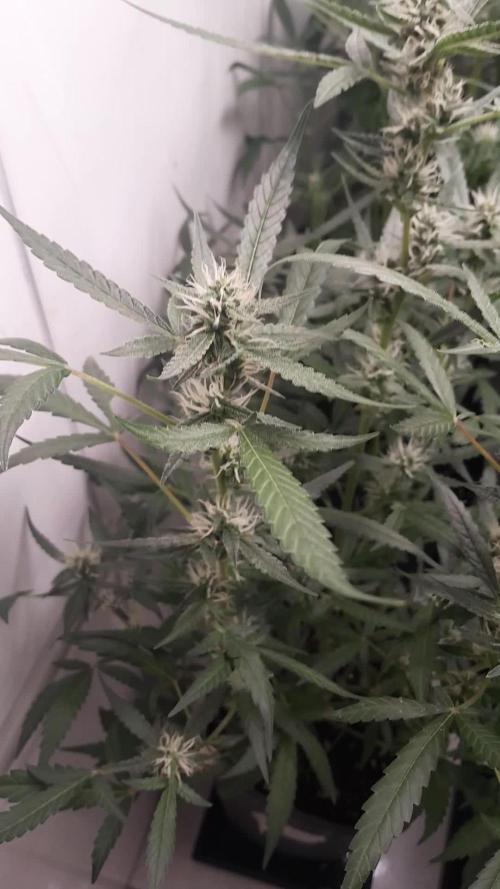
Reduzi a concentração do fertilizante e as plantas estão criando os botões agora, um pouco mais lentos talvez que o LSD, mas sétima semana e estou satisfeito com a aparência, apesar de ter limitado o fertilizante elas não apresentaram sinais de excesso final da sétima semana a geada chegou forte .

Likes
1
Share

@Ninjabuds
Follow
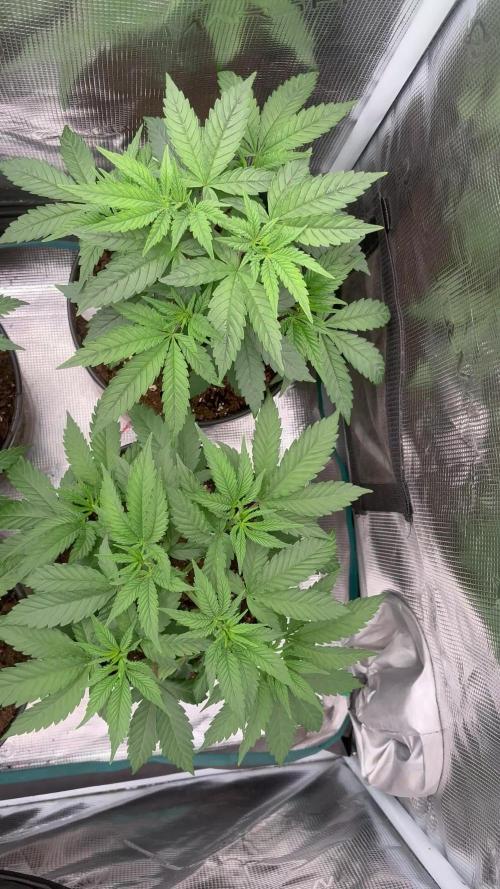
It’s day 33’from seed. All of the plants are really healthy. The plants have a really great root system at this point… I am currently slowly moving the light intensity up to the veg area. Now that are in a groove they are about to explode… I’m hoping I can flip the plants to flower in 1 weeks but I’m thinking I will wait to weeks and let them get a little larger. The plants are just now starting to look visually different next weeks update I will be ababoe to go into the visual differences, they are just not that extreme yet to really talk to much about.


Likes
3
Share


@Shmoopy_me
Follow
Magic castle on day 78 getting close to harvest. Started the carboflush last week and will continue till harvest!

Likes
44
Share


@Jeffrokush
Follow
I found out that we aren’t supposed to give the plants the runoff water oops!! But She is doing great imo .. I’m considering going to a larger pot maybe a 10 gallon!!?
Update I have the 10 gallon pot waiting on promixhp but I’m still not sure if I should transplant at this point!??????????
Well I decided not to transplant into a larger pot so the 3 gallon is going to be her home.
I also watered yesterday with the full amount of nutrients that Emerald Harvest suggest because in doing some research on Purple kush and found out that Purple kush will actually uptake all the recommended dose ages of nutrients
AMAZING and so I gave it a shot! Also I have the Migro 240w at 75% and gradually making my way to 100% before the last two weeks.
So far I’ve learned a lot and had plenty of awesome suggestions and answers from everyone within the growdiaries.com community.
Thank you

Likes
2
Share


@Altitonans_Fulmen
Follow
For most crops, a slightly acidic soil pH between 6.0 and 6.8 is ideal because it optimizes nutrient availability. When soil pH rises above 7.0 (alkaline), the concentration of hydrogen ions H+ drops significantly, and they are replaced by calcium, magnesium, or sodium ions on the clay colloid exchange sites. To naturally lower alkaline soil pH, you can add organic matter (carbon-rich materials), which produces weak organic acids as it decomposes. Maintaining this slightly acidic range stimulates a highly active, diverse microbial community; these microbes decompose organic matter and release carbon dioxide CO2, which plants absorb through their roots and leaves to boost photosynthesis and sugar production. Furthermore, the added organic carbon acts like a sponge, drastically improving the soil's water-holding capacity.
While soil biological activity does involve cellular electron transport, electrical conductivity (EC) in soil is actually a measure of dissolved mineral salts, not a voltage carried by individual microbes. Soil microorganisms secrete organic acids and chelate metallic and non-metallic minerals, transforming locked-up inorganic compounds into bioavailable organic complexes. Unlike harsh synthetic fertilizers that can dehydrate soil life in high concentrations, these naturally chelated nutrients safely nourish the plant, creating a thriving, self-sustaining ecosystem where plants can efficiently synthesize their own food.
Metal-based: Could include elements like iron, manganese, copper, or zinc, which are essential nutrients for plants but can exist in forms not readily accessible.
Non-metal-based: Examples like calcium carbonate, phosphate, or sulfur are also important for plant growth and potentially serve as building blocks for the organic salt.
Chelation in a plant medium is a chemical process where a chelating agent, a negatively charged organic compound, binds to positively charged metal ions, like iron, zinc, and manganese. This forms a stable, soluble complex that protects the micronutrient from becoming unavailable to the plant in the soil or solution. The chelate complex is then more easily absorbed by the plant's roots, preventing nutrient deficiency, improving nutrient uptake, and enhancing plant growth. Chelation is similar to how microorganisms create organic salts, as both involve using organic molecules to bind with metal ions, but chelation specifically forms ring-like structures, or chelates, while the "organic salts" of microorganisms primarily refer to metal-complexed low molecular weight organic acids like gluconic acid. Microorganisms use this process to solubilize soil phosphates by chelating cations such as iron (Fe) and calcium (Ca), increasing their availability.
Added sugars stimulate soil microbial activity, but directly applying sugar, especially in viscous form, can be tricky to dilute. Adding to the soil is generally not a beneficial practice for the plant itself and is not a substitute for fertilizer. While beneficial microbes can be encouraged by the sugar, harmful ones may also be stimulated, and the added sugar is a poor source of essential plant nutrients. Sugar in soil acts as a food source for microbes, but its effects on plants vary significantly with the sugar's form and concentration: simple sugars like glucose can quickly boost microbial activity and nutrient release. But scavenge A LOT of oxygen in the process, precious oxygen. Overly high concentrations of any sugar can attract pests, cause root rot by disrupting osmotic balance, and lead to detrimental fungal growth. If you are one who likes warm tropical high rh, dead already. Beneficial, absolutely, but only to those who don't run out of oxygen. Blackstrap is mostly glucose, iirc regular molasses is mostly sucrose. Sugars, especially sucrose, act as signaling molecules that interact with plant hormones and regulate gene expression, which are critical for triggering the floral transition. When sucrose is added to the growth medium significantly influences its effect on floral transition.
Probably wouldn't bother with blackstrap given its higher glucose content. Microbes in the soil consume the sugar and, in the process, draw nitrogen from the soil, which is the same nutrient the plant needs. Glucose is not an oxygen scavenger itself, but it acts as a substrate for the glucose oxidase (GOx) enzyme, effectively removing oxygen from a system. Regular molasses (powdered if you can), as soon as she flips to flower or a week before, the wrong form of sugar can delay flower, or worse. Wrong quantity, not great either. The timing of sucrose application is crucial. It was more complicated than I gave it credit for, that's for sure. When a medium's carbon-to-nitrogen (C:N) ratio reaches 24:1, it signifies an optimal balance for soil microbes to thrive, leading to efficient decomposition and nutrient cycling. At this ratio, soil microorganisms have enough nitrogen for their metabolic needs, allowing them to break down organic matter and release vital nutrients like phosphorus and zinc for plants. Exceeding this ratio results in slower decomposition and nitrogen immobilization, while a ratio below 24:1 leads to faster breakdown and excess nitrogen availability.
Carbon and nitrogen are two elements in soils and are required by most biology for energy. Carbon and nitrogen occur in the soil as both organic and inorganic forms. The inorganic carbon in the soil has minimal effect on soil biochemical activity, whereas the organic forms of carbon are essential for biological activity. Inorganic carbon in the soil is primarily present as carbonates, whereas organic carbon is present in many forms, including live and dead plant materials and microorganisms; some are more labile and therefore can be easily decomposed, such as sugars, amino acids, and root exudates, while others are more recalcitrant, such as lignin, humin, and humic acids. Soil nitrogen is mostly present in organic forms (usually more than 95 % of the total soil nitrogen), but also in inorganic forms, such as nitrate and ammonium. Soil biology prefers a certain ratio of carbon to nitrogen (C:N). Amino acids make up proteins and are one of the nitrogen-containing compounds in the soil that are essential for biological energy. The C:N ratio of soil microbes is about 10:1, whereas the preferred C:N ratio of their food is 24:1 (USDA Natural Resource Conservation Service 2011). Soil bacteria (3-10:1 C:N ratio) generally have a lower C:N ratio than soil fungi (4-18:1 C:N ratio) (Hoorman & Islam 2010; Zhang and Elser 2017). It is also important to mention that the ratio of carbon to other nutrients, such as sulfur (S) and phosphorous (P) also are relevant to determine net mineralization/immobilization. For example, plant material with C:S ratio smaller than 200:1 will promote mineralization of sulfate, while C:S ratio higher than 400:1 will promote immobilization (Scherer 2001).
In soil science and microbiology, the C:S ratio helps determine whether sulfur will be released (mineralized) or tied up (immobilized) by microorganisms.
A carbon-to-sulfur (C:S) ratio smaller than 200:1 promotes the mineralization of sulfate, when the C:S ratio is low, it indicates that the organic matter decomposing in the soil is rich in sulfur relative to carbon. Microorganisms require both carbon and sulfur for their metabolic processes. With an excess of sulfur, microbes take what they need and release the surplus sulfur into the soil as plant-available sulfate
A carbon-to-sulfur (C:S) ratio higher than 400:1 will promote the immobilization of sulfur from the soil. This occurs because when high-carbon, low-sulfur materials (like sawdust) are added to soil, microbes consume the carbon and pull sulfur from the soil to meet their nutritional needs, temporarily making it unavailable to plants.
200:1 C:S 400:1: In this range, both mineralization and immobilization can occur simultaneously, making the net availability of sulfur less predictable.
This dynamic is similar to how the carbon-to-nitrogen (C:N) ratio regulates the availability of nitrogen in soil. Just as microbes need a certain amount of nitrogen to process carbon, they also require a balanced amount of sulfur. Both mineralization and immobilization are driven by the metabolic needs of the soil's microbial population.
Sulfur is crucial for protein synthesis. A balanced ratio is particularly important in relation to nitrogen (N), as plants need adequate sulfur to efficiently use nitrogen. A severely imbalanced C:S ratio can hinder the efficient use of nitrogen, as seen in trials where adding nitrogen without balancing sulfur levels actually lowered crop yields.
Maintaining a balanced carbon-to-sulfur (C:S) ratio is highly beneficial for plant growth, but this happens indirectly by regulating soil microbial activity. Unlike the C:N ratio, which is widely discussed for its direct effect on nutrient availability, the C:S ratio determines whether sulfur in the soil's organic matter is released (mineralized) or temporarily locked up (immobilized).
Glucose will hinder oxygenation more than sucrose in a solution because glucose is consumed faster and has a higher oxygen demand, leading to a more rapid decrease in oxygen levels. When cells respire, they use oxygen to break down glucose, and this process requires more oxygen for glucose than for sucrose because sucrose must first be broken down into glucose and fructose before it can be metabolized.
In a growth medium, glucose is a more immediate and universal signaling molecule for unicellular and multicellular organisms because it is directly used for energy and triggers a rapid gene expression response. In contrast, sucrose primarily acts as a signaling molecule in plants to regulate specific developmental processes by being transported or broken down, which can be a more complex and slower signaling process.
Critical stuff.
Likes
12
Share


@CruzeBlade
Follow
DLI auf 45 gestellt. Wert bleibt bis zur Beginn der Blüte. Denke noch eine Woche dann Umstellung auf 12/12.

Likes
17
Share


@Nicogreen
Follow
Sindsygt godt ramt af mig ❤️ det er lige begyndt at have plus ➕ grader om natten og så er vi igang næste uge burde den være dobbelt så stor som den er nu. 😉

Processing
Likes
15
Share


@vibealive
Follow
Man... What a week!
So we closed in on week 6.
I JUST moved all of my stuff across town! Went well!
I FINALLY got everyone setup where they belong...
Likes
1
Share


@GreenSunrise
Follow
started the flush this week. started to notice a couple of problems with drying out around 2 of the buds. raised the lights up to get some of the heat away from the top buds. a bit worried i left the flush too late.