


Likes
Comments
Share


Likes
28
Share


@TheHighentist
Follow
First week of flower👏
They got 2 hours extra darkness before flip. Not because of scientific evidence, but simply practical.
Still looking back to the first weeks of veg. WHAT A MESS and WHAT A MIRACLE 🙏
Coming into flower, they had two defoliation and the latest one was 7/10.
Last feed 8/10 Introducing Biobizz CalMag(0.5ml/l) + BioBloom(0.25ml/l)+Topmax(0.25ml/l)+Rootjuice(0.25ml/l)
Still 2ml/L Fishmix+BioHeaven(Fishmix will be switched out with BioGrow)
👽👉10/10 VPD is 1.2,-1.3. good airflow above and below canopy.
👽👉11/10 Mild signs of light stress. They will get used to the VPD. Can't wait to feed in a couple of days and see the reaction. Im sure they are really hungry!
👽👉12/10 Waterday** Introducing higher doses of bloom nutes. The Run off PH and EC are all within the limits
👽👉13/10 They lit up after some nutes. They look happy! Let the stretch begin
👽👉14/10 Already see fast growth. Just monitering factors, to make sure the climate is optimal and their are no symptoms.
👽👉15/10 Waterday* Thirsty ladies
👽👉16/10 Last day of week 1 of flower. Everything is going fine, Good airflow, None of the small symptoms has gotten worse, so overall happy ladies!
How ever one has a little stunned growth or maybe just a bit behind of going into stretch


Likes
14
Share


@AmnZhz
Follow
Week 11 16/12/2018 - 23/12/2018, cant wait to harvest everything is frosty and the smell is just perfect. Hopefully this will be the last week and the next one i ll start flushing. Waiting till the end of next week. Checked the trichromes couple of days ago and they were still transparent. Will check again in a couple of days to see if they turned cloudy.

Likes
376
Share


@Metatronix
Follow
Good day to all my friends and visitors here on GD.
We harvested one of the Tropicana XL girls , this is going to be a weird entry because I decided to not make a harvest entry till the other one lady finishes.
Unfortunately because of my sticky fingers from all the trimming I did not make many pictures/videos of the grow itsels, to fill this void I decided on including the harvest videos and photographs. Although the final weight will be summed up in the final harvest.
We finally see that our problem with the plants may not a deficiency but overfeed...decided to leave the reservoir as it is for this week and add only fresh water next week we will flush the system and for seven days the girls will only drink water.
--------------------------------------------------------------------------------------------------
The SE7000 runs at 520 Watt and about 33cm from the canopy and is doing an astounding job.
For anyone who is interested in obtaining this efficient and affordable light fixture here's the link:
https://spider-farmer.com/products/spider-farmer-upgraded-se7000-730w-commercial-led-grow-light/
A shout out to Sweet Seeds for the gift of this fenomenal genetics: https://sweetseeds.es/en/
Also I want to thank Jungle Indabox nutrients for supplying me with their excellent & affordable nutrients line: https://www.jungleindabox.cz/en
That's it friends, I hope to see y'all next week, bless.

Likes
10
Share


@Shefman93
Follow
I transplanted into the final pot, 20 gallons. I am affording a gallon of medium per week of plant growth. This will be a 20 week grow. This has been a very relaxing grow as I don't have to see about multiple plants at once.

Likes
27
Share


@KnightRider
Follow
Hey Growmies,
So week one and my Blackberries has twisted growth for some reason, i may move the light further away and see if that helps.
Apart from that shes grown nicely from her initial popping and just pushing out her 2nd set of leaves.
Thats all from me this week, thanks for stopping by 😊✌️


Likes
18
Share


@TheGrowHouse
Follow
Wow these girls are growing fast now they have been flipped, had to put net in to control stretch over the next few weeks, slight smell at the moment mostly a slight ammonia smell mainly.
See you next week 💚🌴🌱🙏
Likes
21
Share


@cadur
Follow
Over zealous with my LST and broke a side branch. Have stuck it back in with some cellotape, it's wilting and probably a gonner. Hey ho.
Growth is good, I've added another spider farmer sf1000 and it is like light and day. When I turn it off and go back to 1 sf1000 it seems so dark!
Likes
54
Share


@PremiumBudsEU
Follow
🌿🌿🌿Happy plants 🌿🌿🌿
Watering every 2 day 0, 8 l
Temp 20-30°
Co2 1000 ppm
Light 1100 ppfd
RLF 30%
GREAT WHITE 0,5G/L every week
All plants seems to do well, no signs of heat stress or pests..
First signs of Flowers 🍀🍀
Bloom nutes + booster added 👌
😎👍
Likes
14
Share


@FourVentiFarms
Follow
pics from 11th October for last week
26th week for the Critical
24th week for the Lemon
close to finish, starting to see more yellowing of the leaves
Likes
6
Share


@CrippleHillFarmer
Follow
These girls are only about 13 days old and younger looking great so far.


Likes
37
Share


@DogDoctorOfficial
Follow
🌱 Week 1 Update: Terpyz Mutant Mentha de Croco Journey 🌱
Hey Grow Fam! The Mentha de Croco sprouts are officially a week in, and they’re already showing off their unique personality, each one growing at its own pace. They’re rocking some funky vibes and loving life inside the dome! Here’s a full update on their progress, care, and setup for Week 1.
Living Environment: The Humidity Dome Setup
The seedlings are living in a humidity dome, where we’re keeping the relative humidity (RH) close to 100%. This level of RH mimics a tropical environment, creating the ideal conditions for delicate young plants that need extra hydration support as they begin to develop roots and leaves.
Why High Humidity?
• Encourages Strong Root Development: At nearly 100% RH, plants focus on root growth while pulling in moisture directly from the air, helping them establish themselves early on.
• Protects from Stress: The high humidity reduces transpiration (water loss through leaves), which prevents drying and keeps seedlings hydrated.
• Promotes Healthy Leaf Growth: With constant access to moisture, the leaves expand smoothly, giving each plant a strong start in the vegetative phase.
Growth Status & Observations 🌱
These little mutants are showing some funky characteristics and growing at their own unique pace—a perfect reminder that no two plants are the same! Each seedling has sprouted its initial set of leaves, and I’m seeing great promise in their vigor and resilience.
Key Observations:
• Color: The seedlings are a healthy green, with some displaying slight variances in shade—typical of unique genetics like Mentha de Croco.
• Structure: Leaves are developing steadily, with short internodes (the space between sets of leaves) that hint at nice, compact growth patterns as they continue.
• Energy: Each plant seems to be finding its rhythm, which is a beautiful thing to watch! Some are taking their time, while others are diving right into rapid growth.
Nutrients & Supplements 💧
For this first week, I’m keeping it light on nutrients, letting the seedlings draw what they need from the Root Riots and the remaining seed stores. However, I’ve continued using Aptus Holland’s Regulator and Startbooster, both at 1ml/L, to support foundational growth.
Why These Nutrients?
• Aptus Regulator: Adds silicon to fortify cell walls, giving the seedlings extra strength to handle environmental changes. Even under the dome, this helps build resilience.
• Aptus Startbooster: Supplies essential microbes and root stimulators, setting up these little ones for explosive root growth once they’re ready to venture outside the dome.
Lighting: FOG LED & Environmental Control 💡
I’ve kept the Future of Grow (FOG) 600W LED dimmed to around 200 PPFD to avoid overwhelming these tender seedlings with too much light. They’re getting just enough energy to support healthy photosynthesis without stressing them in their early stages.
Lighting Benefits at Low Intensity:
• Prevents Stretching: With the lower PPFD, plants stay compact and focused on root and leaf development rather than reaching for the light.
• Supports Early Photosynthesis: The FOG LED’s balanced spectrum provides all the wavelengths these seedlings need to kick off photosynthesis and grow with vitality.
Controlled through the TrolMaster Tent X, the lighting schedule is consistent and stable. With this controller, I can manage humidity, lighting, and temperature settings all from one place, ensuring the environment stays perfect for these little ones.
Reflection & Tips for Fellow Growers 💡
Week 1 is about creating a stress-free environment for seedlings to adjust and establish themselves. Here’s a bit of wisdom for anyone embarking on a similar grow:
💧 Humidity & Hydration: High humidity is a seedling’s best friend. Keep your dome or grow area humid for strong, happy plants.
💡 Light Management: Keep lighting low to encourage compact growth and let those roots dig in. Adjust lighting gradually as they grow to avoid any shock.
🌱 Patience with Genetics: Each plant has its own rhythm, especially with unique genetics like these. Let them show you what they’re made of without pushing too fast.
Shout Outs & Community Love 💚
Much love to Terpyz Genetics for these incredible seeds, Aptus Holland for the nutrients, Future of Grow for the stellar LED, and TrolMaster for the environmental control. Big shout out to everyone following this journey—it’s always a blast sharing with you all. Let’s keep the positive energy flowing and watch these seedlings turn into something amazing together!
Stay tuned for Week 2 updates—more growth, more funk, and more growers’ love!
Genetics - Mentha De Croco
https://terpyz.eu/products/menta-de-croco-fern-type?_pos=1&_sid=e9237cbcb&_ss=r
DogDoctorOfficial Discount Codes @ terpyz.eu - DOCTOR 15% off
Nutrition - @aptusholland
https://aptus-holland.com/
Led Power @ F.O.G. Future Of Grow
https://www.thefuturofgrow.com/en/online-store/BLACK-SERIES-600-p489093171
Controls @ TrolMaster
https://www.trolmaster.eu/tent-x
As always thank you all for stopping by, for the love and for it all , this journey of mine wold just not be the same without you guys, the love and support is very much appreciloved and i fell honored with you all in my life
With true love comes happiness Always believe in your self and always do things expecting nothing and with an open heart , be a giver and the universe will give back to you in ways you could not even imagine so
Growers Love To you All 💚

Likes
49
Share


@masterofsmeagol
Follow
8/22 Defoliated what needed it.with all the rain I had to remove some yellow leaves. The container plants are affected the most as the wind drys those bags out in like a day. I'll have to check twice a day. Watered a gallon a plant yesterday before going to the hospital, then went back over after and gave everything at least another half gallon. I'm pretty sure everything got their 10%. Yesterday I upped the feeding regimen to 2.5 pints a plant. A little more on the ones that looked like they needed it most. I took some pretty good pictures. I hope that's not septoria on the leaf that I took a picture of in the fire pit. Glad I sprayed that BT. I'll have to keep up with it. I'm also considering an application of plant doctor just in case. I don't SEE anything fungal bur that would suck. Flowers arecexploding in growth. Just got a text from my father telling me how my plants are "budding big time" lol. I have the bamboo I need but there are still a few individual HUGE branches that will soon need more support.
Update: Wife felt A LITTLE better so I went to check the girls around 6pm. I found my canary starting to droop. I'm not sure If I gave a full two gallons to everything yesterday. One or two may have only gotten one and a half. I compared the weight with the weight of a 22 gallon bag of dry soil and realized it was definately time to water even though only one plant was drooping they were all dry. It may have been okay to leave it but i've let them dry out far too often already so I made sure EVERY PLANT got it's 10% of water (except containers) and I watered slower. I don't see any negative effects from the B.T. but i'm noticing some older leaves turning yellow on a couple plants as this explosive flowering continues. I"m just going to continue monitoring it. I hope I did the right thing and watered. If it was going to rain tonight I might have held off but they were super light. I also took a video and some pictures but my wife is using my phone to listen to music and calm down so i'll need to upload those pictures and videos tomorrow. I finished my defoliation right before dark. Good night guys. I took a nice 3 minute te video this morning but it won't upload or send to anyone.
UPDATE: BAGS HELD THERE WEIGHT!!! YES!! WE'LL GET A TINY BIT OF RAIN IF ANYTHING TONIGHT AND NOTHING TOMMOROW UNTIL THE NIGHT AND RAIN THE NEXT DAY SO ITS LOOKING PRETTY GOOD FOR MY WATERING. ID PREFER TO WATER IN MORNINGS BUT IVE HAD TO KINDA PLAY IT BY EAR. PLANTS LOOK AWESOME. IM SUPER EXCITED. SOME LEAVES ARE DROPPING BUT THAT'S TO BE EXPECTED. IT SEEMS LIKE BUDS DOUBLE IN SIZE ALMOST EVERYDAY!!!
8/23 Noticed damage on a lower branch that looks like earwig damage. I put sluggo plus pellets on the ground between the pallets but I don't think that will help much if they're in the soil. If they are there their aren't many. Or it could be some other pest. It's the very bottom branch that should've been pruned already anyway. Didn't water today as we are supposed to get an inch of rain between tonight and tomorrow. My canary was sagging but it was wet? The soil was definately heavier than the 22gallon bag I use to compare. It just dries out so fast in those bags. I'll check them throughout the day. Oh and I forgot that I only have the 3 10th planet's. I kept referring to another as a "different phenome" so i dug down and found the tag and it was a blueberry cheese. Since the light dep went bad almost half the garden is blueberry cheese. The flowers look much more saliva dominant then the tenth planet or the purple punch. The BIG CHEESE in the 50 in the back had really long saliva looking leaves which is much different than some of her sisters. Anyway things are still doing good. I hope the girls csn make it the day without water. I don't want to water a day before we get an inch of rain. It is sunny and 80 though so I'll play it by ear.
UPDATE: STOPPED AT THE GROW AROUND ONE. MY CANARY LOOKED DROOPING. I BROUGHT THE VIDEO AND PICTURES TO MY COMMERCIAL BUDDY. I DIDN'T WANT TO WATER BECAUSE WE ARE GETTING A HALF IN OF RAIN TOMM AND ANOTHER HALF IN THAT NIGHT. WE WERE ON THE SAME PAGE AND FIGURED TO SPLIT THE DIFFERENCE AS TWO PLANTS WERE SUBSTANTIALLY LIGHTER THAN THE REST. THE CANARY GOT A GALLON. I USED ABOUT 8 GALLONS OF WATER. THE 50 GOT ABOUT A GALLON AS IT WAS DRY AND DROOPING. PROBABLY SHOULDVE GAVE IT MORE. I USED A SMALL WATER CAN TO WATER THIS TIME. THE BAGS WEREN'T SUPER LIGHT BUT THE BREEZE IS PICKING UP AND NOW IT SAYS NO RAIN UNTIL 6AM. I HOPE THIS WAS THE RIGHT DECISION. THEY PROBABLY WOULD'VE MADE IT. A COUPLE MIGHT'VE TOTALLY DRIED OUT AND DROOPY. I WANT TO AVOID THAT AS I DONT WANT TO STRESS THE PLANTS. THE BUDS ARE REALLY EXPLODING! IM LOVING THIS LIQUID KOOL BLOOM! OH, I FOUND ANOTHER APHID AN AND ANTS ON MY PLANTS. FOUND "WHAT LOOKS LIKE EARWIG DAMAGE" ON SMALL LOWER BRANCHES THAT SHOULD'VE BEEN PRUNED ALREADY. IM PLANNING TO GO AT NIGHT WITH A SPRAY BOTTLE AND ALCOHOL AND SEE IF THAT'S THE DEAL. IF NOT THE PILLARS JUST ATE A BUNCH OF BT.
8/24 It was pouring this morning so I just ran down and shook off my plants. Didnt take any pictures or do a video as it was raining pretty hard. IT is now 11am and the rain has stopped. I did not go at night to check for earwigs due to my wife needing me do to her medical illness. I've been through a lot this week. That's why I asked my buddy before I DID ANYTHING. It's a GOOD thing my bags dry out so tast but it means I REALLY need to keep on top of it. I'll make sure I get sleep and a decent meal and I'll check things out later on today. If I see cause for alarm I'll come back at night. I'll go over to shake things off anyway.
UPDATE: Went over after the rain slowed and shook things off. The wind came up and I remembered I had a few plants that were only supported on the main stem. Those plants are strong as hell and have branches the diameter bigger than the main stalk of an indoor plant. Still, I used the fence and the stake that was securing the main stalk and made like a triangle of string attached to the fence and the garden stake. Essentially it just makes a large triangle of string (loose) around this strong compact plant so if the wind blows to hard during the storm it will give it some more support. That was my big purple punch. I added another stake to a blueberry cheese that I FIMed with those huge colas and made sure all the nail branches were tied up. I SHOULD go check for earwigs to tonight but I need sleep. If they're there, there aren't many. I think I used the correct "their's" lol I didn't mean to. I'm losing leaves that are turning yellow and falling off. I think a few may be hungry. I'll check the diary and feed again. I'll try my ph meter as well but I really don't trust it. Everything going in is good and when I phed the rainwater it was much lower.
8/25 RAINED ALL DAY OR MOST OF IT. FOR SOME REASON MY COMMENT IS GONE.
8/26 FED 3 GALLONS TO GARDEN EVERYBODY GOT 1.75 PINTS AT LEAST. Defoliated what needed it after the storm and fed three gallons to the garden of nutrient mix. Each plant got at least a powerade bottle (1.75 pints), the big cheese in the fifty got over two as did the two other 30s. I spread around what was left after and ended up with one powerade bottle of mix left. I should've just gave it to them but hindsight is 20/20. Some plants are yellowing up a little bit and it's climbing the plant. Sunny out today. Plants are exploding in flower and we've experienced some rain but it still concerns me. I'm also concerned about earwigs. Haven't seen any and actually (happily) found a couple aphids and ants. If the earwigs were bad there wouldn't be a single aphid around. I've seen ants on the plants so I'm sure there are some more aphids. The tiny branches that should've been pruned have damage that looks like previous years from earwigs. On one branch it looks like they chewed the stem of a secondary branch and it was just hanging there. I thought I killed all those bastards but if a couple got IN the grow bags it will be much harder to catch them. The damage isn't severe and it's on a branch I was going to prune anyway. It's just the point. They seem to love any plant with "blueberry" in it. They also seem to stay totally away from any thick indica buds though and prefer longer less dense buds. That's my take from dealing with earwigs for several seasons in a row. Even if present in small numbers I think I did enough so they won't have much of an impact even if they are there but I'm going to go check anyway. Boy things are looking good!
UPDATE: Went back over and it seems like a bunch of leaves yellowed on my "big cheese." I hope it's not leaf septoria. I also found one piece of bedroom on the very bottom of a plant. Just shit I shouldve pruned but still. I noticed some ants and a few aphids as well. I'm going to have to watch the yellowing and consider using plant doctor preventatively in case of fungal.
8/27 After that increased feeding I defoliated a shit ton of yellow leaves. The big cheese has lost quite a few fan leaves. It's not just fan leaves though. It seems some newer growth yellows on that plant too. I have a couple blueberry cheese that may have septoria. Or it could be overwater with all this rain. Considering a treatment of plant doctor. Buds are EXPLODING in growth.
UPDATE: Super sunny day spent in the E.R. Went back and checked the girls and they looked even BIGGER!!! I'm super stoked for this fall. Wondering if the leaves dropping from my big cheese is normal. I hope it's not fungal. If it is I have several products to treat it. I might throw a question up and see what ppl think. I've tried to upload this video three times!!! I hope it gets through this time. Won't go past 14% amd I've tried four times. It's a good video too! I'll upload tomorrow when I have better service. FINALLY!
8/28 Bags were wet and heavy as hell. It should be easy to tell when its time to water but my anxiety still fucks around with me. Showed my buddy a bunch of pictures and videos and addressed all my concerns. Mainly septoria. He doesn't think I've got it. He looked through everything and made me feel a lot better. Just senescence and maybe a little over watered from the rain. He said many growers cut the nitrogen right off at the stage of flower where some of my plants are at. That made me feel much better. The sun is out and it's upper 70s at 11. Plants are exploding in growth. Lighting was good this'll morning g so I took numerous photos and videos. I uploaded one but then I deleted all my large files which apparently included tge ones I did today. During my evening check up I'll take a couple more and upload them. Boy things are looking good. Knock on wood but this is looking like my best year ever!
UPDATE: WENT OVER ROGHT BEDORE DARK TO CHECK THE GIRPS. DEFOLIATED A SHIT TON OF LEAVES. IT WAS LIKE 80 TODAY. BAGS ARE STILL HEAVY HAS HELL. BUDS ARE REALLY EXPLODING. THEY LOOK BIGGER TONIGHT THEN THEY DID THIS MORNING AND IM GETTING A REALLY NICE SWEEET SKUNKY SMELL. FOUND A COUOLE APHIDS AMD I COULD DUE TO CLEAN OUT THE INTERIOR OF SOME OF TGE PLANTS. I SHOULD ALSO DO ANOTHER APP OF BT. IVE NOTICED THAT I HAVE SOME PEST ISSUES. NOT BAD ONES BUT STILL.

Likes
2
Share


@OGG420
Follow
Olor terroso característico de las orillas creo le falta menos de 1 semana para cosechar
Likes
1
Share


@GoodBudz
Follow
Started the week with some Low Stress Training and continued to add and rearrange the ties throughout the week. There are a handful of reasons to LST your plants but the main reason should be to train the plant to grow with an even canopy when flowering. If you were to just grow your plant without any training, the plant would typically grow like a Christmas tree where the star would be your main top cola and have smaller buds (larf) on the bottom 3/4 of the plant. When trained correctly and achieving an even canopy will produce multiple large colas across an even canopy allowing as many colas (bud sites) as possible to be the same height from the light source.
The Pineapple grew quickly which made the LST very easy and it worked out great in the end.
The Purple was not growing so good and that was disappointing considering the other Purple that was growing in the other space grew very nice, similar to the Pineapple. Getting a runt / mutant is more common than one would think.
At this point Feed was every other day and 3ml in 3L Ph between 6 - 6.1
*This week switched both SF2000 lights on and was having heat issues which didn't get corrected till late in the week.

Likes
8
Share


@Jays_Not_Here_Man
Follow
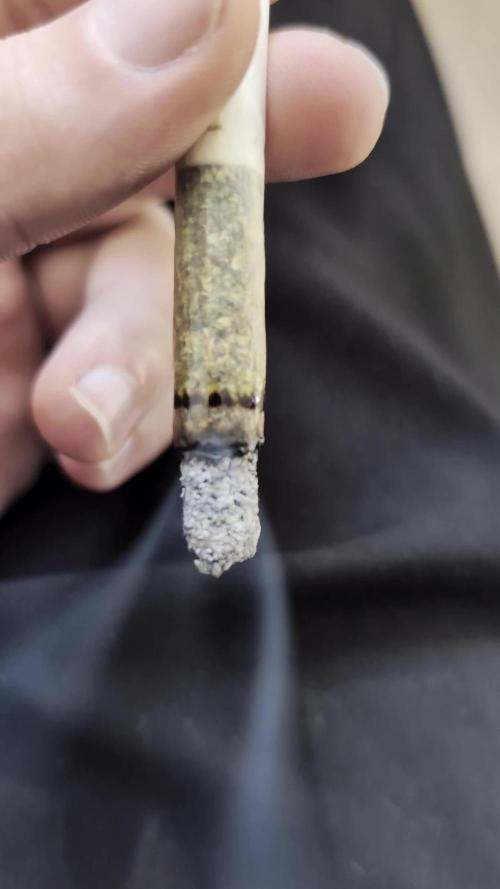
18 weeks from seed to harvest. Love 34 street seeds, quality genetics for a fair price. These garlic cookies showed no disease or pest issues, no mold or powdery mildew. Easy enough to grow, no surprises, no super stretch in flower, but I would recommend training or SCROG to control them. Pungent Pine is what I am callling this smell, over 800 grams wet weight. They are hanging to dry in my tent as I write this, 60 %RH and about 71 degrees of freedom units! Can’t wait to try it out 🇨🇦❤️🌱😎💨



Likes
81
Share


@UnorthadoxDude
Follow
Hey! Welcome to week 8! Karen is mid way through her flowering stretch. Please check back to last week as I update daily so the week is now complete. I count about 20 colas now.
Day 51: Have reconfigured the tent, see video. Karen is now 36cm and still stretching. Karen has more light now. Smell is still there hits you when you open the tent. Fertigated 2l.
Day 52: Height: 39cm. Karen's scent is heavenly. I have reconfigured again and installed some upgrades. Better reflector. Much bigger carbon filter. Increased airflow. Better config. More efficient pot layout. Karen is lovely.
I am grateful to her and for her, so I wrote her a little poem, I hope she liked it.
"Karen! Oh Karen! The phoenix of flowers,
Three lowly weeks she struggled in vain,
Shadowed and starved for five hundred hours,
He slowly wept to witness her pain.
Karen! Oh Karen! I P-H'd your showers,
and in the fourth week you started to gain,
Hallowed and hard you survived as you cowered,
I thought you meek, I was wrong once again.
Karen! Oh Karen! Forgave me my howlers.
She set a pace, a pace she maintained,
Now shes a girl at the peak of her powers,
And so I'm a geek, with buds on the brain."
Day 53: Approx 48h into a simulated dry spell.
Alright I think it is time for Karen to get her first MAJOR defoliation. I will update shortly with photos and info. I will also be doing some gentle LST to separate the colas a bit.
Day 53.5: Defoliation and LST. Finally got chance to photograph that bunda. Enjoy!
Day 53.75: Bit of a fail. Messed up the timer and the lights ended up being off for about 3 or 4 hours. Because I was cooling the room (open window) to keep temperature in the tent down, without any light the temperatures absolutely plummeted as it is sub-zero outside. By the time I realised and turned the lights on, the temp in the main tent had dropped to 14 degrees celsius. Whoops! How is that for mistreating your girl? Defoliated about 80% of her leaves, 4 nodes, significant LST, then stuck her in the cold and dark for 1/6 of a day. Not to mention she is now almost 3 days into a "dry spell". There do not seem to be ill effects, and Karen has already begun to respond to the LST; all the colas that had been changed in angle are now upright again.
The dry spell I keep mentioning, there is a method behind my madness, I have spotted one or two small flies and I think they may be fungus gnats. I am starting to suspect that the 2nd seedling in the Purple OG Punch Auto grow was actually beheaded by fungus gnat larvae. So I am drying out the mediums as much as I dare. I am closely monitoring the plants, so far the only one I have had to break the drought for is Enigma; all the girls in big pots haven't even noticed it's dry yet. How far am I going to push it? Well I will judge it on a plant by plant basis, but quite honestly I am hoping to see physical signs of thirst before I breakdrought. Of all the plants the two I think will respond most strongly to this will be Karen and Bertha, because of where they are. Karen here is actually probably 4 weeks into flowering rather than two, so about now is a good time to give her a little hydration stress. I do not think I will push it past 5 days, as RH is 34%. By now all the plants will be compensating for the lack of moisture and the high temperatures and low humidity. They will be taking more and more moisture out of the coco, and as the coco dries further and further down, those plants that have space will start desperately growing roots to find moisture. Mark my words, 24 hours after I end this drought, every plant in the tent will throw out crazy growth.
Day 54: Ended drought and fertigated 6l, no run off, I will re-fertigate tomorrow. Karen is still stretching her height post LST is now 37cm. The two tallest colas seem to have stopped but the other colas are still stretching.
Day 55: Alright so it has been 5 hours since lights on, and Karen is looking in good shape, all her drooping leaves have perked back up and she has added quite a bit of foliar growth. The colas are all still rising, except perhaps the two tallest. This girl is absolutely loaded with pistils, I'm starting to see trichomes on the sugar leaves, but trich production hasn't started in earnest yet. She has a least 20 colas, and 6 of them are thicker/taller than the primary cola at her tip. Every one of her nodes has reinforced itself with a bulbous growth and these cola branches are swelling rapidly. I am increasingly of the opinion that, all being well, this girl is going to surprise us all with her yield. My first grow, which was just mucking about really, I got 60-70g of the two main plants, and they were just bare sticks with 2 colas. Although her height is less than theirs was, 2/3 of their height was bare stick... whereas every mm of her is befoliaged and living. So in terms of the height of the actual cola I think they were about comparable in usable space on a per cola basis. The main difference being that Karen has 20+ colas whereas they had 2 primary and 2 lower. I know that it is probably unrealistic to expect more than 70g from a single auto grown indoors. Nevertheless my gut tells me this baby could achieve at least 100g, perhaps as much as 150g. The next few weeks will determine that, but given where we were in week 3 I will be grateful for any yield of quality bud. I have dropped the lights down to 18/6 from 'tonight' onwards.
I really have no idea how long we have left for Karen. According the the "brochure" she flowers for 7-8 weeks, with a total crop time of 9 weeks. The problem is I don't know what a total crop time is? Does that mean from seed to finish? If so Karen is clearly not going to be anywhere near that timescale.I am going to go ahead an assume that, for my plant anyway, the first 4 weeks were veg weeks. I think it is fair to count week 5 and 6 as flowering because pistils were popping out very early in week 5 if not before. So that makes this week four of flowering. I am going to assume 8 weeks rather than 7, so I think we have another 4 full weeks give or take a week. On that basis I am expect harvest week to be around week 12 or so. I am not fixed on this though, I am determined not to harvest this girl early.
Day 55: Photos taken 00:00 9/3/23 Strong 24h of veg growth as predicted.
Day 56: Existing leaves continue to swell. Stretch appears to be slowing. I've taken so many media this week that I cannot scroll down far enough to select a recent thumbnail. Probably Karen's biggest week in terms of changes. She is looking like she is going to impress. Height 39cm.

Likes
3
Share


@Rumyn88
Follow
Hey all, its our 2nd week after casing drop. Facing some issues with Night temp, sometimes it could fall to +12C, thinking about how to improve it. Also concerned about slow growth because of that. Using just 1/3 of Plagron recommended dose.
Modified a bit my tank, made some technical window. Also set up automatic irrigation, because wool started to dry up during the day
Upd Sunday 10.12.2023, Decided to put Babys finally to Seramis.
Washing ceramics is some kind of hell:
-First, I decided to sift all the dust through a sieve, stood in a half-bent position with bags of Seramis for 30m (my back didnt like it), but there was a lot of dust.
-then I decided to check the Ph and rinse thoroughly. Although the package says 5.5-5.7 Ph, after the first flush with a balanced solution at 5.5 Ph, there was 6.5 in the drainage.
- I was concerned by the very muddy brick colour water, then got tired of mixing 5.5 in a bucket for flushing and decided to rinse it with tap water from shower and then balance it back to 5.5 Ph . As a result, I poured from the hose for another 30 minutes until the water became more or less transparent.
-I also tested FloraFlex discs, they drip great and, although round, fit perfectly into my square grow bags.
-Meanwhile, the Milwaukee Ph meter broke down, even the readings of the calibration buffer were changing from 4-6 Ph within one minute. In the end, I spent another 30min and half a bottle of buffer on this too. It’s good that i had yellow Chinese Ph meter, which even after 3 years of rest in the box showed accurate buffer readings.
-Finally, the Ph of the drainage was 5.5-5.7 and it was transparent, so I began to move it into the growbox. I sprinkled it as much as I could, it was impossible to dig deeper. The plants do not yet reach the matrix disk, so for now they will grow with the usual felt.
-The cap of the tank is very thin and cannot withstand the weight of 2 grow bags, I’ll have to come up with something else, maybe I’ll put some kind of drainage grid.
Watering will be from a tank with a mixed solution of 5.8 Ph and 1.1 EC.