


Likes
Comments
Share


@BudgetGrows
Follow
So when seedstockers asked if I wanted to test some 3rd gen genetics I obviously obliged, now having grown a few of seedstockers beans previously I can certainly say I wasn't expecting this, I have topped, lollypopped, cut in half as they outgrew my space twice, super cropped, removed whole branches, double scrog - yes these are autos !!!
Thanks for stopping by 👍

Likes
2
Share


@Mr_nugs_lover_David
Follow
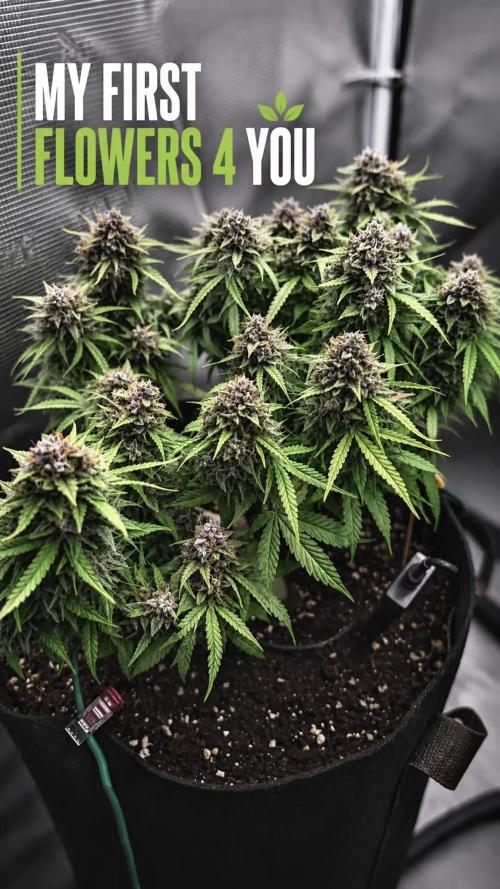
Her aroma it's just super cheesy,I love the autoflowers from this seedbank they have amazing and original aromas and flavors,she's not gonna ve very productive however I love how she smell it's gonna be a pleasure to taste.



Likes
1
Share


@BearBuds
Follow
These girls are really starting to go nuts! We have come to the end of week 5 and they are already starting to pack on the bulk. I had a little issue with nute burn earlier in the week. I think it was because I was allowing them to dry out to much. I backed it down from 975 PPM to 700 PPM for 4 days and now I am back up to 800 again and they seem to be happy. I also think that my light is just a few inches to close. Its at about 16 right now and the leaves at the top are just not looking their best. It's a 340W light so backing it up a few inches shouldn't be to big of a deal. I moved it back to 20 inches from the canopy. Hoping this helps a little. The humidity here has been absolutely WILD! Tent fluctuates between 55% and 65% and I can't make it budge without the dehumidifier which raises the temp way to high. Outside the humidity hasn't dipped below 70% in over a week. Very strange, hoping that I can keep the room clean and keep enough air moving through the tent to avoid bud rot. FINGERS CROSSED

Likes
13
Share


@Flowers_By_Irene
Follow
Partially drained the tank at the start of the week and topped up with ro water and 1ml of final solution per Litre. Last 2.5 days were in darkness.
I trimmed the majority of fan leaves before hanging up to dry in the tent today. Started out trimming with the plants in the tent and soon realised it would be much easier to just cut them down whole, hang them upside down outside the tent and trim them up a bit.
I have a small dehumidifier and a small fan heater setup in the tent and they have been keeping a humidity level of about 60% and a temp of 16 Celsius for the last few days while the lights have been off. I figure that's a good starting point for drying and I can increase the temperature if needed, that will drop the humidity also.
Intake fan at the bottom and extract fan at the top are running constantly as they have been since the grow started (low power 4" fans).
I might add back in a fan for circulation depending on how the drying goes, or maybe even trim or hang the plants better to get more airflow around the buds


Likes
18
Share


@Wakesk8
Follow
9 week flowering..Runtz Auto is almost ready and it’s beautiful!
Balance plants are going well


Likes
21
Share


@MG2009
Follow
02/26/2022
Just enoying the smell, pollination was successful!
On #6 seeds forming nicely 🙏🏻
Also some weird stretching I'm top buds from accidentally leaving light's on a couple days. But should be good. looks like my efforts to pollinate one branch didn't do so well plenty of seeds to grow out now lower buds look clean of pollen no sign of pollination.
Should start adding weight in next two weeks.
Processing
Likes
30
Share


@Growgirl1114
Follow
Week 2 , I'm seeing amazing new growth everyday. Love my @marshydro TS-600 . I’m learning new stuff everyday about growing indoors and I love all the feedback and positive comments from my fellow grow diary peeps. I am looking forward to the next 8 weeks of my first indoor grow. ✌️#growwhereyouareplnted #growerschoiceseeds #marshydro

Likes
226
Share


@JUNGLE_B4RNS
Follow
Hey folks ! Back with some Royal Queen Seeds genetics, lets blow out all their potential and make some monsters plants 😉
The plan is 12 plants of 1 square meter all in personal ScrOG to harvest 12 squares meter.
Light:
2 x Adjust-A-Wings Avenger
1 x 600w SuperPlant Super Red 85000 Lumens 2000K 1498nm
1 x 600w HPS Philips Son-t Green Power 95000 Lumens
Soil:
Platinium Royal Mix Premium Quality Oxygen+
with NPK 8-9-12
Nutrients:
-SensistarBloom, 4 in 1 concentrated gel made under nanotechnology,
NPK (5-12-15) + Cal Mag (2-2.5) + Oligos.
-Superboost PK, P-K (5-20) S (14) perfect combination of concentrated phosphorous and potassium, which contains molasses, carbohydrates, and amino acids from the sugar cane extraction. + growth regulators, vitamins and natural plant hormones.
- Diamond Sugar (3%K, 1%Mg, 4%S), active photosynthesis and promotes the formation of carbohydrates, proteins and their translocation to the fruit.
-Canna Mono Mag, essential for photosynthesis.
-Cellmax SuperEnzyme, improves the absorption of nutrients.
- Cellmax BioLush, P-K (10-12)
[Day 106]
Maintaining RH around 40% to avoid any mold in the buds.
- Water pH 6.5 (Cellmax pH- Bloom) + SuperEnzyme 1ml/1l + Diamond Sugar 1ml/1l + Super Boost PK 1ml/1l + SensistarBloom 1ml/1l Total ppm: 1000ppm
Bubble Kush 1
[Day 108]
- Water pH 6.5 (Cellmax pH- Bloom)
Royal Cookies
Candy Kush 1 , 2
Drain :
Royal Cookies : 980ppm
Candy Kush 1: 980ppm
Candy Kush 2: 820ppm
- Water pH 6.5 (Cellmax pH- Bloom) + SuperEnzyme 1ml/1l + Diamond Sugar 1ml/1l + Super Boost PK 1ml/1l + SensistarBloom 1ml/1l Total ppm: 1000ppm
Royal Gorilla 1 , 2
[Day 109]
- Water pH 6.5 (Cellmax pH- Bloom)
Bubblegum 1 , 2
Fruit Spirit 1 , 2
Bubble Kush 1 , 2
Drain :
BBK 1: 1020ppm
Fruit Spirit 1: 1070ppm
BBG 2: 1000ppm
BBG 1: 830ppm
Fruit Spirit 2: 800ppm
BBK 2: 980ppm
[Day112]
- Water pH 6.5 (Cellmax pH- Bloom) + SuperEnzyme 1ml/1l + Diamond Sugar 1ml/1l + Super Boost PK 1ml/1l + SensistarBloom 1ml/1l Total ppm: 1000ppm
Candy Kush 1 , 2
Royal Cookies
- Water pH 6.5 (Cellmax pH- Bloom)
Bubble Kush 1
Drain : 910ppm
Likes
52
Share


@Rangaku
Follow
Pulled the second cherry Cola today and it looks and smells just like heaven , some nice pinks , purples and greens . Plants look to be around 12 oz together but we’ll see how they dry .

Processing
Likes
21
Share


@420cfm
Follow
Wow. They are very crystallized now. Buds are fattening up every day. Lots of orange hairs and milky trichromes. Plan to go to 8 weeks if I can and flush week nine. Will see how they go but so far so good.


Likes
2
Share


@Kirsten
Follow
15.5.25:
It's been 48 hours after planting, and we have 2 extraordinarily identical seedlings! 🌱🌱
This time germinating, I did not use the humidity domes or spay the leaves.
I adjusted the dehumidifier to around 50% RH.
TEMP: 26°C.
Soil PH: 7.0
Soil temp: 20°C
Water PH: 6.0
Water about 20mls 3x a day.
I used plain, dechlorinated water PH'd to 6.0.
I'm very excited to see how we go! 🌱🤞💚✌️🍃😊
18.5.25:
The seedling 🌱 is looking nice and strong.
Yesterday, I started watering around the perimeter of the pot to help the ecosystem of the soil get started.
I'm watering with plain, dechlorinated, PH'd water.
PPM: 545
PH: 6.0-6.5
The F1 Hybrid experiment has thus far produced identical results.
The experiment compares two different styles of growing;
one using Organic Dry Amendments the whole way through seed to harvest.
The other plant, seed to harvest, will be receiving Liquid Nutrients.
Thanks for following along on this grow 😊💚👌🍃✌️🌱


Likes
3
Share


@Unculti_responsable
Follow
Unos días antes de mandar a flora hiciamos las últimas podas de bajos y apicales la dejamos recuperarse unos días y hicimos el último trasplante a 10 litros , con eso ya listo empezamos con los nutrientes de preflora , hicimos unos riegos foliares 15 días antes de mandar a flora , el mismo día q mandamos a flora y lo tenemos que hacer 15 días después de mandar a flora , con esto ya estamos más que bien para las primeras semanas de floración después de la segunda semana vamos a empezar a fertilizar con guano de murciélago y unas cucharaditas de melaza , después ya con el engorde , pero para eso faltan unas semanas , ahora vamos a ir viendo como le va en sus primeras semanas de floración
Likes
2
Share


@Happygrowing
Follow
Ciao a tutti...sono stato assente sulla piattaforma per un po...ma ora sono ritornato pii forte di prima...
Volevo dirvi che per questo ciclo userò un soil organico italiano al 100% come me 😜

Likes
Comments
Share


@Fiz420
Follow
I hate to even think about this but I took in a clone soulfire FX3 and my world ended Spider mites and Aphids! Three days after I got it in the veg room they found my flowering room and man they where just moving crystals to the end of leaves and covered them in webbs ; ; All soil infected and I did not want to rehab so I reset everything killed them all and 2 weeks of cleaning with different stuff I wont say because my state is crazy with laws for chem's that work but have to use a mask strong :) I did not want to post till I was sure those things where long gone and not sure if I will do a clone again anytime soon and I am not going to bash the dealer but man HendRX and Primecuts need to deal direct to us little guys.
Week 3 just wanted to show bud size and zero burnt tips this run is simple with no pga's just Gaia Greens and House and Garden with Tea's No bugs is my endgame after last run.

Likes
7
Share


@Madman2020
Follow
(39 day VEG)(56 day flower)(107 day clone to harvest)
Co2@800 Made a huge difference
70klux is to high lighting. 60-65 was best
87f+ leaf temp is to high in flower - 80did well
Hot temps made the leaves ugly
Auto irrigation went wrong because the water pressure was not even on all 11 spouts.
Two box fans were not enough. It seems more wind make denser buds
The plants closer to the fans were denser
The Liquid humic acid i think made a small difference.
That “Grow More Liquid kelp” exploded growths during veg stage
The southern AG microbes did well to keep my roots healthy(once a week)
I should have topped the clones at the 3rd node so itd be easier to harvest
I lollipopped plants day 1 flower, day 21 flower, and start of week5.
I defoliated before flower, day 14 flower, wk7 flower, and 2 days before harvest
I want to defoliate the week before harvest and flush 5days before harvest
————————
Harvest
Wet Trimmed
First 3 days 55%RH then 52-60% for 17 days. Ill split branches to speed drying next time
Temp 68F
Indirect Fans
After Drying:
Homemade tumbler/trimmer
Pvc pipe inserted into a barrel made from chicken wire and bucket lids tacked together. Sits inside of a tote bucket. The tote bucket holds the trimmings and kief that falls from buds
Put into mason jars
——-
Weight:
1: 71g
2: 48g
3: 78g
4:41g
5:56g

Likes
27
Share


@GrowInger420
Follow
This week was very good plants look great. Flews are gone🙏 ✌️✌️
Buds grow perfect. I am very surprised, that they go so good. Hope they will stay healthy till the end.


Likes
4
Share

@stadtgaertner
Follow
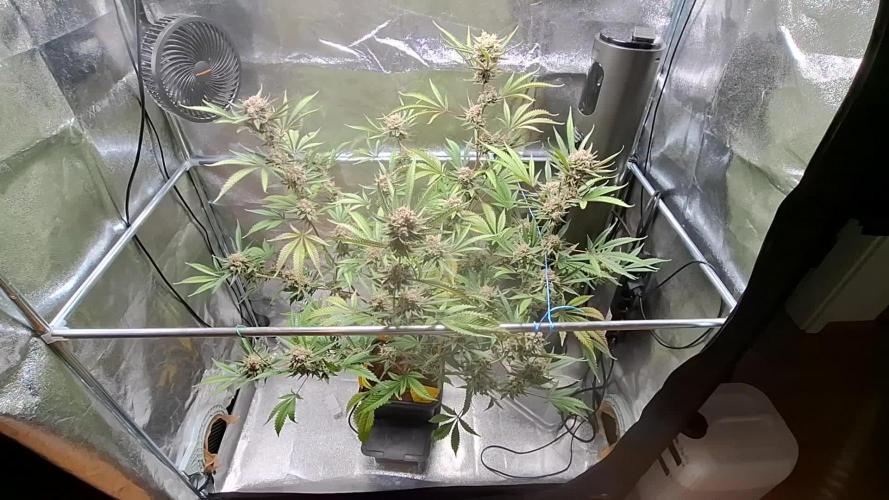
At the beginning of week 7 of flower she started to fade. Her leafs started to get dark purple starting at the bottom. At the end of week 7 of flower there were first signs of amber trichomes on the top buds. I will wait until the lower buds are mostly cloudy before harvesting.


