



@Dictator
Follow
New Plant New Adventure, let’s see together what kind of girl Amirani Auto will be 💚🌱


@Bakeryguy420
Follow
Here we are guys in the middle of week 4 for some and week 3 for the rest!! Alot of them are going into pre flowering. All 12 confirmed females:) amazing rapid growth they are loving these autocobs:). All smiles everyday gg4 and tangie are stretching so amazing. Lights 24/7 in less then two weeks they will all being going into a 4x8 !

Glueberry Auto · Expert Seeds
Gorrila Glue #4 Auto (Expert Gorilla Auto) · Expert Seeds

Tangie Auto · Fast Buds
Sweet Cream Auto · Expert Seeds

Amnesia Haze Auto · Vision Seeds

Amnesia Gold · Pyramid Seeds
OGesus Auto · Expert Seeds

Royal Haze Automatic · Royal Queen Seeds

Caramella Auto · Custom Breeder & Strain
Rhino Ryder Auto · Fast Buds

Fugue State · Mephisto Genetics


@Ultraviolet
Follow
In addition to improving the chemical composition of plants, UV light also accelerates the germination process for seeds and helps prepare plants for higher light intensities. It acts as a natural stimulant for seeds, encouraging quicker sprouting and robust initial growth. Photosynthesis, as we all know, is the process where plants use sunlight, water, and carbon dioxide to create their own food. But here’s a little twist – UV light has been found to enhance this process. When plants are exposed to UV light, their chloroplasts (the tiny structures inside plant cells where photosynthesis occurs) work even more efficiently. This means they can produce more food for themselves! UV light triggers a response in plants by activating specific proteins and enzymes that optimize their photosynthetic processes. This translates into increased growth rates, improved nutrient absorption, and enhanced overall health. It’s like giving the plants a little extra boost to reach their full potential. For instance, when certain flowers are exposed to controlled amounts of UV light, they produce deeper and richer colors. Think of it as a form of “sun-kissed” enhancement! This deepening of color isn’t just about aesthetics; it also indicates improved biochemical processes within the plants.When plants are exposed to UVB light, it is now known something incredible happens—they begin producing vitamin D3 at an accelerated rate. UVB light exposure can lead to an increase in the production of vitamin D3 in plants. The optimal wavelength range for stimulating vitamin D3 synthesis in plants is around 290nm-310nm. Vitamin D3 is produced by UVB exposure of 7-dehydrocholesterol (provitamin D3) in the skin. The conversion to the pre-vitamin D happens by exposure to sunlight at 290–315 nm (UVB). Vitamin D3 is synthesized in the skin upon UVB exposure 290-315nm. The UVB exposure of provitamin D3 (7-dehydrocholesterol) in the skin breaks the B-ring to form previtamin D3, which undergoes thermally induced rearrangement to vitamin D3. Vitamin D3 is transported to the liver where it is hydroxylated at C-25 by the enzyme 25-hydroxylase producing 25OHD3, which is the major circulating form in vertebrates. The 25OHD3 is hydroxylated a second time at C-1 in the kidneys to the active metabolite. Magnesium is used in large quantities for the enzymatic process, which enables the plant to process vitamin D3. Increase magnesium accordingly.


@Ultraviolet
Follow
ANTHOCYANIN production is primarily controlled by the Cryptochrome (CR1) Photoreceptor ( !! UV and Blue Spectrums are primary drivers in the production of the pigment that replaces chlorophyll, isn't that awesome!
1. Diverse photoreceptors in plants
Many civilizations, including the sun god of ancient Egypt, thought that the blessings of sunlight were the source of life. In fact, the survival of all life, including humans, is supported by the photosynthesis of plants that capture solar energy. Plants that perform photosynthesis have no means of transportation except for some algae. Therefore, it is necessary to monitor various changes in the external environment and respond appropriately to the place to survive. Among various environmental information, light is especially important information for plants that perform photosynthesis.
In the process of evolution, plants acquired phytochrome, which mainly receives light in the red light region, and multiple blue light receptors, including his hytropin and phototropin, in order to sense the light environment. .. In addition to these, an ultraviolet light receptor named UVR8 was recently discovered. The latest image of the molecular structure and function of these various plant photoreceptors (Fig. 1), focusing on phytochrome and phototropin.
Figure 1
Ultraviolet-visible absorption spectra of phytochrome, cryptochrome, phototropin, and UVR8. The dashed line represents each bioactive absorption spectrum.
2. Phytochrome; red-far red photoreversible molecular switch
What is phytochrome?
Phytochrome is a photochromic photoreceptor, and has two absorption types, a red light absorption type Pr (absorption maximum wavelength of about 665 nm) and a far-red light absorption type Pfr (730 nm). Reversible light conversion between the two by red light and far-red light, respectively(Fig. 1A, solid line and broken line). In general, Pfr is the active form that causes a physiological response. With some exceptions, phytochrome can be said to function as a photoreversible molecular switch. The background of the discovery is as follows. There are some types of plants that require light for germination (light seed germination). From that study, it was found that germination was induced by red light, the effect was inhibited by subsequent far-red light irradiation, and this could be repeated, and the existence of photoreceptors that reversibly photoconvert was predicted. In 1959, its existence was confirmed by the absorption spectrum measurement of the yellow sprout tissue, and it was named phytochrome. Why does the plant have a sensor to distinguish between such red light and far-red light? There is no big difference between the red and far-red light regions in the open-field spectrum of sunlight, but the proportion of red light is greatly reduced due to the absorption of chloroplasts in the shade of plants. Similar changes in light quality occur in the evening sunlight. Plants perceive this difference in light quality as the ratio of Pr and Pfr, recognize the light environment, and respond to it.
Subsequent studies have revealed that it is responsible for various photomorphogenic reactions such as photoperiodic flowering induction, shade repellent, and deyellowing (greening). Furthermore, with the introduction of the model plant Arabidopsis thaliana (At) and the development of molecular biological analysis methods, research has progressed dramatically, and his five types of phytochromes (phyA-E) are present in Arabidopsis thaliana. all right. With the progress of the genome project, Fi’s tochrome-like photoreceptors were found in cyanobacteria, a photosynthetic prokaryotes other than plants. Furthermore, in non-photosynthetic bacteria, a homologue molecule called bacteriophytochrome photoreceptor (BphP) was found in Pseudomonas aeruginosa (Pa) and radiation-resistant bacteria (Deinococcus radiodurans, Dr).
Domain structure of phytochrome molecule
Phytochrome molecule can be roughly divided into N-terminal side and C-terminal side region. PAS (Per / Arndt / Sim: blue), GAF (cGMP phosphodiesterase / adenylyl cyclase / FhlA: green), PHY (phyto-chrome: purple) 3 in the N-terminal region of plant phytochrome (Fig. 2A) There are two domains and an N-terminal extension region (NTE: dark blue), and phytochromobilin (PΦB), which is one of the ring-opening tetrapyrroles, is thioether-bonded to the system stored in GAF as a chromophore. ing. PAS is a domain involved in the interaction between signal transduction-related proteins, and PHY is a phytochrome-specific domain. There are two PASs and her histidine kinase-related (HKR) domain (red) in the C-terminal region, but the histidine essential for kinase activity is not conserved.
3. Phototropin; photosynthetic efficiency optimized blue light receptor
What is phototropin?
Charles Darwin, who is famous for his theory of evolution, wrote in his book “The power of move-ment in plants” published in 1882 that plants bend toward blue light. Approximately 100 years later, the protein nph1 (nonphoto-tropic hypocotyl 1) encoded by one of the causative genes of Arabidopsis mutants causing phototropic abnormalities was identified as a blue photoreceptor. Later, another isotype npl1 was found and renamed phototropin 1 (phot1) and 2 (phot2), respectively. In addition to phototropism, phototropin is damaged by chloroplast photolocalization (chloroplasts move through the epidermal cells of the leaves and gather on the cell surface under appropriate light intensity for photosynthesis. As a photoreceptor for reactions such as escaping to the side of cells under dangerous strong light) and stomata (reactions that open stomata to optimize the uptake of carbon dioxide, which is the rate-determining process of photosynthetic reactions). It became clear that it worked. In this way, phototropin can be said to be a blue light receptor responsible for optimizing photosynthetic efficiency.
Domain structure and LOV photoreaction of phototropin molecule
Phototropin molecule has two photoreceptive domains (LOV1 and LOV2) called LOV (Light-Oxygen-Voltage sensing) on the N-terminal side, and serine / on the C-terminal side. It is a protein kinase that forms threonine kinase (STK) (Fig. 4Aa) and whose activity is regulated by light. LOV is one molecule as a chromophore, he binds FMN (flavin mononucleotide) non-covalently. The LOV forms an α/βfold, and the FMN is located on a β-sheet consisting of five antiparallel β-strands (Fig. 4B). The FMN in the ground state LOV shows the absorption spectrum of a typical oxidized flavin protein with a triplet oscillation structure and an absorption maximum wavelength of 450 nm, and is called D450 (Fig. 1C and Fig. 4E). After being excited to the singlet excited state by blue light, the FMN shifts to the triplet excited state (L660t *) due to intersystem crossing, and then the C4 (Fig. 4C) of the isoaroxazine ring of the FMN is conserved in the vicinity. It forms a transient accretionary prism with the tain (red part in Fig. 4B Eα) (S390I). When this cysteine is replaced with alanine (C / A substitution), the addition reaction does not occur. The effect of adduct formation propagates to the protein moiety, causing kinase activation (S390II). After that, the formed cysteine-flavin adduct spontaneously dissociates and returns to the original D450 (Fig. 4E, dark regression reaction).
Phototropin kinase activity control mechanism by LOV2
Why does phototropin have two LOVs? Atphot1 was found as a protein that is rapidly autophosphorylated when irradiated with blue light.
The effect of the above C / A substitution on this self-phosphorylation reaction and phototropism was investigated, and LOV2 is the main photomolecular switch in both self-phosphorylation and phototropism. It turns out that it functions as. After that, from experiments using artificial substrates, STK has a constitutive activity, LOV2 functions as an inhibitory domain of this activity, and the inhibition is eliminated by photoreaction, while LOV1 is kinase light. It was shown to modify the photosensitivity of the activation reaction. In addition to this, LOV1 was found to act as a dimerization site from the crystal structure and his SAXS. What kind of molecular mechanism does LOV2 use to photoregulate kinase activity? The following two modules play important roles in this intramolecular signal transduction.
Figure 4
(A) Domain structure of LOV photoreceptors. a: Phototropin b: Neochrome c: FKF1 family protein d: Aureochrome (B) Crystal structure of auto barley phot1 LOV2. (C) Structure of FMN isoaroxazine ring. (D) Schematic diagram of the functional domain and module of Arabidopsis thaliana phot1. L, A’α, and Jα represent linker, A’α helix, and Jα helix, respectively. (E) LOV photoreaction. (F) Molecular structure model (mesh) of the LOV2-STK sample (black line) containing A’α of phot2 obtained based on SAXS under dark (top) and under bright (bottom). The yellow, red, and green space-filled models represent the crystal structures of LOV2-Jα, protein kinase A N-lobe, and C-robe, respectively, and black represents FMN. See the text for details.
1) Jα. LOV2 C of oat phot1-to α immediately after the terminus
Rix (Jα) is present (Fig. 4D), which interacts with the β-sheet (Fig. 4B) that forms the FMN-bound scaffold of LOV2 in the dark, but unfolds and dissociates from the β-sheet with photoreaction. It was shown by NMR that it does. According to the crystal structure of LOV2-Jα, this Jα is located on the back surface of the β sheet and mainly has a hydrophobic interaction. The formation of S390II causes twisting of the isoaroxazine ring and protonation of N5 (Fig. 4C).
As a result, the glutamine side chain present on his Iβ strand (Fig. 4B) in the β-sheet rotates to form a hydrogen bond with this protonated N5. Jα interacts with this his Iβ strand, and these changes are thought to cause the unfold-ing of Jα and dissociation from the β-sheet described above. Experiments such as amino acid substitution of Iβ strands revealed that kinases exhibit constitutive activity when this interaction is eliminated, and that Jα plays an important role in photoactivation of kinases.
2) A’α / Aβ gap.
Recently, several results have been reported showing the involvement of amino acids near the A’α helix (Fig. 4D) located upstream of the N-terminal of LOV2 in kinase photoactivation. Therefore, he investigated the role of this A’α and its neighboring amino acids in kinase photoactivation, photoreaction, and Jα structural change for Atphot1. The LOV2-STK polypeptide (Fig. 4D, underlined in black) was used as a photocontrollable kinase for kinase activity analysis. As a result, it was found that the photoactivation of the kinase was abolished when amino acid substitution was introduced into the A’α / Aβ gap between A’α and Aβ of the LOV2 core. Interestingly, he had no effect on the structural changes in Jα examined on the peptide map due to the photoreaction of LOV2 or trypsin degradation. Therefore, the A’α / Aβ gap is considered to play an important role in intramolecular signal transduction after Jα.
Structural changes detected by SAXS
Structural changes of Jα have been detected by various biophysical methods other than NMR, but structural information on samples including up to STK is reported only by his results to his SAXS. Not. The SAXS measurement of the Atphot2 LOV2-STK polypeptide showed that the radius of inertia increased from 32.4 Å to 34.8 Å, and the molecular model (Fig. 4F) obtained by the ab initio modeling software GASBOR is that of LOV2 and STK. It was shown that the N lobes and C lobes lined up in tandem, and the relative position of LOV2 with respect to STK shifted by about 13 Å under light irradiation. The difference in the molecular model between the two is considered to reflect the structural changes that occur in the Jα and A’α / Aβ gaps mentioned above.
Two phototropins with different photosensitivity
In the phototropic reaction of Arabidopsis Arabidopsis, Arabidopsis responds to a very wide range of light intensities from 10–4 to 102 μmol photon / sec / m2. At that time, phot1 functions as an optical sensor in a wide range from low light to strong light, while phot2 reacts with light stronger than 1 μmol photon / sec / m2. What is the origin of these differences? As is well known, animal photoreceptors have a high photosensitivity due to the abundance of rhodopsin and the presence of biochemical amplification mechanisms. The exact abundance of phot1 and phot2 in vivo is unknown, but interesting results have been obtained in terms of amplification.
The light intensity dependence of the photoactivation of the LOV2-STK polypeptide used in the above kinase analysis was investigated.
It was found that phot1 was about 10 times more photosensitive than phot2. On the other hand, when the photochemical reactions of both were examined, it was found that the rate of the dark return reaction of phot1 was about 10 times slower than that of phot2. This result indicates that the longer the lifetime of S390II, which is in the kinase-activated state, the higher the photosensitivity of kinase activation. This correlation was further confirmed by extending the lifespan of her S390II with amino acid substitutions. This alone cannot explain the widespread differences in photosensitivity between phot1 and phot2, but it may explain some of them. Furthermore, it is necessary to investigate in detail protein modifications such as phosphorylation and the effects of phot interacting factors on photosensitivity.
Other LOV photoreceptors Among fern plants and green algae, phytochrome ɾphotosensory module (PSM) on the N-terminal side and chimera photoreceptor with full-length phototropin on the C-terminal side, neochrome (Fig. There are types with 4Ab). It has been reported that some neochromes play a role in chloroplast photolocalization as a red light receiver. It is considered that fern plants have such a chimera photoreceptor in order to survive in a habitat such as undergrowth in a jungle where only red light reaches.
In addition to this, plants have only one LOV domain, and three proteins involved in the degradation of photomorphogenesis-related proteins, FKF1 (Flavin-binding, Kelch repeat, F-box 1, ZTL (ZEITLUPE)), LKP2 ( There are LOV Kelch Protein2) (Fig. 4Ac) and aureochrome (Fig. 4Ad), which has a bZip domain on the N-terminal side of LOV and functions as a gene transcription factor.
4. Cryptochrome and UVR8
Cryptochrome is one of the blue photoreceptors and forms a superfamily with the DNA photoreceptor photolyase. It has FAD (flavin adenine dinucle-otide) as a chromophore and tetrahydrofolic acid, which is a condensing pigment. The ground state of FAD is considered to be the oxidized type, and the radical type (broken line in Fig. 1B) generated by blue light irradiation is considered to be the signaling state. The radical type also absorbs in the green to orange light region, and may widen the wavelength region of the plant morphogenesis reaction spectrum. Cryptochrome uses blue light to control physiological functions similar to phytochrome.
It was identified as a photoreceptor from one of the causative genes of UVR8 Arabidopsis thaliana, and the chromophore is absorbed in the UVB region by a Trp triad consisting of three tryptophans (Fig. 1D). It is involved in the biosynthesis of flavonoids and anthocyanins that function as UV scavengers in plants.
Conclusion
It is thought that plants have acquired various photoreceptors necessary for their survival during a long evolutionary process. The photoreceptors that cover the existing far-red light to UVB mentioned here are considered to be some of them. More and more diverse photoreceptor genes are conserved in cyanobacteria and marine plankton. By examining these, it is thought that the understanding of plant photoreceptors will be further deepened.


@Ju_Bps
Follow
Hello my friends 👩🌾👨🌾,
This 5th flowering week was good, Buds continue to grow well 🌲, Buds bump and continue to along.
I just spray an insecticide in the box, not really on the plants, because lot of flyers.... Since look a bit better.
💦 1 Watering this week 1.8l/plant .
Water + Terra Flores + Canna Boost + pk 13-14
PH@6
Lamp @100%
Bisous 💋😘, and see you next week.
Thanks community for follow, likes, comments, always a pleasure 👩🌾👨🌾❤️🌲
Mars Hydro - TS 1000
https://www.mars-hydro.com/ts-1000-led-grow-light
Mars Hydro - FC3000
https://www.mars-hydro.com/fc-3000-samsung-lm301b-led-grow-light
Mars Hydro - SP3000
https://www.mars-hydro.com/sp-3000-samsung-lm301b-greenhouse-led-grow-light
The High Chameleon - Bisous Au THC 💋💋🌲🌲😘😘
https://www.thehighchameleon.com/shop/bisous-au-thc-83


@Cultivators_Dream
Follow
Day 42: Starting off Week 6 and this lady is doing awesome. I am however finding discoloration on fan leaves and I am thinking it came from the SledgeHammer flush I did. But going into the 2nd week of flower I truly couldn't be happier with the progress. She is growing well enough you can see the changes daily.. Truly an awesome strain 😎..
12/28 More and more stacking each day.. this lady is really swelling up and she has such beautiful thick white hairs coming out right now just looking super healthy.. Finally got some of that Recharge powder 🙌 gonna start that on next watering and see how she takes to that. Will update again soon but until then stay lit growmies


@Jahasus_Group
Follow
Used royal queen seed fems popped 4 and 3 where successfully. Through veg stage no problems quite sturdy plants growth rate was the same on all round, had abit of nitrogen deficiency.
Flower stage everything changed plants started to grow at different weeks and need separate feeds which became annoying, think this was done to pheno types being different.
Drying stage: I used this new herb dryer called wedryer for to plants and hung the other in the tent.
Wedryer works if you have small yield as can’t fit a lot, drys within a week though but also looses flavour. Have to wet trim bud and then leaves bud flat in one side due to them sitting on the dryer netting. Has fan with carbon filter which stops smells. (But myself prefer hang drying).
Used trimbag to finish the buds off love this product and recommend to others to buy.


@Chubbs
Follow
420Fastbuds
FBT2314/Week2
Weekly update for these 2. I started seeing some rust spots so I decided to add a little General Hydroponics Calimagic at 0.25tsp/gal to my feed. So far seems to stop. I also decided to start a very light dose of nutes General Hydroponics 3 part flora series at the same 0.25tsp/gal to every other feed to see how they'll respond. All in all Happy Growing.


@GemansGoGreen
Follow
WEEK 4:
The plants are now in the third week of the growth phase. I topped all three plants on the main stem and cut off the 4 largest top leaves so that the side shoots have more light available.
Plant #1 is clearly the smallest and is not as developed as the other two. Since I only want to take two plants into the flowering phase, I tend to sort them out.
Plant #2 looks the most vital and has already developed a noticeable smell.
Plant #3 still has a strange leaf shape, although I have the impression that this has improved slightly
The plants in 6L pots and added 5% FLO (Living Soil Fertilizer). I let the soil develop for 14 days beforehand. Clear mycelia have formed and the soil has a very pleasant forest floor smell.
- Light Power: 40%
- Soil: BioBizz Light Mix + 5% FLO (Living Soil Fertilizer)
- Additives: Dynomyco mycorrhiza granules


@Mopish
Follow
17 Jan - 23 Jan
19 Jan
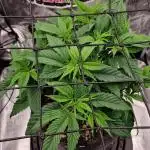
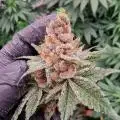
Kush del Arriero: Looking good in color and size, planning to flush next week, hope those possible nanners don't develop enough, not removing due to harvest time being so close and this one being the one that will probably give me the best yield. Some buds and leaves getting purple colors.
Choco Cookie: Still very small, hope they grow a little more before harvest. Some buds and leaves getting purple colors.
Banana Cake: Small buds, decent trichomes.
I hope that KDA won't cause much trouble to the other two plants, I hope I'm wrong about the nanners... Keeping my plans, finish with nutrients this Sunday and flushing for 7-14 days after that.
I'll add a few more pics later today.
Sat 22
Yesterday a friend with more experience in these things took a look at my plants, he seemed impressed by what I've accomplished on my first grow so far. He also confirmed that the weird things on the KDA buds aren't nanners... phew !
He also confirmed my plans for flushing tomorrow are good.
@kevxyn
Follow
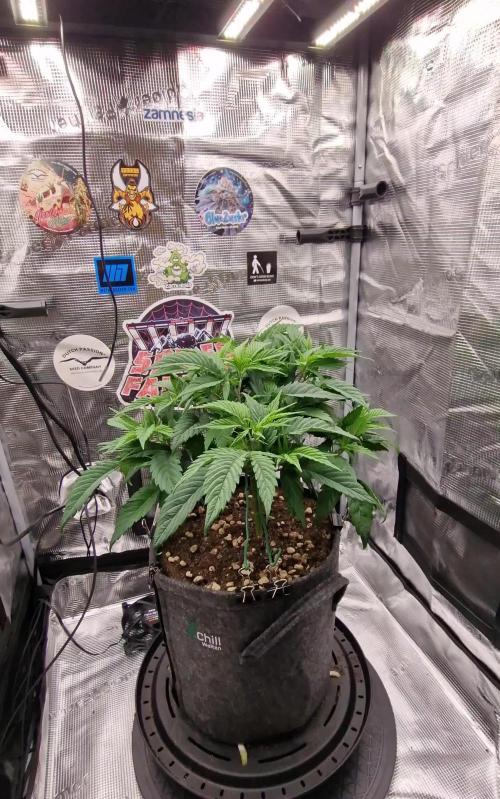
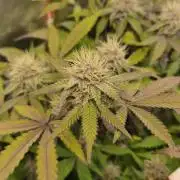
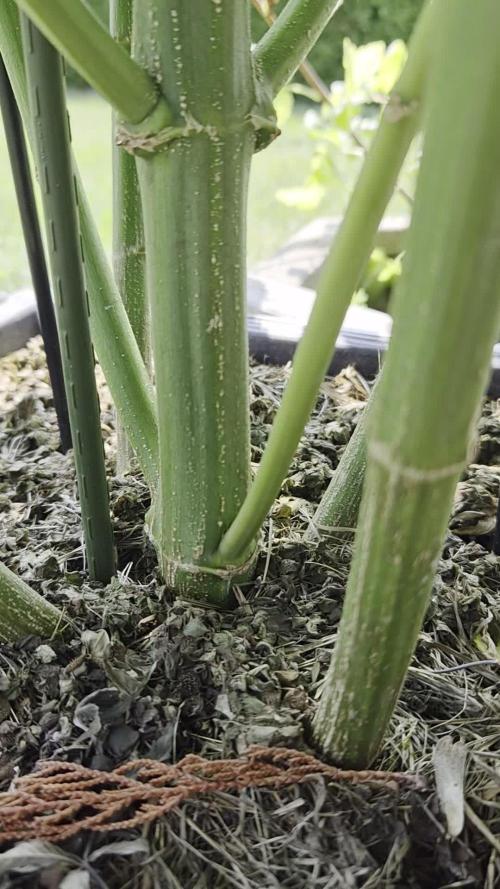
Sie wächst 😁
Die Drähte hab ich auch noch mal angezogen damit sie schön in die Breite geht. Jetzt bin ich am überlegen ob ich mir noch ein Netzt spanne. Aber da hab ich mich noch nicht entschieden mal sehen.
Hab mich jetzt doch für das Netz entschieden 😄

@NoProbation4Weed
Follow
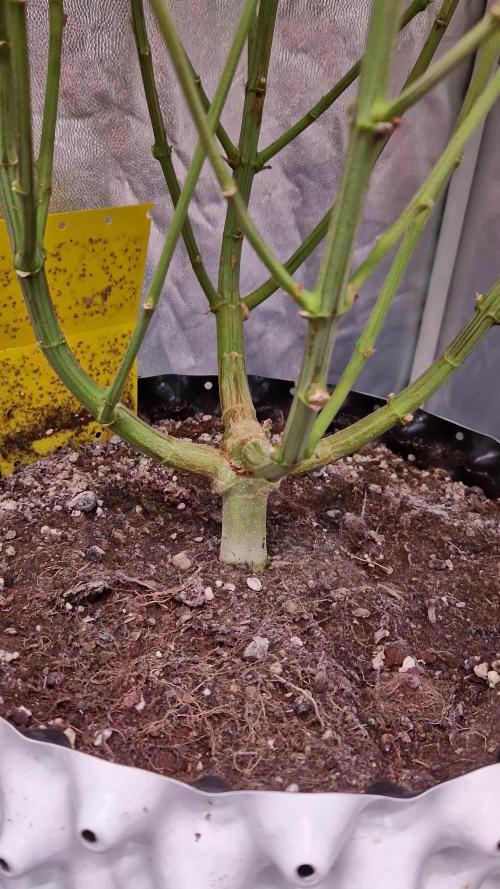
both plant are looking healthy. Its day 28 since flip to 12/12 light circle for the indoor plant. the outdoor plant shows some pre flowers and grows massive. Both got a little defoliation to provide some airflow in between the stems. The indoor Slushberry already gives some strong smell super fruity.

@TrickzCutz
Follow
Die Buds sind schön fest geworden und ich finde der Pheno sieht auch wunderschön aus. Die rote Färbung sieht auch mega gut aus!


shorts_status_processing


@kevgrow
Follow
Hey Growers, end of week 2 from seed
- Plant #2 since the start has been giving me minor problems. Ever since yellow spots began to come out on some of the leaves I've been trying to figure out what’s the issue. I was feeding only water at a PH of 6.35, PPM 34, light lux 75 x100. I decided to drop the PH to 6.0. Its been a slow recovery but the Yellow spots began to turn green again day by day. Its still not 100% but its looking much better than before.
- Growth slowed down a bit, maybe its due to the yellowing in the leaves


@Dreadnug
Follow
Added a top layer of soil with added nutes so that only needed to water normally and let the top mix do the work down below. Will mix in more compost tea every other day and towards the end of the week, hit it with my normal organic nutes mix.
The plant is looking healthy and continues to flower out and each cola is starting to thicken nicely. I have a few leaves here and there showing some discoloration so will watch closely to ensure I don’t have a light or nute issue.
Will move the light intensity to 80% on the LED panels after this next week and as long as the leaves still look good. The grow room is fairly warm (80F) and rH is high (75 – 80rH) but my CO2 levels are fairly high as well so the plants should be fine.
Running 2 x HO Solarcure UVBs for 2 hours about an hour after the LED lights turn on at the beginning of the 12 hour set and for 2 hours about an hour before the LEDs turn off at the end of the set.


@Cogollo_eu
Follow
**Encontrarás la traducción a español al final de la descripción**
From/Desde: 19/04/19 || To/Hasta: 25/04/19
From day/Desde día: 57 || To day/Hasta día: 63
You can find the Gorillas Diary here (Texts are the same this week):
** Podéis encontrar el diario de las Gorilla aquí (Los textos son iguales esta semana):**
https://growdiaries.com/diaries/25675-makingmoney-with-gorilla-mm-vs-gorilla
-----IMAGES & VIDEOS-----
1 - Before defoliation
2 - Defoliation
3 - After defoliation
-----WEEK SUMMARY-----
(Following text was translated with tools and reviewed, sorry for mistakes, misspellings or nosense things)
As you can see I've done a defoliation this week. Yes, I have really gone over the top, I have removed many more leaves than I had, and the tails of the plants has not come to join at all due to the failed defoliation.
Being the first defoliation I do, I did not really know what I was doing and I went crazy. Now that it has been several weeks since I made this defoliation, I realize that I should not have removed the leaves from the nodes of the tails, because they have stopped growing and have not joined with their superior parts. Anyway, the plants are beautiful today and although they could be much better I feel very happy with them.
I know I've made 2 fatal mistakes in this grow
- The first has been the massive defoliation badly done, defoliation yes, but with head ... do not follow my example.
- The second failure that I see today, is that I did not leave enough growth time (18/6) after having made the last pruning and that has made the tails have been a length much less than what would have been desired, I think that 2 more weeks of growth would have been perfect.
-----WATERING CALENDAR-----
20/04/19 - 1,250 ml with Sensizym, Silica, Rhino Sk, Bud Ignitor, Big Bud, Bud Candy & Bud Factor-x @ PH6.4 & 1.2 E.C.
23/04/19 - 1,250 ml with All week nutrients - (Silica, Sensizym & Bud Ignitor) @ PH6.5 & 1.5 E.C.
*****ESPAÑOL*****
-----IMÁGENES Y VÍDEOS-----
1 - Antes de la defoliación
2 - Defoliación
3 - Después de la defoliación
-----SUMARIO SEMANAL-----
Como podéis ver esta semana he hecho una defoliación. Si, efectivamente me he pasado de listo, he quitado muchas más hojas de las que debía y las colas de las plantas no ha llegado a unirse del todo debido a la fallida defoliación.
Al ser la primera defoliación que realizo, no sabía muy bien que hacía y me lancé a lo loco. Ahora que han pasado varias semanas desde que realicé esta defoliación, me doy cuenta de que no debí de haber quitado las hojas de los nodos de las colas, pues estos han dejado de crecer y no se han unido con sus partes superioras. De todas maneras, las plantas están preciosas a día de hoy y aunque podrían estar mucho mejor me doy con un canto en los dientes.
Se que he cometido 2 errores gordos en este cultivo
- El primero ha sido la defoliación masiva mal realizada, defoliación si, pero con cabeza.... no sigáis mi ejemplo.
- El segundo fallo que yo veo a día de hoy, es que no dejé suficiente tiempo de crecimiento (18/6) después de haber realizado las últimas podas y eso ha hecho que las colas hayan quedado de una longitud muy inferior a la que hubiera deseado, creo que 2 semanas más de crecimiento hubiera sido perfecto.
-----CALENDARIO DE RIEGO-----
20/04/19 - 1.250 ml con Sensizym, Silica, Rhino Sk, Bud Ignitor, Big Bud, Bud Candy y Bud Factor-x @ PH6.4 & 1,2 E.C.
23/04/19 - 1.250 ml con todos los nutrientes semanales - (Silica, Sensizym y Bud Ignitor) @ PH6,5 & 1,5 E.C.


