Likes
Comments
Share


@bassik
Follow
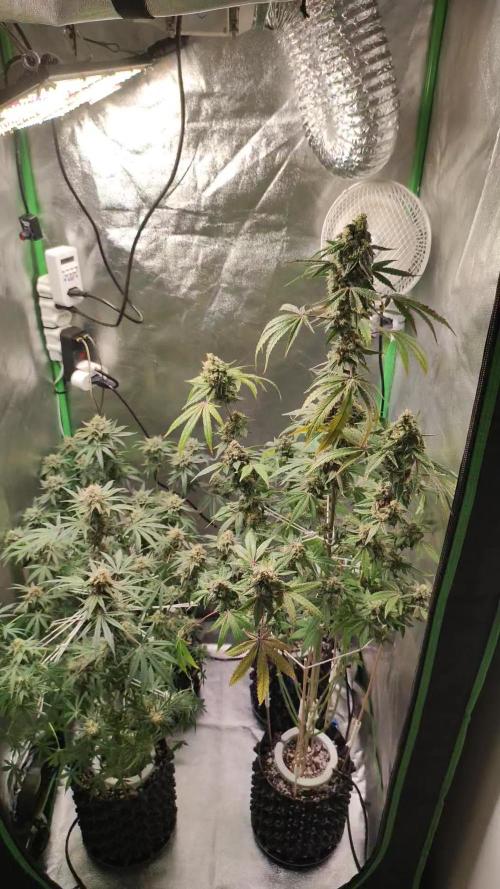
Plants are starting to be full of flowers but one thing I do not explain is why the plant in the middle has a main bud that is actually quite thin.


Likes
2
Share


@MiyaguiOkPolilla
Follow
Hola amigos!
Algunas fotos de esta etapa de las plantas hermosas de Mentha de Croco.
Hicimos el trasplante necesario cubriendo todas posibles necesidades que creímos posibles, sustrato preciso para que prospere vida y mucho aire con el añadido de coco y perlita más un fondo de arcilla expandida 🚀
Algunas de las últimas fotografías son 24 horas después con su manta caliente a 23⁰ / 22⁰ Centígrados y si respectivo riego abundante de asentamiento.
Muy contento con su estructura súper baja, veremos que sigue!

Likes
11
Share


@jonesy_grows
Follow
I'm thinking this is going to be my final week of veg, I'll be switching to hps 12/12 for flower, looking forward to seeing these girls bud up.
5/29
Switched my bulb from MH to HPS, to let the ladies adjust by the end of the week. Starting next week, that'll be on a 12/12 schedule for sure.

Likes
26
Share


@XxxAuto
Follow
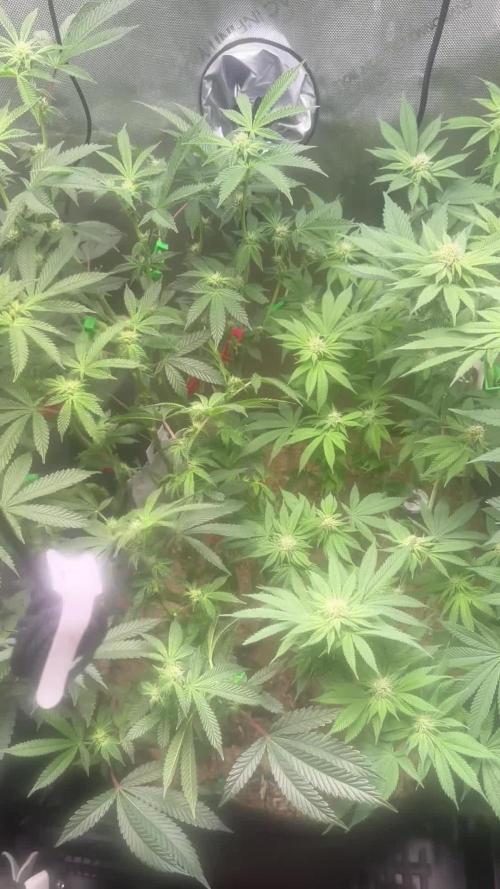
I’ll try them next again, then I should remember the net for trying a Scrog.
It’s a old classic strain that no one forget
;-) if you not have try the white widow, then you must go on !


Likes
3
Share


@RainerWinklerGrow
Follow
Harvested Around 220 Grams from 3 Plants, terps were there slightly, smoked fine, its alright, went with a differnent breeder after.

Likes
10
Share


Likes
2
Share


@CannaIGrow
Follow
Plant is growing well. Probably the prettiest one outta the bunch so far.
Likes
3
Share


Likes
5
Share


@MsMaggie
Follow
6 1/2 weeks into flower and they are packing on weight big time now.
Giving them bloom booster and molasses and water.
Will stop the bloom booster this weekend since I want them to have plenty of time to flush out.
The girls are drinking a phenomenal amount at the moment, they are drinking every drop I'm giving them.
Getting a bit of yellowing on the lower leaves BUT that is to be expected this close to harvest.
Other than that they are very healthy.
Uploaded a short video showing some of the ladies.
This has been without a doubt the EASIEST grow I have ever done and it looks like the yield will be quite respectable.

Likes
34
Share


@Mom74
Follow
Die Pflanzen haben in der vergangenen Woche einen enormen Schub gemacht. Hab sie Anfang der Woche entlaubt und es hat ihnen gut getan. Licht kann die Pflanzen durchfluten. Habe einen Weinballon ins Zelt gestellt. Da bei der Gärung CO2 entsteht nutze ich das um mein Budget zu schonen. Eine CO2 Anlage ist mir zu teuer. Die Luftfeuchtigkeit ist durchschnittlich bei 40%. Kann es kaum abwarten wie die Famen sich bis nächsten Sonntag entwickeln. Werde euch berichten.

Likes
3
Share


@HAPPY91
Follow
Week 8 9/5/2023-9/11/2023:
Day 51 9/5:
Drank about 16 ounces of plain filtered water. 68.9 F-84.7 F 31%-65%
Day 52 9/6:
Nothing today. 68.9 F-86.2 F 23%-65%
Day 53 9/7:
Drank about 16 ounces of plain filtered water. 68.9 F-86.2 F 23%-65%
Day 54 9/8:
Nothing today.
Day 55 9/9:
Nothing today. We had a huge storm hit and lost power most of the day.
Day 56 9/10:
Nothing today. 67.8 F-84.9 F 40%-91%
Day 57 9/11:
Drank plain filtered water.
Light is at 100%

Likes
14
Share


@Smile_gan
Follow
At week 13 of Pineapple express. It nearly to finish. I think her will ready to harvest in next week.


Likes
28
Share


@PrairieFrostGrow
Follow
*
******* Week 10 - June 13 to 19, 2020 - Days 64 to 70 from germination
*
Adding in the pictures right now..........
She continued to ripen this week and really stated to push out the frost at the end of the week when humidity was dropped to 50% and lower at night. She still has lots of nutrients in her to eat up as her leaves are pretty green. Her colas are starting to form points now and swelling/ripening.😍
She is done being fed this week and will start to feed on her leaves and flush out the nutrients👍😃 On Wednesday she was given at 32L flush of plain water to help lower the pH further and since at the end of her life it’s okay to hit the medium hard. She took the flush well and fattened up more. Frost also noticeably increased over the days after.......or the tricombs turned more cloudy😋😋
She has fought off all pest and environment issues and is very stable. She has liked to dry out a fair bit before her next watering as she was outwardly the most happy when pot was kept light. They were switched to a 20 hour light cycle at mid to end of flower and she took that well and swelled further. Opened her up on the inside to the let the light in and she has rewarded with fat little nugs on the lower sites!! She liked the LST and would push harder the day after being tied down. Very nice little girl in the grow portion of her life!!! Smoking part is looking very promising for yield and potency.........that will have to wait😉
Little more detail.........
June 13/20 - Day 64
- 1.5L plain water 275ppm, pH to 5.1
- lower pH to help the building numbers in the pot
- she is not taking up much right now.....slowing down a bit?
- She bulked up a fair bit overnight though.....seems to have liked yesterday's feed.
June 14/20 - Day 65
- dry out day
- KK swelled even more last night. She is a bushy little girl!
- tips forming slowly on the tops and moving away from the button look......ripening👍
- suspect she will be the first one done?
- raised the lights roughly 3" little less intensity right now and leaf temps a little high.
June 15/20 - Day 66
- Flush day today.....need to know where we stand with pH.
- 32L (8 gal) of plain water given, 3.4pH and 280ppm going in.
- in the trays before flush was runoff with a pH of 7.4 and ppm of 1800. (Both are too high for this stage of growth......6.4 and 900 would be nicer)
- runoff numbers after were 6.9pH and 380ppm
- had to stop there as I am using over 30 gallons of water today to flush all the girls......I am out of water😡
- environment holding at 80 degrees and 61% humidity.
June 16/20 - Day 67
- dry out day.......you think :)
- green leaves and red hairs started forming more.....she is ripening now.....no more feed.....only low pH water.
- squished a couple of buds and she is firming up.
June 17/20 - Day 68
- 3.5L watering today.......decided to give Rezin and Liquid Weight @ 1.5ml/L = 285ppm with a pH of 4.0
- yeah.......no NPK but I did give some supplements to help with tricombs and flavour.
- there was lots of runoff water.....didn't bother to check it.......it will be high.
- need to work on lowering the temps and humidity a bit more now as well.....80 degrees is too high now......76 and 55% is the goal.
June 18/20 - Day 69
- dry out day
- for the most part the girls were left alone today.....raining outside so humidity is rising.
- lowered the light again......raising my temps to 78 degrees though........need an air conditioner in the lung-room!
June 19/20 - Day 70
- 2L watering with Rezin, Liquid Weight, and Sensyzime for enzymes to finish cleaning up the roots......more salt I know.....but not too bad...bigger win.
- 385ppm and 4.5pH.........left the pH alone. Didn't want to add pH adjuster with the enzymes being added to her.
- Her top leaves are lightening and she is feeding on herself....perfect.
- the rest of her though appears to be slowing down......swelling on the inside hopefully👍
- frost levels the last 5 days have really increased!!
- raised the light back up again.......don't want fluffy buds so will reduce the temp and accept a little less intensity.
That is it for week 10! We are flushing her and trying to keep her cool now💪
Processing
Likes
30
Share


@Canadian
Follow
I use all 3 General hydroponic nutrients and they are two different pot sizes the Moby Dick is in 30 liter and the blue amnesia is in 18 liters has a very strong odor and blue amnesia is maturing at a faster rate then the Moby Dick.
a scrog net is being used in order to give support to the upcoming buds.
I am also actually on week 4 I just made a mistake calculating the week.
this is my first grow ever.
also I'm not sure if using the scroll net it's a good idea for support rather than tying those branches up .
I am watering every two days feeding nutes every single time at 900 to 1000 PPM ph at 6.2 the plans have not show any signs of stress but I am worried if it is too much nutrients the plant seems to grow very fast after every watering and seems to be loving it.
the blue Amnesia XXL Auto it's growing in soil with 30% Coco and the Moby Dick XXL auto it's growing in hydroponic soil.
the seeds were germinated on jiffy's and 100% germination rate plus the genetics seems to me very resilient to heat and everything else including lots of nutrients.
the moby Dick XXL auto are the two in the front closest to the camera the two farthest to the back of the tent are the two blue amnesiaXXL auto.
today day 31 i did some pruning actually lots of pruning hopefully don't cause stress to the plants or even worse cause them not to bud that nicely regardless the scrog net seems to be working just fine helping them access more light and making it easy for cutting leaves that are no longer needed.
32 yesterday after watering and sleeping today they have show no signs of stress in fact they starting to stretch in the buds that we're not getting sufficient light have start to grow also yesterday from the 16 liters I prepare instead of 3 ml of grow formula I add 6 1/2 to compensate for stress and the need of healing and having new grow stretch. also temperature has dropped dramatically outside making my house cold down from 24 degrees C to 19° at night internal temperature is remaining the same from 30 to 26 C.
Day 33 I have been raising the scrog net every day and the light everyday this plant is growing very fast I also notice that where the fan is hitting all the time that plant is bigger I have been moving the fan to other sections of the grow tent to see if any reaction happens and it looks like it makes the plant grow faster . I will not be moving the Scrog net any higher Rather I will introduce another one once they require more support .
Day34 notice some of the top leaves are showing a curving down like over-watering without actually over water I think they're showing signs of too much nitrogen .for the next water session I will hold back on nitrogen until I see signs of a fully recovering meaning leafs pointing up.
thank you for reading have a happy grow.

Likes
209
Share


@Rock_n_Roll_Randy
Follow
GAME ON FOR A CRAZY GROW!!!. I HOPE IT GOES GOOD. 46 PHOTOPERIODS AND 12 AUTOFLOWERS IN THE 8X8 GROW TENT WITH THE NEW FC-E6500, FC4800 AND TSW2000 🤘
BREEDERS AND SEEDS:
DIVINE SEEDS:
MAZAR, OPIUM, WHITE WIDOW, OG KUSH, PABLO ESCOBAR, DIVINE INDICA.
AUTO WHITE WIDOW
AUTO PABLO ESCOBAR
AUTO WHITE RUSSIAN
AUTO FRACTAL
AUTO MONTREAL
AUTO OPIUM
AUTO KABUL
AUTO MAZAR.
WEEDSEED EXPRESS:
GREEN CRACK, GHOST TRAIN HAZE, LITHIUM OG, CHEESE.
DOCTORS CHOICE:
DC KUSH, AUTO NIAGARA, AUTO ROCK MACHINE.
SPLIFF SEEDS:
MASTER KUSH REGULAR SEEDS.
EXOTIC SEEDS:
HIPPIE BERRY, MALASANA GELATO, EXOTIC ANIMAL.
GENE/MEME SEEDS:
BUMBLEBEE, BLACK HELL.
ORIGINAL SENSIBLE SEEDS:
PURPLE PUNCH COOKIES, WEDDING CAKE, PURE KUSH, GORILLA COOKIES.
SWEET SEEDS:
BLACK JACK, GORILLA GIRL, SWEET ZKITTLES.
EMERALD TRIANGLE SEEDS:
GORILLA GLUE, MASTODON KUSH.
SEEDSMAN SEEDS:
BLACK SUGAR, PEYOTE FORUM, PEYOTE WIFI, BADAZZ COOKIES OG, PURPLE GHOST CANDY, STRAWBERRY BANANA GRAPE, L.A. PEYOTE KUSH, PEYOTE WIFI CBD, FUEL DOG, CRITICAL PURPLE KUSH.
AMSTERDAM MARIJUANA SEEDS:
GIRL SCOUT COOKIES EXTREME, GREEN CRACK.
QUEBEC CANNABIS SEEDS:
BRUCE BANNER, GREEN CRACK, QUEBEC CBD 20:1.
I 💚 GROWING MARIJUANA:
SKYWALKER OG, BANANA KUSH, BLUEBERRY CBD.
FOR EVERYTHING MARS HYDRO VISIT:
www.mars-hydro.com
PROMO CODE: rocknroll
VISIT THE ALIEXPRESS STORE:
@marshydro_aliexpress2
Instagram: @marshydropenny
https://youtube.com/channel/UChU5ZWwNi-DvnO3oWVU3ceA
https://greenbuzzliquids.com/
#greenbuzzliquids
@GreenBuzzLiquids
https://greenbuzzliquids.com/en/shop/
PROMO CODE: rocknroll
https://www.youtube.com/watch?v=8hEqyS1jPpI
https://growdiaries.com/diaries/112437-grow-journal-by-rock-n-roll-randy/week/593118
Thanks for taking the time to read and check out my shit🤜🤛
New FC-E6500 Led Grow Light-FC-E6500 grow light with 3978pcs OSRAM BridgeLux Diodes & Moso Driver, market-leading PPF 2.7 µmol/J, Max 2.5g yield/watt with 30% higher Average PPE, more cost-effective compared with other same type lights.Only consumes 650W, perfectly cover 5x5ft (personal), 4x4ft (commercial) grow space.Innovative Precise Uniform Lighting-Built-in removable bars interval & dimmability enable the exact & dynamic PPFD control over each of the plant growing stages, FC-E6500 detachable bars deliverSuperior Heat Dissipation: Real Aluminum heatsink together with 6 slim profile passive cooled bars (THINNER & LARGER surface) and detachable Meanwell Driver, create less heat, save 50% energy than other old grow lights! Driver can be mounted remotely on the side of a grow tent/rack or on an adjacent wall to remove heat from grow space.Full Spectrum UV IR LED: With Yield Max spectrum (660nm Osram enhanced Deep Red,2800k-5000k,730-740nm IR,380-410nm UV LEDs), Average PPFD FC-E6500 LED grow lamp enable cultivators to produce Density Buds, perfect for full-cycle hydroponic,soil,grow tent/room growing.
Dimmable Commercial Grow Light: Cost-efficient,easy dimming & daisy chain max up to 20 lights, IP65 Waterproof, master light easily controlled for commercial & home horticulture.
GET THE MAX FROM MARS👍: Welcome one of the newest members of the Mars Hydro family🤜🤛🤘. The Mars Hydro FC 4800 480W LED Grow Light can accommodate up to a 4' x 4' area for flowering. It has OVER 2000 LED chips consisting of the best selling Samsung LM301B diodes which has a Luminous Efficacy of: 220 lm/W
0.2 W, 3 V mid power,
Osram 660nm Diodes, Infrared light and UV LIGHT👍. It boasts the incredible efficiency of 2.8 µmol/J, maximum 2.5gram yield per watt with 30% higher Average PPFD. This High-intensity spectrum is beneficial for plants at all stages - from veg to bloom, and creates Big dense Buds👍. achieve 50% higher yields & quality compared with the old lights! Only consumes 480W for 4x4ft personal grows, and 3x3ft for commerical grow. It comes with a dimmer and daisy chain function with a maximum of up to 15 lights, the master light controls the rest👍. Wide 6-bar design offers even & wide canopy coverage and can maximizes your grow space. slim 180° FOLDABLE DESIGN... YES I SAID FOLDABLE🤘🤣 , making it compact and easy to install, it's IP65 WATERPROOF and will give you no worries while growing in a humid environment and makes it a flexible high performance commercial grow light for enormous SUPER FROSTY yields.😛😛😛. MARS GETS EM FROSTY BOYS👍
AWESOME HEAT DISSIPATION: The Low energy consumption FC4800 growing light has 6 passive-cooled bars and an aluminum heat-sink a removable driver you can upgrade later or have it outside your tent. with zero noise you can save up to 50% in your electricity bill compared to HID's or HPS lights!
It also has a removable driver so you can upgrade it in the future or have it outside your grow space for better heat control in your growroom👍
UPGRADED FULL SPECTRUM: Yield Max Spectrum with enhanced red (Top-Bin Samsung 3000k-5000knm, Osram 660nm Deep Red), speed up blooming & fruiting, perfectly suited for full-cycle growing. The FC4800 LED grow lamp was born for Big Buds, perfect for commercial, grow tent, grow room, hydroponics, and all soil grows.👍
THE BEST SAMSUNG DIODES: THE FC4800 has Top Bin genuine Samsung Osram Diodes, combined with remarkable 2.8 µmol/J Efficacy, 30% higher Average PPFD, 50% less energy consumption, to maximize your yields. They give you a TRUSTED 3 years warranty 100% Satisfactory guaranteed!!!
The MARS HYDRO 8x8 Grow Tent interior is made of a unique diamond design mylar which is highly reflective. (Other companies mylar and reflective rate is as low as 50%, and it won't provide efficient light. They use thick 1680D oxford canvas, and being double stitched, it is tear proof and perfect for locking in the light. Their grow tent keeps 100% of the light inside the tent and helps your plants absorb more light. EXTRA-THICK material means No light leaks or rips at all.👍
Strong Stable metal corner adapters and poles are the trustful supporters of the tent. It's very sturdy, neither rusting or paint flaking off. quick and easy tool-free setup. They use heavy-duty metal zippers, with double layer black lining, by far the best on the market which creates a light-proof seal.
The Easy observation windows are made by double layers of cloth. Observe the growing conditions of your plants without opening the tent and avoid disturbing your plants. The observation windows also serves to dissipate heat and ventilate the air.
The tent includes 2 removable waterproof floor trays to hold soil and water. The removable tray can be taken out to wash easily.
They guarantee the grow tents are easy to install even if you've never done something like this before. Clear Instructions and no tools needed! They also offer 30-day unconditional refunds for quality problems. Just contact their friendly 24 hours customer service 👍
Likes
4
Share


@pzwags420
Follow
gsc is about a week away from harvest blueberry will be shortly after and og kush plus blueberry muffin are a little longer still, they were slow to start flowering.


Processing
Likes
5
Share