


Likes
Comments
Share


@majic_happen
Follow
flowering day5 gelato - One branch opened, but I glued it, I hope it will heal soon. I will watch the growth process for another week, I want the plant to grow another 20 centimeters in height.
flowering day5 payote - Defoliation and branch correction. The growth process continues unabated. Thanks seedsman for producing quality seeds.
flowering day8 gelato - This beautiful girl wants more vegetation
flowering day8 payote - I want a big Christmas tree, I returned it to vegetation 18/6 👊
seedling day 40


Likes
6
Share


@organicman
Follow
- new light schedule
- dimmed light drastically
____________________________________________
light- and watering schedule: see photos
now:
12 plants
2 x Auto Orange Bud > Dutch Passion (early80's)
2 x Haze Berry Automatic > Royal Queen Seeds (2018)
2 x Auto Bubblegum > TH Seeds (late 80's)
2 x Original Auto BubbleGum > Fast Buds Company (late 80's)
1 x Strawberry Pie Auto > Fast Buds Company
1 x Gorilla Cookies Auto Seed Stockers (2015)
2 x Auto White Widow x Big Bud > Female Seeds
setup + strategy:
18 seeds
3 x Auto Orange Bud (early80's)
3 x Haze Berry Automatic (2018)
3 x Auto Euforia (late 90's)
2 x Auto Bubblegum > TH Seeds (late 80's)
2 x Auto Bubblegum > Fast Butts (late 80's)
2 x Strawberry Pie Auto
1 x Gorilla-Cookies Auto (2015)
2 x Auto White Widow x Big Bud
setup:
18 x gronest 2 liter
60 cm x 120 cm x 180 cm (2 x 4) growtent
4 l humidifier
25 watt axial fan
15 watt clip fan
ro-filter
bath room with a 50 watts room fan (-> carbon filter not necessary)
...and a lot of odds and ends.
grow strategy:
max yield by stressing with:
1. tiny shoes (2 l fabric pots standing on 3 plastic rings (4 cm) for max oxygen)
2. tiny growspace (18plants on 0.72 sqm)
3. many strains (8 strains)
4. annoying neighbourhood (mixing old - i.e. bubblegum (late 80's) - with young- i.e. hazeberry (2018) - genetics)
5. no stress by light or food or water
6. unintentionally too much food
plus:
- no lst - no hst - just leaf tucking
- positioning bigger strains (euphoria, orange bud, haze berry) or just bigger phenos on less intense light spots (end of tent + edges)
- music-rotation: 24 hrs reggae (for sativas) - 24 hrs classicals (because it's scientifically proofed) - 24 hrs traditionals from the hindukush region (for the indicas)
max efficiency (min electricity - max yield):
- light: 23 h on - 1 h off
- keeping the distance of 18" (45 cm) and dimming to the right par (lux) - value depending on growing stages (see sheet: beginning 185 par ( 10000 lux/100 watt )/end 340 par ( 18000 lux/175 watt )) => ends up in approx. 170 watts in average over max 15 weeks
temperatur management:
- using approx. max. half of what the lamp can do keeps temperature low:
my tsl 2000 is pulling max. 360 watts of the wall - i need only 175 watts, results in less temperature than using a 175 watts lamp
- adjusting the temperature by using a humidifier outside of tent:
blown in humidity is soaking degrees and is transported out by fan, works much better than doing the same with pure air
summer extreme: no humidifier: 36°C / 35 rh - with humidifier: 29°C / 65 rh
works for 1-2 weeks of real hot summer days, no mould, no signs of stress in two summers
germination:
seeding in waterglass
spraying "basic"-water: ro-water (22 ppm) + calmag to 180 ppm every 4 - 8 hours until sprouted
man versus fungus gnat:
5 days before seeding i'm running the tent with "basic"-watered pots as if there were plants inside - led on, fans on, humidifier on. Fungus gnats coming with the soil might take the chance to come out now for breeding. i'm waiting with a 9 mm rifle. in the past i found 6 gnats in 2 of 8 x 50 l biobizz lightmix bags coming out of the soil. i could eliminate every single gnat successfully ;)
rotating harvest:
the little ones will be harvested completely when ready. at this point only the top branches of the big ones will be cut...and the new (basic-watered) pots of the new grow will move into the tent. 2-3 weeks later the secod half of the big ones will be cut and the second half of the new grow will move in...
nutes:
biobizz / soil: biobizz lightmix
bloom,grow,topmax,activera,algamic
+ aminopower instead of bio heaven (too expensive)
individual feeding schedule/once a week:
veg: 200 - 600 ppm
bloom: 600 - 900 ppm
water:
ro-water with:
veg: 100-150 ppm calmag
bloom: 150 ppm calmag


Likes
4
Share


@adam_pawloski87
Follow
At a total of 79 days this Sangria is a beautiful one! A cross between The GOGO and Ogreberry she is super delightful, Dense resiny heavy covers trichome buds , with the smell of Gassy rotten fruit funk on the nose! She a stanky one ! Other then that she was a pretty easy grow , y’all don’t sleep on it an better get your hands on it , at @Twenty20Mendocino they got you covered

Likes
52
Share


@Ultraviolet
Follow
The cannabis strain Grape Guava can be a purple strain, depending on its specific phenotype and genetic makeup. While not all phenotypes of Grape Guava are purple, some variations, such as the Zatix Grape Guava, are noted for their striking purple appearance due to the genetic expression of anthocyanin pigments.
https://www.youtube.com/watch?v=cKdVmdoKJ5k
In a garden of green, Grape Guava gleams,
With its fruity aroma, enchanting dreams.
Clusters of grapes, guava's sweetness ignite,
A strain so divine, in purple and white.
Euphoria whispers, a lush fruity haze,
Grape Guava's embrace, a tranquil daze.
Off and away.@1400ppm. The increased CO2 allows plants to thrive at higher temperatures, which in turn necessitates higher humidity to maintain the ideal VPD for healthy growth and transpiration. 80F -5F = 75F LST with 70% RH = 0.72 kPa. Higher temperatures and humidity promote rapid growth, nutrient uptake, and photosynthesis while maintaining a lower stress level. Temperature influences the rate of enzymatic reactions involved in aerobic respiration. Enzymes, such as those involved in glycolysis, the Krebs cycle, and the electron transport chain, work most efficiently at an optimal temperature range. In low temperatures, enzymatic activity will slow down, thus reducing the rate of aerobic respiration. In high temperatures, enzymes can become denatured, thus impairing their function and stopping the process of aerobic respiration. Glucose is the primary fuel for aerobic respiration. The rate of aerobic respiration increases with the availability of glucose, as it is the starting point for glycolysis. If glucose levels are low, cells may rely on alternative energy sources such as fatty acids or amino acids , but these processes may yield less ATP or be less efficient. To determine this effect, carbon dioxide volume was measured (as carbon dioxide is an output of aerobic respiration)
18/6 with the 6 being IR. The near infrared (IR-a) borders around 700nm up to 1400nm @ photon par flux density of 1.8 instead of darkness, keeping temps overnight a neat 77F-80F.
Think of my tent as a lung. What goes in must come out. When the rate of air going out exceeds the amount of air coming in, it creates a negative pressure. Tent concaves (bends in). If set up correctly, your RH will begin to drop slowly to the desired level you set, and the extraction turns off when it reaches desired% RH. The plant, as it performs cellular respiration, will always be releasing more water into the air, so the RH% of the tent overnight will always increase, so long as oxidative phosphorylation is occurring. As soon as the RH% creeps back up to 55%, the extraction turns back on, over and over. This creates a strong pressure differential which will work wonders on your grow. Replicating high and low-pressure fronts in nature. Critical for oxygen diffusion at the critical time of peak cellular respiratory function..
Moisture will not transfer from a saturated atmosphere to another if that air is already at or above its saturation point, meaning the air can't hold any more water vapor. Once I understood that water is produced as a by product during cellular respiration, specifically at the very end of the electron transport chain (ETC) where electrons are finally transferred to molecular oxygen, the higher the RH of the air, the more resistance there is for more moisture to be added to that environment, and effects the ease with which it does so. But none of that water comes from the pot; it's pulled from the air. If you run high daytime RH, your medium/pot is 100% reliant on transpirational root pull to move water. ZERO evaporation happens across the atmosphere if the tent air has high RH%, the medium cannot release its water through evaporation. Once a canopy develops, light no longer slowly wicks and evaporates from the topsoil. The Soil-Plant-Atmosphere Continuum (SPAC) describes the continuous pathway and process of water movement, driven by a gradient in water potential, from the soil, through the plant's roots, stem, and leaves, and finally evaporating into the atmosphere through transpiration. There is evaporation, there is transpiration, and then there is evapotranspiration; Evapotranspiration (ET) is the combined total of two processes: evaporation (water lost directly from soil and surface water into the atmosphere) and transpiration (water released from plants to the atmosphere through their leaves). Evapotranspiration represents the total amount of water that moves from the medium into the air. There is no such thing as a medium with too much water, only a medium that retains too much for too long.
The water must always flow efficiently from one atmosphere(Medium) to another(Air) in a timely manner. Moisture is a critical factor for bacterial growth and decay. Dictating how long it's allowed to sit in any one location for any given period is a key preferred control. To ensure a net reduction in a bacterial population, the rate of removal (ET) must exceed the rate of bacterial growth (decay rate), which is often modeled as a growth rate for the specific bacterium under the given conditions. By optimizing daytime VPD, we also optimize conditions for bacterial growth to explode exponentially above 77°F.. If water is allowed to sit in a medium without an escape within a timeframe, nothing good will happen. IF High RH is maintained overnight as well as during the day, placing 100% of water movement at the behest of daytime transpiration, roots can only pull where they can reach, and if soil is compressed above a certain point, moisture will become trapped in a medium with no way of moving day or night. This will begin the countdown for decay to take hold. When water stagnates in a medium, it loses oxygen, creating anaerobic conditions that foster the growth of harmful microorganisms like bacteria and fungi, which can produce toxins and disease vectors.
Thigmomorphogenesis, the process by which plants respond to mechanical stimuli like touch by altering their growth and development, results in significant morphological changes to improve survival against mechanical perturbations. This complex response involves sensing touch and initiating physiological and genetic responses, leading to changes in form and structure over days or weeks. The process is triggered by physical forces such as wind, rain, or touch. Plants adapt to these stimuli by changing their shape and structure, which may include slower growth, thickened stems, or altered leaf development. Plants possess sophisticated mechanisms to detect even subtle mechanical stimuli and initiate responses. A variety of molecules, including calcium ions, jasmonates, ethylene, and nitric oxide, are involved in signaling these mechanical inputs. Touch can induce the expression of genes that encode proteins for calcium sensing, cell wall modification, and defense mechanisms. A plant exposed to constant wind may become shorter and sturdier. A plant that is touched frequently might grow more slowly to conserve energy and develop thicker cell walls. These changes increase a plant's resilience and ability to survive in harsh environments.
Let's get Thiggy with it.
Likes
19
Share


Likes
9
Share


@PSK23
Follow
At six weeks into the flowering stage, the Los Angeles Kush Cake—a photoperiodic strain—is proving a challenge to manage due to its extensive size. Recent battles with caterpillars and spider mites were clinical, with daily check-ups successfully eliminating the caterpillars. Unfortunately, some compromises to the inflorescences were unavoidable, requiring the removal of about 3 grams of dry product; these are shown in the attached photos. Thanks to meticulous monitoring, I had eliminated two leaves with moth eggs early on, but one was missed, leading to the recent caterpillars. Detecting caterpillars early by watching for black poop on flowers, chewed leaves, or early maturation saves the surrounding buds and secures the harvest.

Likes
1
Share


@SirNutalot
Follow
Because theyre a little bit slow in growth i consider another 2 weeks before i switch

Processing
Likes
2
Share


@BigHorn
Follow
Has been doing well the past week the growth is coming along nicely. Started nutrients and a fan schedule to strengthen stock has been set. Well come back in 1 week to check growth and monitor daily temp and hummidity is key.

Likes
13
Share


@Rangaku
Follow
She takes a bit of looking after this one needing defols on the reg but the work is well worth it , dripping with resin and tastes like cake .

Likes
5
Share


@ChiloteAnonimo
Follow
- Día 1 de la segunda semana de flora con riego foliar de calmag
- Videos tomados día 2 de la segunda semana

Likes
9
Share


@DeepRootsGrowTrees
Follow
KICKASS AUTO by KANNABIA
Week #11 Overall
Week #5 Flower
This week she continues to pack on weight as her buds develop some density to them. The trichomes just shine in the sunlight. Overall she's doing great being outside no issues!!
Stay Growing!!
Kannabia.com KICKASS AUTO


Likes
1
Share

@Walachiangrowdiary
Follow
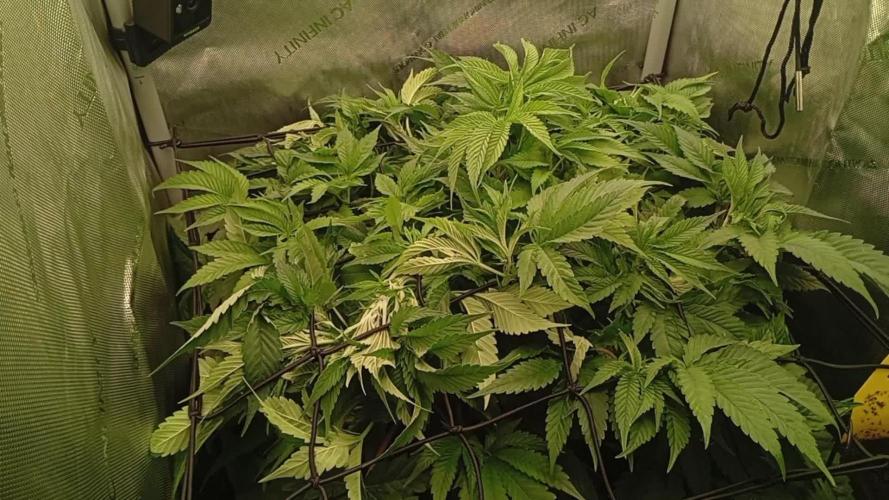
This pheno Is literaly what i looked for this tent because od bushiness and low height

Processing
Likes
13
Share


@Silverback_Guerilla
Follow
SUNDAY 4/28:
I plucked off some dead leaves and did some leaf-tucking and a little more training. I have high hopes for these F1's. When I had to remove a bunch of branches that would have produced a quarter pound of bud, it nearly broke my heart, but it looks like I'll still have a good cross-section of the potential genetics resulting from this hybridization.👍
I haven't seen any more nanners in several days now.😷
Daytime temps are still hovering around 87-90f, but I've got them sitting in 70-72f temps for 6 hours of darkness now.😁
I did a little video today and I'll take a few "glamour shots" tomorrow.
MONDAY:
Today I see a bunch of crispy leaves on several of them..guess I phuktup the PH again because they are getting fed everything they need. I douched everybody with 1/3 gallon including some boomerang, calimag, bembe, bud candy, and terpinator. No time for glamour shots...
TUESDAY:
Not much time today..just checked timers and temps, and changed out carbon filters.
WEDNESDAY:
Finally took some photos today after doing a little training. My best plant's leaves got all crispy, but only one one side of the plant..as if it was sprayed with something bad...buds still look yummy. What's really weird is that a Candy Cane, adjacent to that plant also developed the same problem, at the same time...but only on the branches nearest to this plant..(contagion?)
THURSDAY:
The 'contagion' seems to be spreading through the garden...
I'm thinking maybe I completely PHuktup the ph when I added silica last time and didn't correct it?? Not sure...but it's sad..they're all gonna be less than photogenic for the finish...
FRIDAY:
I plucked some dead leaves and misted everybody with perfectly PH adjusted spring water and increased airflow in the tent. Also decreased the dehumidifier to 45% RH.


Likes
10
Share


@barlobruz
Follow
08/04/2021
- I SEE PISTILLS!!! Really didn't think we'd make it this far 😅
08/08/2021
- Top dressed and watered w/ an AAEWCIF tea.
- Continuing to defol as necessary.
- Too lazy to date and re-organize all those photos through the phone.
- Photos taken from 08/02/2021-08/08/2021.

Likes
8
Share


@JamaicanDream_420
Follow
Vamos terminando la semana 7 y esto parece que marcha,van cogiendo forma y color….




Likes
5
Share


@GG4_in_COCO
Follow
Into the second week of flower now, due for another defol before the stretch ends and the last defol of the grow then let the girls recover and focus on the flowers, cuttings are showing lots of roots 11 days after planting, high humidity in the propagation container and the ezy plugs make it a breeze

Likes
103
Share


@Zurban_Poison
Follow
Hello everybody!
everything is just great! even there is nothing to say so much everything is good)))
I think it's not long left to wait for the harvest .. 2-3 weeks maximum!)