


Likes
Comments
Share


@TheFattyMcCoy
Follow
Hey yall!
Thanks for tuning in this week.
Had a great look under the microscope of my soil, I just ordered a camera for my scope so next week look forward to seeing and identifying some beneficial microbiology!
Another round of compost tea, I added Kiwi 🥝 😋 Fermented Juice, to this round of tea. Also adding food for the bacteria (simple sugars) and for the fungi (complex carbs). I suggest using diverse food for increased biodiversity.
The mycelium network is really established at this point. Which is why I highly recommend to keep reusing your soil, and the larger the pot size the better. I am in 10 gallons for now. Once I move into our house will be into living beds, 100 gallon +
If you can't be in a bed, use 25 gallon. You will benefit in time.
So at this point only using inputs I have made from organically grown plants, mostly grown in house. Anything else was wildcrafted, sustainably, so if I take something from nature I am replacing it with something else. Balance in all things.
Added the fruit for pushing the flowers. Pistol hairs are growing.
This strain is a sativa dominant, and thus my flowers are not as compact and "looser" than indica dominant strains I have always grown.
Review on this sativa dominant cultivar is: harder to grow than most strains, longer flowering time is also a pain while increasing my costs with more days with the lights on.
Getting COAs on the finished flowers and I will post on here, I am hoping for higher levels of THCv, let's get into the rare cannabinoids and higher terpenes!

Likes
16
Share


@Nissimo
Follow
eigener Dünger Konzentrat auf ein Liter ,es wird aber alles in 6liter Eimer gemischt und aufgeteilt auf 1 Liter propflanze vorbereite mir immer 2 gieß Vorgänge alle 3

Likes
25
Share


@AkatsukiVirtue
Follow
Hi Friends!
It looks like stretching has finally stopped 🛑 !!!
I am so happy with this! This has been a long road and I’m so happy to see the end coming about. At 7 weeks into flower everything is looking good and the trichome production is going fully. The nutrient solution has stayed the same for these past few weeks, but I have boosted the bud candy x2. Now It’s just a waiting game.
One thing I’m starting to get concerned about is humidity. It seems humidity is rising when I wake up in the morning. I think it’s because the exhaust fan isn’t running on a constant loop and is only dependent temperature sensor. This means that when the temperature reaches the threshold it turns off even though the humidity might still high. I think I can fix this problem by introducing a new timer the works on a loop.
Enjoy the pictures and a new video 😉.
Till next week!

Likes
2
Share


@Bluemels
Follow
Tag 36: Die Pflanze entwickelt schon wieder offsichtlich einen Mangel, ich versuche es jetzt mal mit Bio.Bloom und Alg a mic zusätzlich.
Tag 41: Ich baue das scrogging Netz ein.

Likes
17
Share


@DjgrowingMj
Follow
The tent smells so great each morning when I open it, this is my favorite phase of growing. I love watching them develop and thicken up days after day. Below are the days of activity since the last update:
Day 50
1 gal distilled water 1/2 tsp Cal-mag 9g Simpro bloom booster formula
Pulled 17 leaves adjusted LST
Day 54
1 gal distilled water 1/2 tsp Cal-mag 9g Simpro bloom booster formula
Day 55
Pulled 16 leaves adjusted LST
Day 58
1 gal distilled water 1/2 tsp Cal-mag 9g Simpro bloom booster formula
Pulled 2 leaves adjusted LST

Likes
Comments
Share

@Mrd1ez
Follow
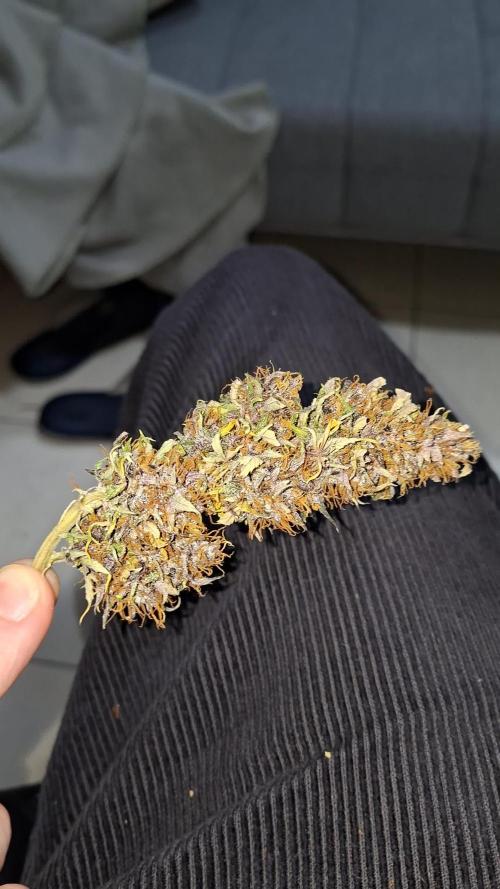
A pesar de sufrir el estrés de la sobre fertilización terminó estando con un muy buen aroma a arándanos y un gusto marcado frutal.






Likes
39
Share


@Mastr
Follow
Hi everyone Today day 30 and I stop feeding with silica and I take co2 bag off too due make high humidity also I reduced bio grow from 3ml to 1ml for this week next week i will stop bio grow till harvest
And I done aggressive defoliation on bottom almost take half leafs down
Update day 39 I done another defoliation and some lst to keep them separate from each other guys the orange sherbat is thirsty strain and seems she love nutrients she drank twice a day and each time 1.5L nutrients whitch is
.5 calmag
2ml heaven
2ml activera
2ml alg amic
2ml bloom
1ml top max
Because they are in small pot so I don't wanna give lots off water so I prefer to feed them twice a day


Likes
31
Share

@Schafe1001
Follow
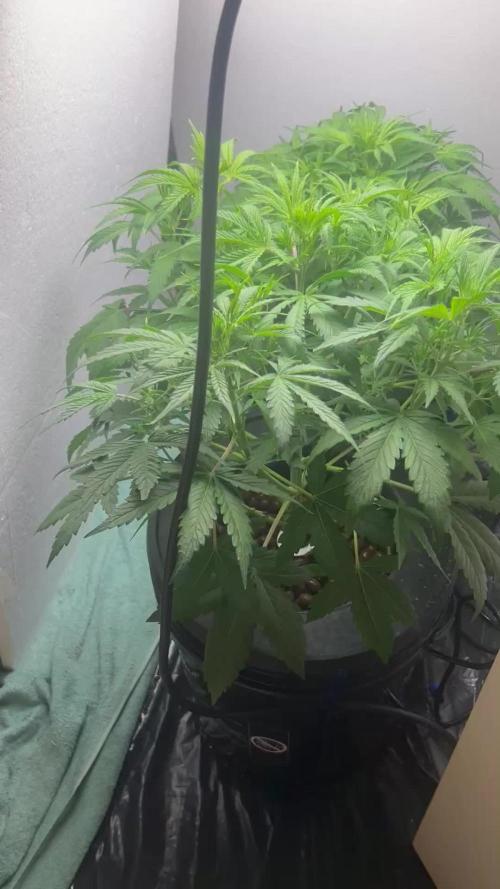
Starting to dial it in, I think? Finally, it seems my plant was growing faster than the chlorophyll could keep up. Thai and some ph adjustment and I woke up smiling 🙂

Likes
4
Share


@Bimli92
Follow
harvest, flower length 64 days, total growth time 88 days. Now wait for it to dry.

Likes
27
Share


@420DeepGrow
Follow
Sorprendido por la noticia de mi primera colaboracion con MarsHydro 😊🙏 y muy sorprendido tambien por el envio de las semillas por parte de Sweet Seeds.
La marca numero uno en focos 💡, carpas de cultivo ⛺️, extractores 🌬️ y demás aparatos que necesitas para tu cultivo.
Para esta aventura arrancaremos con 💡Mars Hydro TS 1000 Full Spectrum LED Grow Light 150W Regulable y 1 semilla autofloreciente a un ciclo de 20/4.
Verdaderos 150w con este TS1000, la mejor luz de cultivo LED para principiantes.
Ofrece una luz adecuada para 2-4 plantas 🌱. Su precio razonable, la marcada mejora del rendimiento y el control variable de la producción la hacen amigable para los nuevos cultivadores. Todo un tesoro para cualquier cultivador que este comenzando.
Usaremos tambien una carpa de 60x60x90, de nuestros amigos de MarsHydro, una carpa para los más exigentes.Con una solapa de cremallera mejorada, dobles cremalleras de metal con forro,reflectante diamante tipo Mylar, postes de metal para una estructura mas solida, no se puede pedir nada mas.
Garantizando una respuesta en solo 24 horas tanto si has usado antes la marca como si no.
Que decir de Barney's Farm uno de los mejores bancos de semillas a nivel mundial, con cepas que te sorprenderan.
Barney´s Farm, MOBY DICK ha evolucionado una vez más siendo cruzado con nuestro BF Super Auto #1.
Producción final impresionante, genética fuerte, robusta y perfectamente equilibrada creando una planta de energía Sativa dominante altamente resistente al moho.
La versión de Moby Dick Auto es ahora más compacta, con un ciclo de crecimiento autofloreciente más corto, pero poco se ha perdido en sus capacidades de producción, potencia y sabor.
💡 MarsHydro TS1000:
https://www.amazon.com/gp/product/B07PLY1WKK
⛺️ 60 x 60 x 90 MarsHydro:
https://www.amazon.com/dp/B081PN2QDN/
🌻 Moby Dick Auto:
https://www.barneysfarm.es/moby-dick-auto-562
Cuarta ,semana floracion. La etapa de crecimiento fue muy corta, simplemente riego con agua y pulverizo también con agua de vez en cuando.
Apliqué humus de lombriz a si que ire suave con los nutrientes
📅 Dia 29: Riego con nutrientes EC 800
📅 Dia 30: Descanso
📅 Dia 31: Descanso
📅 Dia 32: Riego con nutrientes EC 750
📅 Dia 33: Descanso
📅 Dia 34: Descanso
📅 Dia 35: Riego con nutrientes EC 450

Likes
5
Share


@Gram_Solo
Follow
All 3 sour Jealosy looking good and healthy, I Noticed 1 seedling only had 1 first leaf come through but seems to have kicked on despite this.
I have now moved the seedlings into a 3x3 tent with a 650w philzon LED light
Just until late veg early flower then they are going back under the Spider Farmer for the Full MOT and Output lol
Humidity has been easy to deal with luckily . I have been spraying around the solo cups and near the stem with plain water to keep it moist and Humid. Seem to be loving it so far 👌
Next step is wait til these are reaching edge of solo cup and transplant into bigger pots.
Germination was a success 🙌
Party time now
❤️👌
l
Likes
34
Share


@BOMbolenath
Follow
Harvest done, plant is drying.
116 days from seed: 51 days veg + 65 days flora

Likes
103
Share


@PEAKYPLANTERS
Follow
Happy day to all of you, Weed friends.
And welcome to a new week in the Gardens of Queen Peaky.
We have begun to insert a little bit of "Calmag" to support the fertilision program
The apical top of the plant behind is stretching too much ... I wouldn't want to have a burning from LEDs ... but now they have invaded every millimeter
Processing
Likes
3
Share


@Ogbangbang2981
Follow
this week was a lil challenging, had to get out of LST due to the fact that I broke a branch and that just tripped me off and I took off all my ties , apart from that i started giving her bloom products because I noticed a few hairs. I started applying tiresias mist to one of my branches so I can get pollen sacks to produce my own fem seeds, as I plan on crossing my fortune cookies autoflower with my ak48 autoflower and creating a new strain called "DRAKO" AUTOFLOWER well till next update . O.G. Bang Bang !! out.....


Likes
7
Share


@darb35
Follow
All 3 plants are pretty tiny, so happy there are 3 of them.
Hopefully they develop their roots a little more before going into flower.
Got a new camera so this week should be some nicer pics (:
Likes
Comments
Share


@DogDoctorOfficial
Follow
Blueberry Muffin – Pheno B | Week 4
Finding Her Own Rhythm
Welcome back to another chapter of the 8×8 Adventure, where twelve cultivars are being documented individually from seed to harvest under a strict 12/12-from-seed schedule. Every phenotype follows its own diary, allowing each plant to develop independently and reveal the subtle differences that make every seed a unique expression of its genetics.
Week 4 has been another exciting chapter across the entire room.
The explosive growth that began last week has continued, and every day the garden feels a little more alive. Canopies are becoming denser, branches are reaching outward with confidence, and the room is slowly transforming into the miniature forest I imagined when this project first began.
One thing that couldn’t go unnoticed this week was the environmental reading.
33.3°C and 63% humidity.
Apparently the grow room has developed a strange obsession with the number three. 😄
Although temperatures climbed higher than I’d normally like, the relatively high humidity helped soften the impact, and the plants rewarded the stable environment by continuing to grow with impressive vigor. Sometimes nature reminds us that consistency is just as important as chasing perfect numbers.
⸻
Week 4 Environment
🌡️ Temperature: 33.3°C
💧 Relative Humidity: 63%
💡 PPFD: 700–800 µmol/m²/s
🌱 Medium: Plagron Lightmix
? Growing Method: 12/12 From Seed
As the room continues to develop, another interesting difference is appearing naturally.
The lighting itself hasn’t been increased significantly this week. Instead, some phenotypes are simply growing faster and moving closer to the fixtures. Those taller plants are now receiving around 800 PPFD, while the shorter individuals remain closer to 700 PPFD.
It’s another reminder that no two phenotypes read the same instruction manual.
Even under identical conditions, every plant follows its own pace.
⸻
Feeding Strategy
The feeding program has also continued evolving alongside the plants.
During the first weeks the nutrient solution stayed around pH 5.8, maximizing nutrient availability while young root systems became established inside the containers.
Now those root systems have expanded considerably, allowing a slight shift in strategy.
Throughout this week the solution gradually moved toward pH 6.1, while nutrient strength steadily increased, finishing around EC 1.8.
The recipe itself hasn’t changed dramatically.
No major adjustments.
No sudden jumps.
Simply a gentle increase in concentration to match the plants’ increasing appetite. Sometimes the smallest adjustments create the biggest improvements, and this week’s growth has been a great example of that philosophy.
Allowing the pH to drift slightly higher also gives the roots access to a broader spectrum of nutrients available within the substrate, helping support the increasing demands of this new stage of growth.
As always, the goal remains the same:
Listen to the plants, not the feeding chart.
⸻
Blueberry Muffin – Pheno B
This young lady has been quietly writing one of my favourite stories inside the tent.
Unlike her sister, who seemed determined to impress from almost the very beginning, Pheno B decided to keep everyone guessing.
Her first weeks were… let’s call them creative.
The leaf structure wasn’t quite what I expected, growth was a little unusual, and every new set of leaves felt like another clue in a mystery I hadn’t solved yet.
Fast forward to Week 4…
The mystery is starting to make sense.
She’s finding her own rhythm.
Looking at her now, it’s hard not to appreciate just how much progress she’s made over the course of a single week. The unusual appearance that once caught my attention is fading into the background as healthy, vigorous new growth begins taking over the canopy.
She’s still not trying to imitate her sister—and honestly, I hope she never does.
Every phenotype deserves to express itself.
The structure is becoming noticeably fuller, with side branches beginning to establish themselves beneath the canopy while the main stem continues building upward with confidence. Internodal spacing remains compact, creating a nicely stacked framework that should provide plenty of future flowering sites.
One detail I particularly enjoy is the contrast between the older and newer growth.
Fresh leaves emerge in a bright lime-green colour full of energy before gradually darkening as they mature, giving the plant a vibrant appearance that changes almost daily.
Looking deeper into the canopy, more secondary shoots are beginning to appear than I expected only a week ago. She seems to be quietly building herself from the inside out, strengthening her framework before making any dramatic moves upward.
There’s something very satisfying about watching a plant overcome an uncertain beginning.
She may not possess the textbook symmetry of Pheno A, but she’s developing a character entirely her own.
And sometimes, those are the phenotypes that end up becoming unforgettable.
⸻
Looking Ahead
Week 5 should be another exciting milestone.
With nutrient demand increasing, root development well established, and the first signs of flowering beginning to appear throughout the room, I’m expecting another noticeable leap in development.
Over the coming week I’ll be watching closely for:
• Stretch progression as flowering begins.
• Continued branch development.
• Response to the higher EC.
• Structural differences compared to her sister phenotype.
• How her unique architecture evolves as the canopy continues to fill.
The slow start now feels like a distant memory.
This week wasn’t about catching up anymore.
It was about proving that she has every intention of writing her own story.
⸻
Thank You
A huge thank you to everyone following this 8×8 Adventure and taking the time to visit these weekly updates.
Thank you to the entire GrowDiaries community for providing a place where growers from around the world can learn, share experiences, and inspire one another every single day.
A special thank you to Plagron for providing the nutrients and cultivation support that keep this project moving forward.
Thank you to Zamnesia for the incredible genetics, equipment, and the opportunity to document each phenotype from seed to harvest.
And finally, thank you to every grower who leaves a comment, shares advice, asks questions, or simply enjoys following these plants as they write their own stories.
Every phenotype has its own personality.
Watching those personalities emerge is one of the greatest joys of growing.
🌱💚🍇
Growers Love, and I’ll see you all next week.