




Likes
9
Share


Likes
4
Share


@The_Projexx
Follow
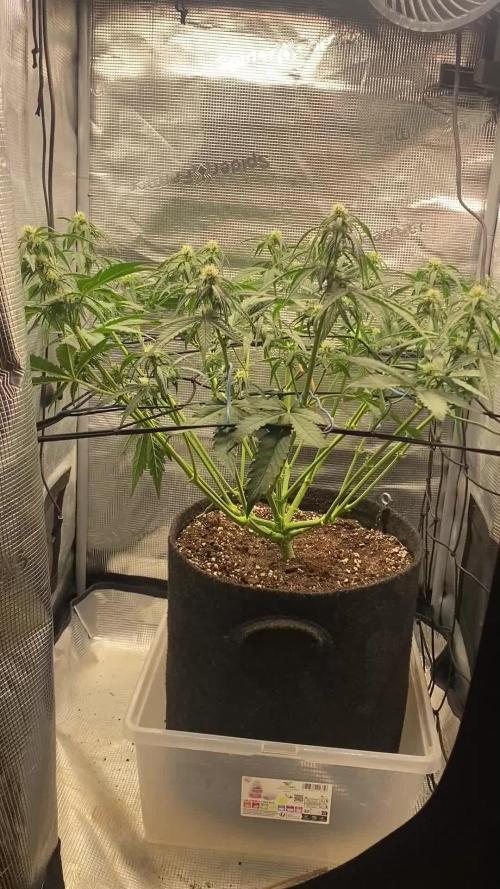
Welcome to week 4 of flower!!! I expect the ladies to slow right down in the stretch and start to focus on fattening up those flower sites. The plants have been going hard since day 1 of flower and I expect they will continue to go hard until the very end!
Huge shout outs to @MarsHydroLED and Hidden Vault Genetics for their outstanding work on gear and genetics that make growing a blast!
HUGE shout outs go to all my followers and people who stop into the diary alike! Keep on giving out those positive vibes!
Follow along and stay tuned wont be long now till we got monster flowers!
-The Projexx
Day#22F Ladies continue to stretch along , MacMelonz still has some stretch time on her.
Day#23F Pictures N/A. Some of the plants are beginning to focus on thickening up their flower sites!
Day#24F Ladies are still stretching it out , some are almost 4 feet tall now!
Day#25F Banana Smoothie is throwing off the wildest Banana Cream terpenes, the other plants are starting to throw smell too but not as hard as Banana Smoothie.
Day#26F Lots of the flower tops are starting to put on mass now.
Day#27F Pictures N/A. Creamy Cereal is deff pumping milk and fruit terpenes now.
Day#28F Ladies are just cruising along and mostly starting to focus on flowers now. MacMelonz will still stretch for a week or so.
Recap: Things went really well this week , the ladies are absolutely exploding and starting to put on mass. With 6-7 weeks left it will be quite exciting to see the end results and the terpene profiles of each plant! Overall really happy and cant wait to see what next week brings!
Likes
2
Share


@Ninjabuds
Follow
Man, that Skunk Apple runtz plant is giving me some trouble. It's still really small and hasn't grown much at all. I think I might've messed up a little because the leaves are looking kinda rough. Hopefully it can bounce back.
Well, it's Christmas again. This year feels a little different, though. Maybe it's the snow blanketing everything, or the way the tree lights up the whole living room. Either way, it's cozy and warm, even when it's freezing outside. I'm really looking forward to seeing what Santa brings. I hope I get that new video game I've been wanting. But most of all, I can't wait to spend time with my family. We always have so much fun
This past week was a good one for the plants. They started the first week of their stretch, and they've already grown a decent amount. I can really see them filling out. It's cool to watch them grow so fast. I can't wait to see how big they get by the end
I always get a little worried at this stage, like they're not gonna get as big as I want them to. But then I remember how they always end up surprising me. By the end, they're always perfect.
Likes
4
Share


@Lazuli
Follow
This plant now only gets overdrive, i didnt flush her so theres still enough nitrogen, it will deplete slowly she will be ready in about 2 weeks
Likes
2
Share


Likes
3
Share

@PapaTerps
Follow
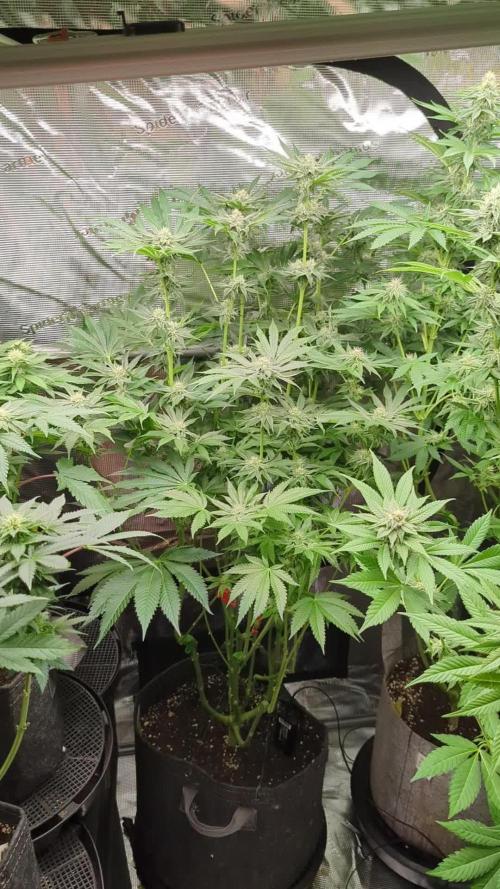
Black Lobster - Cipher Genetics
Week 4 Bloom
🌸 Another great week for this girl, she's developing her budsites really well and has started to bulk too! The flower has a typical indica structure with purple tips and short thick stigma. Her smell is really coming through now and is the most dominant in the tent; heavy on the blueberry with a sharp citrusy scent that lingers, really stunning! Her overall structure is good too, with strong lateral stems that haven't struggled with the weight of her flower 💪🏻 All the girls have been moved into the Spider Farmer 8x4, because the 5x5 and 4x2 were too difficult to manage 👍🏻
✂️ No work this week, she has sufficient airflow through the canopy as well as light penetration to the lower budsites.
💧 Watered every three days with 4L of RO water - nutrients were mixed individually, in order and then finally pH'd to 6.3. I've increased her nutrients again to keep up with her flower production.
💡 PPFD: ~800
♒ VPD: 1.52kPa
🌱 Days from seed: 87
🌸 Days in Bloom: 28

Likes
7
Share


@PoshGrow
Follow
Welcome to LSD-25 Grow by PoshGrow!
🍀 Week #2 2020 November 11th. - 17th.
General Info:
When planted: 2020 October 28th.
Week: 2
Days: 7 - 14
Last Update Day: 2020 November 12th.
Plants: 6 LSD-25 girls by @FastBuds.
NOTICE: Check vegetation week 1 for full equipment list.
Comment:
Whats up everyone! Everything going perfect, girls got their first feeding and went smooth. No problems at all.
Got my Spider Farmer SF2000 to support this grow tent also I thinking about getting AC Infinity Cloudline T4 kit for exhaust to.
2020.11.14 first LST training.
Stay tuned & happy growing! ✌️


Likes
88
Share


@Wastent91
Follow
Ehi ragazzi come va???? Tutto bennee?? A me benone devo dire! Progetti su progetti e le abilità crescono di giorno in giorno esponenialmente ! Grazie all essenza di questa magica pianta! Allora torniamo alla descrizione di questo fantastico hybrido F1 della RQS che gentilmente mi han donato in prova.. devo dire che la pianta rimane davvero uniforme , cresce e si incrocia si se stessa rimanendo cespugliosa e esplodendo internodi da tutte le parti che danno spazio alle cime di raggiungere la luce ! Spettacolare anche come la stabilità genetica resiste anche alla differenza di nutrienti tra le due piante , aspetto molto interessante devo dire, cmq questa settimana ho dato a tutte e due un benefico tea di compost pk ,fatto con sapienza, e devo dire che i risultati si stanno vedendo xké la pianta è davvero molto rigogliosa di un verde scuro intenso ma non quello da eccesso da azoto, semplicemente si vede che la ragazza sta bene in tutto e per tutto è sana al 💯 x 💯👍💪 ormai il metodo bio tabs e rodato e devo dire che ogni volta mi stupisce sempre di più come l unione simbiotica di diversi organismi possa produrre una pianta così rigogliosa !! È una cosa che affascina e appassiona alla stesso tempo! Questo è quello che è successo a me ! Cmq ringrazio Mars hydro per la luce e il grande James the master di RQS che lo ha reso possibile ! Buon 420 a tutti!! 😼💪🧙♂️🌿✨🌲💨😋

Likes
10
Share


@Backwood_scientist
Follow
Everything is looking good and doing good . Not bad for my first run . Also I would love to know about any nutrients that you use . Looking to try new ones so leave a comment .

Likes
42
Share


@GanjaReaper
Follow
This week i only gave them 2 feedings, one only water and one with Enzym+ because last week I gave them lots of nutrients.
I did that because they asked for it and could take it but in the other hand it was really hot so alot of feeding got evaporated
which can result in a salty/old nutes medium.
So with that in mind i let the enzymen do their work(cleaning and re-using nutrients) while making sure that i lower the EC in my pots down again
because right now the weather this week is like 20-23 degrees with alot of rain, because of that, the plants don't drink up/evaporate that fast as they do when its hotter.
Meaning i can't give as much water as they used to, so the EC in the pots will stay higher.
A high EC is not a smart thing to have, plants will get a higher change of shutdowns, can even get diffiencies because of that.
And the last thing a grower wants to have is heavy pots for lots of days LOL.
ps, I should consider making 2 different buckets of feeding because my criticalkushes are still not showing signs of preflowering.
To be honnest i'm not completely happy about the critical kush strain because the breeder promised a 100% Indica strain, which in my opinion is not.
It is just another hybrid and a really slow one.
pss, I will lower my EC in the comming weeks because I want my buds to get bigger and in later stages I will raise my EC again to make them compact,smelly,tasty,frosty,
With high EC, you get compact,smelly,frosty,tasty but small buds, with low ec you get big but fluffy ones and not that frosty.
This doesn't count for Autoflowers since they need way less ec...
I did this many times with inside grows, we will see how it goes outside with these two strains.

Likes
3
Share
@PapaTerps
Follow
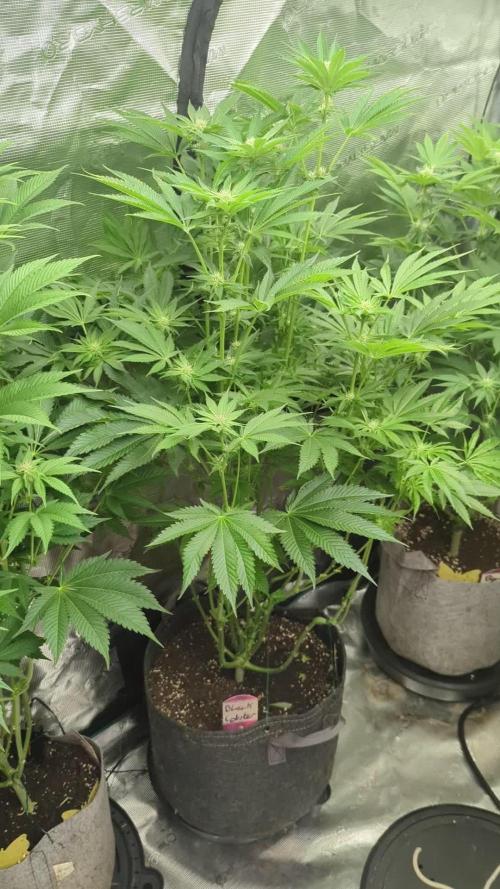
Black Lobster - Cipher Genetics
Week 3 of Bloom
🌸 She has finished her stretch and is working hard of developing her flower! No real scent just yet, hopefully that comes in over the next few days. She has strong lateral stems and looks really healthy, so all good so far 🙌🏻
✂️ I've lollipopped her again, removing all leaves stems and budsites below the top 6-7 nodes from the canopy - these lower branches won't develop into anything and will more than likely cause problems later down the line. I've also removed a couple of the larger fan leaves from her center, to improve airflow and light penetration 💪🏻
💧 Watered every three days with 5L of RO water, with nutrients mixed individually, in order and then finally, I pH'd the solution to 6.3. I've increased some of her nutrients and added the Alg-A-Mix as a precaution to any temperature fluctuating that might occur this time of year.
💡 PPFD: ~740
♒ VPD: 1.34kPa
🌱 Days from seed: 78
🌸 Days in Bloom: 19


Likes
28
Share


@PrairieFrostGrow
Follow
*
********* Week 11 - June 20 to 26, 2020 - Days 71 to 77 from germination ***********
*
It is the end of flush week and she went into darkness on Wednesday night, day 75, for two days. Saturday will be harvest day and start and the dry process👍
This week she continued to fill in and she also pushed out more frosty tricombs!! The fade happened this week more and she fed off of more of the nutrients within the plant.....perfect😃......would like a little more even but she was ready based on tricombs. Would like to have seen the lower leaves a little more yellow but its good.
I am feeling very strongly that the big part of the pH issues this run was a change in feed water. I have always used bottled RO water for all my grows, except outdoors, but this grow I switched to tap water. Dechlorinated the water with air stone and gave it 24 hours min before using. Wanted to save some money and tired of lugging bottles downstairs a couple of times a week☹️ This is worked out nicely and a lot more convenient. However, the city must be putting some crap in the water that is causing issues in my media and raises the pH after the watering. Out of the tap it is 8.4pH and 275ppm. Since ppm were not too bad in my opinion I moved forward without filtering the water.......oops🤬🤬🤬 Out of options on what is causing the issue, I switched back to RO water late last week........all the girls are happier!!!! F......missed the cause for weeks. Always learning from this plant and my own mistakes to get better every run😉👍
Also wanted to add a little more stress to girl to help push out some increased resin. I drilled a 5/16” hole into the main stem to cause her stress. I did this rather than trying to break a branch and will see it goes this run. Sterilized a new bit in Alcohol and went for it. They went into darkness about a couple of hours later. Excited to see what happens when she comes out to get chopped😃😃
Not really a lot more to add this week as it was mainly looking at the tricombs and her buds. The pH will impact the harvest but she has been fun to grow and very resilient to pest and bug issues as well as grower curve balls. As always.......nice job Sweet Seeds....... SWS56 is very solid and I look forward to running her again one day. Beautiful little girl and makes me smile😃😃😃
Little more detail......
June 20/20 - Day 71
- Rezin and Liquid Weight @ 2ml/L = 285ppm and 4.0pH
- 8L given to get a good flush....pH still running around 7.4
- Runoff in pots already were 7.9pH and 685ppm.
- after 8L water runoff was 7.4pH and 360ppm.
- she is 20” tall and 24” wide.
- a number of clear tricombs but more becoming cloudy.
June 21/20 - Day 72
- dry out day.
- buds are firming up......squeezed a couple🧐
June 22/20 - Day 73
- Rezin @ 1ml/L = 120ppm and pH the water to 2.7!!!!!!!!!
- Given 2L watering.
- No runoff water and I am good with that as I want the low pH water to stay in the medium.
- her frost levels are really coming out now.....was able to lower tent temps to 75 degrees and 51% humidity......its been raining a bit so damn humidity has been high.
June 23/20 - Day 74
- 2L plain water feed - 80ppm and pH to 2.4!!!!!!
- not excited about these crazy low pH numbers but doing what we can
- her tops are getting more pointy now and ripening nicely
- leaves continue to fade......she is close
- checking tricombs, I think we are done and tomorrow will be her last day so that I can take down on Saturday.
June 24/20 - Day 75
- 2L plain water feed - 80ppm and pH to 3.0
- Going into darkness tonight so this was her last bit of moisture.
- drilled a hole into the stem.....was going to do a couple of holes but not trying this method before I decided to leave it with one hole.
- into darkness tonight
So we finish up the week with her in the dark. Next update will be the harvest!!
Thanks very much for taking the time to review my diary!! Sorry for running behind often on this run.........everyone has had a busy life the last couple of months in the world and its been no different here...........a huge Kudos to all the Growmie‘s that are able to keep up with their diaries on daily basis on GrowDiaries.......its a commitment😃👍👍
Sweet Seeds girls are very solid genetics with great vigour and resilience.......this strain is no different........great job Sweet Seeds🙏

Processing
Likes
5
Share


@sercultiveta
Follow
35 dias de actividad en el indoor, foto periodo de 20 horas de luz y 4 de oscuridad

Likes
30
Share


@Love2Bud_UK
Follow
1/9 Both finally transplanted to 7gal Fabric pots. Plant 2 is doing really well, no stopping her now!! Plant 1 is doing slightly better than she was, going to give a slight defoliation over the coming week and hope she picks up.
2/9 plant 1 is slowly getting her shit together I think, I'm going to leave her be as much as I can this week. Plant 2 is doing me proud, recovered well after transplant/topping I'm going to continue training her as I see fit.
3/9 #2 has been fed today, nothing for #1. #1 is slowly getting there now, #2 is still going strong as ever💪 I think I may take a few clones off her soon
4/9 been noticing a few wet patches the past couple of days, had a biting a trim and will continue to do so as needed. Plant 1 is starting to do her thing now too, plant 2 going string as usual. Both have had a little trim ....can't remember if i watered or fed today 😂
5/9 no comment today, tired out
6/9 plant 1 doing well now, shes starting to look quite hungry sevill give her a feed tomorrow of the easy boost 123 combo. Plant 2 doing her thing as usual 💚
Likes
2
Share


@Elguacho420
Follow
Buenas a tod@s....🏻♂️ Bueno esta fue la última semana de gestación para las critical, están bastante bien, las veo parejas, fuertes, uniformes al crecimiento prácticamente, más alla de alguna hojita media fea en aspecto van muy bien, controlando mucho la temperatura en esta época del año q hace más frío, lo demás van muy bien... Ahora cambio de siclo y vemos a ver q tal van... Buen fin de para tod@s y buenos humos... 💨💨😎👍🏻 🇦🇷🤝🏻🇪🇦
Likes
11
Share


@MR_FASTBUD
Follow
This is plant one and two, plant one cane down 5 days before plant two so didnt get the exact wet weight, 5 days into hang dry plant one weighed 250g, plant two was cut down and chopped for box dry, weighed 200g for the heads and 300g for the lower plant produce, will update when dry and tested


