Likes
Comments
Share
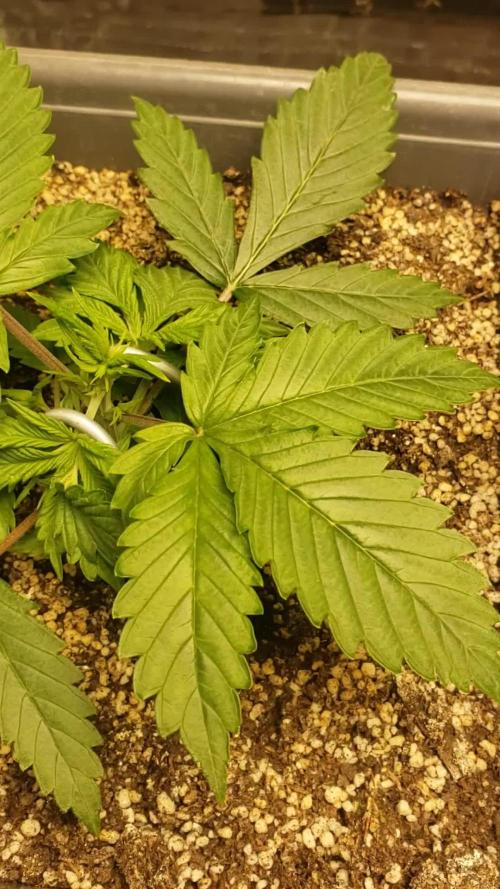
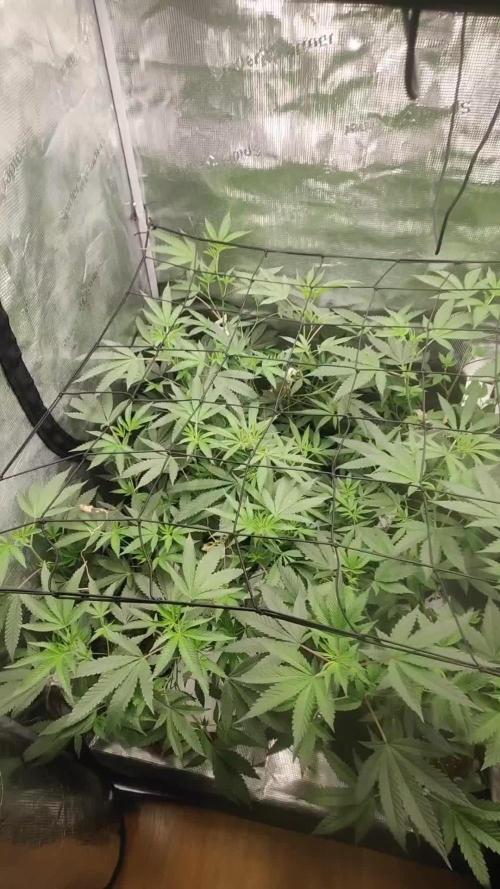
she looks down on a couple photos that was me and late watering hihi ups but i can assure you all that she is back on track looking like that never happened i did took a few leafs that did not look good anymore <3 <3 <3 i keep bending her and trying to fill up the canopy to a point i enjoys the view more than i do now hihihi I love getting medicated and just look at my Kale salad cutie pie, I mean this Supafreak @hsceurope is just so lovely and one never gets tired of just looking at her, I am sure this one thinks I am crazy with my big eyes all over every 5 minutes or so <3<3<3 joking or am I <3<3<3 She is almost at a point were I fell like I can take some cuts and flip her in to a 11-13 light schedule <3<3<3 dying here to see this beauty in flower mode showing of her fruits, for now I keep eating a occasional leaf here and there with fruits , on salads or just because I felt like having her lime leaf tree taste on my mouth, something I am enjoying more often than mb I should hihi As always thank you all for stopping by , for the love and for it all, i fell blessed to have you all with me for one more love journey, and a different one form the rest i did so far <3 <3 <3 Thank you Thank you Thank you , you guys are great and have been amazing , thank you for everything <3<3<3 #aptus #aptusplanttech #aptusgang #aptusfamily #aptustrueplantscience #inbalancewithnature #trueplantscience #dogdoctorofficial #growerslove
 With true love comes happiness , Always believe in your self and always do things expecting nothing and with an open heart , be a giver and the universe will give back to you in ways you could not even imagine so <3 <3 <3 <3 <3 <3 Growers love to you all <3 <3 <3
Likes
2
Share
We become aware at such times of man's wonderful ability to bring seemingly unrelated elements into harmonic balance, and receive a glimpse into a world where everything exists in conscious sympathetic attunement to everything else. When we listen to a piece of music that seems to strike a beautiful chord somewhere inside us, or view a painting that simply glows with harmonic awareness well executed, we probably do not spare much time to contemplate the wonderfully intricate combination of vibrations that our sensors make it possible for us to perceive. We tend to appreciate the relationship between the parts of something by an awareness of the harmony or dissonance of the whole. This ability enables us to say "what a beautiful house!" instead of "analysis has proven that this collection of building materials exhibits certain elements of harmonic proportion." While this ability to instinctively appreciate the beauty of true harmony has an important role to play in evolution, a more analytical understanding of the laws involved can be most useful. This is especially so if we wish to create works of art where each part exists in true harmony, not only with the other part of that particular whole, but with the universe within which the creator and the created exist. Everything vibrates. From the most dense matter to the most subtle cosmic rays, everything which our senses allow our thoughts to become aware of, can be specified in terms of wavelength or frequency of vibration. These two terms define the same thing, but from different points of view. The following are the approximate wavelengths of various energy carriers: Cosmic rays 0.000,000,001 mm Gamma rays 0.000,000,1 mm X rays 0.000,500 mm Ultraviolet rays 0.003 mm Visible light 0.006 mm Infrared 0.01 mm Sound waves 1 meter Radio waves 300 meters Violet light 400 nm to 450 nm Blue light 450 nm to 500 nm Green light 500 nm to 570 nm Yellow light 570 nm to 590 nm Orange light 590 nm to 610 nm Red light 610 to 700 nm 1 nanometer (nm) = 0.000,000,1 cm = 1/10,000,000 cm If a guitar string is plucked and we hear a sound, it is not too difficult for the human mind to associate this sound with the vibration of the guitar string. With color it is quite different. It is difficult for us to conceive that the color of a substance is not an inherent property of the substance itself, but an indication picked up by our senses of that substance's ability to absorb or reflect the light which happens to be shining on it at that moment. Neither the matter nor the light is colored. What happens is that the brain learns to differentiate between the frequencies reflected or transmitted by the substance the eyes are focused on. The same thing happens with sound. When we say "Oh! Listen, they're playing my favorite song," what we really mean is: "My brain has stored within it a particular pattern of frequencies. I have compared the new information being received with this stored pattern and have deduced the answer that the two patterns are similar within certain specified tolerances." The 'pleasure' involved could have something to do with our running the pre-recorded pattern at the same time, in 'sympathy' with the new pattern as it is received. The word sympathy describes very well our ability to appreciate color and sound. It also describes the reason behind certain elements of harmony. For instance, if a substance vibrating at 100 cycles per second (tone 1) is in the proximity of another substance vibrating at 200 cycles per second (tone 2), we could perceive, if we had the right equipment, a certain sympathetic relationship between the two. We will see from this that there is a uniform doubling of the first tone seen in the second. At various points along the waves, the two are the same in amplitude. At other points, they are at opposite poles to each other. This doubled frequency has more points of similarity to the original than any other frequency except the original itself. If the equipment we had available for measuring these two frequencies was a soundboard amplifier and a pair of ears, then we would hear what would sound to us like one tone. If we had the opportunity to hear one at a time, we would hear that although they sound the same, one is higher in pitch than the other. This characteristic of 'the same but different in pitch', musicians have called the octave. Any two tones produced where one has exactly doubled the frequency of the other is called an octave. Speaking in ratios, an octave would appear then as the ratio 2:1 or 1:2, depending on whether we are talking of an octave up or down. A single note produced by almost any instrument will contain more than one wavelength or frequency. It will have a dominant frequency, the wavelength of which we would call the note's 'fundamental' or 1st harmonic. It will also have a varying number of upper harmonics, gradually fading in intensity into infinity or silence. Natural harmonics always have the same pattern of intervals between them. The interval between the 1st and 2nd harmonic is a perfect octave; between the 2nd and 3rd a perfect fifth; between the 3rd and 4th a perfect 4th; and so on, the intervals becoming smaller and smaller until they lose any relationship with the western 12 tone scale as it exists at the moment. Just as an octave has certain elements of sympathy with its fundamental, so some intervals have been noted to be more perfectly in sympathy with the fundamental than others. The ratio of the 'perfect 5th' or interval of 7 semitones, as it occurs in the harmonic series, is 3:2 or 2:3, while that of the 'perfect fourth" is 4:3 or 3:4. All the tones in the western 12 tone scale can be expressed in terms of the ratio between the upper tone and its fundamental. This would seem to be an ideal way of generating a scale from any given fundamental and several attempts have been made to do this, the Pythagorean system being probably the most well known. Although when working with a single tone instrument playing on its own, the Pythagorean formula works wonderfully well, if we had several instruments tuned this way together and asked them to play almost any western music, we would find that at times they sounded quite out of tune to each other. The lack of flexibility of the various scale systems based on the harmonic series has led to what is known as the 'tempered' scale. This uses as its primary unit of interval the ratio of the octave or 2:1. It then proceeds to divide the interval between any fundamental and its upper octave into 12 smaller intervals by applying the ratio: two to the one-twelfth power, to one (21/12:1). This equals 1.059463094, so by multiplying any frequency by this number, we will obtain the tempered semitone next up from our fundamental. We will also find that any tone twelve semitones up from any other tone, in a scale generated in this way, will have exactly double the frequency. If we took the note middle C on a piano and halved the wavelength, we would have the note C one octave above. If we halved this, we would have the C above, and so on. However, within about 6 octaves, we would find that although a 'sound' was being produced, no human ear could perceive it. If we kept on going, halving and producing upper octaves of our fundamental C, we would proceed through the infrared band, into the visible light spectrum. If we happened to be outside during the day, we would, for one octave only, see the note C with our eyes. The next octave above would already be in the ultraviolet band, and outside the eye's sensitivity range. If we can think of color as being an indication of a substance's vibratory rate or wavelength, we may begin to see a relationship that could exist between the color and sound spectrums. The logical extension of what has so far been said is that there exists a scale in the color spectrum that corresponds exactly to the scale in the sound spectrum, each color tone being an octave of the equivalent note in the sound range. This is not the end of the story but only the beginning. If we can for the moment accept that any wavelength in one band has upper and lower octave stretching out to infinity, then the next question is 'fine, but what shall we use as our fundamental? A particular color? A particular sound frequency?' The musicians among us will probably say 'A 440'. This means that the note A should vibrate at 440 Hertz, or 440 times per second. They would tell us that this is standard pitch has been adopted by most orchestras around the world; pianos are tuned to it, instruments are constructed to formulas based on it, and so to them it would probably seem the most appropriate place to begin. Some of these musicians may know of the battle that is still raging with regards to this being the standard, but few would know why A = 440 Hz was chosen except that it worked when it was set to be a suitable compromise between the many different pitches in use at the time. 432 Hz is said to be mathematically consistent with the patterns of the universe. Studies reveal that 432 Hz tuning vibrates with the universe’s golden mean PHI and unifies the properties of light, time, space, matter, gravity, and magnetism with biology, the DNA code, and consciousness. When our atoms and DNA start to resonate in harmony with the spiraling pattern of nature, our sense of connection to nature is said to be magnified. Another interesting factor to consider is that the A=432 Hz tuning correlates with the color spectrum, while the A=440 Hz is off. Audiophiles have also stated that A = 432 Hz music seems to be non-local and can fill an entire room, whereas A=440 Hz can be perceived as directional or linear in sound propagation. Once you adopt the idea that sound (or vibration in general) can have an equalizing and harmonizing effect (as well as a disturbing effect), the science of harmony can be applied to bring greater harmony into one's life or tune to specific energies. There is a form of absolute and relative harmony. Absolute harmony can, for example, be determined by the tuning of an instrument. The ancients tuned their instruments at an A of 432 Hz instead of 440 Hz - and for a good reason. There are plenty of music examples on the internet that you can listen to in order to establish the difference for yourself. Attuning the instrument to 432 Hz results in a more relaxing sound, while 440 Hz slightly tenses up the body. This is because 440 Hz is out of tune with both macro and micro cosmos. On the contrary, 432 Hz is in tune. To give an example of how this is manifested microcosmically: our breath (0,3 Hz) and our pulse (1,2 Hz) relate to the frequency of the lower octave of an A of 432 Hz (108 Hz) as 1:360 and 1:90. It is interesting to note that 432 Hz was the standard pitch of many old instruments and that it was only recently (19th and 20th century) the standard pitch was increased. This was done in order to be able to play for bigger audiences. Bigger audiences (more bodies) absorb more of the lower frequencies, so the higher pitch was more likely to “cut through”. One of the oldest instruments of the world is the bell ensemble of Yi Zeng (dated 423 BC), tuned to a standard F4 of 345 Hz, which gives an A= 432 Hz. The frequency of 345 Hz is that of the platonic year! Similarly, many old organs are tuned in A=432 as well; for example, St. Peter’s Capella Gregoriana, St. Peter’s Capella Giulia, S. Maria Maggiore in Rome. Maria Renold’s book “Intervals Scales Tones and the Concert Pitch C=128 Hz” claims conclusive evidence that 440 Hz and raising concert pitch above scientific “C” Prime=128 Hz (Concert A=432 Hz) disassociates the connection of consciousness to the body and creates anti-social conditions in humanity. The difference between concert pitch A=440 Hz and Concert A=432 Hz is only 8 cycles per second, but it is a perceptible difference of awareness in the human consciousness experience of the dream we share called existence.
Likes
6
Share
@Hempcules
Follow
WEEK 7 My plant is now well into flowering, but hasn’t stretched much so far. That might be due to the large number of shoots that have developed. Still, there’s already a decent amount of visible buds, which makes me really happy. I expect she’ll gain a bit more height, but overall she’ll likely stay compact and bushy. I’m satisfied and excited to see more of what’s to come. This week, my lamp ran at 600 PPFD, and I watered once with plain water and once with nutrient solution.
Likes
10
Share
Things are looking good. Couple of the plants are getting an awesome purple tint. Beautiful plants honestly glad that I just let them grow. Harvest is going to be a handful for sure but whatever it’ll be worth it. Still got a good month at minimum but excited to see what the week to week progress is the next few. Loving all the colors. Thanks for stopping by and as always 🍻
Likes
12
Share
Eccoci qui... Scusate per il ritardo ma sono stato super impegnato, SIAMO ENTRATI NELLE ULTIME SETTIMANE DI FIORITURA!! Ormai si vede una maturazione costante giorno per giorno ed ha tutte cime come PIETRE, durissime e super colorate!!! Grazie a @KhalifaGenetics e @xpertnutrients per la collab e a tutti per il supporto🔥🌲❤️
Likes
44
Share
Giorno 74 (14 fioritura) Le piante stanno abbastanza bene. Per il prossimo giro autunno/inverno dovrò stare attento con le temperature perché tra vegetativa e ora inzio fioritura hanno sofferto un po' di basse temperature (nulla di preoccupante ma preferisco avere 23/24° piuttosto che 17/18°). Come detto la settimina scorsa ho dovuto flushare una Pink Gasoline perché tutte le foglie avevano macchie chiare distribuite in modo non uniforme.Ora, dopo dieci litri di acqua con gli ultimi due con una leggera dose di fertilizzanti finalmente i nuovi getti sembrano stare meglio. Tutte le altre piante stanno bene, sta solo a me non dare troppo cibo e monitorare il colore delle foglie per correggere eventuali eccessi/carenze. Non posso fare danni con questi incroci 😃 🙏 A settimana prossima sperando di vedere un po' di resina 😋
Processing
Likes
45
Share
@Magich
Follow
More pistills showing everywhere! 😍 day 61: everyone is female, except for 2 plants, and it is not one of the big ones 😁 hasn’t shown male signs either day 63! Everybody has a pussy! All females in my beautiful garden now! 👩🏼☠️️
Likes
101
Share
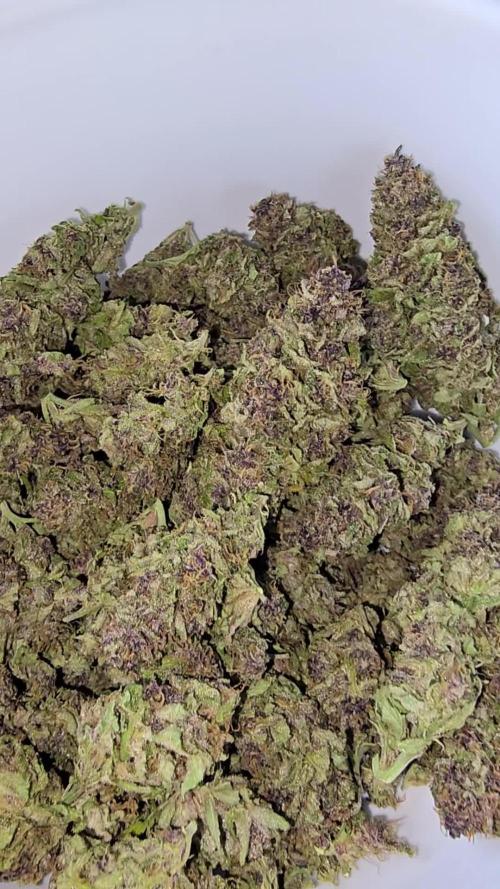
Conclusion: Apple & Bananas from Kannabia fully delivered – 454g of wet, premium-quality buds, plus extra popcorn buds for later use. While not the largest in size, the intensity of flavor, density, and resin production make this strain a true winner. Photos are wet buds. Once they are dry, the smoke report will follow!!! See you again in 2-3 weeks 😇😇
Likes
11
Share
@Thigh
Follow
Ich warte auf den richtigen Ernte Zeitpunkt. Farbe und Geruch kommt immer stärker. Werde sie nurnoch Spühlen. In der Nacht an Tag 82 kamen sie ins Zelt für eine 48 Stunden Dunkelphase um sie zu stressen und den THC Gehalt zu erhöhen. An Tag 84-85 wird geerntet 👨🏽‍🌾🤪
Likes
12
Share
Eccoci qui... Questa varietà mi lascia a bocca aperta è gigante!!! Sono rimasto molto colpito da come pur avendola messa giù da seme sia avanti in fioritura come i cloni con 53 giorni alle spalle!!!!! Sono curioso di questa bellezza, e come in tutti i diari SI INIZIA CON I VIDEO. Grazie a @KhalifaGenetics per la collab e a tutti per il supporto🔥🌲❤️
Likes
8
Share
These guys seem to have some stunted growth from being in that shitty rock wool dish setup I had but they are making up for it now that they are in the air pots. I transplanted them into sunshine #4 because my other plants have had problems with N tox in coco loco, the only other soil mix I have...probably won’t ever be using fox farm soil again. Too expensive for what it is and it’s a pain in the ass dealing with nute probs. Day 8: into the new grow tent tomorrow Day 10: My Timber Grow Lights 480/500W QB came in! This thing is so sleek. I got it in 3000k which is a tiny bit orange/yellow because I plan on spending most of my time in flower with autos. But I find it works just as well for veg too, hard to notice any slower growth or anything. Since I’m in veg I might add my 2000w blurple to the mix to keep the girls happy
Likes
31
Share
@wolfvb
Follow
🌿 week 7 Update: Frost & Fire! ❄️🔥 We are officially moving into the "sweet spot" of the flowering phase! The tent is starting to smell incredible, and the girls are putting in some serious work. If you look closely at those bud sites, the trichome production is kicking into high gear, giving everything that beautiful, frosty shimmer we’ve been waiting for. The Feeding Strategy This week, I’m leaning heavily into the bloom boosters to ensure these colas have everything they need to swell up. Here is the current cocktail: Bio-Bloom (BioBizz): 2 ml/L – Keeping those base flowering nutrients steady. Top-Max (BioBizz): 1 ml/L – Stimulating cell division and increasing sugar production. PK 13-14 (Plagron): 2 ml/L – The "heavy hitter" for this stage to add some serious density. 📈 Progress Report The Stretch: It looks like the vertical stretch has finally stabilized, and the plants are now focusing 100% of their energy on bud development. Canopy Check: I’ve been performing some light defoliation to make sure light is reaching the lower bud sites. Airflow is key right now to prevent any moisture buildup in those thickening clusters. Flower Development: The pistils are still mostly white and reaching out, meaning we still have plenty of swelling left to do. Grower’s Note: Keep an eye on the leaf tips! With the addition of the PK 13-14, I'm watching closely for any signs of nutrient burn, but so far, the girls are drinking it up like champs. 📸 What’s Next? The plan for the coming days is to maintain a steady environment and keep the pH dialed in. I’ll be watching the buds get thicker and stickier by the hour.
Likes
57
Share
2 girls 1 cup week 3! Thanks for stopping by and checking out my experiment. They're getting a little big to be taking individual overhead pics everyday now. They always both end up in the same shot no matter what. Will still update daily with pic. Got a new cam that can do timelapse. Almost sent it back until I said fuck it and tried TWO layers of sunglasses. Diff colors too. One more of a FLD filter color, one more of a UV filter color. Both are polarized as well. I'm sure the night vision footage will be trash with the IR behind the lenses, so the timelapse will have res checks/changes and night prob edited out. Stay tuned for that! Going 1/2 strength GHE week 3 light feed and actually changed RES last night. Was looking at em and already noticed WG was drooping more than it should. Normal transportation and growth/energize cycles are expected, but was looking overwatered. GC if you look in vid "d14" in first and second set of fingers showing interveinal chlorosis. PH has been between 5.52 and 6.4 (lowest and highest), and averages a swing in a 12hr shift from 5.71'ish to 6.17'ish. Not uploading notes again like last week, but you'd get the idea if you saw them, I take notes lol. So PH wasn't an issue. They've been averaging a 7-15ppm drop in res per 12hr and has only been climbing again due to ph down additions. I should prob change RES mid week so it's not a high concentration of ph product. So they're DEF eating proper, have stable ph swings, optimal res Temps and dissolved oxygen is good. WG taking on more water to get the nutes, causing leaves to droop from excess water. GC moving nutes from old growth to the new growth. So they're hungry. Ghe claims 62.5ppm nitrogen, 275-375ppm target per mixture below. Mixed and measured in between each addition to get my numbers. -2gal Water/calmag/hydroguard 215ppm -Micro 4.9mL - 170ppm -Grow 4.6mL - 100ppm -Bloom 3.4mL - 60ppm Nute concentration - 330ppm (nailed it again GHE) Water - 215ppm Total - 545ppm Ph'd to 5.6 final tds 563ppm Mars Hydro TSW2000 on theeee way to finish these girls off right.. some of my worries are settled. For now... *they just ate 32ppm since this mornings RES chk/adj... I was thinking I'd have to swap RES once mid week once they get older, but think they may benefit from it sooner than later. Tap roots popping out by the chute for the air line, the temp sensor, and the main stack.. going to have to pump the res out pretty soon to avoid root damage. Timelapse will turn out pretty sweet if I would quit bumping the damn camera, and stay TF outta there 🤣. **these girls are starting to BLOW UP! Figured I'd bump their feed up a bit today because they told me to. Eating as much as they are as quick as they are I'm going to have to be on top of it or shit will go south quick.. so, for the record.. GHE wk 3 "light" feed 3/4 strength Projected nitrogen - 93.75ppm Projected TDS - 412.5-562.5ppm 2gal water/calmag/hydroguard 202ppm Micro - 7.35mL 229ppm Grow - 6.9mL 145ppm Bloom - 5.1mL 97ppm Nute total - 471ppm RES total (after ph corrections) - 690ppm May have to hit them harder if they keep eating like they are. Trying to borderline optimal without crisping their leaves. So I am watching the TDS to see how theyre eating. Aiming for 10-15ppm per 12hr. If they eat more, feed em more. Eat less, feed less. Seems to be working so far, just like last time. May up my calmag TDS of my spring water/tap mixture to 250ppm from the 80'ish it ends up being after mixed. I'm sure they want more calcium too. It can't hurt right?? Wedding Glue couldn't be happier with its bump up in nutrition... can't wait for this timelapse... ***realized I messed up settings on timelapse after the fact.. pissed I missed out on the footage from its night and day shift today. Uploaded footage from after RES change with more food for em to eat, sped WAY TF up cause I decided to grab a frame every 3sec vs 1min. Trying 2min this time and stop/save/start vid every 12hr. Fingers crossed it turns out. WG was happy ASF and let me know with a big ole wave. And some BIG growth over the time. Have tied em both down again to avoid topping, yet. . Looks like just wiping off the two leaves that got effected by my carelessness wasn't enough. Few drops of something got on GC in two spots shown in pics. Note taken, wash it off next time or just be more fucking careful.. got it. On a surprising note... RES level not only dropped 600mL, but also dropped from 690 to 645ppm (total tds). So they're eating MORE with the increased feed... doesn't suprise me much, but heard auto's don't like to be over 6-700?? Nute concentration @ 471 yesterday, and it's dropping FAST... will probably fatten up their plate on Sunday and go with a RES change, full strength week 3 GHE. ****tired of reading this shit yet?? Here we go with yet another RES change.. just bumped em up YESTERDAY! they're still showing signs of hunger, WG more than GC. Can't let these girls go hungry now can I? A couple bucks in nutes down the drain is better than letting em starve.. Plus they're more attractive when their leaves aren't full of water. So here goes... starting to smell in the tent.. GHE wk 3 light feed Projected nitrogen - 125ppm Projected ppm - 550-750ppm 2gal spring/tap, calmag, hydroguard - 248ppm Micro - 9.8mL 362ppm Grow - 9.2mL 189ppm Bloom - 6.8mL 111ppm Nute total = 662ppm RES total (after ph correction) - 940ppm Just realized if I delete timelapse from wyze app, it deletes from gallery too. Fuck, another good one... my bad. I think I got it now... side note, guess I have to count cotyledons as first node since these bitches wanna grow some arms from what mangled pieces are left next to em. Need to grab some 91% before I go cutting on these girls though, so they stay for now. *****d19 mars tsw2000 showed up two days early! hung it during the "night". timelapse updated, day 18 and 19. lots of growth under the fans, and WG trying to push GC tf out of the cup lol. Training rods installed for the mains, and all the 3 fingers are plucked. Ended up plucking a 9 finger from WG and a 5 finger from GC to make way for the under growth. Feel like Bruce Almight parting a bowl of soup lol ******didn't want to post a pic of my girls in distress, but documenting everything else, so why tf not. swapped out the clear sight tube for a more UV friendly agro green. Marked the tube in the same spot as the clear, but it was almost a gallon more in reality at the same mark. I was drowning them with no air gap below the upper growing chamber. After measuring, it was submerged by about 5/8th inch. Sorted that out, and took almost all day for em to perk up. On top of that, the new light and adding another oscillator changed my environment. No more humidifier in the tent. Thought I lost both of them.. Soggy leaves, spotting, etc. Backed nutes back down to 3/4 strength wk 3 due to slight curling in new growth and one lighter tip on one new finger. Shortened the training rods tonight and started with some bondage. Prob the last time they'll get tied down before the net gets used (if needed) here in a week or so. Backed off to 16 DLI from 20 until they really perk up. End of week 3
Likes
Comments
Share
@Nftgrower
Follow
Total yield was 105 grams per plant
Likes
31
Share
@MxGrow
Follow
Feliz por como van mis gorilas, todos los días hay cambios y cada semana tengo que aumentar el riego, esta semana utilice en total 18 litros, 4.5 litros para cada planta aproximadamente. En los primeros 6 litros uso: ▪️︎4ml de Connoisseur A y B por litro de agua. ▪️︎2ml de Rhino por litro de agua. ▪️︎2ml de Bud Candy por litro de agua. ▪️︎2ml de Carboload por litro de agua. ▪️︎2ml de B-52 por litro de agua. Espero 30 minutos y despues aplico otros 6 litros con los siguientes nutrientes: ▪️︎4ml de Connoisseur A y B por litro de agua. ▪️︎2ml de Nirvana por litro de agua. ▪️︎2ml de Big Bud por litro de agua. ▪️︎2ml de Overdrive por litro de agua. ▪️︎2ml de Voodo Juice por litro de agua. No tengo medidor de EC, por lo tanto trato de que las mediciones en ml sean exactos con una jeringa. ☆ 1 día a la semana riego las plantas con 6 litros de agua sin nutrientes y con un PH en 6.0, hasta el momento no han presentado carencias pero tengo la duda si tienen exceso de nitrógeno por el color verde intenso de las hojas.
Likes
14
Share
@TOMI08
Follow
Sziasztok 40.nap Jól reagálnak a hajlításra a lányok Esővizet kapnak.. A tápanyag amit rendeltem meg nem jött meg... Wuxal supert használok etetni szeretik nagyon