


Likes
Comments
Share


@eldruida_lamota
Follow
Cómo estamos , familia, de nuevo actualizamos semana, y esta vez andamos con la primera semana de floración, si es que parece mentira pero el tiempo vuela y cuando menos lo espere tendré que cortarlas y volver a empezar .
Pero a lo que vamos aquí va esta cepa increíble de Zambeza seeds , que tienen una distancia de Inter nudos muy corta y una buena vegetación, cumple expectativas de que tendrá largas colas laterales , iremos viendo el proceso estas semanas.
Agrobeta:
https://www.agrobeta.com/agrobetatiendaonline/36-abonos-canamo
Mars hydro:
Code discount: EL420
https://www.mars-hydro.com/
Las maximas de temperatura no superan los 26 grados y las mínimas no bajan 19, así que no me puedo quejar.
Los niveles de humedad también son los correctos van entre 50%/60%de humedad relativa.
Por supuesto el Ph lo estamos dejando alrededor de 6.
Hasta aquí es todo poco más la verdad, solo deciros que buenos humos 💨💨💨y nos vemos el finde en SPANNABIS.

Likes
18
Share


@Wrongholn519
Follow
It's been an interesting week. I had to ask for help with resolving the intense smell coming from my garden... I can smell it from my driveway at this point.. I was advised that I probably turned my fan up way too high, which overloads the carbon filter on the end of my exhaust. I ordered another new one.. turned it down.. and I also had to cut down the cheese auto... all her trichomes were cloudy bit I definatly could have left her for another week... just couldn't handle the smell lol.
Ask for help and you shall receive, thanks Growdiaries. And thank you Oozlefinch for the solid advise.. ✌️
I bought a rosin press this week and it's awesome.. she will be used for this grow as soon as things are ready.
I cut out my backyard to plan for round #3 for all these plants.. plus a whole lot more!
Process/ Environment changes:
-Turned down my exhaust fan.. the carbon filter can't keep up with the amount of air being pushed through it.. in the water industry we would call this 'short circuiting'....
The Gorilla cookies is growing well. It's a tall plant with long nugs ( I hope the full out a lot more). I would recommend supporting the branches at this point in the grow. There's a slight smell coming off her and trichome production was late to start compared to most the other plants I have... I suspect she will go past 90 days unfortunately, but I'm excited to see what the finished product looks like.
Hitting her with compost teas at a pH of around 6.7
That's it.. I'm on auto pilot at this point.. there's not much I can do except sit back and wait.
Thank you Fastbuds

Likes
12
Share


@2SeedsToParadise
Follow
Easy week
Potted coco 3 gallon fabric
Started General Hydroponics 3 part with CalMag
Likes
10
Share


@pHilosophy420
Follow
She’s almost ready for harvest, just one more week of watching the weather, a big flush, and then it’s time. She’s looking incredibly frosty for a CBD plant; the buds are more like what you’d expect from a high-THC strain. Can’t wait to see how she tastes and what the effects are like in the next few weeks.

Likes
7
Share


@FourTwenty_Plants
Follow
I almost stripped them naked kinda but I need to get more light to the lower bud sites otherwise they are pretty much popcorn.
The Green Gelato is happily starting to produce flowers while the Lemon Cherrys are taking their time to stretch one of them is almost 130cm tall and that was the 1 that was the most behind in the early weeks ahhahaha.
Date: 26.08.2024

Likes
2
Share

@eldruida_lamota
Follow
Que pasa familia, vamos con la tercera semana de floración de estas Orange Sherbet Fast Flowering, de FastBuds.
Agradezco a Agrobeta todos los kits obtenidos de ellos 🙏.
Vamos al lío, El ph se controla en 6.2 , la temperatura la tenemos entre 22/24 grados y la humedad ronda el 50%, añadimos ya varios productos de la gama de Agrobeta.
Las próximas semanas veremos cómo avanzan.
Agrobeta:
https://www.agrobeta.com/agrobetatiendaonline/36-abonos-canamo
Hasta aquí todo, Buenos humos 💨💨💨
Likes
16
Share


@osmrducks
Follow
Day 22: Honestly didn't think I would have made it this far. The girls are looking great minus a couple of issues. I have over watered them and over fed too! Not to mention trying to LST too early. I will wait a bit longer before watering this time.
Day 23: MORNING - They were super dry. I have been over watering a bit so I watered maybe 1/2 gallon for all 6. I also did some more LST and took 1 large fan leaf off of each plant. I will update again before lights out.
Day 23: NIGHT - The girls are responding very well to the LST. I don't think they are liking the 80°. I am starting to have issues with lower humidity again. I need to try and figure some sort of ducting out or possibly even get a small AC unit for the grow room.
Day 24: MORNING - I removed a couple more leaves that were covering potential bud sites. I have also done a partial main-line on the smallest girl. It looks to be already showing pistols. I've had to open the tent with a big fan blowing directly in with the humidifier behind it. The girls were getting hot and dry.
Day 24: NIGHT - Well 5 are showing to be female. The biggest plant is showing no signs of sex. I am guessing it will be the mystery seed. I will be doing no more LST to these ladies for at least a week or better. I think I have stressed them out enough the past 2 days.
Day 25: These girls are very resilient!! I tortured them all weekend and the one I nopped off to do a sort of mainline grew by 20% at least.
Day 26: It is the official 3 week mark today and the girls are starting to flower. I tied em down to get light to all bud sights. I will 100% not touch them unless they need it from this point!!!! They are soo small and I need not stunt them any more!! I have removed the Mystery Seed as it looks to be a male and I do not want to take the chance!! Also fed and watered today. Only 200 ppm for the feed.
Day 27: Nothing new to report. These girls are gonna be tiny :| I must've stressed em too much too soon :( Looking good though I think! 💪
Day 28: I never do what I say. Dumb! Broke main stem on one of the best plants. Taking it as a lessons learned. It's been two hours and she looks SICK! Oh well.

Likes
13
Share


@Gg_kush
Follow
Bigger and bigger everyday !!
Gonna be awesome
Can’t wait to see her bloom !
I had to attach the branches, they are very long 😍
Likes
12
Share


@SamDo
Follow
Hello, fin de semaine 8 de croissance.
Les plantes se portent bien. J’ai préparé le scrog pour le passage en Flo. J’ai taillé les parties basses, en retirant toutes les petites pousses qui ne sont pas exposées à la lumière pour ne laisser que ce qui se trouve au dessus du filet ou presque.
Je continue le travaille du scrog le temps du passage en floraison et du stretch.
J’ai sûrement du faire des erreurs sur ce premier scrog, mais c’est comme cela que l’on apprend!🧐😅
Voilà pour cette semaine...
Happy grow...😎

Likes
46
Share


@crazy_haze
Follow
So week 2 was a bit of a fuck up, I think.
The scrog went into flower and by the end of week 1, it was looking far to busy and leafy, zero light was getting through so I decided to thin down a little.
Also I wasn't happy with how the scrog was over developing, so I took away the net and allowed them some free growth and little more spread across the canopy.
I think this work stressed them a little, who knows?? Ideally I should have given them a far more comprehensive prune a week before flower, alas I didn't so here I am.
This weekend will mark 3 weeks of flower, and apart from the prune I've seriously left alone and will have for a couple weeks, so this weekend they will get some serious defoliation and probably a few straggler tops will be removed to thin down a little.
After this weekend, again, just feed and monitor.
So looks like I was just being a bit of a drama queen, the plants are doing superbly as I near wk 3, lots and lots of colas. I will be thinning these as needed whilst I prune by taking out any stragglers.
I've also added back in some boost nutes just to help overcome any stress I may have caused.
I've also raised the lights slightly to reduce stress at this important stage.
Last one for this week, all plants fully defoliated which I'm stoked about, no problems, I think I'll need the odd support cane since a binned the scrog, but apart from that not much else left to do other that monitor all aspects to make sure of no silly mistakes.

Likes
7
Share

@Antarctic
Follow
11.02.2026 – 17.02.2026
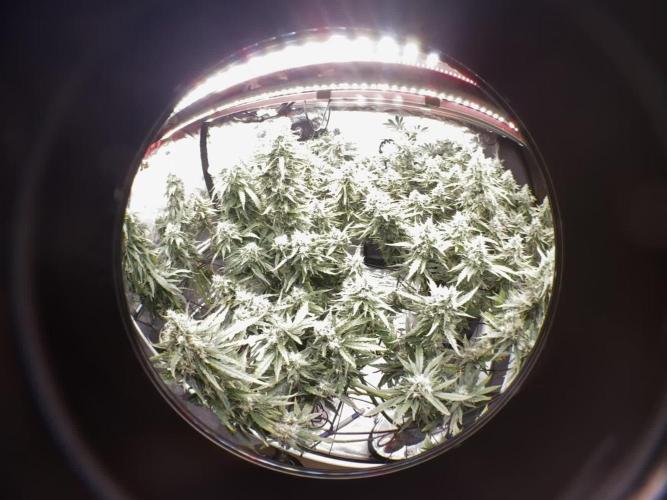
Canopy Adjustment: To ensure an even light spread, I’ve raised the Wonder Pie by placing it on a container. Now, all tops are leveled for maximum photon absorption.
The "Draft" Hack: To combat the late-flower heat, I’ve implemented a new ventilation strategy. By opening windows in both the grow room and the adjacent room, I’ve created a cross-ventilation effect (draft).
Temperature Drop: Success! I managed to drop the peak temperatures from 30°C down to a perfect 24°C. This drop is crucial for preserving terpenes and increasing resin production as we head toward the finish line.
Current Specs: pH 5.8, PPM 1000. Stability is the name of the game right now.

Processing
Likes
12
Share


@rhodes68
Follow
8/24 Week 6 Flower
Reducing Grow nuets will Increase Bloom as we go.
Want a lower EC with lots of runoff for tonight, been pretty high and its going up from here.
Looking good what to say?
Stretch has started but its very reasonable
8/25
Nuets changed to all Bloom 8ml/gal A&B and Koolbloom 1ml/gal
EC at 1500 see if we can keep this until ripening
8/26
Resuming twice a day feeds
8/27
Giving a dose of Kangaroots for their early flower root building this is the last of that.
Defoliated lowers removing all under growth
Tent is getting pretty full ... maybe they are like goldfish...
8/28
Growing @ 1/2 - 1 inch per day still
8/30
End of week six so Recharge for everyone! 2.5ml/gal one time
The girls look great

Processing
Likes
2
Share


Likes
13
Share


@Sublyme_ness
Follow
Stocky plant, thick stem.
Mutations continue. Some looks like tobacco mosaic but I doubt it.
Thrips seem to avoid this plant comparative to my others at present.

Likes
8
Share


@MaxGrowCanada
Follow
Moved the plants into their flowering space, will probably veg for another week as I am slow on the lighting.
Wondering, at this point, if I should just flower at 25w each..
End ppm and ph at 400 and 6.5 respectively, start at 720 and 5.8
Likes
10
Share

@AestheticGenetix
Follow
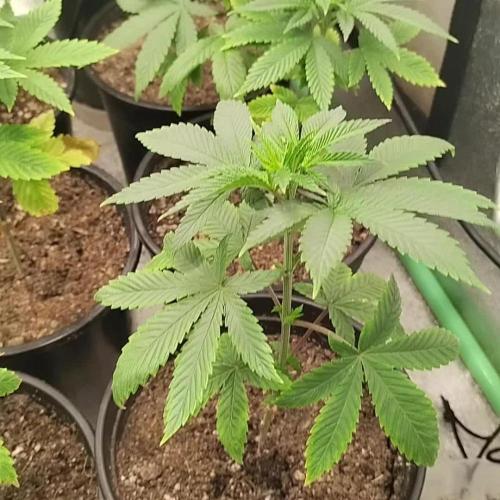
Been on 12/12 for about 10 days.
Some of the plants are starting to shift and show sex. Can't tell for sure what's what. But in the next couple of days I should have know for sure


Likes
Comments
Share


@german_growing
Follow
Really nonflexibal cells - breaks very easylie when low stress trained with Bud Clips
But she recovered every stem break and growing healthy and vigorously
Likes
24
Share


@FlynnRyder
Follow
What is up you sexy displays of humanness? It's week something lol.. 9 I think. I always forget if a week is passed then counted or vice versa lol. The plants look waaaaay better from the first time I flowered. I think the environmental controls like the AC and the light distance are finally all getting locked in. I could be messing up nutrients but based on what I see I'm not burning or underfeeding to my knowledge. I'm praying for that last fattening week for these things to bulk up because I'm pretty sure they have maybeeeeee 2 weeks then a 3-day flush. Yall are the experts though so feel free to weigh in. Especially with the plants looking all over the place. Ill bust out the electronic microscope for some trichome pics next week closer towards harvest time. I keep reading it's a long flower and they still have a lot of white pistons. Plants are hella icier though compared to the first run, they look stickier, and overall I'm feeling more accomplished. I can't tell if I'm leagues away from pulling 1 lb per plant. Now the right light...... ugh.. idk why but I was trying to get my damn BN link dual timer programmed bc I have the closet in there still vegging and once I plugged everything in that right light had half the board go out again. This happened a while back and after I've checked all the connections it just randomly came back on one day and I have not questioned it over the months. Kinda pissed I cant have 1 smooth day but that's life I guess haha. oh weird question but my rooms are completely sealed. they don't really have ducting or new air pumping in. Could the plants be suffocating themselves getting that big and flowering in a closed room? I've heard the air you breathe is more than enough most time and I don't want to burn unnecessary money but If they are logically just not getting enough Co2 to transpire then.. ya.. you get my point lol. Oh and I scratched the pk 13/14 bc i felt like I was pushing my luck with it only recommended for 1 week and also it's about the end of my knowledge so I figured cutting something extra was the safe bet. the leaves are all dark too

Likes
16
Share


@nurari
Follow
Растем! Наконец то бутоны начали бурное развитие, одна девочка очень радует, другие отстают наверное на неделю. Уже чувствую что урожай будет хорошим. Дал последний раз убойную дозу Дельта 9. Надеюсь что сбор урожая будет в первых числах декабря
Likes
Comments
Share


