


Likes
Comments
Share


@madlangs
Follow
Being harvested in two days. What a lovely easy problem free grow.


Likes
34
Share


@MarsHydroLED
Follow
The ladies got 2 more days then they’re getting the chop ✂️
Harvest time is coming~ So excited!! 😋
Likes
24
Share


@Doubleb84
Follow
Great harvest! Ended up a little shy of 12 ounces from the two plants, all super dense sticky top buds!! It’s smooth, flavorful and strong! Love it!

Likes
10
Share


@SkunkyDog420
Follow
Hallo zusammen 🤙.
Sie wächst sehr schön und macht keine Probleme
Rabattcode für den BIOTABS-Webshop https://biotabs.nl/en/shop/ GDBT420, damit erhalten Sie 15 Prozent
Likes
55
Share


@Roberts
Follow
Fruity Pebbles autoflower #1 is growing great. She love the Medic Grow Mini Sun-2 light, and distance I have her at. She is looking really good, and I have done some training today. Lst, defoliation, and roots pruned. Can see the ball of roots that developed from prior pruning, and roots spreading out wider vs longer. She looks like she is gonna start her pre flowering very soon. Thank you ILGM, and Medic Grow. 🤜🏻🤛🏻🌱🌱🌱 Merry Christmas and Happy Holidays everyone.
Thank you grow diaries community for the 👇likes👇, follows, comments, and subscriptions on my YouTube channel👇. ❄️🌱🍻
Happy Growing 🌱🌱🌱
https://youtube.com/channel/UCAhN7yRzWLpcaRHhMIQ7X4g


Likes
19
Share


@Naujas
Follow
The girls look good :) I have never raised without LST, this time it will be just like that :)

Likes
20
Share

@Northern_Ent
Follow
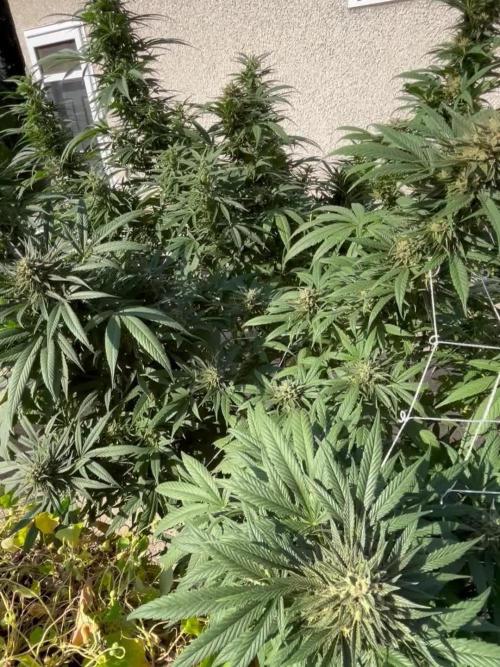
Aug 30: it’s still hot (too hot at peak for photosynthesis) so lots of water, watering outside of growbag, etc to cool things off a bit.
Sep 1: almost ready. Found a dried leaf and a spot of bud rot which was immediately removed. Main tops are almost ready and I’ll start harvesting this one later this week.
Sep 2: buds are looking pretty ready (at least the tops) and the pistils changed colour last night. Heatwave is now past and now we’re into a couple days of smoke from fires in the NWT. Sucks, but at least this is the first serious smoke here this year.
Sep 4: decided to do a chemical flush this year. Great buds last year but didn’t burn well because of excess P in late flowering. Considered another flush product but looking at the MSDS sheets that stuff had ‘editic acid’ which is an obscure but acceptable name for EDTA. That is a very strong chelating agent which will remove salts effectively but I’d rather avoid it. In contrast, Final Flush from Grotek has potassium sorbate (generally recognized as safe food additive) and good old citric acid which is a chelating agent but not as strong as EDTA. Similar products but citric acid is more gentle and the plant still gets some potassium.
Sep 5: don’t take flash pics of photoperiod plants unless you follow up with a far red light.

Likes
8
Share


@Salokin
Follow
All went very well this week. She is drinking like crazy and reservoir needs to be changed almost every 4 - 5 days. he buds slowly start getting frosty and I hope that they will fill up the internodal spacing nicely.

Likes
21
Share


@3lementa1
Follow
Had to cut. Open house through my apartment for 4 hours/day every day basically until it sells. I'm keeping them hanging in the window until the tours come through, then they go in a paper bag in a bin under my bed and I burn incense. It went ok today. I just used a microscope and they're both pretty early. This one has mostly cloudy trichomes with some clear and very few amber. The White Widow has a lot of white hairs that aren't even through growing, and the trichomes aren't really there as much either. Certainly not glowing white with resin. It's a shame I had to cut early but I think it will still be some good smoke as long as I can keep if from going mouldy.
Likes
15
Share


@GreenEldritchGardens
Follow
Still recovering at a slow pace, now her sister is bigger than her. But I still think she is worthy.
moving this week to a bigger a more reflective tent also with more light, let’s see how she responds .

Likes
6
Share


@TGriner420
Follow
This week they did more stretching as you can see the one on the left is into and above the light! I can't believe this but I'll role with it! I slowly defoliate just a little here and there between watering and filling the humidifiers. They really like to eat! Also, something to note that is they love the humidity as well as the warmth. I had to clean the outside of their grow bags this week. To my surprise the roots are starting to come out the bag! I can't believe it but this is awesome! Now they'll die due to contact with the air, and in return get bigger to take in even more nutrients! As predicted they fell off because their little pieces are on the floor. Well I fed and watered them daily. Like normal whenever I fed them either nutrients or soil amendments I made sure to water the plants with plain pH balanced H2O the next day in order to flush them. Then I would do any soil amendments if needed. After that plain pH balanced H20 and then you could do another fertilizer nutrient for them. After that pH balanced H20 and then you return to the soil amendments if needed. That way every other day you're feeding soil then pH balanced H20 then nutrients then pH balanced H20. This will allow you to monitor pH imbalances, nutrient burn, or any subtle changes you need to make you can catch it before it happens hopefully!

Likes
37
Share


@RFarm21
Follow
Foram regadas no dia 11/07/2021, 3 plantas com um total de 5L . E.C 0,43.
A R.Gorilla 2 foi regada com 1,5L e foi a primeira vez que foi alimentada. E.C 0,16 / pH 6.2
R.Juice - 2ml ; Bio Heaven - 1ml ; Activera - 0,5ml ; calmag - 0,2 ml ;
Ansioso para ver os resultados do LST, na royal gorilla 2 ( a mais pequena ) irei fazer o lst mais cedo e tentar não dobrar tanto o caule junto ao solo para ver as diferenças.
Será que fiz bem?

Likes
12
Share


@StarfishSmallBatch
Follow
This week I've been maintaining the new seedlings, helping a growmie with some trimming work and staying on top of my flower tent to the best of my ability.
Mr. Wowie took down the first plant from his harvest of some Killer Queen bag seeds he had been saving for a few years. He was able to microscope out his trichomes well, with a 45x microscope with a display screen, he got from Amazon. This tool gave him a way better view than a jewelers loupe. He was able to take the plant down after a dry, and we trimmed it up. We were able to use our Cannabrush Trim Brushes, our Harvest More Trim Bins, and two pairs of snippers too make short work of it. The buds came out awesome! Shout out to the homie on the harvest!
As for my garden today I went ahead and gave the seedlings and the companion clones in the same tent, a dose of Mykos WP with the Trinity from Roots Organic. The Trinity has a Black Strap Molasses, Saponin blend (Q and Yucca), and added Kelp Extract which I've noticed works great when combined with the Mykos WP. Temps have been around 77-79 daily and humidity around 50%. I have been able to start using my hand sprayer instead of a spray bottle for watering now, since the seedlings are now large enough to be watered instead of misted. I'm still using the AC Infinity Seedling Fan in the tent to provide a little air flow. I'm hoping to get another 14 days or so out of these little seedling pots, then I plan on transplanting to half gallons until I can finish my flower run to save tent space.
Ethos Lilac Diesel #22 (x) Grandpa's Cookies #7- The Ethos Seedling has been growing awesome! It looks like it should start its full vegetative growth stage soon! It has been drinking it's water in it's seedling pot nicely. It no longer needs its bread tie and binder clip support I made for it and stands tall on its own. It's leaves are green and begining to come in almost daily. It still stands at 6 inches, so it looks like it finally found a PAR range it wants to be in and stopped it's stretch. Good for me. I now have the PPFD sitting at around 110.
HSO/ Geist Grow Tow Truck- This seedling still looks weird! Its two leaves have a white strip across them and don't look very healthy. The new growth being generated by the plant appears lush and green so I believe it's growing out of whatever is going on. It surely hasn't stopped drinking water, it still keeps up with all it's companion plants and has been growing new growth and keeps on trucking! No pun intended 😅 I'll remove the effected leaves once there are a few more leaves available for the plant to use. It stands at 3 inches tall and hasn't had any trouble standing up since sprouting.
Raspberry Ripple (Flower Tent)- The Flower Tent is on day 25, The number one phenos are doing awesome in the larger 15 gallon grassroots pots with cover crop. The number two phenos are in 5 gallons again this run but also seem to be doing better than last time and the nugs are larger than last time at this stage in flower. I'm not sure if this is to do with the new light (HLG Blackbird) or because I've been doing a slightly heavier feeding of build a flower this run or maybe because i used light doses of build a bloom weekly for the first 3 weeks. Im chalking it up to a combination of everything. I reammended some old soil to use in the 15 gallon pots. I also mixed it with new soil at a 50/50 ratio. This worked well but I could tell it was lacking a little at first. After a few waterings and a build a bloom feeding it all sorted out. I've been plucking some awkward leaves here and there! But this run is coming along well!
That about sums it up for this week! Thanks for checking out my grow diary! -Starfish


Likes
2
Share

@CaveGanja
Follow
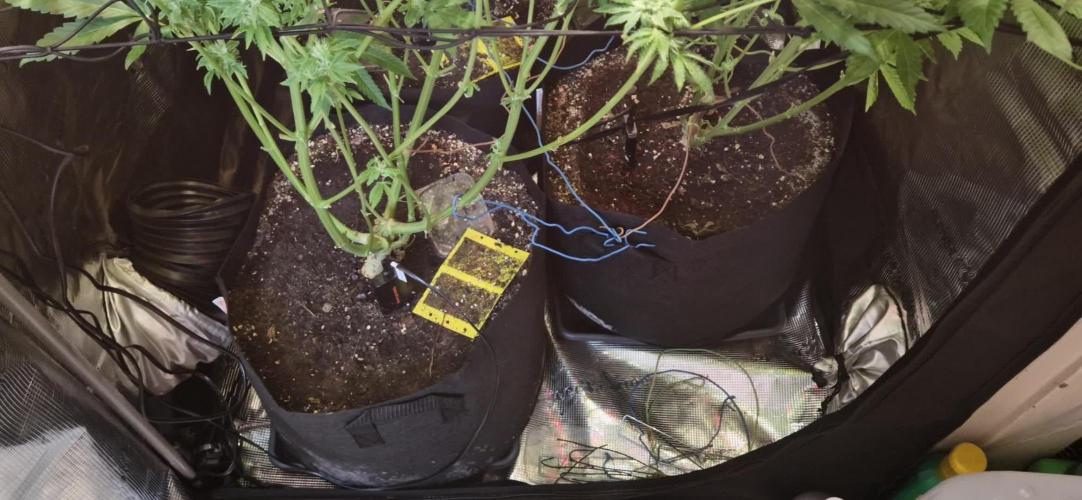
Every day i open the tent the only thing i think is pls dont let me spot budrot.
Plants donig well i have 3 fans on max lvl and my dehumidifier 24/7 runnig.
I use less fertilizer.
last week i forgot to turn on 2 fans for 24h gives me the bad feeling you f*** up but still all seems fine.
Likes
44
Share


@Jays_Not_Here_Man
Follow
This was the girls 1st full week of flower. They have done great, lots of stretch, small buds starting to form, and lots of praying 🙏 They have been pretty easy so far, I hit the barrier for these girls with nutrients, burnt the tips a bit , despite that, they have shown no issues. Looking forward to these girls finishing (as always) but they have been lab tested by other home growers who hit 3-4% terpenes, and close to 29% thc

Likes
4
Share

@DogDoctorOfficial
Follow
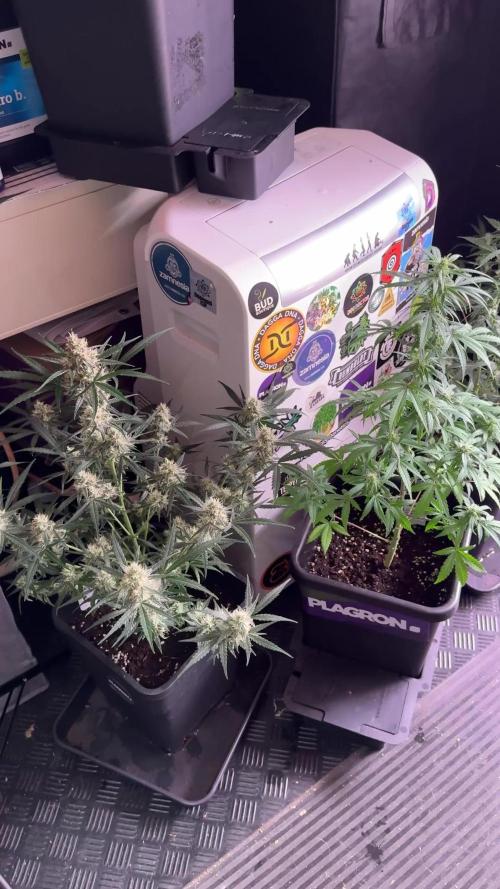
💜 Purple Haze by Zamnesia – Pheno A Week 8 | Let Her Shine
Welcome back to another chapter of the 8×8 Adventure!
Eight weeks into flowering, Purple Haze Pheno A continues to prove that sometimes the best thing a grower can do is simply step back and let the plant speak.
And this girl has plenty to say.
She's green.
She's vigorous.
She's developing beautiful flowers.
She's covered in healthy foliage.
And honestly?
I have very little to complain about.
While some of the other girls in this room have recently received defoliation to improve light penetration and airflow, Purple Haze Pheno A is taking a different path.
For now, I'm leaving her exactly as she is.
She's leafy, yes.
But she's also healthy.
And there's an important difference.
So this week, rather than forcing her into a particular shape, I'm going to let her shine exactly as she wants to.
🌱 One Room. One Method. Twelve Different Personalities
If this is your first visit to the diary, welcome!
The entire 8×8 Adventure is built around one fascinating experiment:
12 different genetics.
One environment.
One growing method.
One nutritional strategy.
Every seed in this room was placed directly under a 12/12 light schedule from seed.
There was no long traditional vegetative period.
Instead, the plants were given the opportunity to reveal their genetic personalities under the same conditions from the very beginning.
The same:
• Plagron nutrition
• Future of Grow Black Series lighting
• TrolMaster environmental control
• AutoPot irrigation
• Soil
• Temperature
• Humidity
• Light schedule
• General care
There are no favourites.
No special feeding.
No individual environmental adjustments.
The variables are intentionally kept as consistent as possible.
The biggest variable left in the equation is genetics.
And Purple Haze Pheno A is showing us a personality that is becoming increasingly easy to recognize.
💜 Purple Haze Is Finding Her Rhythm
Some phenotypes announce themselves immediately.
Others take time.
Purple Haze Pheno A feels like the second type.
She hasn't been the tallest girl in the room.
She hasn't been the fastest.
She hasn't needed to dominate the canopy.
Instead, she's quietly developed into one of those plants that becomes more impressive every time you look at her.
The colour alone is beautiful.
Her foliage has that deep, rich green that immediately catches the eye.
The leaves remain large and well developed, with strong petioles and excellent overall structure.
And then you look underneath that foliage...
…and the flowers are there.
Lots of them.
Healthy flowering sites developing throughout the plant, with increasingly defined bud structure and plenty of visible resin production.
She's not screaming for attention.
She's simply doing her job.
And doing it beautifully.
🌸 Week 8 — What Is Actually Happening?
This is an interesting point in the flowering cycle.
By Week 8, we're no longer looking at the early formation of flowers.
The plant has already made that transition.
Now the focus increasingly shifts toward flower maturation, calyx development, resin production and overall bud density.
The plant is still photosynthesizing aggressively.
Those large fan leaves are still important energy-producing organs.
The flowers continue developing.
The calyxes continue swelling.
Resin production becomes increasingly obvious.
And the plant gradually begins moving from building the structure of the flowers toward finishing and ripening them.
But there's an important distinction here.
Week 8 does NOT automatically mean "harvest soon."
A calendar tells us how long the plant has been flowering.
It doesn't tell us exactly when the plant is finished.
Different genetics mature at different speeds.
Different phenotypes within the same genetic line can also mature differently.
That's exactly why we're watching the plant rather than simply counting weeks.
🍃 And What Week 8 Is NOT
Week 8 also doesn't automatically mean:
"Remove all the leaves."
This is something I think is worth documenting because this girl provides a perfect example.
There is a tendency to think that once flowering reaches the later stages, a plant should automatically be stripped down.
But defoliation is a tool, not a flowering requirement.
If a leaf is healthy, photosynthetically active and contributing to the plant, its size alone isn't a reason to remove it.
Purple Haze Pheno A is certainly leafy.
But look at her.
The flowers are developing.
The foliage is healthy.
The plant is not showing obvious signs that it is struggling under its own canopy.
So why interfere?
For now, I'm choosing not to.
🌿 Let Her Be
This is probably the biggest lesson from this week's update.
Not every plant needs the same intervention.
Some of the girls in the 8×8 Adventure have benefited from defoliation.
Purple Haze Pheno A isn't one of them—at least not yet.
Her natural architecture is working.
She's producing flowers throughout the plant.
She's maintaining excellent colour.
She's maintaining healthy foliage.
And most importantly, she doesn't look like a plant asking me to solve a problem.
So I'm not going to create one.
I'll continue monitoring airflow, humidity, light penetration and the development of the lower flowering sites.
If the plant gives me a reason to intervene, I'll respond.
But until then...
she gets to be herself.
💡 The Light Reaches More Than Just the Top
The addition of the Lumiflora under-canopy lighting continues to make this experiment particularly interesting.
Traditional top lighting naturally gives the upper canopy the greatest photon exposure.
As plants develop, the lower portions can receive considerably less usable light.
The under-canopy lighting gives those lower areas another source of illumination.
And this is exactly where I want to observe rather than assume.
Will the lower flowers continue developing strongly?
Will flower density become more uniform throughout the plant?
Will the additional light allow me to maintain more foliage without compromising the lower canopy?
These are the questions that make this project so interesting.
We're not simply trying to produce a harvest.
We're observing how different phenotypes respond to the same ecosystem.
And Purple Haze Pheno A is giving us another opportunity to learn.
💧 Feeding This Week
The nutritional strategy remains consistent with the flowering program.
This week's feeding includes:
• Terra Bloom – 2.2 ml/L
• Power Buds – 1 ml/L
• Green Sensation – 1 ml/L
• Sugar Royal – 1 ml/L
• pH Plus – 0.03 ml/L as required
• Lemon Kick – 0.03 ml/L as required
The goal at this stage isn't simply to push more and more nutrition.
It's about maintaining a balanced environment where the plant can continue performing without unnecessary stress.
Purple Haze Pheno A is responding beautifully to the current strategy.
Her foliage remains strong.
Her flowers continue developing.
And visually, she is telling me that she's comfortable.
That's exactly what I want to see.
🌡️ The Environment
Consistency remains one of the strongest foundations of this entire project.
Current conditions:
• Flower Week: 8
• Height: 120 cm
• Light Schedule: 12/12
• Day Temperature: 29°C
• Night Temperature: 25°C
• Relative Humidity: 60%
• pH: 6.0
• EC: 2.0 mS/cm
• Solution Temperature: 22°C
• Substrate Temperature: 21°C
• CO₂: 639 ppm
• Pot Size: 15 L
• Watering: 1.2 L per plant / 24h
One of the things I particularly enjoy about this project is that these numbers aren't being adjusted specifically for Purple Haze.
She is living inside the same ecosystem as the other phenotypes.
And she's responding beautifully.
📸 A Closer Look at Purple Haze
The photographs this week really tell the story.
The wide shots show a plant with a strong natural structure and a considerable amount of healthy foliage.
The closer photographs reveal something even more interesting.
Her flowers are becoming increasingly defined.
The resin coverage is becoming more obvious.
Pistils are beginning to transition in colour while fresh white pistils continue appearing across the flowers.
And those sugar leaves are already carrying an impressive layer of trichomes.
This is one of those plants where you can look at a photograph and immediately understand why I keep saying:
She's beautiful.
Not because she's the biggest.
Not because she's the tallest.
Not because she has been aggressively trained.
Simply because everything appears to be working together.
💚 The Beauty of Not Interfering
There's a strange discipline involved in growing plants.
Sometimes we think we're supposed to constantly do something.
Trim something.
Tie something.
Remove something.
Change something.
Adjust something.
But growing also teaches you when not to touch the plant.
Purple Haze Pheno A is currently giving me that lesson.
She's telling me:
"I'm good."
So I'm listening.
I'm going to continue observing her canopy, her flowers, her environment and her overall health.
If she needs something, I'll respond.
If she doesn't...
I'll let her shine.
🔮 Looking Ahead
The coming weeks should become increasingly interesting.
Flower development will continue.
The calyxes should continue swelling.
Resin production should become even more apparent.
And eventually, the conversation will shift from building flowers toward determining when those flowers are actually mature.
But I'm not going to rush that process.
We're going to watch the plant.
We're going to watch the flowers.
We're going to watch the trichomes when the time comes.
And we're going to let Purple Haze Pheno A tell us when she's ready.
For now, she's still working.
And she's doing a beautiful job.
💜 Let Her Shine
Week 8 has given me something I really appreciate about phenotype hunting.
Not every beautiful plant needs to be manipulated into looking beautiful.
Sometimes the genetics already know what they're doing.
Purple Haze Pheno A has developed into a lush, healthy and increasingly impressive plant.
She's leafy.
She's vigorous.
She's green.
She's producing flowers beautifully.
And right now, I don't see a reason to change that.
While some of her sisters have gone through defoliation, this girl gets to remain in her natural state for a little longer.
Because this isn't about making every plant look identical.
It's about discovering what each phenotype wants to become.
And Purple Haze Pheno A?
She's becoming something very special.
So for now...
No unnecessary intervention.
No stripping just because the calendar says Week 8.
No trying to force her into someone else's shape.
Just observation.
Patience.
And appreciation.
Let's make this girl shine. 💜🌿
🙏 Thank You
Thank you so much for following another chapter of the 8×8 Adventure.
Every week this project becomes more fascinating.
Twelve plants.
One environment.
Twelve completely different personalities.
That's the beauty of growing from seed.
A huge thank you to:
💚 GrowDiaries for providing a platform where growers from around the world can document, learn and share.
🌱 Zamnesia for providing the Purple Haze genetics that allow me to explore this phenotype.
💜 Plagron for the nutrition supporting this entire project.
💡 Future of Grow LED for providing the lighting driving the canopy.
🌿 TrolMaster for helping maintain the stable environment behind the scenes.
✨ Lumiflora for bringing under-canopy lighting into the experiment and giving me another variable to observe.
And finally, thank you to everyone following along, commenting, asking questions and sharing the journey.
Every plant has a story.
Purple Haze Pheno A is writing hers slowly.
Beautifully.
And without asking for much attention.
Sometimes the best thing a grower can do...
is simply step back and watch.
Growers Love! 💜🌿

Likes
2
Share


@autofloweronly
Follow
Starting to see some frost not much but the smell is dank. Can’t wait to exhale the smell and hope it get me high as hell. This stage of growing is slow. I guess because you are always looking at the clock. “Is she ready yet”
Likes
13
Share

@Stork
Follow
Day 84 Mon
Add Water
PH 6.1- 6.0
EC 0.7 - 0.5
DLI 12h
PPFD
Water 18c
Day 85 Tue
PH 5.9
EC 0.5
DLI 12h
PPFD
Water 18c
Day 86 Thu
PH 6.0
EC 0.5
DLI 12h
PPFD
Water 22c
Day 87 Fri
PH 5.9
EC 0.5
DLI 12h
PPFD
Water 17
Day 88 Sat
PH 6.0
EC 0.5
DLI 12h
PPFD
Water 18c

Likes
14
Share


@Terpyboyz
Follow
So this grow came to a finshed but I had a. Few issues that’s held me up from finishing up the diary, but in due time I will reupload it all in order soon. But over all I will also update with a final weigh in of each strain produced so stay tuned 🤙🏻🔥


