Processing
Likes
Comments
Share
@UrbanFog
Follow
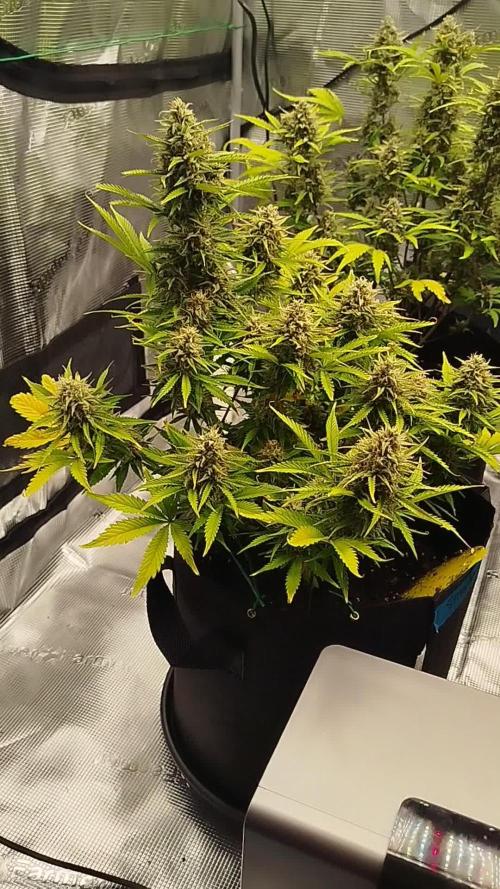
Growth has been good even with serious power / lighting issues. But with effort the plants had very little down time. The heads are starting to look thicker and continue to stack and grow. Some of the plants are more frosty then others but that is pheno variation more than anything. Really looking like we may have a substantial yield in the next 5-6 weeks. The plants are being watered heavily with 2-3 day long dry periods and it seems to make the growth after a feeding just insane.
Likes
2
Share
I ran out of beastie blooms so I went ahead and switched to sonic blooms. It's a lot stronger than beastie so we will see if there is a difference. But here we are at week 4. Everything is going pretty smooth, I did a res change. Been changing around every 14 days I notice a little nitrogen build up if I go any longer than 14 days. Very low nitrogen feeding plant
Likes
140
Share
@MrJones
Follow
mrjones - Slurricane #7 S1 🌱Slurricane #7 S1 @inhousegenetics_official 👨‍🌾🏽GD Grower: MrJones 🔹🔹🔹🔹🔹🔹GOALS🔹🔹🔹🔹🔹🔹 🌞Environment - 75/80℉ and 55% Humidity 💧 Feeding - Advanced Nutrients Organic ⚗️Soil - 50% Ocean Forest / 20% Tupur Royal Gold / 10% Earth Worm castings / 10% lobster Compost / 10% Additional Perlite 🍃Training / HST, Will be topping, Cloning, and creating larger plants, and placing to flower under a trellis 🕷️ IPM - Will be using Green Cleaner" 1 OZ per Gallon, and CannControl from Mammoth alternating between product each month for Integrated Pest Management. 💡Mars Hydro LED / Veg Geeklight Monster Board 480W V4 / Flower 480W FC 4800 🔹🔹🔹🔹🔹🔹🔹🔹🔹🔹🔹🔹🔹🔹🔹 📜 Rambling - With week 8 coming to an end, this week was spent with cloning, they are 1 week old as of today and so far they look great above the soil, started venting a little more, and over the next week will be hardening them and getting them ready to go into the veg tent. The nutrients have also been cut back to 50% with a PPM of 500. 🔹🔹🔹🔹🔹🔹🔹🔹🔹🔹🔹🔹🔹🔹🔹 ▶️ Sunday - 03.28.21- These plants are recovering well from being cut back and cloned.- Fed girls with 30 ounces, they keep getting larger ▶️ Monday - 03.29.21- Fed with 40 ounces of nutrients at 50% strength. the plants are looking great. ▶️ Tuesday - 03.30.21- Fed with 40 ounces of nutrients at 50% strength. the plants are looking great. ▶️ Wednesday - 03.31.21- Fed with 40 ounces of nutrients at 50% strength. the plants are looking great. ▶️ Thursday - 04.01.21- Fed with 40 ounces of nutrients at 50% strength. the plants are looking great. ▶️ Friday - 04.02.21- Fed with 40 ounces of nutrients at 50% strength. the plants are looking great. ▶️ Saturday - 04.03.21-Feeding at 50% has allowed the plants to recover and are looking great. 🔹🔹🔹🔹🔹🔹🔹🔹🔹🔹🔹🔹🔹🔹🔹 📜 Cultivar Information - In House Genetics - Slurricane #7 S1 🔹🔹🔹🔹🔹🔹🔹🔹🔹🔹🔹🔹🔹🔹🔹
Likes
13
Share
So, eventful week. Prior to putting my seeds into my system, my light and rdwc system was left on as I was dialling in the growing environment before placing the seeds as a final home. My only issue was I had a light leak BEFORE putting the foil top covers on the clay pebbles. Long story short, I got algae which ended up turning to root rot. I spotted it very swiftly and did a res change adding beneficial bacteria to the system along with the base products of remo nutrients. A few days later new growth and recovery is taking place. Day 16- Fully back on track, new roots shooting out into the water and the growth rate has picked up as it should. Foliar feeding twice a day for a little boost until the root system establishes a bit more. Huge changes in just a day. Can't wait to see what a week's growth looks like. Really loving the sunset/sunrise feature on the trolmaster, something I got to experience watching recently! Watching by closely to make sure everything stays in track. Stay tuned for the next one 😉
Likes
4
Share
@Kekkonen
Follow
Two of the plants had little bit of powdery mildew so I defoliated those leafs. Also sprayed them with baking soda, liquid soap and water mixture. Hopefully we don't find any more of that. Otherwise everything seems good they are healthy and growing well.
Likes
190
Share
@Herbalize
Follow
Hello folks Havest Day 64 of flowering ( Life cycle 99 days ) Drying with 62% RH--18/21°C since 10 Days Now everything is in jar and in a week or more, I would add my little boveda pack 62% for a good storage Overall everything went well ! The Moby Dick 1 give me 115g of dry buds The Moby Dick 2 give me 97g A very good weight with 400w, really impressive,and look at these colas😵💪 The taste is good but not my favourite, i dont like the haze aftertaste I think ,1 month curing will improve that 👌 Thanks to all who comment / like either to encourage or give advice GD community are The Best 🙏😻 see you soon guys 😘 Peace Love and Weed00
Likes
56
Share
Once again she passes my expectations, late to the show with trichome production. I'm surprised there is purple on the bud, maybe Purpinator does work. I thought I could see hints under the grow lights and thought my eyes were deceiving me, I was just being hopeful. But nah 2 of the 3(under the UV) have developed a beautiful tone of purple. I was never going to bother with a deep freeze but maybe the whole bud will change given conditions, that would be something, fingers crossed. 🤔 was a little skeptical that reducing temps humidity would change density, but it does, buds are solid something I've not been able to achieve before. Rule of thumb is never to surpass 60% RH in the flowering phase and try to progressively reduce it down to 40% in the last 2–3 weeks before harvest. The plant will react as it seeks to protect its flowers, responding by producing denser buds and a higher concentration of resin. Cannabis plants are sensitive to sudden temperature changes, especially in the flowering stage. Extreme heat or cold can impact bud density and overall yields. In nature as a defense mechanism from cold, the plant sensing sudden dips in temperature will attempt to remove the pockets of air within the bud, it achieves this by compacting itself in doing so to better protect itself from cold snaps which are normally indicators in nature that worse weather is on the way. Terpene levels are the highest just before the sun comes out. Ideally, you want as many terpenes present in your plants as possible when you harvest. Cannabis plants soak up the sun during the day and produce resin and other goodies at night. The plant is at its emptiest from "harvest undesirables," so to speak,k right before the lights come on. Freshly cut buds are greener than dried buds because they still contain loads of chlorophyll. However, when rushed through the drying process, the buds dry but retain some chlorophyll, and when you smoke it, you will taste it. Chlorophyll-filled buds are smokable, but they aren’t clean. Slow drying gives the buds enough time and favorable conditions to lose the chlorophyll and sugars, giving you a smoother smoke. How the plant disposes of the chlorophyll and sugars by a process of chemically breaking them down and attaching the decomposed matter once small enough to water molecules, which then evaporate back into the ether. Time must be given to the process to break down the chlorophyll and sugars. Think of it like optimizing the environment for decay. Plant growth and geographic distribution (where the plant can grow) are greatly affected by the environment. If any environmental factor is less than ideal, it limits a plant's growth and/or distribution. For example, only plants adapted to limited amounts of water can live in deserts. Either directly or indirectly, most plant problems are caused by environmental stress. In some cases, poor environmental conditions (e.g., too little water) damage a plant directly. In other cases, environmental stress weakens a plant and makes it more susceptible to disease or insect attack. Environmental factors that affect plant growth include light, temperature, water, humidity, and nutrition. It's important to understand how these factors affect plant growth and development. With a basic understanding of these factors, you may be able to manipulate plants to meet your needs, whether for increased leaf, flower, or fruit production. By recognizing the roles of these factors, you'll also be better able to diagnose plant problems caused by environmental stress. Water and humidity *Most growing plants contain about 90 percent water. Water plays many roles in plants. It is:* A primary component in photosynthesis and respiration Responsible for turgor pressure in cells (Like the air in an inflated balloon, water is responsible for the fullness and firmness of plant tissue. Turgor is needed to maintain cell shape and ensure cell growth.) A solvent for minerals and carbohydrates moving through the plant Responsible for cooling leaves as it evaporates from leaf tissue during transpiration A regulator of stomatal opening and closing, thus controlling transpiration and, to some degree, photosynthesis The source of pressure to move roots through the soil The medium in which most biochemical reactions take place Relative humidity is the ratio of water vapor in the air to the amount of water the air could hold at the current temperature and pressure. Warm air can hold more water vapor than cold air. Relative humidity (RH) is expressed by the following equation: RH = water in air ÷ water air could hold (at constant temperature and pressure) The relative humidity is given as a percent. For example, if a pound of air at 75°F could hold 4 grams of water vapor, and there are only 3 grams of water in the air, then the relative humidity (RH) is: 3 ÷ 4 = 0.75 = 75% Water vapor moves from an area of high relative humidity to one of low relative humidity. The greater the difference in humidity, the faster water moves. This factor is important because the rate of water movement directly affects a plant's transpiration rate. The relative humidity in the air spaces between leaf cells approaches 100 percent. When a stoma opens, water vapor inside the leaf rushes out into the surrounding air (Figure 2), and a bubble of high humidity forms around the stoma. By saturating this small area of air, the bubble reduces the difference in relative humidity between the air spaces within the leaf and the air adjacent to the leaf. As a result, transpiration slows down. If the wind blows the humidity bubble away, however, transpiration increases. Thus, transpiration usually is at its peak on hot, dry, windy days. On the other hand, transpiration generally is quite slow when temperatures are cool, humidity is high, and there is no wind. Hot, dry conditions generally occur during the summer, which partially explains why plants wilt quickly in the summer. If a constant supply of water is not available to be absorbed by the roots and moved to the leaves, turgor pressure is lost and leaves go limp. Plant Nutrition Plant nutrition often is confused with fertilization. Plant nutrition refers to a plant's need for and use of basic chemical elements. Fertilization is the term used when these materials are added to the environment around a plant. A lot must happen before a chemical element in a fertilizer can be used by a plant. Plants need 17 elements for normal growth. Three of them--carbon, hydrogen, and oxygen--are found in air and water. The rest are found in the soil. Six soil elements are called macronutrients because they are used in relatively large amounts by plants. They are nitrogen, potassium, magnesium, calcium, phosphorus, and sulfur. Eight other soil elements are used in much smaller amounts and are called micronutrients or trace elements. They are iron, zinc, molybdenum, manganese, boron, copper, cobalt, and chlorine. They make up less than 1% of total but are none the less vital. Most of the nutrients a plant needs are dissolved in water and then absorbed by its roots. In fact, 98 percent are absorbed from the soil-water solution, and only about 2 percent are actually extracted from soil particles. Fertilizers Fertilizers are materials containing plant nutrients that are added to the environment around a plant. Generally, they are added to the water or soil, but some can be sprayed on leaves. This method is called foliar fertilization. It should be done carefully with a dilute solution because a high fertilizer concentration can injure leaf cells. The nutrient, however, does need to pass through the thin layer of wax (cutin) on the leaf surface. It is to be noted applying a immobile nutrient via foliar application it will remain immobile within the leaf it was absorbed through. Fertilizers are not plant food! Plants produce their own food from water, carbon dioxide, and solar energy through photosynthesis. This food (sugars and carbohydrates) is combined with plant nutrients to produce proteins, enzymes, vitamins, and other elements essential to growth. Nutrient absorption Anything that reduces or stops sugar production in leaves can lower nutrient absorption. Thus, if a plant is under stress because of low light or extreme temperatures, nutrient deficiency may develop. A plant's developmental stage or rate of growth also may affect the amount of nutrients absorbed. Many plants have a rest (dormant) period during part of the year. During this time, few nutrients are absorbed. Plants also may absorb different nutrients as flower buds begin to develop than they do during periods of rapid vegetative growth.
Likes
7
Share
Day 39 - 26.06 Set new light, 200watt led plus new swing fan Day 44 - 01.07 - Defoliation 50 leafs cut
Likes
67
Share
@Natrona
Follow
2025 Plagron / Zamnesia Eternity Grow Week 8 2/23-3/1 Week 8 flower week 4 Runtz Auto is in full bloom, the buds are stacking up with several pistols are turning orange. Trichomes are just starting to form, and the buds are sticky with faint smell. I took off a few large fans. Because I over fed my gal, her leaf tips are burnt and edges yellowing so she is not as pretty as she should be. This week I am trying to remove excess fertilizer from the planting medium by giving ph6.5 water only. Ph 6.5 Temp 65 Your likes and comments are appreciated. Thanks for stopping by. Growers love 💚🌿 💫Natrona💫
Likes
57
Share
12/15: Some plants are taking too long to transition and stretching beyond my space constraints, so I dialed the photoperiod back to 12/12. 12/16: Fed today and rotated edge plants. Added another 150w of 3000k below the canopy. 12/17: Worked on ventilation...no A/C necessary now, as I'm using another AC Infinity 6" fan to intake outdoor air into the closet whenever temps reach 75f..and it's been cold as hell outside.👍 The final trick will be to replace the 6" exhaust fan with an 8" so as to be able to fully exchange the closet air faster ...but that's gonna have to wait til next season.
Likes
35
Share
@nonick123
Follow
Día 44 (15/07) Wow! No hay shock de trasplante! 😍💥😁 Todas las ramas se han estirado hacia arriba tras el ajuste de LST y se están formando nuevos nodos rápidamente Esta combinación de nutrientes de Lurpe + substrato de PRO-MIX HP es una maravilla 😍 Día 45 (16/07) Ayer tuvimos ola de calor (37 ºC) y han aguantado muy bien! A última hora de la tarde (cuando ya no había sol directo) les apliqué H2O en spray foliarmente para refrescar los estomas Hoy parece que vuelven las temperaturas estándar para esta época del año: 29 - 30 ºC en las horas centrales del día Riego con 1 litro de H20 pH 6,5 Día 46 (17/07) Pequeños ajustes de LST Hay algunas ramas inferiores que no se han formado / estirado mucho Lo más probable es que haga una buena limpieza este domingo, 7 días después del trasplante, para dejar solo los brotes por encima del 4º nudo Día 47 (18/07) Riego con 0,5 litro de H20 pH 6,5 Este domingo (día 50) haré limpieza de partes bajas y tal vez también de nuevo topping en las 4-6 ramas principales 😁 Día 48 (19/07) Día de muchísimo calor con 37 ºC. A ver como lo llevan! Riego con 0,5 litro de H20 pH 6,5 Día 49 (20/07) Para ayudarles a llevar mejor el calor de las horas centrales del día, coloca una malla de sombreo (70%) sobre el invernadero Lo cierto es que se nota que baja mucho la temperatura debajo de la malla! Van a estar más fresquitas! 😍 Riego con 0,5 litro de H20 pH 6,5 Día 50 (21/07) Training session! Hago limpieza del tercio inferior de la planta, de todas las ramas y nudos que no superan la línea del dosel marcada por el 4º nudo (1er topping) También hago topping (2º) a todas las ramas principales La idea es tener 12 ó 14 colas principales para que no se hagan muy altas De paso saco unos cuantos clones de las ramas inferiores eliminadas 😁💥 Para superar el estrés, hago las siguientes aplicaciones y riego: - Riego con 1 Litro de Té Vegetativo de Lurpe Solutions. Preparación: 24 horas con bomba de aire (oxigenación) con ingredientes: Green Sunrise 8 ml/L + Insect Frass 16 ml/L + Hummus Lombriz 8 ml/L + Melaza 1 ml/L + Kelp Hidrolizado 0,25 g/L - Aplicación foliar Kelp hidrolizado de Lurpe Solutions a 0,25 ml/l 💦Nutrients by Lurpe Solutions - www.lurpenaturalsolutions.com 🌱Substrate PRO-MIX HP BACILLUS + MYCORRHIZAE - www.pthorticulture.com/en/products/pro-mix-hp-biostimulant-plus-mycorrhizae
Likes
Comments
Share
Week 10 into this grow and just finished week 4 of flower. The girls are looking great and starting to smell just as great. Definitely some hungry hippos. Buds are filling in nicely. Already medium sized and still going frosty colas. Beautiful widow white with that pungent gorilla smell. Like I said before such a wonderful mix. Added a video this week of the girls and my canopy.
Likes
13
Share
@Stork
Follow
Day 104 Mon PH 5.8 EC 0.4 DLI 12h PPFD Water 16-24c Day 106 Wed PH 5.7 EC 0.4 DLI 12h PPFD Water 16-24c Day 107 Thu Add ph Up PH 5.4 - 5.9 EC 0.4 DLI 12h PPFD Water 16-24c Day 109 Sat PH 5.5 - 5.8 EC 0.4 - 0.5 DLI 12h PPFD Water 16-24c
Likes
116
Share
“Minds are like flowers; they open only when the time is right.”
Likes
18
Share
This lady was quite the pleasure to grow💯🤩 I just let her do her thing and this is the outcome 😍🙏 If I could only let you 👃 it’s insanely good I had no issues what so ever, other then she got very hungry and started to suck all nutrition from the big leaves 😳 Luckily I upped the fertiliser in time, and she finished quite nicely 💯🙏🌱💚 Final report will come when dried and put to in to jars 🤗
Likes
12
Share
Alrighty, we’re closing in on the final transplant (moving from 3L to 11L) which should really encourage lateral growth. The two Northern Lights plants are very compact, so I’m already working on opening up the canopy early to prepare for a proper SCROG. If we transplant within the next 7 days, we’re likely looking at flipping to bloom in about three weeks. As a newbie to photoperiods (I’ve only run autos before), the growth pace feels very different; slower and more deliberate. But I actually enjoy how much more control you have. You can really shape them the way you want. Next step: stretch that canopy wide and let the net do its magic. The screen is coming soon; let’s weave a green carpet. Stats so far: 💧 Watering: Every third day 🌡️ Temp: 26–28°C 💦 Humidity: 70% RH 📈 VPD: ~1.13 kPa 💡 Light: ~600 PPFD