


@ConspiracyFly
Follow
Gorilla Cookies Auto (Fast Buds)
Keep getting fatter
Week 11....6 week of flowering (80 days)
It has 64 centimeters
16L
This Week - Defoliation
Godzilla Cookies (Herbies)
Keep getting fatter
Week 10 .... 3 week of flowering (70 days)
It has 71 centimeters
15L
This Week -
Gorilla Glue Auto (Herbies)
It has 35 centimeters
7 Week...2 Week of flowering (45 days)
This Week - LST - Defoliation


@capogino
Follow
I probably won't grow this strain again, just due to the growing difficulties, short lifespan, and low yield, although the bud is definitely quality. I learned a lot as this was my first grow, and the next I'm hoping for better yield quantities.


@JeyGanesha
Follow
Siamo arrivati alla terza settimana anche con queste prosecco, l'ho toppata al 3°nodo. Sta crescendo super bene..come le altre...


@Samsemilla
Follow
Zweite Woche im Oktober, das Wetter wird immer unbeständiger, die trychome sehen gut aus - Zeit für die Ernte.
Ich habe erstmal einige Fächerblätter ohne Harzbesatz entfernt und den Rest zum trocknen aufgehängt.
Aufgrund von Platzmangel teils in Umzugskartons und teils im Netz.
Nach einer Weile habe ich die Blüten dann vom Stengel getrennt, Manikürt und ins Glas verfrachtet.
Aufgrund der Menge war ich bei der Maniküre nicht all zu penibel und habe auch einiges zur späteren Weiberverarbeitung im Eisfach gelagert.


@Coopmc
Follow
Just a amazing!!
Both last FireBerry hit 3 Oz with good measure 14g pressed to a bit over 2 g of rosin


@CannabisCultivate
Follow
These little ladies have been moved to their fabric pots and so far seem to be doing well. We had an issue with damping off and unfortunately lost some others. We look forward to a nice easy grow before the outdoor fun begins, hopefully it grows without a hitch!




@Ultraviolet
Follow
What's in the soil? What's not in the soil would be an easier question to answer. 16-18 DLI @ the minute. +++ as she grows.
Probably not recommended, but to get to where it needs to be, I need to start now.
Vegetative @1400ppm 0.8–1.2 kPa 80–86°F (26.7–30°C) 65–75%, LST Day 10, Fim'd Day 11
CEC (Cation Exchange Capacity):
This is a measure of a soil's ability to hold and exchange positively charged nutrients, like calcium, magnesium, and potassium. Soils with high CEC (more clay and organic matter) have more negative charges that attract and hold these essential nutrients, preventing them from leaching away.
Biochar is highly efficient at increasing cation exchange capacity (CEC) compared to many other amendments. Biochar's high CEC potential stems from its negatively charged functional groups, and studies show it can increase CEC by over 90%. Amendments like compost also increase CEC but are often more prone to rapid biodegradation, which can make biochar's effect more long-lasting. biochar acts as a long-lasting Cation Exchange Capacity (CEC) enhancer because its porous, carbon-rich structure provides sites for nutrients to bind to, effectively improving nutrient retention in soil without relying on the short-term benefits of fresh organic matter like compost or manure. Biochar's stability means these benefits last much longer than those from traditional organic amendments, making it a sustainable way to improve soil fertility, water retention, and structure over time. Needs to be charged first, similar to Coco, or it will immobilize cations, but at a much higher ratio.
a high cation exchange capacity (CEC) results in a high buffer protection, meaning the soil can better resist changes in pH and nutrient availability. This is because a high CEC soil has more negatively charged sites to hold onto essential positively charged nutrients, like calcium and magnesium, and to buffer against acid ions, such as hydrogen.
EC (Electrical Conductivity):
This measures the amount of soluble salts in the soil. High EC levels indicate a high concentration of dissolved salts and can be a sign of potential salinity issues that can harm plants.
The stored cations associated with a medium's cation exchange capacity (CEC) do not directly contribute to a real-time electrical conductivity (EC) reading. A real-time EC measurement reflects only the concentration of free, dissolved salt ions in the water solution within the medium.
98% of a plants nutrients comes directly from the water solution.
2% come directly from soil particles.
CEC is a mediums storage capacity for cations. These stored cations do not contribute to a mediums EC directly.
Electrical Conductivity (EC) does not measure salt ions adsorbed (stored) onto a Cation Exchange Capacity (CEC) site, as EC measures the conductivity of ions in solution within a soil or water sample, not those held on soil particles.
A medium releases stored cations to water by ion exchange, where a new, more desirable ion from the water solution temporarily displaces the stored cation from the medium's surface, a process also seen in plants absorbing nutrients via mass flow. For example, in water softeners, sodium ions are released from resin beads to bond with the medium's surface, displacing calcium and magnesium ions which then enter the water. This same principle applies when plants take up nutrients from the soil solution: the cations are released from the soil particles into the water in response to a concentration equilibrium, and then moved to the root surface via mass flow.
An example of ion exchange within the context of Cation Exchange Capacity (CEC) is a soil particle with a negative charge attracting and holding positively charged nutrient ions, like potassium (K+) or calcium (Ca2+), and then exchanging them for other positive ions present in the soil solution. For instance, a negatively charged clay particle in soil can hold a K+ ion and later release it to a plant's roots when a different cation, such as calcium (Ca2+), is abundant and replaces the potassium. This process of holding and swapping positively charged ions is fundamental to soil fertility, as it provides plants with essential nutrients.
Negative charges on soil particles: Soil particles, particularly clay and organic matter, have negatively charged surfaces due to their chemical structure.
Attraction of cations: These negative charges attract and hold positively charged ions, or cations, such as:
Potassium (K+)
Calcium (Ca2+)
Magnesium (Mg2+)
Sodium (Na+)
Ammonium (NH4+)
Plant roots excrete hydrogen ions (H+) through the action of proton pumps embedded in the root cell membranes, which use ATP (energy) to actively transport H+ ions from inside the root cell into the surrounding soil. This process lowers the pH of the soil, which helps to make certain mineral nutrients, such as iron, more available for uptake by the plant.
Mechanism of H+ Excretion
Proton Pumps: Root cells contain specialized proteins called proton pumps (H+-ATPases) in their cell membranes.
Active Transport: These proton pumps use energy from ATP to actively move H+ ions from the cytoplasm of the root cell into the soil, against their concentration gradient.
Role in pH Regulation: This active excretion of H+ is a major way plants regulate their internal cytoplasmic pH.
Nutrient Availability: The resulting decrease in soil pH makes certain essential mineral nutrients, like iron, more soluble and available for the root cells to absorb.
Ion Exchange: The H+ ions also displace positively charged mineral cations from the soil particles, making them available for uptake.
Iron Uptake: In response to iron deficiency stress, plants enhance H+ excretion and reductant release to lower the pH and convert Fe3+ to the more available form Fe2+. The altered pH can influence the activity and composition of beneficial microbes in the soil. The H+ gradient created by the proton pumps can also be used for other vital cell functions, such as ATP synthesis and the transport of other solutes. The hydrogen ions (H+) excreted during photosynthesis come from the splitting of water molecules. This splitting, called photolysis, occurs in Photosystem II to replace the electrons used in the light-dependent reactions. The released hydrogen ions are then pumped into the thylakoid lumen, creating a proton gradient that drives ATP synthesis.
Plants release hydrogen ions (H+) from their roots into the soil, a process that occurs in conjunction with nutrient uptake and photosynthesis. These H+ ions compete with mineral cations for the negatively charged sites on soil particles, a phenomenon known as cation exchange. By displacing beneficial mineral cations, the excreted H+ ions make these nutrients available for the plant to absorb, which can also lower the soil pH and indirectly affect its Cation Exchange Capacity (CEC) by altering the pool of exchangeable cations in the soil solution.
Plants use proton (H+) exudation, driven by the H+-ATPase enzyme, to release H+ ions into the soil, creating a more acidic rhizosphere, which enhances nutrient availability and influences nutrient cycling processes. This acidification mobilizes insoluble nutrients like iron (Fe) by breaking them down, while also facilitating the activity of beneficial microbes involved in the nutrient cycle. Therefore, H+ exudation is a critical plant strategy for nutrient acquisition and management, allowing plants to improve their access to essential elements from the soil.
A lack of water splitting during photosynthesis can affect iron uptake because the resulting energy imbalance disrupts the plant's ability to produce ATP and NADPH, which are crucial for overall photosynthetic energy conversion and can trigger a deficiency in iron homeostasis pathways. While photosynthesis uses hydrogen ions produced from water splitting for the Calvin cycle, not to create a hydrogen gas deficiency, the overall process is sensitive to nutrient availability, and iron is essential for chloroplast function.
In photosynthesis, water is split to provide electrons to replace those lost in Photosystem II, which is triggered by light absorption. These electrons then travel along a transport chain to generate ATP (energy currency) and NADPH (reducing power). Carbon Fixation: The generated ATP and NADPH are then used to convert carbon dioxide into carbohydrates in the Calvin cycle. Impaired water splitting (via water in or out) breaks the chain reaction of photosynthesis. This leads to an imbalance in ATP and NADPH levels, which disrupts the Calvin cycle and overall energy production in the plant. Plants require a sufficient supply of essential mineral elements like iron for photosynthesis. Iron is vital for chlorophyll formation and plays a crucial role in electron transport within the chloroplasts. The complex relationship between nutrient status and photosynthesis is evident when iron deficiency can be reverted by depleting other micronutrients like manganese. This highlights how nutrient homeostasis influences photosynthetic function. A lack of adequate energy and reducing power from photosynthesis, which is directly linked to water splitting, can trigger complex adaptive responses in the plant's iron uptake and distribution systems.
Plants possess receptors called transceptors that can directly detect specific nutrient concentrations in the soil or within the plant's tissues. These receptors trigger signaling pathways, sometimes involving calcium influx or changes in protein complex activity, that then influence nutrient uptake by the roots. Plants use this information to make long-term adjustments, such as Increasing root biomass to explore more soil for nutrients. Modifying metabolic pathways to make better use of available resources. Adjusting the rate of nutrient transport into the roots. That's why I keep a high EC. Abundance resonates Abundance.


@rainman
Follow
Start of second week. Everything is going ok. Getting used to coco. Watering every day, getting about 10-20% runoff. No signs of problems on plant, seems to be healthy and happy. Getting about 10-20% runoff.
Day 8 - 500ml with nutrients.
Day 9 - 750ml with nutrients.
Day 10 - 600ml water.
Day 11 - 750ml with nutrients.
Day 12 - 750ml with nutrients.
Day 13 - 1L 250ml with nutrients.
Day 14 - 1.5L with nutrients.
Peace.


@TheBulldozerSicily
Follow
Mercoledì 6/03/2024
Cambiamo acqua, e passiamo dosaggio soluzione fioritura
Aggiungo 75 demineralizzata
Ottenendo ec 422 ph 7.6
Dosaggio per 80 lt
64 grow 128 micro 192 bloom
Ottenendo ec 1550 ph 6.5
80 cal mag 80 sensizym 80 rhino skin 80 bud candy 80 bud factor x 80 big bud 20 ml fulvic
Ottenendo ec 1993 ph 6.5


@Zannabis7
Follow
Day 12 of organic grow and all is well. Seemed to have dialed in the conditions and able to keep good air movement, CO2 levels, and consistent temperatures/humidity with the ThruWall Closet Fan (Model TW108 ), and the Holmes Twin Exhaust/Intake Fan (Model HAWF-2041). Humidity is maintained with a Lovoit 6L Ultrasonic Programmable Cool Mist Humidifier (Model# LV600HH). Added a SCROG screen (just a cargo net) and bought the Sample Pack of organic nutrients from Nectar for the Gods (just pay shipping and they will send you the sample nutrients - check out the website). People say their line of nutrients make the buds smell and taste like no other! I have always been an organic Earth Juice nutrient guy, so I am going to experiment with combining the two.
Lights are on 24/0 and she has tight internodal spacing with good vertical growth. Room that closet is in is beginning to smell skunky at times, and like diesel at other times. Will begin light organic nutrients with next watering. If you made it this far, please check out my other autoflower grows.
Day 13 - Watered today with very low strength nutrients added. - Zannabis7


@Ciore
Follow
La verdad que no puedo decir Nada en negativo sobre esta chepa para mi Royal Queen Seeds es unos de Los mejores Banco de semilla por un error mio la sourdiesel se quedó pequena, però ha hecho su trabajo muy bien y a sido fuerte a resisti mi error.
💯💯💯💯💯💯Royal Queen Seeds


@Capzinator
Follow
I want to start LST on Day 23. I will just bend her down and tie the leaves to the side.
Every Strain is doing really good, im watering them all 3 days adding the nutritions above. But i also see some strains that didnt like the overwatering at the start. And i burned my strawberry gorilla a bit with waterdrops on the leaves. but she seems to be unimpressed by that. Today i also noticed a very little smell when i opened my tent. im curious which one is making this scent, it was really sweet.
i raised the light intensity from 70% to 85%, leavin the rest for bloom.
Day 24: i watered them yesterday with about half a litre of water. i included lacalva stress treatment before making the LST. i kind of feeling like im a bit too late, but we will see.
Day 26: we had a blackout, because a constructionworker hitted the main cable. 2,5 hours less light, im so glad that these are automatics!
Day 27: Damn guys, i think i did bad on this LST stuff. all of them are really bushy and very strong showing upward. in my first grow, i never had these issues. but all of the stems are so huge. they are close to be bigger than the final stem of my first grow. i think i need to defoliate them soon. i removed the wire and let them do what they want, until they get to know the net.


@Marshydrots1000
Follow
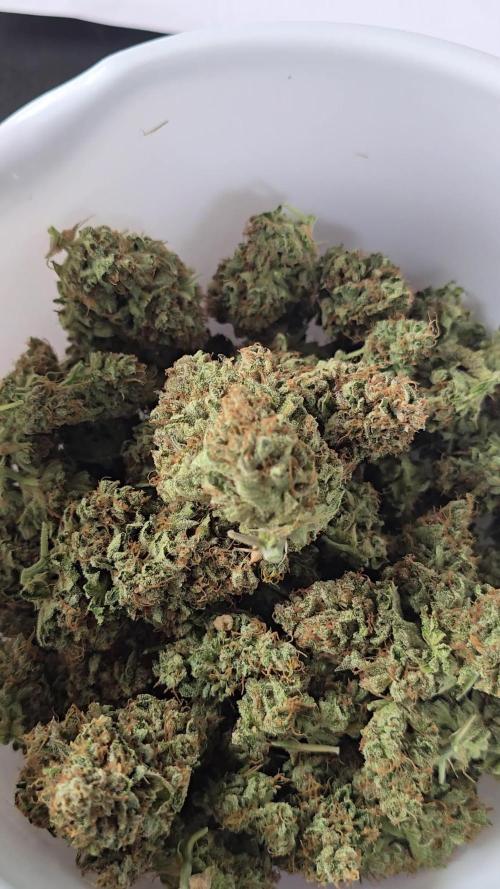
Used dragon force now for 2 feedings then start flushing ! There almost there


@Naujas
Follow
Harvest day has finally arrived for my Frostbanger Auto, and I’m very happy with how this run turned out.
She finished at 69 days from seed and impressed me from start to finish. Throughout flowering she developed a strong, sweet aroma that became richer and more noticeable every week. By harvest time, opening the tent released an amazing smell that filled the entire room.
The buds developed beautifully, with excellent frost coverage and plenty of sparkling trichomes covering the flowers and sugar leaves. Visually, she became one of the prettiest plants I’ve grown, showing great structure and dense, resin-coated buds.
Final wet weight came in at 230g, which I’m very pleased with. The plant stayed healthy, responded well throughout the grow, and rewarded me with a solid harvest and outstanding bag appeal.
Overall, Frostbanger Auto was a pleasure to grow. Great aroma, heavy trichome production, beautiful buds, and a satisfying yield. Now it's time for drying and curing, and I can't wait to see how the final quality develops over the next few weeks.
Final stats:
🌱 Strain: Frostbanger Auto
📅 Harvested: Day 69
⚖️ Wet Weight: 230g
❄️ Trichome Production: Excellent
👃 Aroma: Sweet, strong, and very pleasant
🌿 Overall Impression: Beautiful plant with great resin production and a rewarding harvest
⭐⭐⭐⭐⭐ Very enjoyable grow from start to finish


@Roberts
Follow
Blue Dream Auto is doing good. I have been keeping her lst up to date, and defoliated her a little more. Everything is looking good. Thank you Seedsman, and Medic Grow. 🤜🏻🤛🏻🌱🌱🌱
Thank you grow diaries community for the 👇likes👇, follows, comments, and subscriptions on my YouTube channel👇.
❄️🌱🍻 https://www.seedsman.com/?a_aid=Mrsour420.
This is my affiliate link to seedsman.
Thank you Happy Growing 🌱🌱🌱
https://youtube.com/channel/UCAhN7yRzWLpcaRHhMIQ7X4g.


@goeser
Follow
İ dont know why but 1 of 3 is growing amazing. 2 of 3 are weak and like bonzai plants which i realy donr like. All plants germinated the same day and say day put it soil.
Looks like the quality of the seeds was not so good... my first try of theese Brand... not so god so far


@Ukfarmer420
Follow
So I thought the plants was going to be a flop but they turned it around, really long time tho for a auto flower, I could of ran photos with a better yield, but never the less these look like 10/10 nugs and smell amazing i can't wait to see how these look dried off.
