


Likes
Comments
Share


@SlickCityOrganics
Follow
Black Strap and Peach Crescendo getting close. I see they will get cut way before the Fat Bastard. Fat Bastard must have a long flowering period. But branch structure is thick. I will get a heavy yield from it. Peach Crescendo has so much frost on it. Ethos fkn rocks! Black Strap smells like baked cookies and gas.


Likes
22
Share

@Caertner
Follow
Immer ein wenig entlauben und die unteren Achseln ausgeizen (Lolipop).
Ich hoffe bei dieser Dame auf etwas voller Blüten als bei der BlueSkunk. Wir werden sehen.
Keine Mangelerscheinungen, keine Wachstumspausen. Die Dame sollte bald Pelz tragen.
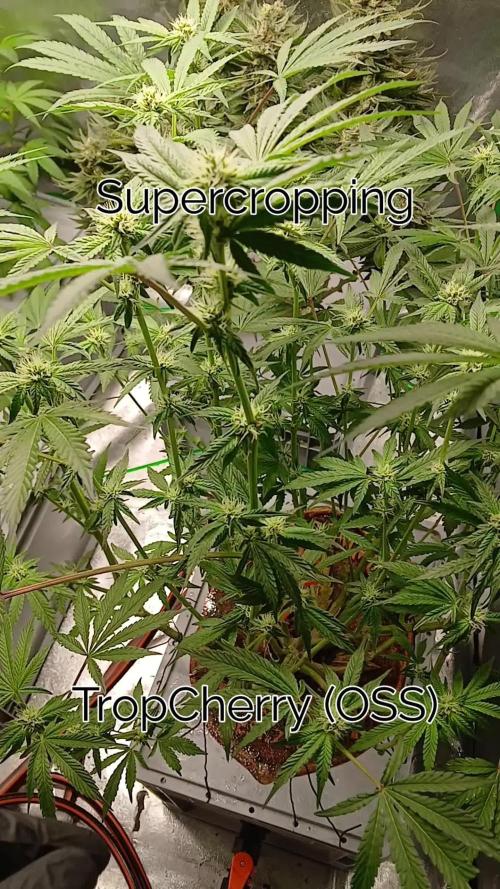
Update: Erster Schicht Puderzucker liegt auf... Wegen Nachfrage und Test wurde bei zwei Trieben mal "Supercropping" angewendet:
Triebverstümmelung:
Zwischen Daumen und Zeigefinger einquetschen und vorsichtig drücken oder rollen, bis die innere Struktur nachgibt, die Außenhaut aber intakt bleibt. Dann kann man den Trieb um 90 knicken, ohne ihn abzubrechen. In 7-10 Tagen ist die Knickstelle dann angeschwollen und geheilt. Trieb wird kräftiger und hat mehr Ertrag... so zumindest der Plan. Bilder folgen...

Processing
Likes
3
Share


@bk_garbage
Follow
So it has been a bit more than a week since update but the ladies seem to be thru the stretch and budding well now. I think in the next update I'll do pics of the defoliation at week three(upcoming Sunday) I added some drip rings to even out watering between different strains. The Orange blossom gets two water lines pumping it while KK gets one and is still a bit damp. The adjustable drip tips just weren't keeping their settings and Blossom gets thirsty fast right now. They are just part of the floraflex kit for rockwool cubes, but with Coco I find water absorbs/disperses just fine.(I usually use 1/2'' black holes drippers but stepped on 3 of em..)
Ladies are pretty healthy but lacked some N after the stretch here and yellowed some bottom leaves. I gave them a bit of Grow food in this reservoir. Just at 1 part. Micro at 2 parts, and Bloom 3. I really under feed and adjust up if they look hungry usually. I stopped using the Piranha and Tarantula powders after week two so those are on the shelf until the next rotation. But since I see buds I started, I added in the Liquid Kool bloom at .5 ml/l, again thats like 1/8th strength but its plenty. Too much of the boosters and stuff burns quick.
I did a decent job keeping them trained back from the vert bulb this time so haven't crisped up any leaves yet which is great. The plants are about at 24 inches tall after the stretch to keep them under the big double ended. Thats actual height for the Krishna, but the blossom is bent into a bunch of z's to keep it low. These are actually some big plants stuffed in there, so hoping they make some good sized buds.
Got some pics of the bud starts for each plant. No frost yet but it'll start by next week I think. Maybe a week until I pull off any buds that are not the size of a grape yet, and leave the good starts to get extra juice. I'm over trimming under buds since my last overgrown scrog.
Processing
Likes
12
Share


@Piablo
Follow
Day 21: First topping. Happy to removed the light-stressed part of the plant from the equation if only for cosmetic reasons. I waited for 5 nodes before the topping.
Day 22: Godammit, the light failed again. Turned it off and waited for it to cool down. Turned it back on and it worked. Lost 1 hour of light.
Day 23: Because of previous light stress and canopy temperature, I felt that 35cm is a good distance for the light.
Day 25: First LST on the new growth tips. Started the mainline.
Day 26: Again the light is failing to come on. I rewired once again, cursing my very existence, and it worked again. Again lost an hour of light in the morning. Continued refining the LST, and seeing how far I can push it. Noticed a slight tear at the base of one of the mains. Since the plant energy is coming from below and there is no noticeable affect on growth I'm going to ignore it. Checked the roots - look healthy. Though the new growth tips are not completely symmetrical, those leaves look good enough to eat. Trimmed the excess fan leaves. Topped up with a small amount of nutrients.
Day 27: light didn't come on again. I rewired again, but this time it was stone cold refusing to do anything. Again I cursed my existence and all of life. Returned to grow store, turns out bulb was defective after all. Again lost 4 hours of light. But at least now I know the problem is solved. Rene at the grow store is a champ though, very helpful guy. The new bulb is noticeably brighter also. Maybe this was affecting growth? Also once this issue was fixed, I noticed some small amount of nutrient burn on the leaves tips. Rebalanced nutrients. Was 1.9 mS/m lowered to 1.65 mS/m, then to 1.48 mS/m. Must be more careful in future when upping the dosage but the water conductivity is now less than before (1.55 mS/m) so this should be ok. Also lowered pH of water slightly since it was 6.0. It's currently showing 5.2 but experience has taught me that this measurement will comfortably go back up to 5.7. water pH is seemingly constantly rising as the plant grows, and adjusting pH is really more art than science. (Edit: It was 5.7 the next morning, so ya ... )

Likes
56
Share


@Ledbelieve
Follow
Been super busy so lagged on getting this posted. All plants are down and currently drying. The weather has gotten chilly so taking longer to dry than I would like. Super excited to get it jars and all cured up. First plant is all done and came out bomb af.... a couple of friends didn't even think it was real..lol.. because it was to purple.... the potency is totally there on this one ☝️ sometimes purple lacks that but this stuff has it all. Bag appeal, smell, taste, and potency!!! This is not a commercial strain due to the slow growth and average yield, but a conasuers dream. Didn't weight wet weight, but will post final dry weight


Likes
4
Share


@Funkyfreshgreens
Follow
Recovering from being topped, bushing out. Some leave damage, stress or weather I assume

Likes
5
Share


@noshoesguy
Follow
The pictures don't do these buds justice. They are a brilliant purple and orange color. I have definitely outdone myself for my first grow ever. These buds have that perfect subtle smell and taste of blue salt water taffy. It's brilliant. I couldn't get it to reveg which is a disappointment but it will live on in my memory


Likes
11
Share


@Cheeba_Inu
Follow
December 16: Seeds places into rapid rooters for germination.
December 21: Germinated seed just starting to push plug out of rapid rooter.
December 22: Planted in seedling pot.
December 23: Seedling having issues shedding seed.
December 24: Removed shell and casing, seedling showing signs of recovery.

Likes
55
Share


@Organic_LarF
Follow
Just nature at work!!!
Love it!!!
Thats it for this week boys and girls,
Thanks for reading and passing by and 💚💚💚👏👏👏👍👍👍 for Marshydro leds. Quality/price top!
Grow safe buds and feel free to check out my other ladies doing fine thanks!
🌈viparspectra🌈
🎟️Organic_LarF♡viparspectra 🎟️
for your discount!!!!
https://www.viparspectra.com/?aff=nbemz68cxril&utm_source=affiliate
🌈Join us now🌈
🙏🌿🌿🌿🙏
Special thanks to
🏅🌿greenbuzzliquids🌿🏅
Use organic_larF for 15% discount
👏👏👏Weedseedsexpress!!!! 👏👏👏
LarfxWSE for discount at
weedseedsexpress!!! 15% off!!!
👽👽👽Zamnesia!!! 👽👽👽
Add OrganicLarF as a code when buying your own MarsHydro LED light and get a nice reduction!!!👽🚀🛸


Likes
9
Share


@Budking420
Follow
The purple punch is doing very well with her companion banana purple punch sisters! She already even has a wonderful smell. I'm very excited for her to get a little lst later in the week. Just trying to be patient I wanna do lst but I feel it's even still a little early. I have been tucking leaves but I may defoliate a small amount here soon when I perform LST. Check back next week to see just how fast she grows & remember its 4:20 somewhere!!!!!!!!!!
Likes
27
Share


@LockDownGrow
Follow
Ok so this week I did a defoliation and a tigh down too the netting , I really was not planning on doing such a big defoliation but the leafs became thick and dense and there was almost no light penitration down too the lower branches of the plant , so she is opened right up now and the humidity and temperature has dropped loads and the air is moving alot better around the leaves and branches , I will not take anything more off her now , I have also added Cal mag too the nutrients for this week only , she is well into pre flower now but the stretch has not yet started so I figured it's no or never too defoliate and tigh them down ,
I am very happy with them so far and being new too all this it's all very exciting ,
Thanks for looking :)
Likes
89
Share


@Nebula420
Follow
In this week the plant is fine, no have any problems.
Gorilla Girl grows well, have a amazing smell of citrus, watermelon, woody and earthy.
I love this strain, amazing and sweetie), buds like stone, heavy and frosty) satisfied.
Thanks to everyone who follows my grow reports. 😘

Likes
6
Share


@organicman
Follow
harvested
hb2,ww1,ob3-2nd,gc1,ww2,bg1,bg3,bg4,sp1,hb2,bg2-2,ob1-2
see all results in fotos
____________________________________________
light- and watering schedule: see photos
now:
12 plants
2 x Auto Orange Bud > Dutch Passion (early80's)
2 x Haze Berry Automatic > Royal Queen Seeds (2018)
2 x Auto Bubblegum > TH Seeds (late 80's)
2 x Original Auto BubbleGum > Fast Buds Company (late 80's)
1 x Strawberry Pie Auto > Fast Buds Company
1 x Gorilla Cookies Auto Seed Stockers (2015)
2 x Auto White Widow x Big Bud > Female Seeds
setup + strategy:
18 seeds
3 x Auto Orange Bud (early80's)
3 x Haze Berry Automatic (2018)
3 x Auto Euforia (late 90's)
2 x Auto Bubblegum > TH Seeds (late 80's)
2 x Auto Bubblegum > Fast Butts (late 80's)
2 x Strawberry Pie Auto
1 x Gorilla-Cookies Auto (2015)
2 x Auto White Widow x Big Bud
setup:
18 x gronest 2 liter
60 cm x 120 cm x 180 cm (2 x 4) growtent
4 l humidifier
25 watt axial fan
15 watt clip fan
ro-filter
bath room with a 50 watts room fan (-> carbon filter not necessary)
...and a lot of odds and ends.
grow strategy:
max yield by stressing with:
1. tiny shoes (2 l fabric pots standing on 3 plastic rings (4 cm) for max oxygen)
2. tiny growspace (18plants on 0.72 sqm)
3. many strains (8 strains)
4. annoying neighbourhood (mixing old - i.e. bubblegum (late 80's) - with young- i.e. hazeberry (2018) - genetics)
5. no stress by light or food or water
6. unintentionally too much food
plus:
- no lst - no hst - just leaf tucking
- positioning bigger strains (euphoria, orange bud, haze berry) or just bigger phenos on less intense light spots (end of tent + edges)
- music-rotation: 24 hrs reggae (for sativas) - 24 hrs classicals (because it's scientifically proofed) - 24 hrs traditionals from the hindukush region (for the indicas)
max efficiency (min electricity - max yield):
- light: 23 h on - 1 h off
- keeping the distance of 18" (45 cm) and dimming to the right par (lux) - value depending on growing stages (see sheet: beginning 185 par ( 10000 lux/100 watt )/end 340 par ( 18000 lux/175 watt )) => ends up in approx. 170 watts in average over max 15 weeks
temperatur management:
- using approx. max. half of what the lamp can do keeps temperature low:
my tsl 2000 is pulling max. 360 watts of the wall - i need only 175 watts, results in less temperature than using a 175 watts lamp
- adjusting the temperature by using a humidifier outside of tent:
blown in humidity is soaking degrees and is transported out by fan, works much better than doing the same with pure air
summer extreme: no humidifier: 36°C / 35 rh - with humidifier: 29°C / 65 rh
works for 1-2 weeks of real hot summer days, no mould, no signs of stress in two summers
germination:
seeding in waterglass
spraying "basic"-water: ro-water (22 ppm) + calmag to 180 ppm every 4 - 8 hours until sprouted
man versus fungus gnat:
5 days before seeding i'm running the tent with "basic"-watered pots as if there were plants inside - led on, fans on, humidifier on. Fungus gnats coming with the soil might take the chance to come out now for breeding. i'm waiting with a 9 mm rifle. in the past i found 6 gnats in 2 of 8 x 50 l biobizz lightmix bags coming out of the soil. i could eliminate every single gnat successfully ;)
rotating harvest:
the little ones will be harvested completely when ready. at this point only the top branches of the big ones will be cut...and the new (basic-watered) pots of the new grow will move into the tent. 2-3 weeks later the secod half of the big ones will be cut and the second half of the new grow will move in...
nutes:
biobizz / soil: biobizz lightmix
bloom,grow,topmax,activera,algamic
+ aminopower instead of bio heaven (too expensive)
individual feeding schedule/once a week:
veg: 200 - 600 ppm
bloom: 600 - 900 ppm
water:
ro-water with:
veg: 100-150 ppm calmag
bloom: 150 ppm calmag


Likes
3
Share


@DrewZenRox
Follow
Into 2nd day of week 3.
Jealousy/Green Poison inside the Epic Attic Tent 1.2x1.2x1.6. Growing Under 'Karma EVO 3'
SkyWalker OG Inside unbranded 60x60x120 Tent. Growing under 'Karma Stealth 1000'


Likes
44
Share


@Jays_Not_Here_Man
Follow
This was the girls last week! I decided to call them finished on day 63 the tricomes are almost all cloudy, with a small amount of amber. I’ve learned that they continue to degrade as you dry and cure your flower, so I’m trying something new for me, and pull them a little earlier than I usually would.
In addition, after watching a podcast (Dude Grows Show) if you don’t know, check it out… I decided to run the lights for 18 hours instead of 12/12 for the last 5 days before harvest. The idea behind this, is to stress the plant enough to increase its natural sunblock/protections, which would be terpenes and tricomes just before you harvest, while also possibly quickening the finishing time for your plant. The group was discussing the benefits of this (listed above) while some already had implemented these practices when finishing plants. The recommended time to run extra light time would be around the last 5-9 days of the plant, without having any nanners or weirdness happening with your plants.
Anyways, they finished amazing, sticky, stinky and heavy ❤️ the Terps are crazy on these strains….Harvest details to come. Thanks for stopping by 💚🇨🇦👊

Likes
18
Share


@Sti_Cazz
Follow
So I'm seeing some yellow tips, also on the new growth and I'm a little surprised because I'm not feeding that much tbh...at least I think I'm not.... reading up a bit, not sure if its nute burn or something else... got some cal-mag anyway , seeing i'll need it soon..
Tthe Northern Lights is going up like crazy! it has a completely different 'build' to it, much wider and distances then the more compact Diesel.
Held off on the feeding, just distilled water ...but maybe 'll just switch to tap water, leaving it outside for a night or two...no more root booster....seems a little redundant.