


Likes
Comments
Share


@GoldenWeedGrower
Follow
Legend
Timestamp: 📅
EC - pH: ⚗️
Temp - Hum: 🌡️
Water: 🌊
Food: 🍗
pH Correction: 💧
Actions: 💼
Thoughts: 🧠
Events: 🚀
Media: 🎬
D: DAY, G: GERMINATION, V: VEGETATIVE, B: BLOOMING, R: RIPENING, D: DRYING, C: CURING
________________________________
📅 D98/B36 - 21/02/24
⚗️ EC: 0.8 pH: 5.3
🌡️ T: 21-23 °C H: 45-75 %
🌊
🍗
💧
💼 Some defolation
🧠
🚀
🎬 Added timelapse video and screenshots
________________________________
📅 D99/B37 - 22/02/24
⚗️ EC: 0.8 pH: 5.3
🌡️ T: 19-24 °C H: 50-75 %
🌊 14 L
🍗 Calmag - Bloom A-B
💧
💼 I've prepared all the stuff for 3 days out. I'm going to leave today and get back on Sunday (25/02). Humidifier filled up
🧠
🚀
🎬
________________________________
📅 D100/B38 - 23/02/24 💯💯💯
⚗️
🌡️ T: 19-23 °C H: 45-65 %
🌊
🍗
💧
💼
🧠
🚀 First Day Out
🎬
________________________________
📅 D101/B39 - 24/02/24
⚗️
🌡️ T: 21-24 °C H: 50-65 %
🌊
🍗
💧
💼
🧠
🚀 Second Day Out
🎬
________________________________
📅 D102/B40 - 25/02/24
⚗️ EC: 1.0 pH: 6.0
🌡️ T: 20-24 °C H: 55-70 %
🌊 RES Changed 💦💦💦
🍗 Calmag - Bloom A-B - Bud Candy - B52 - Overdrive
💧
💼 I changed the res for last 10-15 days of blooming until ripening and flush
🧠
🚀 I'm back
🎬 Big job on media. I edited the cumulated time lapse videos and splitted day by day. Also uploaded the screenshots from the TrolMaster App for each day out. Great job !
________________________________
📅 D103/B41 - 26/02/24
⚗️ EC: 0.8 pH: 5.2
🌡️ T: 20-24 °C H: 50-70 %
🌊 1L
🍗
💧
💼 Some defolation
🧠 She's not yet ready, I think a couple of week more
🚀
🎬 8 pics added + 4 pics macro. Timelapse and screenshots
________________________________
📅 D104/B42 - 27/02/24
⚗️ EC: 1 pH: 5.9
🌡️ T: 20-24 °C H: 50-65 %
🌊 6L
🍗 Calmag - Bloom A-B - Bud Candy - B52 - Overdrive
💧 some pH+
💼
🧠
🚀 End of the 6 weeks of flowering
🎬 Added timelapse and screenshots. I also prepared a timelapse of the entire week with some music 🎵🎵🎵 and weekly rate of T-H and VPD 📈📈📈

Likes
18
Share


@TheSurfBud
Follow
Fed water and foliar sprayed with small amount of GREEN-SUPREME and RHIZO-MOJO.

Likes
7
Share


@Chubbs
Follow
Week 6 update:
What up Grow family. These testers are growing fast and strong. Where in week 6 now and the swelling and ripening of flowers are going amazing. Still feeding 500ml/16oz daily as I've found that's the sweet spot for 3gal fabric pots for these. I'd say these probably have about 2 weeks left until they'll be finished.
All in all Happy Growing.
Processing
Likes
7
Share


@x_grower
Follow
Last week plants grew very healthy, as they got bushier the humidty raised providing a better enviroment, I could even reduce the amount of water I give them. Planning to move to flowering stage very soon.

Likes
16
Share

@Bncgrower
Follow
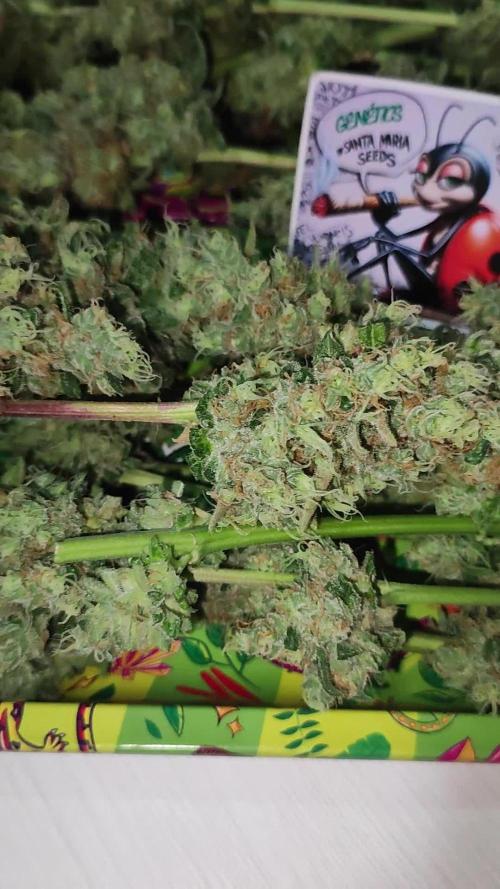
Harvested today, truly strong smell, cultivation was absolutely perfect from start to finish. Very happy with the result, anxious for the drying and curing process! Thank you for following along.. 🤜🤛🌱🌿🌲
Likes
23
Share


@MadeInGermany
Follow
Hey everyone ☺️.
She has developed well this week, but still wants more food.
Although I'm already at 5 ml per liter of water 🙈😃.
topping was also used this week 👍.
Otherwise everything is going great and everyone is on schedule 😃.
Have a nice week, stay healthy 🙏🏻, and let it grow
You can buy this Strain at
https://thecaliconnection.com/seeds/girls-scout-cookies-34.html
You can buy the fertilizer at
https://www.greenbuzzliquids.com/
Type:
Girls Scout Cookies
☝️🏼
Genetics:
GSC Tint Mint
👍
Vega lamp:
2 x Todogrow Led
Quantum Board 100 W
💡
Bloom Lamp :
2 x Todogrow Led
Cxb 3590 COB 3500 K 205W
💡💡☝️🏼
Soil :
Canna Coco Professional +
☝️🏼
Fertilizer:
Green Buzz Liquids :
Organic Grow Liquid
Organic Bloom Liquid
Organic more PK
More Roots
Fast Buds
Humic Acid Plus
Growzyme Big Fruits
Clean Fruits
Cal / Mag
Organic Ph - Pulver
☝️🏼🌱
Water:
Osmosis water mixed with normal water (24 hours stale that the chlorine evaporates) to 0.2 - 0.4 EC. Add Cal / Mag 2 ml per l water every 2 waterings . Ph with Organic Ph - Pulver to 5.8 .

Likes
54
Share

@MadeInGermany
Follow
Flowering day 48
since time change
to 12 / 12 h
Hey guys It's such a beautiful sight every day 💚.
The buds develop great and smell delicious 😃
Watering was done twice this week with 1.2 l each
The tent was cleaned and each lady examined individually :-).
Have fun with the update and stay healthy 💚🙏🏻
👇🏼👇🏼👇🏼👇🏼👇🏼👇🏼👇🏼👇🏼👇🏼👇🏼👇🏼👇🏼
‘Powered by GreenHouse Feeding’
Copy the link for 10% off all Nutrients 👇🏼
https://shop.greenhousefeeding.com/affiliate/MadeInGermany_PassionGrower
👇🏼👇🏼👇🏼👇🏼👇🏼👇🏼👇🏼👇🏼👇🏼👇🏼👇🏼👇🏼
You can buy this strain at :
https://www.amsterdamgenetics.com/product/choco-cheesecake/
👇🏼👇🏼👇🏼
Use the coupon code: madeingermany
for 10% on all Amsterdam Genetics seeds
Water 💧 💧💧
Osmosis water mixed with Cal/Mag (24 hours stale that the chlorine evaporates) to 290 ppm and Ph with Ph- to 5.8 - 6.4
MadeInGermany

Likes
3
Share


@CalGonJim
Follow
4/28 MONDAY 330am.... Looking great. All plants growing in an almost perfect square
4/29 3am looking good
5/1 4am Doing great!!!! Did you know that NOT burning your plants makes them grow better???...boring. I better add TONS of supplements.
5/2 12am 8ml Con. bloom. a little left over Grow nutes. 430 am 7Z is strong enough to trim off bottom buds. I usually leave those as early samples not this time. Concentrate all power to 4 solid easy to trim, dry and store.
They are ALL STRONG.....WOW the flowers are FAST they really live up to the name and they JUST started they are going to be great if I dont burn them!!!! Great luck with them all!!!!!! 2 pm. Defoliation and bud trimming worked great. 7Z has3 colas that are VERY big and one that is just ok. Im going to think about this for a day or so, BUT I MIGHT chop to a 3 cola grow, get rid of the smaller one and see if that will bring THAT potential energy to the remaining strong colas?????🚨

Processing
Likes
8
Share


@eldruida_lamota
Follow
Que pasa familia, ya estamos de nuevo y actualizamos la segunda semana 😘
La verdad que están creciendo bien pronto tendremos que trasplantar para corregir la altura.
El Ph Lo tenemos controlado en 6.2 y poco a poco van tirando.
Todavía no echamos nada de productos
Pronto bajaremos la altura del foco también.
Esta variedad de @zambezaseeds no pinta mal familia 🙈


Likes
22
Share


@Spliffi
Follow
Week 11👍🤙👍🌱
I can see the end. This Contest have been a eye opener!!
Jon Dabs
Check them out here:
https://jondabs.com
@jondabs Instagram
The Sponsors
Check them out here:
Dutch Passion
https://dutch-passion.com/en/
Hydroponic.co.za
https://hydroponic.co.za/hydroponic/harvesting-and-growing-accessories/
Bud Juice
https://www.gohydro.co.za
The Best Grow
https://thebestgrow.co.za
Dynomyco
https://www.dynomyco.com
Nuclear Roots
https://www.nuclearroots.co.za
Photronic
https://shop.photronic.net
Special Thanks to Hydroponic.co.za. I buy all my products from them. Best service.
Daily updates coming...

Likes
9
Share


@Orchydis
Follow
I use a tent 90x60x180, I put my lamp at 1 m and at 50% only, I use cotton disks for the germination, I’m gonna change #4 with #10 I think because she seems in bad health.

Likes
6
Share


@TheFamilyShire
Follow
So these seedlings were in to hot of soil. I tried to remove the plant and put a nest egg of happy frog in between the hot soil. It has definitely helped but as you see the small seedling is struggling with the soil. I guess i didn't add enough happy frog.
Well they are both growing and looking okay.
Got a new light. The one grow mc2000. 200w full spectrum light. Love it. I have it set at 24in away and on about 50% power. Its between 200-300ppfd.
Well stay tuned to see how these girls grow.

Likes
10
Share


@RandomStreetMerchant
Follow
Hello, I have had the pleasure of growing this cultivar a few months back. this time I will only be growing 2 both being those awesome seeds from Barney's. I believe that letting these girls have more space will do wonders. as my last grow was quite cramped. that being said, I'm going to try to fill the tent up with the 2 mxop's ill be planting. Mimosa X Orange Punch (MXOP) is a fantastic cultivar and I cannot wait to show you guys how beautiful they get! have a good one!//05/25/23//

Likes
8
Share


@Geili_Seili_fireinfireout
Follow
Tag 16 in flow.
Dieser cut is soooowas von geil vital. So wie die apples n banans.👌🔥 top genetik top cut🌱
Freu mich ihr beim wachsen zu zusehn🙃😁
Diese geilen vitalen cuts gibts wie immer bei ROOTS-FARMS. Vital und sauber.

Likes
79
Share


@DogDoctorOfficial
Follow
Greetings, fellow cultivators! Welcome to the Week 7 Report on our magnificent Epsilon F1, where the journey of green greatness continues to unfold with each passing day. Prepare yourselves for a detailed and immersive exploration of our botanical wonder as we delve deep into the heart of her flourishing beauty.
Let's begin with a momentous decision: the Day 21 Flower Defoliation. With careful consideration and a keen eye for detail, I embarked on this transformative journey, gently removing select fan leaves to allow for increased light penetration and airflow. It's like giving our Epsilon F1 a botanical makeover, revealing her true splendor beneath the foliage canopy. This strategic pruning ensures that every bud site receives the attention it deserves, setting the stage for a bountiful harvest of epic proportions.
But that's not all! As we bid farewell to the defoliation process, it's time to release all the bindings and restraints that were used to guide and train our green goddess throughout her growth journey. With a sense of liberation and pride, I untangle each tie, allowing our Epsilon F1 to stretch her leafy limbs and reach for the heavens. It's like setting a bird free from its cage, unleashing her full potential to soar to new heights of botanical glory.
Now, let's talk about the environment. The TrolMaster controls have been instrumental in maintaining the perfect climate for our Epsilon F1's growth and development. From temperature and humidity to light and CO2 levels, these precision instruments ensure that our green queen receives the optimal conditions for flourishing. It's like conducting a symphony of growth, orchestrating each element to harmonize in perfect unity.
And of course, we cannot forget the nourishment that sustains our botanical masterpiece. The Aptus Holland nutrients continue to be the lifeblood of our grow space, providing a balanced diet of essential macro and micronutrients. From the Micromix Soil to the Substrate Buffer Powder and All-in-One Pellet, each component plays a vital role in nurturing our plant to perfection.
But let us not overlook the unsung heroes behind the scenes. Shout-outs to Royal Queen Seeds for bestowing upon us the genetic marvel that is the Epsilon F1, a testament to their dedication to excellence in breeding. To Aptus Holland, our main sponsor, whose unwavering support and innovative nutrients have propelled our grow to new heights of success. To TrolMaster, for providing the tools that empower us to create the optimal growing environment for our plants. And to Grow Diaries, the platform and community that fosters collaboration, knowledge-sharing, and camaraderie among growers worldwide.
As we bid adieu to Week 7, let us revel in the glory of our Epsilon F1's progress and look forward with anticipation to the weeks ahead. Happy growing, dear readers, and may your gardens be forever green!
Genetics -Epsilon F1 @rqs_esp @royalqueenseedssp @rqsglobal
Food - @aptusholland @aptus_world @aptus_es @aptus_portugal @aptusbrasil @aptusplanttechaus @aptus_thailand @aptusplanttechnz @aptususa_official
LES @lumatekeu
Controls - @trolmaster.eu @trolmaster.agro @trolmaster.support
As always thank you all for stopping by, for the love and for it all , this journey of mine wold just not be the same without you guys, the love and support is very much appreciated and i fell honored and blessed with you all in my life
With true love comes happiness , Always believe in your self and always do things expecting nothing and with an open heart , be a giver the universe will give back to you in ways you could not even imagine so
#aptus #aptusplanttech #aptusgang #aptusfamily #aptustrueplantscience #inbalancewithnature #trueplantscience #rqs #ApoloMission #MoonHarvestAdventure #playwithlego #lego #legotime #legovideo #tothemoonandback
More info and complete updates from all my adventures can be found Link in the profile description
Friendly reminder all you see here is pure research and for educational purposes only
Growers Love To you All


Likes
3
Share


@High_Grade_Dadli
Follow
2 of dem from the 2nd set don't seem to catch dem self yet🤷🏾♂️ but the rest are taking off....those from the 1st set still ain't transplanted and they are pushing hard ties ain't holding dem back. 2 that where transplanted previously jus tryin to get dem a good size n send dem on a breeding project for the beginning of the
Most of new cutting have visible root

Likes
54
Share


@Homeboy981
Follow
Good News!!! I found a single Hermie that had a few branches with seeds! I thought the whole Harvest was going to be junk. It turned out to be better than I expected. So, never give up!
