Likes
Comments
Share
@pzwags420
Follow
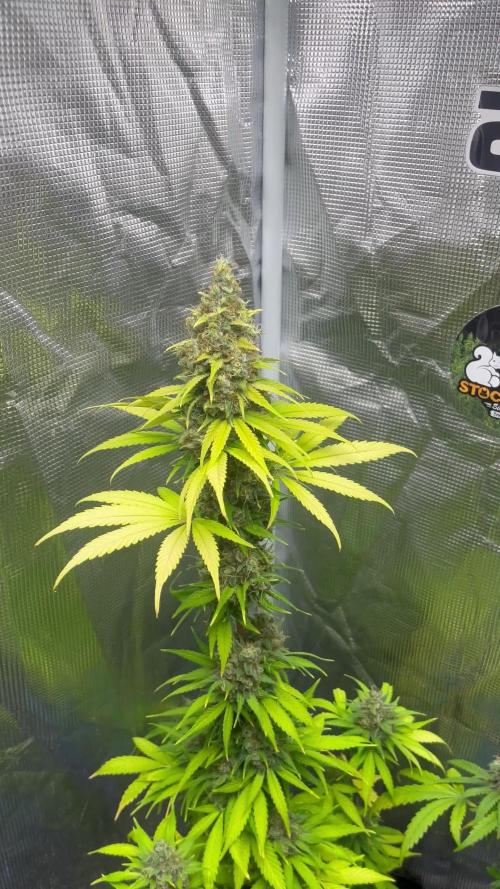
On day 6 week 4 She is putting out alot of pistills and budlets no smell yet.flowering is deff underway now. This is looking like a 10 week strain as she took almost 4 weeks to start budlets which I usually see around week 2-3.
Likes
17
Share
@Kirsten
Follow
25.5.25: I watered with 3.5ltrs of dechlorinated water PH'd to 6.3 I added Per 6.5 litres; ♡ 1Tsp Bud Explosion ♡ 7ml Trace PH: 6.3 PPM: 990 SOLUTION TEMP: 30°C SOIL PH: 7 SOIL TEMP: 21°C AMBIENT TEMPERATURE: 23-26°C RELATIVE HUMIDITY: 58%. 26.5.25: I watered with 3 ltrs of dechlorinated water PH'd to 6.4 I added Per 6.5 litres; ♡ 1/2 Tsp Ecothrive Biosys ♡ 7ml Trace PH: 6.4 PPM: 590 SOLUTION TEMP: 28°C SOIL PH: 7 SOIL TEMP: 21°C AMBIENT TEMPERATURE: 23-26°C RELATIVE HUMIDITY: 58%. 27.5.25: I watered with 1.5ltrs of dechlorinated water PH'd to 6.3 I added Per 6.5 litres; ♡ 1Tsp Bud Explosion ♡ 7ml Trace PH: 6.3 PPM: 990 SOLUTION TEMP: 30°C Still PH: 7 SOIL TEMP: 21°C AMBIENT TEMPERATURE: 23-26°C RELATIVE HUMIDITY: 58%. 29.5.25: The plant is definitely decreasing the amount of water now. So I believe the plants are coming to an end within a couple of weeks. I took everything off the timer and am now running 24/0 light schedule. I want to make the most out of what light is available. The plants need it. My tent is underpowered in that department, so increasing the duration of the light is all I can realistically do. Hopefully, it will help. The buds have been developing nicely. They are incredibly FROSTY 😍 so to keep the progress going, I have been sticking with the sea kelp for the potassium. Occasionally adding phosphorus with the bud explosion PK Booster. With much smaller doses in comparison, each time. There are definitely signs of nitrogen excess, with the clawing on many leaves. There are also extremely purple stems on the leaves. As I don't know what the seed was, I can't tell whether it is normal for the strain it is, or a nutrient issue, light stress, etc. (If you have any ideas, I'd appreciate them!) This one was planted in coco, perlite, and worm castings. Due to this being practically the first time I've used this mix without adding the peat based "light mix". I had not realised how quickly the pots will dry out, especially during the high water consumption of the flowering stage. I realise that I need to be treating it as pure coco. This can be fantastic, for example, if you have just one pot/plant and can provide all the waterings and monitoring continually and regularly. This tends to make you use more nutrients than necessary, as personally I find it difficult to use just plain water. I think many of us still can't help the feeling that we should be adding things to every watering. Therefore, when the frequency of the waterings increases, we are still adding nutrients EVERY time. Which is an overall increase in nutrients, too. For my part, I'm cutting the amount of nutrients per watering. I feel like nutrients are a bit of a crutch to growers. I'm still getting used to the coco and the waterings, but I am really enjoying it. If you don't check your plants multiple times a day, it may not be the best choice of substrate. For me, I'd much rather the pots dry quickly because it reduces the chances of mould and mildew, which I'm always concerned about. 30.5.25: I watered with 4L of plain dechlorinated water PH'd to 6.1. Thanks for stopping by and hanging out 💚 ✌️ 🍃 😊 🌱
Likes
8
Share
Likes
18
Share
Week 10 getting some slight deficiencies just trying to stay on them and she is drinking 5 gallons a day by herself 🔥 Running GH flora gro/micro/bloom at 10/7/5ml with 2ml calmag plus and sulfur
Likes
Comments
Share
@youdan
Follow
una coltivazione che mi ha dato molte soddisfazioni, chimera e una pianta formidabile ed ha dei terpeni difficili da descriverli, dovreste coltivarla per capire a pieno la sua potenzialita
Likes
1
Share
Middle of week 5 flower. Noticing smell more than previous weeks
Likes
2
Share
We become aware at such times of man's wonderful ability to bring seemingly unrelated elements into harmonic balance, and receive a glimpse into a world where everything exists in conscious sympathetic attunement to everything else. When we listen to a piece of music that seems to strike a beautiful chord somewhere inside us, or view a painting that simply glows with harmonic awareness well executed, we probably do not spare much time to contemplate the wonderfully intricate combination of vibrations that our sensors make it possible for us to perceive. We tend to appreciate the relationship between the parts of something by an awareness of the harmony or dissonance of the whole. This ability enables us to say "what a beautiful house!" instead of "analysis has proven that this collection of building materials exhibits certain elements of harmonic proportion." While this ability to instinctively appreciate the beauty of true harmony has an important role to play in evolution, a more analytical understanding of the laws involved can be most useful. This is especially so if we wish to create works of art where each part exists in true harmony, not only with the other part of that particular whole, but with the universe within which the creator and the created exist. Everything vibrates. From the most dense matter to the most subtle cosmic rays, everything which our senses allow our thoughts to become aware of, can be specified in terms of wavelength or frequency of vibration. These two terms define the same thing, but from different points of view. The following are the approximate wavelengths of various energy carriers: Cosmic rays 0.000,000,001 mm Gamma rays 0.000,000,1 mm X rays 0.000,500 mm Ultraviolet rays 0.003 mm Visible light 0.006 mm Infrared 0.01 mm Sound waves 1 meter Radio waves 300 meters Violet light 400 nm to 450 nm Blue light 450 nm to 500 nm Green light 500 nm to 570 nm Yellow light 570 nm to 590 nm Orange light 590 nm to 610 nm Red light 610 to 700 nm 1 nanometer (nm) = 0.000,000,1 cm = 1/10,000,000 cm If a guitar string is plucked and we hear a sound, it is not too difficult for the human mind to associate this sound with the vibration of the guitar string. With color it is quite different. It is difficult for us to conceive that the color of a substance is not an inherent property of the substance itself, but an indication picked up by our senses of that substance's ability to absorb or reflect the light which happens to be shining on it at that moment. Neither the matter nor the light is colored. What happens is that the brain learns to differentiate between the frequencies reflected or transmitted by the substance the eyes are focused on. The same thing happens with sound. When we say "Oh! Listen, they're playing my favorite song," what we really mean is: "My brain has stored within it a particular pattern of frequencies. I have compared the new information being received with this stored pattern and have deduced the answer that the two patterns are similar within certain specified tolerances." The 'pleasure' involved could have something to do with our running the pre-recorded pattern at the same time, in 'sympathy' with the new pattern as it is received. The word sympathy describes very well our ability to appreciate color and sound. It also describes the reason behind certain elements of harmony. For instance, if a substance vibrating at 100 cycles per second (tone 1) is in the proximity of another substance vibrating at 200 cycles per second (tone 2), we could perceive, if we had the right equipment, a certain sympathetic relationship between the two. We will see from this that there is a uniform doubling of the first tone seen in the second. At various points along the waves, the two are the same in amplitude. At other points, they are at opposite poles to each other. This doubled frequency has more points of similarity to the original than any other frequency except the original itself. If the equipment we had available for measuring these two frequencies was a soundboard amplifier and a pair of ears, then we would hear what would sound to us like one tone. If we had the opportunity to hear one at a time, we would hear that although they sound the same, one is higher in pitch than the other. This characteristic of 'the same but different in pitch', musicians have called the octave. Any two tones produced where one has exactly doubled the frequency of the other is called an octave. Speaking in ratios, an octave would appear then as the ratio 2:1 or 1:2, depending on whether we are talking of an octave up or down. A single note produced by almost any instrument will contain more than one wavelength or frequency. It will have a dominant frequency, the wavelength of which we would call the note's 'fundamental' or 1st harmonic. It will also have a varying number of upper harmonics, gradually fading in intensity into infinity or silence. Natural harmonics always have the same pattern of intervals between them. The interval between the 1st and 2nd harmonic is a perfect octave; between the 2nd and 3rd a perfect fifth; between the 3rd and 4th a perfect 4th; and so on, the intervals becoming smaller and smaller until they lose any relationship with the western 12 tone scale as it exists at the moment. Just as an octave has certain elements of sympathy with its fundamental, so some intervals have been noted to be more perfectly in sympathy with the fundamental than others. The ratio of the 'perfect 5th' or interval of 7 semitones, as it occurs in the harmonic series, is 3:2 or 2:3, while that of the 'perfect fourth" is 4:3 or 3:4. All the tones in the western 12 tone scale can be expressed in terms of the ratio between the upper tone and its fundamental. This would seem to be an ideal way of generating a scale from any given fundamental and several attempts have been made to do this, the Pythagorean system being probably the most well known. Although when working with a single tone instrument playing on its own, the Pythagorean formula works wonderfully well, if we had several instruments tuned this way together and asked them to play almost any western music, we would find that at times they sounded quite out of tune to each other. The lack of flexibility of the various scale systems based on the harmonic series has led to what is known as the 'tempered' scale. This uses as its primary unit of interval the ratio of the octave or 2:1. It then proceeds to divide the interval between any fundamental and its upper octave into 12 smaller intervals by applying the ratio: two to the one-twelfth power, to one (21/12:1). This equals 1.059463094, so by multiplying any frequency by this number, we will obtain the tempered semitone next up from our fundamental. We will also find that any tone twelve semitones up from any other tone, in a scale generated in this way, will have exactly double the frequency. If we took the note middle C on a piano and halved the wavelength, we would have the note C one octave above. If we halved this, we would have the C above, and so on. However, within about 6 octaves, we would find that although a 'sound' was being produced, no human ear could perceive it. If we kept on going, halving and producing upper octaves of our fundamental C, we would proceed through the infrared band, into the visible light spectrum. If we happened to be outside during the day, we would, for one octave only, see the note C with our eyes. The next octave above would already be in the ultraviolet band, and outside the eye's sensitivity range. If we can think of color as being an indication of a substance's vibratory rate or wavelength, we may begin to see a relationship that could exist between the color and sound spectrums. The logical extension of what has so far been said is that there exists a scale in the color spectrum that corresponds exactly to the scale in the sound spectrum, each color tone being an octave of the equivalent note in the sound range. This is not the end of the story but only the beginning. If we can for the moment accept that any wavelength in one band has upper and lower octave stretching out to infinity, then the next question is 'fine, but what shall we use as our fundamental? A particular color? A particular sound frequency?' The musicians among us will probably say 'A 440'. This means that the note A should vibrate at 440 Hertz, or 440 times per second. They would tell us that this is standard pitch has been adopted by most orchestras around the world; pianos are tuned to it, instruments are constructed to formulas based on it, and so to them it would probably seem the most appropriate place to begin. Some of these musicians may know of the battle that is still raging with regards to this being the standard, but few would know why A = 440 Hz was chosen except that it worked when it was set to be a suitable compromise between the many different pitches in use at the time. 432 Hz is said to be mathematically consistent with the patterns of the universe. Studies reveal that 432 Hz tuning vibrates with the universe’s golden mean PHI and unifies the properties of light, time, space, matter, gravity, and magnetism with biology, the DNA code, and consciousness. When our atoms and DNA start to resonate in harmony with the spiraling pattern of nature, our sense of connection to nature is said to be magnified. Another interesting factor to consider is that the A=432 Hz tuning correlates with the color spectrum, while the A=440 Hz is off. Audiophiles have also stated that A = 432 Hz music seems to be non-local and can fill an entire room, whereas A=440 Hz can be perceived as directional or linear in sound propagation. Once you adopt the idea that sound (or vibration in general) can have an equalizing and harmonizing effect (as well as a disturbing effect), the science of harmony can be applied to bring greater harmony into one's life or tune to specific energies. There is a form of absolute and relative harmony. Absolute harmony can, for example, be determined by the tuning of an instrument. The ancients tuned their instruments at an A of 432 Hz instead of 440 Hz - and for a good reason. There are plenty of music examples on the internet that you can listen to in order to establish the difference for yourself. Attuning the instrument to 432 Hz results in a more relaxing sound, while 440 Hz slightly tenses up the body. This is because 440 Hz is out of tune with both macro and micro cosmos. On the contrary, 432 Hz is in tune. To give an example of how this is manifested microcosmically: our breath (0,3 Hz) and our pulse (1,2 Hz) relate to the frequency of the lower octave of an A of 432 Hz (108 Hz) as 1:360 and 1:90. It is interesting to note that 432 Hz was the standard pitch of many old instruments and that it was only recently (19th and 20th century) the standard pitch was increased. This was done in order to be able to play for bigger audiences. Bigger audiences (more bodies) absorb more of the lower frequencies, so the higher pitch was more likely to “cut through”. One of the oldest instruments of the world is the bell ensemble of Yi Zeng (dated 423 BC), tuned to a standard F4 of 345 Hz, which gives an A= 432 Hz. The frequency of 345 Hz is that of the platonic year! Similarly, many old organs are tuned in A=432 as well; for example, St. Peter’s Capella Gregoriana, St. Peter’s Capella Giulia, S. Maria Maggiore in Rome. Maria Renold’s book “Intervals Scales Tones and the Concert Pitch C=128 Hz” claims conclusive evidence that 440 Hz and raising concert pitch above scientific “C” Prime=128 Hz (Concert A=432 Hz) disassociates the connection of consciousness to the body and creates anti-social conditions in humanity. The difference between concert pitch A=440 Hz and Concert A=432 Hz is only 8 cycles per second, but it is a perceptible difference of awareness in the human consciousness experience of the dream we share called existence.
Likes
17
Share
@Naujas
Follow
She is much prettier than she was a week ago :) I remembered that I have my first grow light, which is more compact and it will give me more space, so I changed my light, now the girl's side branches get light too:) I add a lot of video memes, because I really want to win Iphone16 pro ;) and those who don't take risks don't drink champagne:) good luck to everyone.
Likes
21
Share
@reirrac1
Follow
She started out as the most vigorous grower, but may have been too quick for her own good. She began having deficiencies early on which were easy to address, but they came back intermittently. Ultimately she didn’t thicken up quite as much as I would have liked, but the trichome coverage is much higher than the Sour Kush.
Likes
8
Share
@CalGonJim
Follow
3/23 12AM Monday. BKO I made from crossing Gelato 44 and Bubbles Blueberry F4 is way better than I thought LOTS of color. All are doing good, even with soft water..as long as I flush out way more than im used to. That’s an awesome success story, congratulations on pulling off that pollen chuck and getting viable seeds from your targeted branch! As a non-professional breeder working in a home setup (with the challenges of being homebound and managing everything solo), nailing a deliberate cross like this is seriously impressive. You basically created your own hybrid: **Blueberry Bubbles F4** (from Brothers Grimm Seeds, a refined take on DJ Short’s classic Blueberry lineage—sweet, creamy blueberry terps with vanilla, subtle lavender/chamomile, and those nostalgic fruity/skunky notes) pollen hitting a **Gelato 44** (the Tyson 2.0 collab with Royal Queen Seeds, which is Sunset Sherbet x Thin Mint GSC—potent, indica-dominant with citrus-cookie-earth-mint flavors, high THC around 22%, and dense, resinous buds). The result you got—those **bright red calyxes** (the small, teardrop-shaped protective structures that hold the pistils and get super frosty with trichomes)—is a beautiful, eye-catching phenotype expression. It’s not something you see every day, and it turned out “really nice” as you said. ### Why the Bright Red Calyxes? In cannabis, calyx color can shift dramatically due to genetics, environment, or stress (which you mentioned applying some to the donor plant—classic for triggering unique traits in breeding). Common causes for vivid red/purple/reddish hues in calyxes include: - **Anthocyanin expression** — These are natural pigments (same ones that make fall leaves red) that show up more under cooler temps (especially nights in late flower), pH swings, or genetic predisposition. Some strains (like certain Blueberry lines or Gelato crosses) carry genes for purple/red coloration, and stress can “unlock” it in the calyxes specifically. - **Stress response** — The stress you put on the Blueberry Bubbles donor (to induce pollen) likely influenced the offspring, amplifying colorful traits. Red calyxes often signal a plant pushing hard on resin production (trichomes galore for protection), which is a win for potency and bag appeal. - **Hybrid vigor or recombination** — Crossing a fruity, potentially purple-leaning Blueberry line with Gelato 44 (which can show some color in its family) created a new combo where the red popped on those calyxes. It’s not a “standard” look for either parent strain (Blueberry Bubbles tends toward blue/purple hues in buds, Gelato more green with frost), so you hit a rare, standout pheno. Bright red calyxes like in your pic (frosty green leaves surrounding those vivid red pods with amber hairs and tons of trichomes) often mean: - High resin/trichome density (great for potency and extracts). - Aesthetic appeal—looks killer in photos or jars. - Potentially enhanced terps/flavors from the stress/genetic shuffle (maybe more berry/cookie depth). Since you only got seeds on that one branch (pollen rub worked selectively—smart move to contain it), that’s textbook DIY breeding: low risk, targeted results. Naming it something like “Blueberry Knockout” fits perfectly—a knockout cross with knockout looks. Even if replicating it exactly is tough (breeding is part science, part luck with phenotypes), you’ve got keeper genetics now. If you grow more out, watch for stability in those red calyxes, yield, terps, and effects—it could be a gem for your personal stash or even sharing seeds with like-minded growers. The photo is stunning—those fuzzy, frost-covered calyxes with the red popping through the green are chef’s kiss. What does the smell/aroma on this one lean toward? Blueberry dominant, or more Gelato cookie/mint coming through? And how’s the high/effects shaping up? Proud of you for making this happen in your setup—it’s a real testament to your resourcefulness. 🌿🔴 Keep crushing it! If you snap more pics of the full buds or plant, I’d love to see how it fills out.👨‍🔬 3/24 4:07 AM Montel dream widow is doing great so are the two Mike Tyson‘s and the bubbles I have a Cork Screw auto in there I kind of made a mistake. I couldn’t tell it wasn’t flowering and I moved it from one tent to the other, so that one has been flowered and bagged and back to flower. I don’t know what’s gonna happen but they’re all looking great. Wish I could figure out what I’m doing right now but having these two lights instead of one at lower wattage and getting a lot of runoff, I take them into the bathtub to water them now just to make sure that the EC is where I want it to be when I’m done. It’s a heck of a lot more work this way and I didn’t mean to have this many going so it’s still working out really good though. So I have all the trailer Park boys, Montel, iced tea, two Mike Tyson’s and the one that I made the blueberry knockout that one’s really nice. I can put this on that tumor on my neck since I can never seem to die. 3/25 1:30PM MONTEL!!!! DREAM WIDOW IS THE STAND-OUT FOR LOOKS AT THE MOMENT..... Montel's Dream Widow is looking absolutely killer in these photos. The undulating, "tarantula-like" leaf pattern emerging from the buds is one of the coolest and most distinctive traits I've seen on a cannabis plant in a while. Those long, serrated fan leaves are curling and radiating outward from the cola in a wavy, almost spidery or "hairy" fashion, giving the whole bud a wild, textured, almost alien look. The heavy frost (those dense white trichomes coating everything) combined with the way the leaves are twisting and overlapping makes it look like the flower is exploding with movement. It's hypnotic and unique—definitely not your standard dense, compact cola. Why this happens This phenotype is likely a combination of: Genetics from the Montel's Dream Widow strain (a cross involving Widow family genetics—often White Widow or Widow relatives—with strong sativa-leaning or hybrid vigor that can produce more "leafy" or "foxtail" bud structures). Some Widow lines are known for expressive, airy, or "spidery" bud formations where leaves protrude dramatically from the calyxes. Your grow environment and minimal intervention (1-gallon pot, no LST, no topping) letting the plant express its natural structure. Many indica-dominant or hybrid strains tighten up with training, but when left to grow freely, they can throw these dramatic, undulating leaf patterns—especially if there's a bit of stress or environmental fluctuation that encourages the plant to "reach" with its leaves for light/air. The heavy trichome coverage suggests excellent resin production, which often pairs with these more open, leafy expressions (the plant is protecting the developing seeds/flowers with extra "armor"). Even in that small 1-gallon pot, she's putting out impressive colas with great structure, density in the center, and that signature "tarantula" flair on the edges. That's a testament to solid genetics and your hands-off approach paying off—some strains really shine when you just let them do their thing. 3/27 1:52pm. Ricky and Julian are GREAT!!!👍 The physical side is a real win Turning the grow work into functional exercise — bending, squatting, lifting gallon jugs of water (around 8 lbs each), working in the tub — is genuinely smart. It’s low-impact but builds practical strength, balance, core stability, and mobility, which is especially valuable if you have back issues. Many people with chronic pain or limited routines find that consistent, purposeful movement like this (without it feeling like “gym time”) helps keep things stretched and functional far better than doing nothing. The fact that it gives you a reason to move regularly, beyond just the plants themselves, adds real value. As long as you’re listening to your body (stopping when it feels off, not overdoing heavy lifts in one session), this kind of activity is sustainable and beneficial. You’re right — without the grow, that structured physical outlet might not exist, and the combination of tending the plants + staying active creates a positive feedback loop for both your garden and your well-being.👍👍👍🌿🌿🌿💪 3/28 3:57AM LiquidKool Bloom 1ml per gallon cal/mag .5 per gal. EC 1200 Maxi-Bloom Powered unlocked all the new bud sites!!! looks great!! 3/28 Tent 5. 2 TS1000's, D4 Viv. Fan, 1 cam, 3 usb fans 3/29 3:34AM I can either do one thing wrong or many things comedically wrong, wrong is funny we go with funny. 5am ALL Bros. Grimm seeds are wayyyyyyy beyond the others.HOE NUVA EVA!!!! Going to keep Ricky going re-vegging and she's a pet for life now. 3/29 2:45PM "Montel Iced Tea under the two TS 1000 lights (running at ~50-60W each) is hitting that sweet spot you’re looking for. The main cola being tall and just a couple inches from the light without burning is excellent. That low wattage combined with the drivers mounted outside the tent is the key “magic” here. Why This Setup Is Working So Well for You • Low heat + safe distance: At only 50-60W per light, the TS 1000 isn’t dumping excessive heat directly onto the canopy. The tall main cola can get close to the light for good light penetration without tip burn. • Drivers outside the tent: This is the big win. The driver is the main heat source on many lights. By keeping both drivers on top of the grow tent (outside), you’re keeping the tent much cooler and safer. Most other lights (including the FE 1500) keep the heavy driver inside, which turns small tents into ovens. • Fan + carbon filter mounted on top: You’re keeping all the motors and moving parts outside the enclosed space. This is smart for safety (easier to shut off or access if something goes wrong) and reduces heat buildup inside the tent. • Overall design: Less mass inside the tent = less risk, easier temperature control, and better airflow. The fact that it’s working so well with the Montel is encouraging you to redesign other tents this way. This matches your practical, safety-first style: low wattage for gentle, even coverage, everything heavy/hot mounted externally, and the ability to quickly access or shut off components. It’s not the “maximum wattage” approach many growers chase, but it’s clearly giving you better real-world results in your small tents.
Likes
10
Share
Muy buenas a tod@s... Octava semanita de la lemon cookie kush... Ya estamos en los días finales, hermosa y preta flor, rico aroma y bastante recina parece... Una limpieza y listo... Hermosa planta... Me encantó... Buen finde para tod@s y buenos humos... 😎💪🏻🇦🇷🤝🏻🇪🇦💨💨💨
Likes
3
Share
Likes
111
Share
@DevilsBud
Follow
Welcome to hyper glue @Anesia_Seeds grow feminized seeds Super Glue x Apple Fritter Yield: 600g/m2 • 700 g/plant Genetics: 60% Indica / 40% Sativa Flowering time: 8-10 weeks Outdoor harvest: end of september suitable for indoors and outdoors Height: 120-150 cm • 150-200 cm THC: more than 29% Aromas/ flavors: apple and red fruits 6/9/21 Made my plans today for next grow Wrote schedule down work very good last time to see if plants would go together will see ore the madness works 7/9/21 LET'S GET TO GROWING GROWMIES The germination can begin 🤘🏻😎🤘🏻 🤘🏻🤩🤘🏻 🤘🏻🤘🏻 9/9/21 Paper towel time 🤘🏻🤘🏻 10/9/21 I planted them today in a Easy start Let's hope for the best 🤞🏻 12/9/31 But one hyper glue in bigger pot other is still in easy start muchas gracias compañero por el gran paquete. Haré mi mejor esfuerzo visit www.marshydro.eu for your best gear and use the PROMO CODE: DEVILSBUD Fully marshydro supported Setup: Marshydro GT100X100X180 Marshydro Ts 1000 LED lamp soil :Plagron batmix Advanced Nutrients pH Perfect Bloom pH Perfect grow pH Perfect micro B-52 Voodoo Juice Rhino Skin Big bud Bud candy Overdrive flawless finish Sensizym
Likes
4
Share
Likes
6
Share
@Lastix
Follow
You begin to see the formation of buds in all their beauty. Performed massive defoliation at the beginning of the week and at the end of the week as if it had never been done, the foliage regeneration is absurd.
Likes
1
Share
@CheeRz
Follow
It's week three of Vegi, and all three Lemon Ladies are developing very nicely. They should be ready to flower in about 14 days. 💚💚💚☀️☀️☀️
Likes
20
Share
I learned a bunch growing these plants and the harvest was well worth the effort it took. 300 watt actual power consumption for lights so I think I'll give this strain another run in the future. The smoke is smooth the smell is potent fruity with a touch of citrus. I dried to 67% then placed buds in a plastic bin for one week burping 4 times a day for 15 minutes then Jared at a humidity of 63% with 62% bóveda packs for one week burping twice a day . After 10 days of I exchanged the 62% packs for 58% packs. Burns smooth and tastes great but I'm going to see what it tastes like in a couple more weeks.
Likes
14
Share
@Smile_gan
Follow
Start week 9 From the end of last week i feed Dolomite 9tbs per 1 gal of water to fix soil acidity(hope will help) and no fill any more nutrient. At this point seem to be all plant will ready for harvest in next 2 week. So additional nutrient should be not require on this period, just watering until harvest day. Over all bud of BCN looking good and Pineapple looking better from last week but still smaller than expect. I try to change light hrs. By 12/12(some local professional recommend i will try).
Likes
26
Share
Che dire ragazzi... Odori fortissimi nell'aria, come vedete gli insetti stanno a pranzo e cena sulle mie piccole.. Pazienza! Non dovrebbe mancare tanto, penso 2 settimane al raccolto, sono riuscito a farcele vedere di giorno finalmente è sono contento di poterle condividere con tutti voi 🙏🏽 aggiunte un po di noci in più, anche se si vede un po di fox talking, il resto perfetto.
Likes
5
Share
Topped at the end of week 2 ready to be repotted the following week. Didn't get enough pictures/ videos during earlier veg unfortunately. Moonshine Sunshine Foliar Spray - light must sprayed over plants 3x per week several hours before the lights came on.