The Grow Awards 2026 🏆 











Likes
Comments
Share
@LSchnabel
Follow
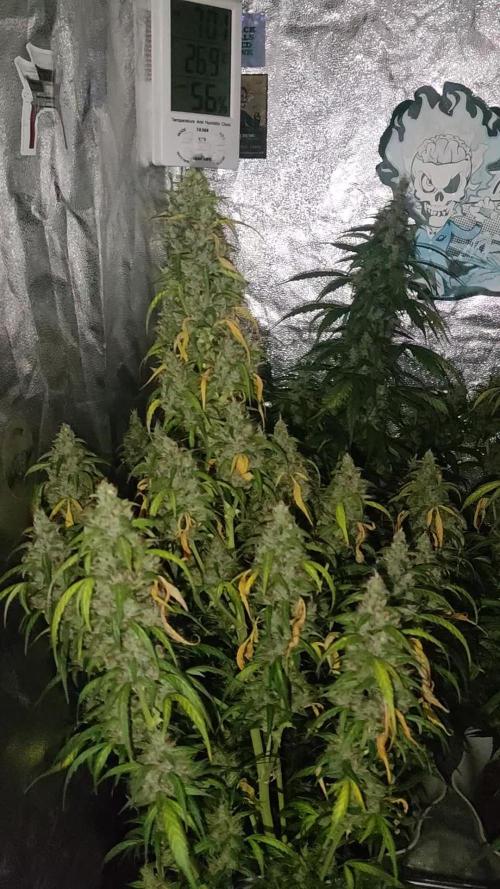
This plant is really starting to pack on the weight now. Buds are getting dense and absolutely covered in frost. The smell is phenomenal and very very strong now.
I had to take out a few fan leaves that started to cover up some bud. Doesn’t look like this one will be too hard to trim after the dry.
Light is sitting around 950 PPFD so she is getting absolutely blasted to the max without adding in CO2. No signs of stress ever in this plant.
I’m guessing roughly 1-2 weeks before she gets cut. Will start checking at the end of this week.
Next feed will be just CalMag and Silica.

Likes
6
Share
@Genussmittel420
Follow
day 1- first sings of the pistils visible for the bare eye
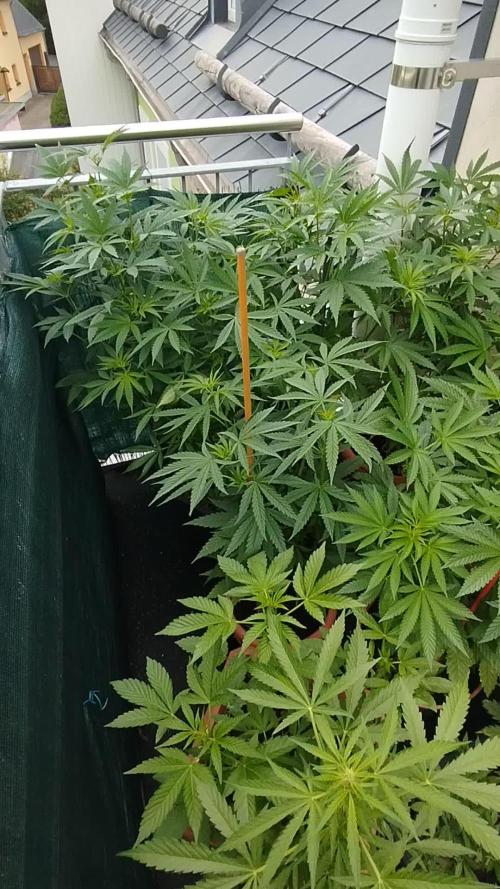
day 3 - all bud sites got their first calyces and pistiles now and seem to grow quiet fast and healthy. still waiting for my PH down but seems like it will take about 2 more weeks because of the high demand in germany right now after legalizeing. i guess she will be fine with just still the tiny mini yellow tips at the end of the leafs.

Likes
33
Share
@Herroqitti
Follow
Still week 5 9/19/20. Started some low stress training with pipe cleaners and floral wire. Leaves look a little damaged, tiny brownish spots.
Likes
17
Share
@Papastroumf
Follow
Day 43 : Watering with co2 tab / 5L. Also added food again because i think they need it. Increased ppm to 850. Maybe the next one will be pure water. Ventilation works all the time when lights are on. Temp and humi are stable and this is good for the girls. Patience is the key always. Also removed some burned leaves from all ladies.
Edit (Day 47) : Watering with co2 tab every 5L. I watered with juices again at 850ppm because i felt that they need it. Only DsD drank pure water because of burns. NL stopped also vertical growth, started to fatten her buts. :D Her main cola will be huge.

Likes
45
Share
@Robbaus
Follow
Fantastica settimana! Finalmente iniziano a formarsi i fiori e i primi peli! Per la prima volta ho aggiunto una seconda rete per aiutare lo scrog, sono molto soddisfatto, ho solamente dovuto lasciare un buco nella rete per far passare il vaporizzatore per tenere bassa la temperatura del box e di conseguenza dell'acqua nai vasi. Ho risolto il problema della muffa sulle radici grazie al trichoderma e alle micorizze, stanno tornando come nuove dopo un mesetto non proprio positivo sotto questo punto di vista, anzi, se peggiora a rischiavo di non arrivare alla fine del raccolto. Corso sono stato un pelino alto con l'ec, arrivando quasi a 2.8,l'ho abbassata rabboccando. Manca un mese, siamo nel momento clou 😍😍🤩🤩😝😝🍀🍀🍀🔝🔝🔝💪🏼💪🏼💪🏼

Likes
8
Share
@SyntheticSmokie
Follow
Some trich are truning amber I think I should harvest next week
2x2 homegrow 👽

Likes
15
Share
@GermanGrow182
Follow
Durchwachsene Woche. Öfters Regen und prompt die erste SchimmelStelle diese Saison. Eine dicht gewachsene tropicana Cookies purple Auto war das erste Opfer. Auch noch der mainbud... 😐 Da auch eine fat Banana Auto und drei Apple fritter Auto reif sind, hab ich zwei komplette fritter und die mainbuds von einer Fritter und einer banana geerntet. Spatz in der Hand ist besser, als die Taube auf dem Dach... Sicher ist sicher. Die Photos kommen herrlich und haben knapp 90cm mit je 8 Haupttrieben. Das wird gut. Denn die wachsen noch mindestens 4 Wochen 😁👌 bis nächste Woche. Dann wird die erste Ernte beziffert ✌️
Likes
2
Share
@AlpenZilla
Follow
Week 10 – Day 71 (Flower Day 43)
🔄 General Notes
White Widow is now at day 43 of flower – slowly approaching the finish line 🏁
💧 Water uptake has noticeably decreased, so I’ve reduced the nutrient dosage by around 20%
❓Do you guys do the same near the end of flower?
I remember reading it's common practice to taper off, but I’d love to hear your thoughts!
❄️ White Widow Status
Still going strong 💪
Buds are frosty, dense, and nicely uniform
💬 Honestly, the pictures speak for themselves – everything’s running smoothly!

Likes
49
Share
@masterofsmeagol
Follow
6/15. Glad I listened to my intuition and held off watering. IT Rained andctheb again last night. Plants seem to be doingvreal well. Slight burn on lower leaves where it was before from being in the garage and I found on spot that LOOKED like it could've been caused by a pillar but it's right on a burn. I sefoliated one leaf. This is minor stuff. Next watering I'll be adding silica. I'm not giving nutes until the plants tell the need them. The 3 gallon ones may receive nutes first as they'll run out. I'll update as I progress.
Went back over at 8:30. It's just overcast with showers. Plants seemed to like it. They all look good. Noticed a chunk out of a leaf and a POSSIBLE pillar spot. I'm going to have to get the BT out and and give the girls an application. I'm waiting until they settle in a bit more though. I need to start LST as well AND the light dep. Unfortunately "life" has made things difficult. I'll get back over there today though and I'll start the light dep. Kinda makes me wonder though. The 1pth planet I wanted to light deo is tge same size as the others in the much bigger containers. The thought came that maybe I should just hold on to them as extras in case something happens. I also am going to start silica next watering but it will be a few weeks before any nutes are given.
UPDATE: WENT BACK OVER AT FIVE AND TOOK ACSHOT TON OF PICTURES. IM TRYING TO UOLOAD NOW. THINGS ARE POPPING OFF AND IM GETTING A NICE SWEET SKUNKY ODOR. WHILE I WASCTHERE WE GOT A QUICK SHOWER. DIDNT LAST MORE THAN TEN MINUTES BUT IT RAINED HARD. I FOUND A TEMPORARY SPOT TO LIGHT DEP THE TWO PURPLE PUNCH AND THE ONE TENTH PLANET. I DONT SEE ANY LIGHT LEALS AND ITS SURE AS HELL DARKER THAN IT IS AT NIGHT. I'LL SEE HOW IT GOES LEQVING THE COVER ON ALL NIGHT. IF IT DOESNT WORK I MAY JEED TO ADD A FAN OR CHANCECTHE SPACE. I ALMOST DIDNT WANT TO DO THIS AS THE 10TH PLANET IS KEEPING PACE WITH ITS SISTERS, DESPITE THE SMALLER POT. OH WELL I WANT TO GIVE IT A SHOT AND I DONT WANT MY CAGE OVER CROWDED. I'M LOOKONG TO DO A 6:30 TO 6:30 SCHEDULE.
6/16 First night of light dep for the three little ones. I won't be able to call them that soon. I'm currently trying to upload a video. My grow buddy mentioned the droopiness of a couple of my plants in this video and how I hadn't been watering. This kinda scared me so I ran over and checked the too few inches on the two that had a little droop and came out dry. I had some water already phed ready to go (I'm hoping that the ph doesn't change if it's stored a day or two) and used the gallon to moisten the dry topsoil. Looking back over my diary we have had nothing but rain. I then tried the "lift the pot method" and came to the conclusion that these bags were indeed still holding moisture. I assumed they would be considering the thunderstorms we've had. I held off on fullt watering because the weather said the next dry day is going to be Monday. Today is Friday so thats two solid days of rain. Three if you count today through the night. I concentrated my watering of the one gallon on the couple plants that appeared to droop. If it doesn't rain like they say it will I will need to water. I need to set up a decent watering schedule but I need it to hold off raining long enough to do so.
UPDATE: I WENT BACK OVER AND PUT THE 3 GALS IN FOR BED AND CHECKED OUT THE REST OF THE GARDEN. I WATERED THE 3 GAL GIRLS A LITTLE MORE SINCE THEY WONT BE OUTSIDE. THE BIT OF WATER I GAVE SEEMED TO HELP LIFT SOME OF THE GIRLS. AT LEAST I THINK IT DID. THE RAIN SHOULDVE COME ALREADY. I WOULDVE WATERED MORE HAD THE BAGS NOT BEEN SO HEAVY.
6/17 Rained all night which is good. Brought the three transplants out but left them under the overhang so they. Dont get soaked. So far light depoing is going good. Well its only been two nights but we'll see. I'll update as I go. Not feeling well today. Went back over and checked on the plants and did a video. Probably won't get uploaded until tomorrow. I'm giving it a shot. It's raining in good shape. Plants looked fine when I was there. I need to get my supports and my trellis in place. Video won't upload. No suprise. I'll get it tomorrow.
6/18 Uploaded videos if they fuck up from me editing I'm gonna be pissed. Anyway it's still pouring with high winds. I added a couple supports where it looked like it needed it. I need to put my trellis up. I've been able to keep up with the light dep and those plants haven't been used and abused. They stay in the building facing the sun when the weather is this bad. I think they're looking great. I may start a new diary just for them. Sun came out around four. Trying to upload a couple videos but doesn't look like it's going to happen. Tucked the three little ones in at six. It had stopped raining and the wind died down some. If adverse conditions create good plants then I'm on the way to a great harvest. Minor bleaching and burns on a few lower fan leaves and some wrinkling on some from wind burn other than that plants seem to be acclimated. Did a video but will have to wait until tomorrow to upload
6/19 It's not raining! We got four inches this past storm lol. Having the bags raised on pollens I believe has greatly helped. As did the high winds that help dry the soil in the bag. Had to add a few temporary supports. Light dep is going good. Adjusted amd found a better spot. I'm considering getting "pool noodles" or some other thing like a Hulu hoops or pvc pipe and making either a frame on the roof for the entire cage or on top of each individual plants posts so I could roll clear plastic over it when it rains. I'm thinking about later on in the fall when this could really help. I found a roll of plastic. Also thought about putting that up on the back wall but I didn't. What I'm doing right now is working. I just need to keep up with it. I also need a solid watering schedule to stick too. It's hard when each plants needs are different. Oh well. I'm just happy to be growing again. I pray to the cannabis gods and the Lord above himself that I'm not plagued with the problems of last year.
6/20. I'm sick as fuck but I got the little girls out in the sun. Light dep is going good. Plants look great. I'll update when I feel better and if I do anything. Still feel like shit. Luckily I looked up just in time to get to the grow and put the little ones to bed. They were thirsty (especially the bushy 10th planet so I gave them about 3/4 of a gallon of water. Got lots of run off from 10th planet. Didn't notice as much from the others but I was hurrying. I'll upload later. Still sick.
6/21 Plants seem to be doing great. I removed some lower growth on a few just to see how they respond. I'm going to do some defoliation down low and I want to see how the plants respond. I'm planning my first full watering Thursday as we have a real good stretch of weather after that. Grow bags are still heavy as hell so they have sufficient water. I'll be adding silica nextcl watering. Not time for nutes but I think it would be okay to start the silica and in another week I might start small doses of nutes. The light dep on the little girls is go8ng great! It's cool I'll get to sample some of these strains before fall. I'll update after I do something. Tucked the girls in at 6. I might need to think about transplanting that 10th planet in the 3 gallon. I watered until runoff yesterday and it's light as hell today. Plus I fimked it and it's bushy as hell. I've Bern turning it si it gets all angles of the sun. I have a bag of 707 left and a 5 gallon bucket with holes drilled all over it like an air pot and a ten gallon grow bag. This will take some thought. Hot af today. I wad able to lift the grow bags so I decided tomorrow will be the girls first real watering. I think I'll be adding silica and possibly kelp me kelp you due to the heat stress I've been noticing. Nothing bad just a few tacoed leaves. I've had several people that have seen my grow in person tell me that this is by far the healthiest (not biggest I've had bigger) but by farcthe healthies5 crop I've grown. They believe I'll have my best year ever this year. I hope they are right. Vid won't be uploaded until tomorrow.
6/22 WATERED TODAY. I'm still a little gun shy with watering. That fusarium last year pretty much traumatized me. I left the container plants alone. I gave them a little water but not enough to do much. I used a pump sprayer on a mist setting and went one by one and back around gently watering the entire medium. This took forever and I'll be finding a different way to water. I hope this was enough water. I'll check later on and if they look like they want more I give it to them. I started LST on the light dep 10th planet and tucked some branches of a another under the tomato cage. I had missed that earlier. I also went around and cleaned up the bottoms on most. Getting rid of things that will amount to nothing. I noticed what looked like thrip damage on ONE leaf on ONE plant. I also saw a chunk missing from a grasshopper bite and a finger of a fan leaf petiol was broken so I'm going to need to get my ipm up and running. I'm unsure whether I'll be using chemicals or predators. Probably BT and spinosad. That's what I've had the best luck with. I also noticed bottom leaves dying off on the bottom of a couple plants. It was where the burns were though so I'm almost 100% its just related to the light burns they got when i first put them up. I'll be updating the diary as I do more stuff.

Processing
Likes
2
Share
@Zarixhd
Follow
This 3rd week was so good, the plants showed some signs that she loved the biobizz’s bio grow 😎

Likes
6
Share
@DRO420
Follow
First week of Flower. Girls are starting the final stretch before forming the flowers.

Likes
2
Share
@DogDoctorOfficial
Follow
🌱 Skywalker OG — Week 5 From Seed (12/12 Run)
Hello everyone, welcome to another update, and a big thank you to everyone following along, newcomers, longtime readers, sponsors, platform, and of course the breeders and creators behind these genetics. It truly means a lot to share this journey together.
For those just joining: this is a 12/12 from seed run, approached gently and observationally. No rush, no aggression, just letting the plants express themselves while we listen closely.
⸻
🌡️ Environment & Room Conditions
• Temperature: 21°C
• Relative Humidity: ~58%
• Outside conditions: 4–5°C with 90–98% RH
Given what’s happening outside, I’m actually very happy with how stable the room is staying. The plants seem to agree, posture, color, and overall vigor are excellent.
• CO₂: ~666 ppm
For now, this is perfectly fine. No need to push or supplement — steady and natural.
⸻
💡 Lighting Strategy (Top + Under Canopy)
At the start of the week:
• Only top lights are running
• Power: 100%
• PPFD: ~700–850 (depending on plant size)
As the plants stretch and rise above the under-canopy fixtures, we’re now introducing under-canopy lighting:
• Lumiflora under-canopy lights
• Starting at 30% power
This is very intentional.
The goal isn’t to blast the plants, but to teach them that light and photons will be arriving from more than one direction. We want a gentle adaptation — letting the plant reorganize how it uses light rather than forcing it.
Power will be increased later, but right now it’s all about adjustment, not intensity.
⸻
🌿 Training Approach (or lack of it)
Because this is a 12/12 from seed run, we are being extremely conservative.
• No topping
• No hard training
• No defoliation
The only work being done:
• Leaf tucking
• Gentle leaf bending
And the response has been incredible. These girls are reacting with:
• Tight internodes
• Bushy structure
• Calm, confident growth
Sometimes, truly, less touch = better performance.
⸻
🌱 The Triple-Branching Lady (Main Focus of the Week)
This week’s highlight is one very special plant showing clear triple branching.
At each node, instead of the usual two shoots, she’s producing three distinct branches, stacking from the bottom all the way up. The structure almost looks like she’s tucking herself naturally, creating a dense but elegant framework.
This is not something we forced. It’s purely genetic expression meeting the right conditions.
She looks happy. She looks calm. And she looks like she’s planning something special.
We’ll be doing a dedicated report on her by the end of the week, because this kind of morphology deserves proper documentation.
⸻
💧 Watering & Nutrition Strategy
Water Source
We’re using a mix of:
• Rainwater
• Dehumidifier-collected water
This water is extremely soft, so this week we introduced something new:
➕ CalMag Pro
Not because the plants were asking — but thinking ahead.
Before adding nutrition, we want a proper mineral foundation. This helps stabilize uptake and prevents issues before they even show up.
Aside from that:
• No changes to the main recipe
• Everything remains steady and predictable
⸻


Processing
Likes
4
Share
@Snuffys_garden
Follow
Into day 30 and I have some flowers starting. The girls look healthy and I am only using some LST and defoliation. Backed off the Foxfarm Big Bloom and I am now just using Ph balanced water between 6.3 and 6.5 Very pleased with their progress so far🌱🤙
Likes
2
Share
@aquaMan
Follow
Premise was to see how "optimal" i can get my first ever Grow. After some Research i came up with the idea to build an Aeroponic System myself using Water Buckets and Venturi Injektors to provider proper aeration.
Sadly Seedlings had to wait in EazyCubes cause some parts and Nutrients didnt arrive on time. System was fully operationable on Day 16. Atami Nutrients are inside the System since Day 24, Calmag has been added Day 28. Before that, some Tri-part Nutrient.
Planning on switching to Plagron in the Long run, as well as adding Co2, a water chiller and a ~700W LED.
Stats:
- 5 30L Buckets, 4 Plants and 1 Reservoir
- Recirculation happens through 90mm PVC pipes
- 16000 l/h pump going through 4x 1" Venturi Injektors pulling around 700 liters of Air per hour
- 1mx1mx2m Growtent
- 250W The Jackson Nemesis LED
Happy about any Questions and Suggestions!
Likes
176
Share
@NuggetPawn
Follow
So, with the harvest complete and the dry finished, the rest is now going into jars for the final cure and storage.
Overall I enjoyed this grow, it needed minimal interventions and had a smaller work load compared to the other grows.
The amount of dried flowers is 752g (1.11gpw) so a decent haul, I threw a lot of B grade buds in the hash bag due to the large number of low level flowering sites (I need to rethink my canopy management) and also with the lack of stretch after flipping made the internodal spacing a bit too tight. Managed to extract 215g of grade a hash from her as well which I have pressed into a slab (pictures).
I learned many things along the way, namely root health and the importance of keeping organic additions as low as possible. I also decided to try out clones for my next run, just to get a little more canopy and growth consistency - those of which are in an aeroponics tub at the moment waiting to root (picture).
Thanks for those of you who followed along most of the way, good luck with all your grows!
Likes
16
Share
@Vincent11
Follow
Hi everyone this last few weeks have been crazy as you all can see this Gelato turned out to be a Photoperiodic plant.
Week 17 in to flower for 2 weeks now.
All was going well but I did not have much time to look after it.
And got some light burn in the early stages did some training techniques and She looks is recovering now.
Some nice pictures how big one of those can get when I wasn't expecting this plant to be a Photoperiodic.
But let's see she turned out a female so that's great will be a nice surprise probably.
Happy Growing and have a lovely week.


Likes
9
Share
@WeeDay420
Follow
Start all seeds together super now we must wait and wait and wait on the next days better together Thank You follow me guys and YT
HAPPY NEW YEAR !!?😅💚
Likes
18
Share
@blendmedmedman
Follow
the start was kind of slow about 5 days for the seed to pop, I was kind of worried but soon after she came up. she grew short like most indicas do, she started to frost up in her 3rd week of flowering, her frost continued to coat her buds while they where getting fatter and denser. she started to smell real nice around the 4th week so if smell is a factor u will want to get a carbon filter. she is sticky and dank, real strong smell. she is not a big producer but you could increase yields by putting a net on her as well as a bigger pot, 5 gals. and let her go. I did not top her as I was unsure how this strain would re act. she grows pretty bushy around the 5th week in and you may want to defoliate in the first 2 weeks in flower. she was not much of a drinker, about every other day. the germination was good as I only popped 1 out of 3 so I have 2 more to work with later. I probably will grow this strain again as she was easy and with little effort I got a ounce of some dank dens buds. I do kick myself for not running 1 more of the seeds but I am happy with the weed I have. I have more weed today than I did the other day. big thanks @fastbuds for letting me do some testing. the fades of purple light green and yellows made my day.
Processing
Likes
26
Share
@APOLLO
Follow
a week or so and you could never tell there were two plants in the tent ! she has taken over the entire space now.
Increased all the good stuff up a notch because she has never got any burnt tips or anything, she just drinks and drinks. Every 24 hours, 4 litres of nute water (with about 400ml runoff). I mean I never thought a plant would drink that much ??? I am questioning the feeding method, this is very binding... an irrigation system perhaps?
Meanwhile off she goes, no fucks given
