


Likes
Comments
Share


@BLAZED
Follow
Week 14 (2-5 to 8-5)
2-5
Temperature: 27.3 degrees (lights on) 19.5 degrees (lights off)
Humidity: 69% (highest) 52% (lowest)
Watering: 2000 ml.
3-5
Temperature: 24.2 degrees (lights on) 19.3 degrees (lights off)
Humidity: 68% (highest) 50% (lowest)
Watering: None.
No pictures.
Increased the light's power output to 90%
LUX: 22.500
4-5
Temperature: 24.1 degrees (lights on) 20.3 degrees (lights off)
Humidity: 63% (highest) 43% (lowest)
Watering: 1000 ml.
5-5
Temperature: 24.8 degrees (lights on) 20.3 degrees (lights off)
Humidity: 66% (highest) 43% (lowest)
Watering: 1000 ml.
No pictures.
6-5
Temperature: 24.4 degrees (lights on) 19.4 degrees (lights off)
Humidity: 66% (highest) 44% (lowest)
Watering: None.
7-5
Temperature: 24.4 degrees (lights on) 19.2 degrees (lights off)
Humidity: 66% (highest) 44% (lowest)
Watering: 1000 ml.
8-5
Temperature: 24.2 degrees (lights on) 19.4 degrees (lights off)
Humidity: 65% (highest) 48% (lowest)
Watering: 1000 ml.

Likes
7
Share

@Trinidad
Follow
01.07.25 Day 77
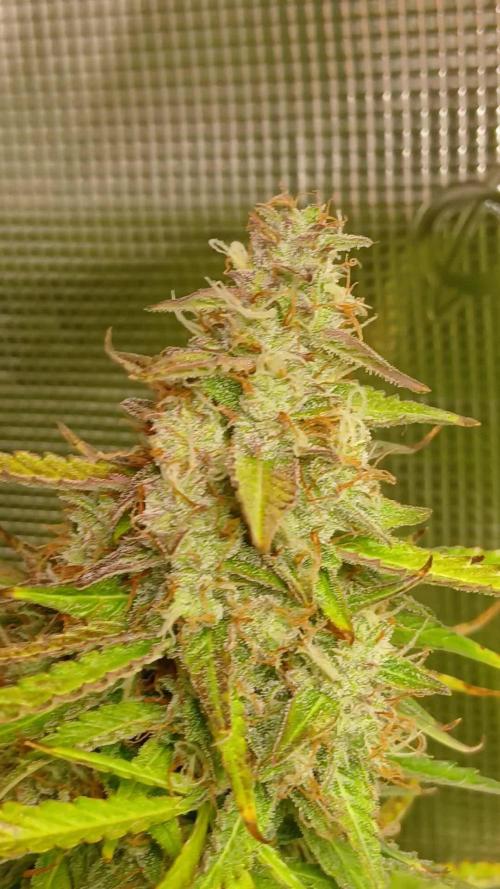
On 2 phenos the buds are dense. I think the others are becoming dense. I just need to wait for them to catch up. The smell is so amazing (sweet with citrus) and the buds are sticky. Trichomes look cloudy. Fresh reservoir change out today. I will be flushing after this week. Or if trichomes say other wise. This will be my 1st time flushing

Likes
20
Share


@Ultraviolet
Follow
Let her show us her unlimited potential; all possibilities exist within the present moment, yet most people predict the future based on past experience, when you are truly present. The observer effect is
the phenomenon where the act of observing or measuring a system inevitably alters its state, a concept fundamental to quantum mechanics and applicable to various fields. It occurs because measuring tools interact with the subject (e.g., photons hitting a particle), rather than requiring conscious observation. Detection forces particles to behave differently—acting as particles rather than waves. It is closely related to Heisenberg's uncertainty principle. Light exhibits a wave-particle duality, acting as both an electromagnetic wave and a particle (photon) depending on how it is observed. It travels like a wave (refraction, interference) but interacts with matter as distinct, quantized packets of energy, known as photons. This duality is a cornerstone of quantum mechanics. Quantum particles, including light, can exist in multiple states or locations at once (superposition). In complex processes like photosynthesis, light energy acts as both a wave and a particle, traversing all possible paths simultaneously to select the most efficient route, acting as a "quantum computer". Particles can become so deeply linked that the state of one instantly influences the other, regardless of the distance between them. This phenomenon, initially doubted by Einstein, has been validated through rigorous experimentation. When researchers quantize the classical electromagnetic field, the theory predicts four potential oscillation modes, but only two are observable. The other two are "ghost" photons—unobservable yet necessary for the mathematical framework of quantum theory. Quantum mechanics is not limited to cold, isolated laboratory settings. Research indicates that plants utilize quantum coherence at room temperature to achieve 99% efficiency in photosynthesis. Recent experiments have shown that light can be manipulated to exist in dozens of dimensions, which could revolutionize quantum computing and secure communication. New research suggests that classical light interference patterns arise from, and are controlled by, specific quantum states known as bright and dark states, which persist even when light waves appear to cancel each other out. These findings challenge the fundamental understanding of reality, suggesting that the universe is far more interconnected, probabilistic, and mysterious than previously imagined.

Likes
46
Share


@Crwfz1
Follow
This plant has been a literal joy to grow thing was so stress free didn't give me any problems at all and grew Soo fast and vigorously I was so impressed with how much she yielded indoor highest one plant yield indoor yet and the bud is absolutely blasted with trics I harvested little early because me and my wife like a little less than 50 percent amber seems to be little less couch locking no matter the strain but anyways great grow amazing plant and couldn't have asked for more !! Definitely one of my favorites


Likes
4
Share


@alexb420
Follow
buds starting to get shape and trichs coming in nice. the blueberry muffin has such a unique berry pastry smell. no dank weed smell at all. the khalifa mintz x (bcc x jealousy) is still pretty gassy, with stronger fruit profiles on both strains now that the buds are starting to get fuller. update in a bother 2-3 weeks lol.


Likes
29
Share


@Naujas
Follow
it looks great!!!!! although the upper leaves "burn" from the strong light, but the flowers are developing well:) Palgron nutrient fertilizer waste does its job :) I like it:) also visited the quality control - "cat" no violations were noticed !!!:) I moved my suitcase to another room :) now the daytime temperature is only 28° ;) I managed to reduce it by 4°, which will definitely benefit her :) good luck to everyone :)


Likes
4
Share


@XoticGROW666
Follow
DAY 14 of flower🌸🌼
G41 BiG bushy pheno
Feed Compost & SST tea
No Bottles no Nutes

Likes
43
Share


@inversi0n
Follow
Hello, readers!
Slow-looking grow, Mirra feels fine.
I removed some lower-smallest buds at the beginning of the week.
Smell become super strong now.
Feeding that's not from TA is in gr/l
Likes
10
Share


@AsNoriu
Follow
Day 79. 3.5 phed water in.
Worst looking and most lost foliage girl, but she will be biggest by harvest. Heavy lack of food, but she should make it ;)))))
Most damaged/consumed leaves were taken off.
That strain always grows big and frosty, but this time only big .... Needed better conditions 4sure...
Happy Growing !!!

Likes
45
Share


@TrippyTerps
Follow
So the final day has come. Day 115. Wow she took 4 months!
I struggled a little bit with cutting her, I had to do it with a handsaw. She is a chunky girl!
I partially trimmed the plant, mostly removing any fan leaf left and any big leaf without trichomes on them. I consider this more of a pre-cleaning and not a real trimming. That will be done after the plant has dried in about 2 weeks
It was quite nice to document my grow. This was my 3rd one ever. I will continue with the grows and journaling because it really makes things sound clearer in my head.


Likes
27
Share


@LockDownGrow
Follow
Ok so this week I did a defoliation and a tigh down too the netting , I really was not planning on doing such a big defoliation but the leafs became thick and dense and there was almost no light penitration down too the lower branches of the plant , so she is opened right up now and the humidity and temperature has dropped loads and the air is moving alot better around the leaves and branches , I will not take anything more off her now , I have also added Cal mag too the nutrients for this week only , she is well into pre flower now but the stretch has not yet started so I figured it's no or never too defoliate and tigh them down ,
I am very happy with them so far and being new too all this it's all very exciting ,
Thanks for looking :)
Likes
4
Share


@Sadom
Follow
29.09.: Da es sich langsam dem Ende neigt bekommen beide nur noch Wasser zu trinken. Leider ist mir bei näherer Untersuchung der G41 aufgefallen, dass sie im oberen Bereich naher der Lampe Bananen ausgebildet hat. Ich hoffe und vermute, dass noch keine Pollen freigesetzt wurde, allerdings wird es nur eine Frage der Zeit sein, bis ich eine übersehe. Es ist natürlich sehr schwer zu sagen, woran es liegt, aber ich hoffe, dass es nicht noch sehr viel mehr werden. Auf den Blüten sind bisher noch keine braunen Trichome zu erkennen, also brauchen sie noch ein wenig.


Likes
43
Share


@The_Northern_Skunk
Follow
Raised the height of the grow lights and highed the light output, threw all the autos into one tent for the time being as they love lfe in there over than in the cupboard! but ill get around to making the cupboard I have spare into a space to grow again. All.of the plants are doing great really, one purpe punch isnt doing to well im going to flush her then feed half the dose of nutes that i have been already feeding her. 💚🤘

Likes
3
Share


@I_roll_my_own_420
Follow
Flushing started. All looking fantastic and smells even better. The biggest bud of Amnesia Bilbo is 18cm long and 7cm wide. Cant wait to try it after curing. So now only clean water is given. Peace and love 💚

Likes
5
Share


@Gingercannacat
Follow
Beginning of week 4 so far so good. The girls are reacting well to there training. Vita race from plagron is a game changer. They are super green and healthy everytime I feed them you see the difference.Did some defoliation. Nothing major just removed any leaf overlapping or blocking light to lower parts of the plant.


Likes
6
Share

Processing
Likes
4
Share


@BUDPRIEST
Follow
My plant's got a name - Melanie. She fights against the pests. We suppose that the yellowish colour of the leaves are caused by them. As I decided to help her, I used the insecticide called Dursban. As a result, the pests' number has lessened but not totally removed. Do you have any advice for me? Thank you in advance.
