


Likes
Comments
Share


@Tgrow411
Follow
Hatte etwas Calcium Mangel 👉🏼 0.8ml / L CalMag.
Die Größten musste ich toppen um alle auf einer Höhe zu halten zusätzlich etwas LST.
Ca. alle 4 Tage 1.1L Wasser

Likes
9
Share


@Robmags
Follow
Update 14/09/20 - All systems ahead at this stage. Plants are drinking approximately 2.5 litres per day and reservoir is constantly filled and Ph checked daily. Ph average 6.1 Humidity 50% Day Temp 28c Night 20c
Seems to be Approximately 3 weeks left on Colorado Cookie & one of the mixed bag as well or may be slightly ahead, by possibly a few days. Time schedule looks as though 1 of the mixed bags 1st, then Colorado Cookie, 3rd Second mixed bag (lightly topped) then may a week or 2 will be the Blueberry. The next weeks 4 weeks are exciting!!! I'm excited to see how much more they fill out from this point! They may exceed my expectations!!
14/09/20 - I increased the nutrients slightly as the Blueberry was a little light green as opposed to all other plants that have that have lush green into flowering as well as a little extra flower boost to try to fatten up the buds. 5 mls extra of Flower Booster 25 mls per 10 ltrs.
16/09/20 - Realised that Mixed bag x 2 & Colorado Cookie only have approximately 3 - 4 weeks, so I decided to begin to reduce the nutrients instead on the 3 girls. Blueberry is at least 2 weeks behind so I have continued to feed her 1/4 nutrients and 20mls bloom per 10 ltrs. Did another defoliation on the Blueberry and this will be the last time for her until later in flower. very light defoliation of bud sites to Mixed bag x 2 & Colorado Cookie.
* The Colorado Cookie has a magnificient fragrance, the Mixed bag as I'm not sure what they are they do have a Citrus fragrance. Trichomes have begun and are still clear An eye must be kept on Trichomes from here *
17/09/20 - Systems are good and everything moving along nicely.

Likes
Comments
Share


@Robom069
Follow
Day67/68 lookin very good
dont know what else to do than lettin them grow

Likes
12
Share


@Kingseeds
Follow
This strain has a yield of extra large, compact colas that are heavy in weight and covered in extra adhesive trichomes that stick to your fingers. Cherry Punch's exterior is dark green and exhibits small amounts of midnight purple leaves
Cherry Punch's exterior is dark green and exhibits small amounts of midnight purple leaves. Its aroma is fruity but skunk-like, and has a soft, sweet berry taste that resembles its parent Purple Punch

Likes
15
Share


@GYOweed
Follow
Nothing special. Its sis in south facing solo cup smells amazing and sticky but that one is farther ahead. Gonna do just organic ferts and water see what happens im getting lazy


Likes
15
Share


@OrganikTek
Follow
Black Cream stretchig full on flowering. Shes polling up the net. Think i wont train here anymore.
Bomberry Glue Really its a diferent kind. Slow started and look at here now. Shes a beauty. Truly Ganja Leaves.
Wedding starting to flower. Stretshing good. Started Scrog on here.
Purple Couskush looking good. Like how the new branchs are so big for her but still stretching verticaly. Nice genetic nuace. Something to add to newer genetics.
Temps are getting up , vents are getting are dry and up VPD goes. trying some foliar to help.
Lets see what happens
Cheers Brotherhood

Likes
3
Share


@SPCKush
Follow
End of week 6; Day 42
So far so good, Frost is setting in on the strawberry Gorilla. The cookies is stretching beyond belief and is about 55in tall from the floor up.
The strawberry has stayed shorter and bushier than the cookies. Smell is also coming pretty strong.
Happy Growing y'all

Likes
9
Share


@Arcadios
Follow
Mon - 1/25/21 The top feed + 5 Tbs of Dr Earth life per 3gallon pot seems to be doing pretty well. Today I'm just watering with 6.2 water.
Tuesday - 1/26/21 Still looking good, no action
Wed - 1/27/21 - Soil was still wet enough that I didn't need to water. Will resume tomorrow
Thur - 1/28/21 - Watered 5 gallons across all 3
Fri - 1/29/21 - No water
Sat - 1/30/21 - No water
Sunday - 1/31/21 - Watered up!
Overall, I'm pretty happy! The leaves have healed up a bit and the buds are super dense. Not quite as frosty as I'd like, but I plan to do some Fox Farm Big bloom next week.


Likes
36
Share


@Salokin
Follow
All is developing nicely, introduced cannazym and boost to the mix. Finally I have access to a better camera which you will see on the later pics. The cuttings I took seem to survive for now, with some outrooting their cubes already.
Likes
16
Share


@DedeLirante
Follow
Day 71 - 13/06/2025
It was also the harvest day for Mango Cream! 🧑🌾
This plant was so thickness. Huge buds with 7cm of width and strong smelling of gas and fruity, but mainly gas terpenes.
Those plants were with small structure but with large and dense buds.
This plant is heaviest than Strawberry Cola 1 and I'm expecting to have 80g+ from this one.
It's already on the dry box with Strawberry Cola 1 and should be ready for trimm in 7/10 days.
Let's keep following the process!
Cheers! 🍁🤞🏽🔥

Likes
Comments
Share

@HK_OG
Follow
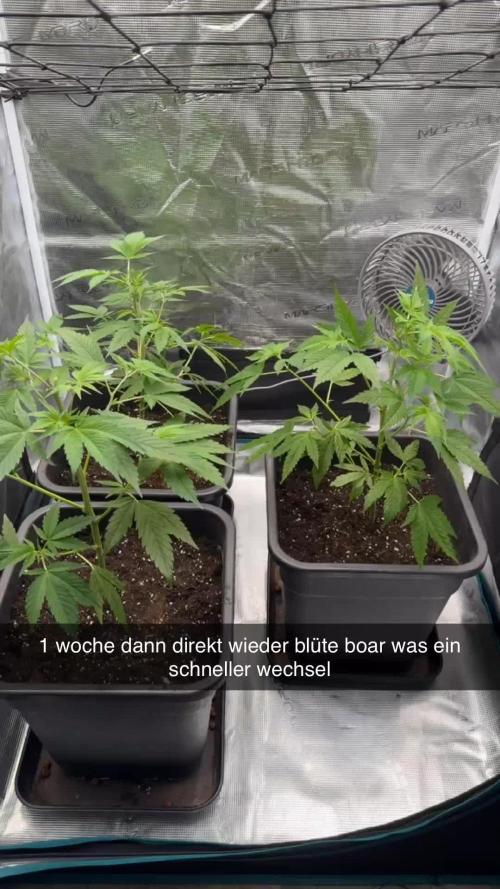
Hab erst jetzt angefangen mit Bildern für die Dokumentation, hab sie jetzt frisch von 3.5L Topf in die 20L Töpfe umgesetzt und lasse sie eine Woche ca. im neuen Topf ankommen. Nach der Woche wird direkt auf 12/12 umgestellt damit auch bloß keine Zeit verloren geht. Ich gehe stark davon aus das sie genauso wie ihre Mutti das Zelt sehr gut ausfüllen werden. Sie sind der 1. Cut, der 2. ist gerade schon wieder am Wurzeln.
Likes
25
Share


@Luna91
Follow
Hey Guys,
Finally the Harvest time arrived, and it was way harder than I imagined!!
I thought It’ll be fun to cut and trim but It was something that needed lots of attention and patience, getting near a kg bud, trimming and hanging them, checking on other buds in the jar and feeding my 2weeks baby plants , while keeping the area clean and out of reach of my dogs!! Everything was extremely in a Rush in a couple of days. But Im totally happy with the results. I set up the grow tent to 20degree and 55% relative humidity with two fans from each corner, I hope I get the best outcome when I see finally find them dry. I already smoked it up and the smell & taste is undescribable ... smell of pineapple is all over the place, my Grinder is full of it. Slowly gets me high without attacking and keeps it up to hours.. very strong Sativa feeling, Very fruity and such a sweet good strain. I just love it and will definitely grow the same strain Again & I’m Very happy that I chose this Strain for my first grow.
Thanks a lot for watching these girl’s journey guys.... I’ll update more photos later when I weight them dry.
Happy Growing
Likes
105
Share


@BioBuds
Follow
And another week has passed, they are bigger but didn't do the growing I expected them to do. I think something stressed them for a couple of days, where the XL Runtz took the stressing factors a bit better.
I'm trying to find out what it could have been and preventatively softened the light, lowered temps and it seemed to recover.
Maybe I pushed the SP-3000 by Mars Hydro a bit too hard... We also had some white pointy bits...
With a lot of trust in this growing method, after the previous grows, and the plants look overall happy I'm not too worried.
The soil will balance out if just don't push the lights too hard. It's a matter of adjusting and finding sweet spots and limits.
So I started bending a little and this week will bend over the tops, to further the LST which is about the only thing ill do and maybe some defoliation after 3rd week of flower....
Thank you for checking out my diary again!


Likes
119
Share


@Tropicannibis_Todd
Follow
💩Holy Crap Growmies We Are Back💩
Well after another short break we are back at it 😁
So what do you say we have some fun 👈 We got us the Strawberry Pie from FASTBUDS 😛
Alrighty growmies we are 7 days in and everything is going great👌
Lights being readjusted and chart updated .........👍rain water to be used entire growth👈
👉I used NutriNPK for nutrients for my grows and welcome anyone to give them a try .👈
👉 www.nutrinpk.com 👈
NutriNPK Cal MAG 14-0-14
NutriNPK Grow 28-14-14
NutriNPK Bloom 8-20-30
NutriNPK Bloom Booster 0-52-34
I GOT MULTIPLE DIARIES ON THE GO 😱 please check them out 😎
👉THANKS FOR TAKING THE TIME TO GO OVER MY DIARIES 👈
Processing
Likes
27
Share


@Hawkbo
Follow
Couple got a little burn I think maybe a little too much soil in there with the coco on top of the light feed? I got all the final pots filled up today they will go in 3 gal bags either today or tmm. It's a Greentree pro ultra coco/perlite mixed with some roots organic soil about 70/30.
Likes
35
Share


@MadeInGermany
Follow
Info:
Unfortunately, I had to find out that my account is used for fake pages in social media.
I am only active here on growdiaries.
I am not on facebook instagram twitter etc All accounts except this one are fake.
Have fun with the update.
Hey everyone :-).
This week the baby saw the light :).
She came out 2 days ago.
It is sprayed into the main area every day so that the humidity stays at the upper level :-).
Until the main comes down next week, it does not have to be poured but only sprayed :-).
I am very curious how it will develop in the coming week and until then I wish you a lot of fun with the update 😊.
Stay healthy 🙏🏻 and let it grow 🍀👍
You can buy this Strain at :
https://www.zamnesia.com/de/3271-zamnesia-seeds-blue-dream-feminisiert.html
Type:
Blue Dream
☝️🏼
Genetics:
Blueberry x Haze
20% Indica / 80% Sativa
👍
Vega lamp:
2 x Todogrow Led
Quantum Board 100 W
💡
Bloom Lamp :
2 x Todogrow Led
Cxb 3590 COB 3500 K 205W
💡💡☝️🏼
Soil :
Canna Coco Professional +
☝️🏼
Fertilizer:
Green House Powder Feeding
☝️🏼🌱
Water:
Osmosis water mixed with normal water (24 hours stale that the chlorine evaporates) to 0.2 EC. Add Cal / Mag to 0.4 Ec Ph with Organic Ph - to 5.5 - 5.8 .
Likes
11
Share


@Farmer1
Follow
Hi it is the fourth week it grows well with short internodes, it supports high temperatures well. Soon I will transplant it into a bigger pot and practice the LST. Wish you all a nice day 🌳😎
Likes
15
Share

@GermanGrow182
Follow
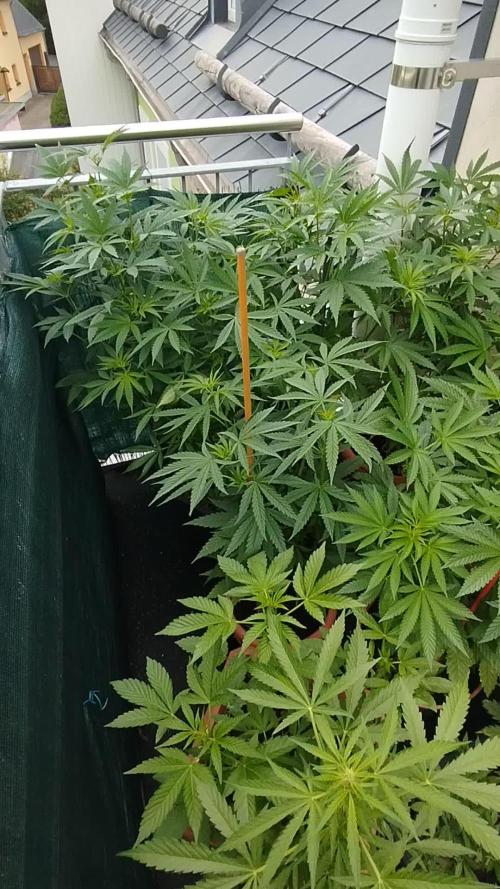
Durchwachsene Woche. Öfters Regen und prompt die erste SchimmelStelle diese Saison. Eine dicht gewachsene tropicana Cookies purple Auto war das erste Opfer. Auch noch der mainbud... 😐 Da auch eine fat Banana Auto und drei Apple fritter Auto reif sind, hab ich zwei komplette fritter und die mainbuds von einer Fritter und einer banana geerntet. Spatz in der Hand ist besser, als die Taube auf dem Dach... Sicher ist sicher. Die Photos kommen herrlich und haben knapp 90cm mit je 8 Haupttrieben. Das wird gut. Denn die wachsen noch mindestens 4 Wochen 😁👌 bis nächste Woche. Dann wird die erste Ernte beziffert ✌️

Likes
13
Share


@madlangs
Follow
All going well. No problems
15.12.24
Height
Purple lemonade 78cm
Small jelly breath 57
Large one 78cm
Slurricane 59
Lemon haze 72
Tangie 60
Hubbabubba 49
Cosmic queen 54
15.12.24
Mixed 12L tea and added 6L water at the end
Gave all 1.5L pk tea
3ml/L Pk 5-8 total 54ml
2m/L Acti Vera 36ml
2ml/L Bio heaven 36ml
bactrex 8 blue spoons


