





Likes
52
Share


@Salokin
Follow
The High intensity was to strong (clearly my fault) in the beginning which stunted her overall stretch, she however still delivered super dense, terpene and trichome loaded buds.

Likes
2
Share


@Cancangrower
Follow
Discovered a magnesium deficiency this week. Flushed and added Epsom salts


Likes
4
Share


@XxDetermined100
Follow
The plant was easy to grow overall .. it grew fast and a little on the tall side which had me nervous but I was able to raise the lights up just enough to finish, so it all worked out in the end. buds came out hard and frosty no complaints . This was a freebie seed too! didn’t expect it to come out as fire as it did man was i wrong. Straight fire 🔥
Ran into root rot in the beginning of veg but the great white and hydroguard saved my ass.🙏

Likes
7
Share


@Andres
Follow
here is in winter with cloudy days ... if she is like that it is my fault for not spending enough time on her ... we will say that of a flavor and good effect .
she has a good sweet smell ... we hope that I have a good smell, taste and effect ... a couple of days more and it will be harvested


Processing
Likes
13
Share


@kevgrow
Follow
Hey Growers, end of week 12 from seed
Not much has changed this week, its been a slow bud growth. I feel it still needs to grow thicker, 2-3 weeks before flushing
Smell is a bit stronger, hoping a sour flavor.
It been difficult trying to maintain a steady humidity level due to weather outside. I will consider buying a stronger humidifier for my next grow.
Trichomes are cloudy, no amber yet
Some of the leaves have yellow-orange tips, this happened after I changed ph meters, my old one broke so I had to purchased a different ph meter at my local hydroponics store.
Will keep you guys posted, see you next week


Likes
8
Share

@Northern_Ent
Follow
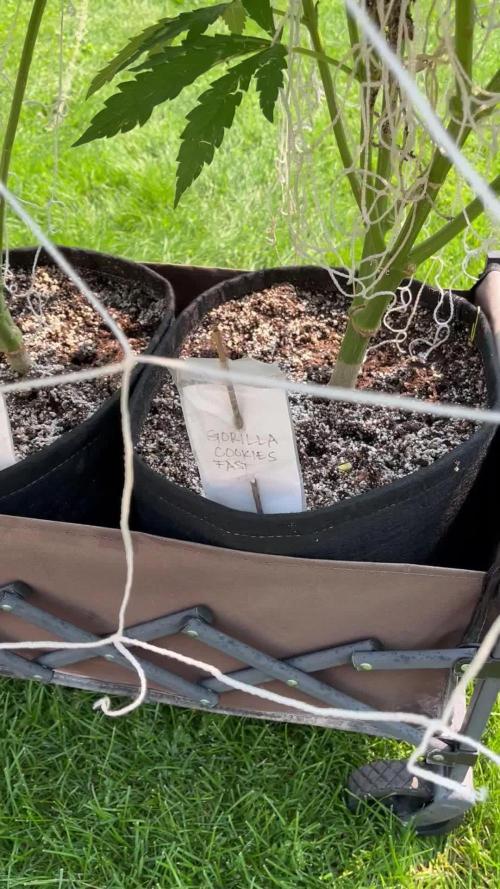
Aug 1: she’s doing great after two weeks of force flowering. In dark garage at 9 pm, few seconds of 730 nm far red light and out of garage at 7 am. This gives 10 h of darkness plus 2 h of ‘virtual’ dark by initiating dark mode faster. Like having a 26 h day which is a great trick if you have daily access to your plant.
Added another scrog net layer that is clipped to the lower net that is tied off to 500 g weights which holds things apart to let sunlight in.
Hail net was out for a brief hard rain, but no hail this time.
Processing
Likes
55
Share


@Max1973
Follow
Day 29 - Things going along nicely .... i trimmed down some of the bigger bottom leaves, i didn't have enough soil to fill the pots, and the plants are short, bushy, weird little things, that filled out the inside of the pots..... they are only 15cm tall, but the leaves are 10+ cm .... really weird little plants.... haha....
i decided to trim the fk out of one of the ones in the double pot, and practiced topping on her.... i'll cut her down maybe trimmer her of the pot, and focus on just the 2........ they seem to be still growing upwards, so i'm not in a hurry to put em into flower mode......... on the main one i noticed some neut deficiencies ... so i upped the neuts.... should be ok, i put a good heavy neut and it stopped the spots etc..... i think some bug or something got in the double pot and is livin in there, but he doesn't eat much, haha....... the main stalks are as big as my thumb and under each canopy is all the branches..... it's really strange, to go in under all the growth and see it all .... they look kinda small, but the entire under canopy of leaves is all full .... i'm moving the huge sized leaves out and pulling each branch up over them as they grow..... this is 21 THC and 19 CBD, so it's all the good stuff for medicine ... the smell is getting abit noticable and i'm hoping the exhaust fan arrives from china soon.... just got positive ventilation into a carbon fil. ... and daily air out........ i think i had the led lights too low..... so i'll raise em abit more and see if i can get em to stretch ....
Day 30 -- added some video's...... daylight vids... worth watchin for a laugh ...... first grow, so idk what i'm doin, ... any help/comments appreciated
Day 32 -- added some pics of the late night trim and LST,... idk looks ok....
Day 34 -- added a video...
Likes
2
Share


@Bigterpene
Follow
*all white spots are from nutrients + water* Titan has been entering flowering for a week or so its week 5 now and the pistils are are getting decently long seeing the buds starting to form and some pistils are orange many bud sites been doing lst to maximize bud sites, special kush #1 on the left has been doing pretty good for the torture it’s been through both plants are obviously stunted but special kush is pretty resilient, trimmed the edges of leaves as they were over nutriezed and touching soil, while I was doing lst a couple weeks ago I split the stem where the tops were growing on accident and I tied it together with a piece of rubber tightly and it’s been doing pretty good the 2 tops came back and they’re getting pretty big and developing more branches
Likes
9
Share


@DeepRootsGrowTrees
Follow
KICKASS AUTO by KANNABIA
Week #6 May 7th-14th
Week#1 Flower
This week she had continued to stretch both vertically and horizontal her side branches all have multiple bud sites on them she's a really bushy plant looks like she's going to produce a nice harvest. She's looking 👍 good no issues being outside she's actually thriving ✨️ right now. Stay Growing!!
Kannabia.com Kickass Auto

Likes
21
Share

@masterofsmeagol
Follow
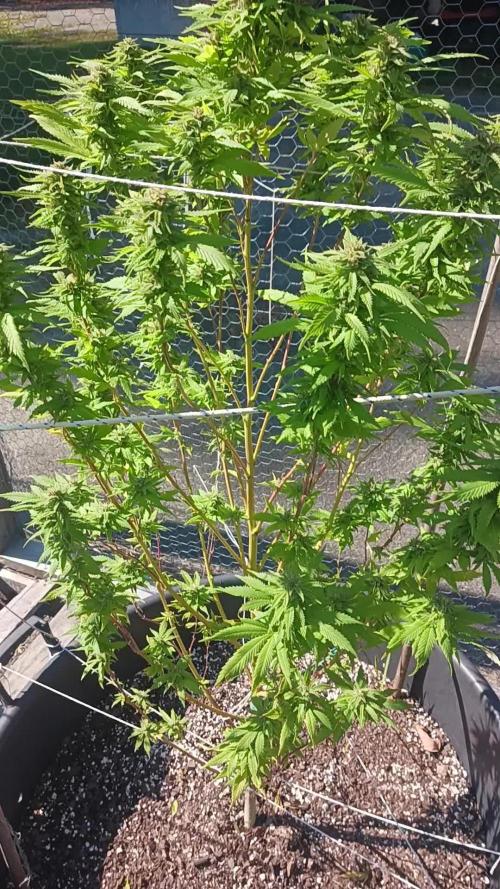
It seemed there were two very different phenomes. One had pink calyxes which was cool. One had extremely dense buds and the other were fluffier put had trichs on top of trichs. The last plant taken had almost all stigmas bright red. Very pretty plants. I wish I didn't lose so much to insects. I learned ky lesson. Next year floating row covers. This strain made it through septoria and a host of other problems including inclement weather and a thrip infection. This plant looked so perfect and it just seems like I'm losing a little more daily. I was hoping the buds would fill out more on the last one but they were INCREDIBLY frosty and had reached the date it said on the package. Not that that matters.


Likes
54
Share


@GarciasGarden
Follow
PINK KOSHER#1 (keep in mind I have 2 other kosher)
I Am super happy with the outcome on this one ! the bright red /orange hairs on top of the light green/ purple frosty nugs really gave it great bag appeal. I ended up getting 4 OZ!! Out is this 1 plant! I was not expecting to get that much off of only one❤️ The smell on this plant is like cookies mixed with a jolly rancher... idk it’s just bomb / The taste is Of super deep Kush With a hint of caramel/ The effects will make you want to create your own dance while watching spongebob and laughing at the most stupid shit ! SORRY IVE BEEN SLACKING MY PHONE BROKE AND I JUST FIXED IT!!


Likes
25
Share


@TherealNICOGREEN
Follow
Opdagede der var stort set 4.5 pH i alle planterne! Men det har været ganske kortsigtet, da DER INGEN FEJL ER AT SE KUN PÅ LAVE FREEz . Men det kan reddes! Tilbage til det det handler om;) 💚☮️ jeg er overbevist om jeg har en flot pige pt ! Nu kommer mit spørgsmål så;) : er der grund til at plante den over i en 26 liters potte ? Jeg har set og hørt forskellige historier om det! Så vil gerne have en pro til at sige go ore no go ☮️😇🌸held og lykke alle sammen! Fra Nicogreen 💚💜💙tilføjet lige lidt billeder af den ca 1/4 del jeg har af gødning;) OG DET ER ALLE PENGENE VÆRD!💚💜

Likes
2
Share


@DogDoctorOfficial
Follow
👑 8×8 Adventure – Week 13 🌿
Godfather OG – Pheno A 👑🔥
🌸 The Queen Is LOUD… And She's Looking Better Than Ever
Hello everyone, and welcome back to another chapter of the 8×8 Adventure! 🌱💚
Guess what?
The Queen is still shining.
👑✨🌸
And honestly...
WOW.
This girl continues to surprise me.
Godfather OG Pheno A is looking absolutely remarkable right now. The flowers are developing beautifully, the colours are changing, the plant is moving deeper into maturity, and the overall appearance of this girl is becoming something really special.
And then there's the smell...
😂
OH MY GOD.
This girl is LOUD.
🔥👃💨
I don't know yet if she's going to be the loudest plant in the entire 8×8.
But let's just say...
she's making a very strong argument.
And that's quite something considering what we've already smelled in this room.
She's been one of the more difficult girls throughout the journey. She hasn't always been the happiest-looking plant in the room. She's had her moments. She's had her stresses. She's made us work a little harder to understand what she was trying to tell us.
But now?
Look at her.
Just look at her.
The Queen is looking like a Queen.
👑🌸💚
So let's give her the spotlight she deserves.
────────────────────────
👑 WEEK 13 – THE QUEEN KEEPS SHINING
Week after week, Godfather OG Pheno A has been writing her own story.
And it hasn't necessarily been the easiest story.
She's had stress.
She's had moments where she wasn't exactly the happiest girl in the room.
She's made me question things.
She's made me watch her more closely.
She's made me learn.
But that's exactly what makes this week so satisfying.
Because despite everything...
she's still here.
And she's beautiful.
Really beautiful.
The flowers are looking increasingly mature.
The colours are becoming more pronounced.
The pistils are changing.
The foliage is fading in places.
And the overall plant is giving us that unmistakable feeling that we're moving deeper into the final chapter.
She's not simply growing anymore.
She's finishing.
And she's doing it in her own style.
👑🌸
────────────────────────
🌿 LOOK AT THOSE COLOURS
This is one of the things that really caught my attention this week.
Look at the fading.
Look at the colours appearing throughout the plant.
Look at the transition.
This is one of those moments where the photographs really tell the story.
Earlier in the grow, she was carrying much more uniform green.
Now we're seeing those deeper flowering-stage changes becoming more obvious.
And I absolutely love it.
Not because "fading = better."
That's not the point.
The point is that we're watching the plant change.
We're watching her move through time.
We're watching the transition from active flowering development toward maturity.
And with Godfather OG Pheno A, that transition is becoming beautiful.
She's developing her own palette.
Her own colours.
Her own final expression.
And when you put the photographs from earlier weeks beside these...
you can really see how far she's travelled.
────────────────────────
🌸 THE FLOWERS ARE LOOKING BEAUTIFUL
And then we get to the part that really matters...
the flowers.
🔥🌸
They're developing beautifully.
The buds are becoming more substantial.
The structure is becoming increasingly defined.
The pistils are changing.
The resin continues to catch the light.
And everything is starting to look much more mature.
This is the stage where you can finally start seeing the plant's personality expressed through the flowers themselves.
Not just:
"Here is a flowering plant."
But:
"This is what THIS phenotype produces."
And Godfather OG Pheno A is giving us something beautiful.
She's not trying to be the biggest.
She's not trying to be the most perfect.
She's not trying to behave like the other eleven girls.
She's simply being herself.
And I really like what she's becoming.
────────────────────────
💎 THE RESIN IS STILL GETTING MY ATTENTION
Of course...
I can't talk about this girl without talking about the frost.
😂💎📸
The closer we get...
the more she gives us.
The flowers are becoming increasingly decorated with resin.
The sugar leaves are carrying that beautiful frosty appearance.
And when you combine that with the changing colours?
Oh my.
👑❄️🌸
This is exactly why I love photographing these girls week after week.
The full plant tells one story.
The individual flower tells another.
And the macro tells you something completely different again.
You can see the progression.
You can see the maturity.
You can see the resin.
You can see the colours.
And you can see just how much this girl has changed.
────────────────────────
👃 AND THEN THERE'S THE SMELL...
Okay.
We need to talk about this.
Because this girl is LOUD.
😂😂😂
I mean...
LOUD.
🔥👃💨
Every time I get close to her, she makes her presence known.
And that's saying something in a room with twelve different plants.
I don't know yet if she's officially the loudest.
I'm not giving her that crown just yet.
😂👑
We need to wait.
We need to compare.
We need to get through the harvest.
We need to see what happens during drying and curing.
And then, eventually...
we'll really know what this girl has to say.
Because aroma can evolve dramatically throughout the rest of the journey.
But right now?
Let's just say...
Godfather OG Pheno A has entered the conversation.
And she's shouting.
😂🔥👃
────────────────────────
🔊 IS SHE GOING TO BE THE LOUD ONE?
This is now officially one of the questions I'm carrying into the final part of this diary.
We've got twelve girls.
Twelve different phenotypes.
Different structures.
Different flowers.
Different expressions.
And eventually...
we'll get to compare them.
Who has the most interesting aroma?
Who has the strongest aroma?
Who changes the most during drying?
Who develops the most interesting cured profile?
Who surprises us?
And who...
is simply fucking loud?
😂🔥👃
Godfather OG Pheno A may have just volunteered herself for that last category.
But I'm not declaring the winner yet.
We'll see.
And when we eventually get to the smoke reports and final reviews...
that's where we can really talk about it properly.
For now...
I'm just enjoying the smell.
A LOT.
────────────────────────
🌿 THE QUEEN WASN'T ALWAYS THIS HAPPY
And this is something I really want to acknowledge.
Because looking at her now, it would be easy to forget the journey.
She hasn't exactly been the easiest plant in this room.
She's had stress throughout the grow.
She's had moments where she didn't look like the happiest girl.
She's made me pay attention.
She's made me adapt.
And sometimes...
she simply made me shake my head and say:
"Okay, Queen. What are you doing now?"
😂👑
But that's the beauty of growing individual phenotypes.
You don't get twelve perfect copies.
You get twelve personalities.
Some are easy.
Some are demanding.
Some are fast.
Some are slow.
Some seem to love everything you do.
Some make you work for every little bit of cooperation.
And Godfather OG Pheno A?
She's definitely made me work for her.
But now she's giving something back.
And I think that's pretty damn special.
────────────────────────
❤️ THE REWARD AFTER THE STRESS
This is probably what makes me happiest about this week.
It's not just that she looks beautiful.
It's that she looks beautiful AFTER everything.
After the stress.
After the difficult moments.
After all the times I wondered how she was going to finish.
She's still standing there.
Still flowering.
Still producing resin.
Still developing colour.
Still smelling absolutely ridiculous.
And looking better than ever.
😂👑🌸
That's a reward in itself.
Sometimes the plants that give you the easiest ride aren't necessarily the ones you remember most.
Sometimes...
it's the difficult ones.
The ones that make you learn.
The ones that make you pay attention.
The ones that keep you guessing.
And then, at the end...
they turn around and give you something beautiful.
That's Godfather OG Pheno A for me.
────────────────────────
💡 THE PHOTON EXPERIMENT CONTINUES
The lighting setup remains unchanged.
We're still running the upgraded Future of Grow environment with the two additional Black Series 600W fixtures.
We're controlling their output at approximately:
🔌 59% power from the plug
And the upper canopy remains around:
☀️ ~1,500 PPFD
That's a lot of photons flying around this jungle.
😂☀️🌿
But again, the interesting part isn't simply the number.
It's what the different plants do with those photons.
Godfather OG Pheno A is giving us another answer.
She's developing.
She's maturing.
She's producing flowers.
She's changing colour.
And she's showing us her own expression.
Same artificial sun.
Different genetic response.
That's the 8×8 Adventure.
────────────────────────
☀️ SAME PHOTONS — DIFFERENT QUEEN
This is something I keep coming back to because it becomes more obvious every week.
The environment is shared.
The lighting is shared.
The irrigation is shared.
The nutrition philosophy is shared.
The room is shared.
But the plants don't behave the same.
Godfather OG Pheno A has her own interpretation.
And I love that.
We're not trying to force her to behave like another phenotype.
We're not trying to make her look like somebody else.
We're simply providing the stage...
and watching what she does on it.
And right now?
She's putting on one hell of a show.
👑🔥🌸
────────────────────────
⚗️ NUTRITION – THE FINISH IS APPROACHING
We're also continuing with the gradual nutritional transition as the room moves deeper into the flowering cycle.
Terra Bloom has been reduced from the earlier level toward:
🌱 2.0 ml/L
with the EC now around:
⚡ ~2.05 mS/cm
The philosophy remains the same.
Gradual.
Observational.
No dramatic overnight changes.
We're approaching the final part of the journey, so we're beginning to reduce the mineral base while continuing to watch how the plants respond.
And Godfather OG Pheno A is giving us plenty of information.
The flowers are developing.
The colours are changing.
The plant is moving.
The resin is building.
And now we're watching her approach the final stage.
She's getting there.
But we're not rushing her.
────────────────────────
🌸 THE PLANT GETS THE FINAL VOTE
This is probably one of the biggest lessons from the entire 8×8 Adventure.
We can have calendars.
We can have feeding schedules.
We can have expectations.
We can have numbers.
But ultimately...
the plant gets the final vote.
Godfather OG Pheno A is telling us:
"I'm changing."
"I'm maturing."
"I'm getting closer."
And our job is to listen.
That's what I'm doing.
I'm not trying to force her into a specific timeline.
I'm watching.
I'm photographing.
I'm smelling.
I'm comparing.
And I'm letting her show me where she is.
────────────────────────
📸 THE QUEEN DESERVES HER PORTRAITS
And yes...
the Queen gets her photographs again.
😂📸👑
After her previous photographic privileges were restored, there is absolutely no way we're taking them away again.
She's earned them.
And honestly...
look at her.
These flowers deserve to be photographed.
The colours deserve to be photographed.
The resin deserves to be photographed.
The fading deserves to be photographed.
And the plant herself deserves the spotlight.
This is what these individual diaries are about.
Not just showing the final result.
Showing the journey.
Showing the difficult weeks.
Showing the beautiful weeks.
Showing the changes.
Showing the personality.
And Godfather OG Pheno A has certainly given us a journey.
────────────────────────
🌡️ WEEK 13 – CURRENT ROOM CONDITIONS
The 8×8 continues under the same general environment:
🌸 Flowering — Week 13
💡 Light schedule — 12/12
☀️ Upper-canopy PPFD — ~1,500
🔌 Future of Grow Black Series output — ~59% from the plug
🌡️ Day temperature — ~26.5–27°C
🌙 Night temperature — ~25–26°C
💧 Relative humidity — ~60–61%
🌱 Substrate temperature — ~25–26°C
💦 Nutrient solution temperature — ~25°C
⚗️ pH — approximately 6.0
⚡ EC — ~2.05 mS/cm
💨 CO₂ — ~693 ppm
💧 Irrigation — ~1.4–1.45 L/plant/24h
🌱 Pot size — 15 L
The room remains stable.
The lighting remains strong.
The plants continue moving at their individual speeds.
And the Queen?
She's still doing her thing.
────────────────────────
🔬 SAME ROOM — DIFFERENT JOURNEY
This is becoming more fascinating every week.
Because we're getting close enough to the end that the differences between these plants are becoming extremely obvious.
Some are still very green.
Some are fading.
Some are moving quickly.
Some are taking their time.
Some are developing huge flowers.
Some are developing unusual structures.
Some are incredibly frosty.
Some are incredibly aromatic.
And Godfather OG Pheno A?
She's giving us colour...
resin...
flowers...
and one hell of a smell.
😂👑🔥
That's her expression.
That's her story.
And I wouldn't change it.
────────────────────────
🌿 LET HER FINISH HER STORY
At this point, I'm not interested in trying to turn her into something else.
She's already shown us who she is.
She's been stressed.
She's been difficult.
She's been beautiful.
She's been stubborn.
She's been rewarding.
And now she's approaching the final chapter.
So we're going to let her finish.
We're going to continue observing.
We're going to continue documenting.
We're going to continue watching the flowers.
We're going to continue watching the colour changes.
We're going to continue enjoying that ridiculous aroma.
And eventually...
we'll harvest.
Then we'll dry.
Then we'll cure.
And THEN...
we'll really get to know this girl.
Because that's when the story gets even more interesting.
────────────────────────
🔮 WHAT COMES NEXT?
We're getting closer.
And I have to admit...
I'm curious.
Very curious.
Because the plant is already giving us clues.
Beautiful colour.
Mature-looking flowers.
Increasing resin.
Changing pistils.
And that smell...
😂🔥👃
But we're not going to spoil the ending.
We'll let her take us there.
And when we eventually reach the harvest and curing stages, we'll talk properly about the aroma.
The flower structure.
The final appearance.
The dry weight.
The cure.
The smoke.
The flavour.
The effects.
Everything.
But for now...
we're still in the garden.
Still watching.
Still learning.
Still enjoying the Queen.
────────────────────────
❤️ FINAL THOUGHTS – LOUD, BEAUTIFUL & STILL THE QUEEN
Week 13.
And Godfather OG Pheno A is still shining.
👑🌸💚
Honestly...
I'm really, really happy with how she's looking.
Look at those flowers.
Look at those colours.
Look at that fading.
Look at the resin.
Look at the plant.
She's remarkable.
She's amazing.
And considering how much stress she's had throughout this entire grow...
I'm genuinely impressed.
She hasn't been the happiest plant in the room.
Not by a long shot.
😂
She's made that very clear.
But maybe...
just maybe...
she was saving all that energy for the flowers.
Because now?
She's showing us something beautiful.
And she's smelling absolutely insane.
🔥👃💨
I don't know if she's going to be the loudest girl in the 8×8.
I'm not giving her that crown yet.
But she's certainly making her case.
And when we finally get to the smoke reports...
that's going to be a very interesting chapter.
For now, though...
let's just appreciate what she's becoming.
The Queen has been through a lot.
She's had her moments.
She's tested our patience.
She's made us pay attention.
She's made us learn.
And now she's standing there...
beautiful.
Frosty.
Colourful.
Aromatic.
And completely herself.
That's what I love about phenotype hunting.
You don't always get the easiest plant.
You don't always get the happiest plant.
You don't always get the biggest plant.
But sometimes...
you get a plant that makes you say:
"Wow."
And Godfather OG Pheno A is giving me that feeling right now.
👑🔥🌸
So let's give her the spotlight.
Let's celebrate her.
Let's photograph her.
Let's enjoy her aroma.
And let's see how loud this Queen really is when the time comes.
Until then...
Keep shining, Queen.
You've earned every bit of that crown.
👑🌿💎🌸🔥
────────────────────────
🙏 THANK YOU
A huge thank you to Zamnesia for giving us these Godfather OG genetics and allowing us to explore this individual phenotype throughout the 8×8 Adventure. 💚🌸
Thank you to Plagron for supporting the garden throughout this journey and providing the nutritional foundation behind these flowering girls.
A massive thank you to Future of Grow for supplying the Black Series lighting and especially for providing the two additional Black Series 600W fixtures we're testing in this room. 💡🔥
The extra lighting capability has given us another fascinating variable to observe across these twelve completely different plants.
Thank you to Lumiflora for helping bring additional light deeper into the canopy and allowing us to explore this room as a three-dimensional lighting environment.
Thank you to TrolMaster for helping us monitor and manage the environment behind the scenes.
And, of course...
thank you to everyone following the 8×8 Adventure here on GrowDiaries.
Every week...
another chapter.
Another phenotype.
Another personality.
Another lesson.
And Godfather OG Pheno A has certainly given us a story.
She's been stressed.
She's been difficult.
She's been beautiful.
And now...
she's becoming absolutely remarkable.
👑🌸🔥
And possibly...
very, very loud.
😂👃💨
We'll find out.
The final chapters will tell us.
Until then, we're going to keep doing what we do.
Observe.
Document.
Listen.
Adjust when necessary.
And let the plants show us who they really are.
Godfather OG Pheno A...
the Queen is still shining.
And she's looking damn good doing it.
👑💚🌸💎🔥
Growers Love, happy growing, and take care everyone! 🌱💚
See you next week in the 8×8 jungle.
🌿🔥👑


Likes
8
Share


@Shadowpup369
Follow
These two did great even through a lil stress they still came out on top. I almost want to run it back but I think it's time for something fruity maybe, maybe having a terpene profile that helps initiate a more stone heavy affect and be indica heavy.
