




Likes
16
Share


@BudsBanditUK
Follow
Well she is the star of the tent. Her purple colour is amazing, her sickly sweet smell is amazing. She has not given me any problems at all during this grow. Maybe a week left and I cant wait.

Likes
10
Share


@Mr_Ewell
Follow
Week 8 update....
Plants are taking their sweet time. Hoping im doing this shit right. I trimmed some more popcorn bud branches and took out a bunch of fan leaves. Trying to utilize my light and control environment. Opened up the canopy with some pipe cleaners.... is it too early to guesstimate yield? Plants are 8 weeks, about 2 weeks into flower. . i figure i have another 50 days or so. Breeder gives 65 days for flowering. Im at around 15. Not counting the week stretch after first preflowers...... feeding about 2300 ppm. Light about 15 inches above canopy. Now it's the waiting game. Light staying where it's at. Ec staying where it's at until flush. They're shouldn't be many leaves growing back. My only thing i have to focus on is the amount of times i water a day and keeping an eye out for any cal mag deficiencies. Gave a little cal/mag/ nitrogen for the loss of leaves in tonight's feeding.

Likes
12
Share


@Desertfarmer
Follow
I’ve been feeding every other day and everything is looking green, healthy, and filled the canopy out nicely. The buds are getting bigger everyday. Everything recovered well From the defoliating. Definitely starting to smell stronger. So far so good going to keep pushing these girl so hard! Cheers everyone
Likes
2
Share

@Weedman268
Follow
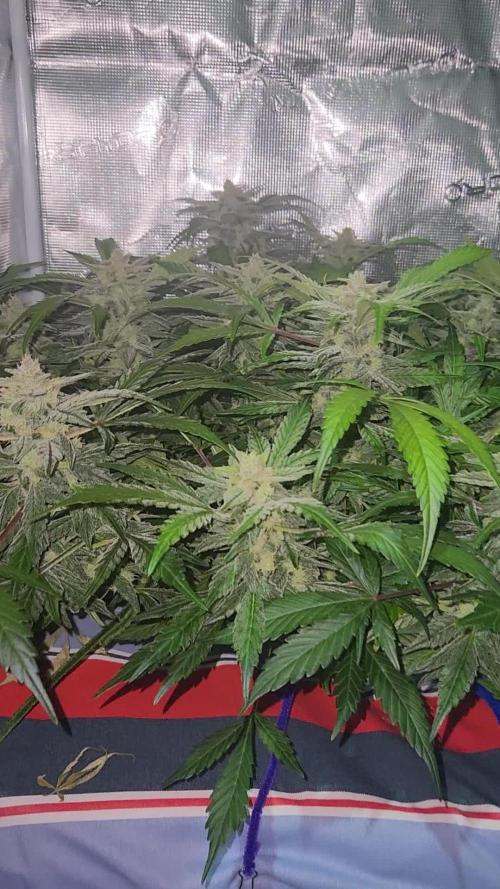
Week 6 of flower, she's looking good, just been filling the reservoir when empty and observing her.
Likes
6
Share

@Salokin
Follow
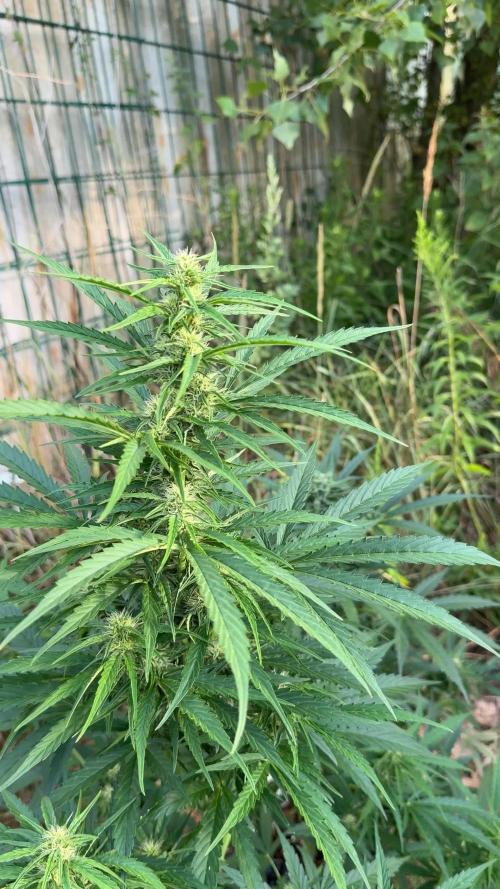
Week 9 | Godfather OG
She's the slowest of the outdoor lineup this season, and at this stage that's just how this one's running. Height crept from 100cm to 105cm — vertical growth has effectively stopped and flower development is taking over. Looking at the main cola, bud sites are stacking along the stem with white pistils pushing out on every node, and the lateral branches are following the same pattern. The structure is there, she's just building on her own timeline.
Nutrient stack unchanged from last week: CANNA Aqua Flores A+B 3ml/l each, Plagron Green Sensation 0.5ml/l, CalMag Agent 0.9ml/l, Aptus Regulator 0.1ml/l. pH 6.2, EC stepped up slightly to 1.4 mS/cm. Watering holding at 2L per plant per 24h. Still in the 5L pot.
Conditions: 25°C day, 18°C night, humidity 60%. Light schedule now down to 16h as summer starts pulling back — the days shortening is doing its job. No deficiencies, no stress signs, just a slow and steady build.
She'll get there on her own terms.
Updates every Sunday. Stay tuned.


Likes
25
Share


@PrairieFrostGrow
Follow
***** Week 6 Veg - January 9/21 to 15/21 *****
This week the girls saw lots of change! They have seen a light change and now they have been transplanted and topped. Push the girls harder and see how they react😃 They have been in very good shape and healthy so they have been reacting well to the stress. These two girls have been strong growers from the start and its not stopping yet. The side branching is doing well and pulling up nicely👍
Topped all of the ETS girls and left them with 4 sets of branches on each. If the lowest set of branches were tiny, I have stripped them off already. Not sure if I am going to SCROG or not.....I don’t really want to but it is the best way to fill the canopy and test out the light spread......will see. These girls seem to be growing strong and may need to be tied down or stretch could be a bitch😂
They have continued to be fed once a week roughly and supplemented with calmag and microbes.
Little more detail.......
Jan 9/21, Day 36 Veg
- Transplant day today!!!!!! Both girls into 5 gal pots.
- Root mass was much better than in the solo cups......not as strong as Gorilla Girl for comparison but just about perfect and didn’t need to prune them.
- 1.5L watering of the pots after transplant with CalMag @ 2ml, Microbial Mass @ 3ml, Piranha @ 2ml (effectively microbes, fungi and CalMag watering)
Jan 10/21, Day 37 Veg
- 1.5L Feed with full strength week 2 nutrients
- added CalMag @ 1ml as well. New coco in the pots that have not been buffered so added a little more.
- 1,300ppm and 5.9pH.......feeling it might be a little high.....target was 1150ppm.
- no run off water from the pots. Didn’t want to “soak” the pots, jet wet them.
- New light in the tent today. 650watt but dialled down so the girls have roughly 10,500 LUX.
- Topped the girls today as well😃
- left 4 sets of branches on each girl. Topped them up high on the node above to help avoid splitting the main stem.
Jan 11/21, Day 38 Veg
- Dry out day
- girls reacting well to the high ppm feed from yesterday.
Jan 12/21, Day 39 Veg
- 1.5L watering with CalMag @ 1ml
- 200ppm and 5.9pH
Jan 13/21, Day 40 Veg
- Dry out day
Jan 14/21, Day 41 Veg
- 2L watering with CalMag @ 2ml
- 250ppm and 5.9pH (actually added 1ml of Micro as pH was a little high)
- IPM spray tonight with Lost Coast Plant Therapy @ 3ml/L. Done at lights out.
- This product been working well and nothing has been a set back so not going to stop now😃👍
Jan 15/21, Day 42 Veg
- Dry out day.
- Girls doing well. Still have some strong purple in the fan leaves coming off the main stem.
- Not too worried about it.....keeping an eye ono the main stem.

Likes
422
Share


@Crashoverite
Follow
Hi all 🧑🌾
Welcome to my 🍌💜👊 week update.
Hope everyone keeping well and having a good week.
Thank you so much for your support on this bananas journey 💜💚💜💚
I am so happy to see how girls are developing in recent days. It's seems that Athena finally stopped her stretch and hoping that Xena will follow her sister very soon. Buds are gaining weight and size rapidly. Lots of nice colours and tonnes of trichomes on those buds already.
Week 10
Dec 18-24
Dec 18-19
Mainly observation. Xena is still stretching like crazy. both girls are developing beautifully.
Dec 20
First watering for this week. 7.5 ltr beetwen both. Runoffs PH's Athena 6.2 Xena 6.3.
Dec 21
Due to lack of light at lower parts of conopy decided for another selective defoliation, lowered a bit tallest branches with colas dangerously close to light by tieing them to netting. Couple cm will make a huge difference here. Could not clear well at the back wall of the cabinet due to limited access.I'm very happy with final result.
Dec 22-23
Joyful observation of my 🍌💜👊girls development 🧑🌾
Dec 24
All is looking great. It's seems that stretch is finally stopped. Girls looking healthy and happy.
Second watering for this week. 8 ltr beetwen both. Both runoffs PH 6.2.
It's the end of this week.
Happy Xmas everyone 🤶🎄❄️🎁☃️✌️💚🌲🎅🎄
Stay tuned for new week update ✨🍀✨✌️💚
Likes
6
Share


@Nune2021
Follow
Hey Leute die Pflanzen machen sich sehr gut wie ich finde ich muss nur die unterschiedlichen Größen Händeln aber das passt schon duften tuen sie auch schon


Likes
8
Share


@Philippovic
Follow
Die Temperaturen sind seit einigen Tagen sehr niedrig, was ich versuche, möglichst zu regeln, indem ich den Lüfter bis auf 10 % gedimmt habe Und eine Heizmatte im Zelt habe. Tagsüber hält sich die Temperatur relativ gut bei 18-20° nachts fällt sie auf 16° wenn das Licht aus ist.
Die Pflanzen wurden entlaubt und beschnitten. Sie entwickeln sich toll und werden langsam schön purple ❤️

Processing
Likes
6
Share


@Flydope21
Follow
Only a few more weeks and I will be ready to flip these. Things are moving along quite well.

Processing
Likes
15
Share


@MG2009
Follow
06/02/2020
Gonna feed them today 1tbls of blood meal.
I snapped a branch on #2 (see video) her stems, I don't like break to easy so I will give some micro nutrients to help stems from breaking. Unless she is the HOLY GRAIL. I will cull her clone.
All others handed super cropping well. 🙏
#4 in hydro is in it's own diary called Small Batch Seed making some F1
#1 showed her sex today, clones well took cut on 05/20/2020 is rooting well outside in coco coir, in humidity dome just cut and scrape the stem,once rooted I cut off yellowing leaves i hope her smoke is as good as she looks.
5 days into week 10 and #2, and #4 are male so indoors they go for pollen collection. Will dust one bud of each female with each male and hunt for what I want. Also see what each passes on in the cross.
Likes
21
Share


@TheStrainAlchemist
Follow
Impressive guys, is outstanding the root growth, this little pot of 1,5L only lasted 3 days, was already root bound and I had to moved them to the final pot, as you can see I left quite a lot of space for the future top dressing.
She looks slightly smaller then the wedding cake even if she started bigger and stronger but the early topping slow down her a lot. She’ll recovery I am sure.
Enjoy fellow growers. ♥️☮️


Likes
65
Share


@CorinnaFarm
Follow
Einfacher Anbau, Geschmack nach Zitrone und Pfirsich, Kompakte Knospen und ein Guter Ertrag. Schnelle Blütezeit!
Auch den hohen THC Gehalt merkt man direkt!
Lohnenswert🌱💚

Likes
11
Share


@Sauce_XL
Follow
2.24.2024: Start of week 5 from seed. Started to flower last week. Nothing done today. Still no nutes given, still scared to defoliate. Plant is 15.5 inches tall and looks healthy. Light is 11 inches from the top and at 75% power, 112 watts. I'm clearly no expert and i'm sure there's something i should be doing(feeding) but she's chugging along.
2.25.2024: Day 37 from seed. She's so healthy, and the budsites are producing a ton of white hairs. Some of the fan leaves have purple stems and a dark green color which i think indicates something with nitrogen but she's rolling along. Still no nutes given. 64oz of 6.3ph. 19 inches from soil. Can't tell if watering lowers the soil level but since i haven't touched the light height, i'm assuming its upward growth.
2.26.2024: Day 38. Small bit of upward growth. Will feed tomorrow for the first time at 1/4 strength nutes from the fox farm trio and maybe some calmag.
2.27.2024: Day 39 from seed. Finally fed the plant, albeit small amounts. Foxfam trio at 1/4 strength of the week 5 dose plus calmag. 64oz of the solution at 6.5ph.
2.28.2024: Day 40 from seed, 36 from sprout. Humming along. Bud development is going nicely. 21 inches in height. Light at 75% 9 inches from the top.
2.29.2024: Day 41. 96oz at 6.5ph. Another .5 inch of growth. Sitting at 23 inches from soil. Bud sites are clearly defined with tons of long white pistils. At first glance, she's the winner between the two in the tent so far.
3.1.2024: End of week 6, day 42 from seed. Plant is healthy as far as i can tell. Some yellow leaf tips, some burnt leaf tips, and most likely some nitrogen toxicity but shes taking it all well. Lots of learnings so far. FFOF probably isn't ideal but its working. I've got half a bag left so i'm stuck with it for the next cycle or two. I bought the fox farm trio for nutes and given i've only used them once, and a few mililiters at that, i feel like those containers are going to last forever.

Likes
16
Share


@Sadhus
Follow
Rempotage en 13 litres, pleine santé rien a signaler, jolie feuille fine et pointues avec de belles dentelure bien prononcé , plantes très élancé, les sept sont très belles, encore une semaine ou deux et floraison et j'ai hâte de voir sa !
#kannabia
#madamegrow
#trolmaster

Likes
17
Share


@BLAZED
Follow
Week 4 (21-2 to 27-2)
21-2
Temperature: 25.3 degrees (lights on) 20.4 degrees (lights off)
Humidity: 63% (highest) 49% (lowest)
Watering: None.
22-2
Temperature: 25.9 degrees (lights on) 19.8 degrees (lights off)
Humidity: 64% (highest) 49% (lowest)
Watering: Both 1500 ml.
Light 60% at 60 cm, LUX: +/- 15.500
Today i gave them both their first real feed of 1.5L
1.5 Liter water + 0.75 ml Calmag + 0.3 ml Silica + 0.45 gram Grow. EC: 0.7 PH: 6.0
23-2
Temperature: 29.4 degrees (lights on) 19.6 degrees (lights off)
Humidity: 66% (highest) 49% (lowest)
Watering: None.
No pictures.
24-2
Temperature: 23 degrees (lights on) 18.8 degrees (lights off)
Humidity: 65% (highest) 51% (lowest)
Watering: None.
25-2
Temperature: 23.8 degrees (lights on) 19.7 degrees (lights off)
Humidity: 61% (highest) 49% (lowest)
Watering: None.
Removed some leaves.
26-2
Temperature: 23.6 degrees (lights on) 19.7 degrees (lights off)
Humidity: 65% (highest) 46% (lowest)
Watering: None.
27-2
Temperature meter was broken, so no temps etc for today.
Watering: Both 2000 ml.
Today i topped the plants and gave them both 2L.
2 Liter water + 1 ml Calmag + 0.4 ml Silica + 0.7 gram Grow. EC: 0.8 PH: 6.0
I fully installed the AutoPots and their base aswell, wich get connected to a water reservoir.

Processing
Likes
22
Share


@CenturionGrower
Follow
26/07/20 (Sunday)
Plants were starting to exhibit signs of light burn so I switched back to the 75W bulb. SVG never seemed to recover from having it's cotyledon damaged so I decided to take a risk and fed all of the seedlings 20-20-20 nutrients except the D.R. which I thought would've suffered shock, so I just watered it.
27/07/20
Decided to mist the plants with a homemade pesticide mix today because they're readying to be introduced as full time outdoor plants in a week or two so their sun basks are getting longer.
28/07/20
Noticed what looks like new growth from the first true leaves of the SVG, fingers crossed it's making progress.
29/07/20
The new growth from the SVG has split into two on both sides leading me to theorize that it's abandoned it's main stem (for now at least) and started two new stems. All other plants are working on new nodes and are showing a steady growth of .5cm a day. I've decided to revert to the 100W bulb because I believe I've misdiagnosed the light burn.
30/07/20
Today I left them outside for their longest sunbask to this point; 7 of their 18 total hours was provided by sunlight. The SVG now has two new 3-leaf true leaves on each new stem confirming my theory. Also starting to see signs of a minor mite problem on one of the leaves of my TT plant (Though it's new growth that wasn't sprayed with my homemade concoction.)
31/07/20
New growth has already begun sprouting from between the new true leaves of the SVG with no visible progress on the 'abandoned' main stem. Also had a power outage for 2 of the plants 18 hours.
01/08/20
Today the plants again stayed out in the sun for longer than previously making 8 hours in direct sunlight. I've decided to keep them in the grow tent for a further week because when I went to retrieve them the Jam was blown down flat by winds and had started to grow bent towards the light, so I doubt it's stem is ready for that daily beating. I raised the soil level and massaged it back into shape and it seems to be back on track. The D.R. is slowly beginning to bounce back from being stunted in the seedling tray and from it's third node (from the bottom up) of 3 leaf true leaves has turned into 5 leaf leaves. The SVG has made a major recovery and seems to be on it's way to even surpassing the others by the end of the week. The TT is officially the sturdiest of the younger seedlings and it's growing right behind the Jam in terms of node development. All in all this week was an overall success growth wise and I'm looking forward even more to week 3.