Likes
Comments
Share
Following The Grow Boss tips on YouTube "...yield is based on light, quality is based on growers talent" "...number one problem is, too much light, too much water, too many nutrients" Nutrients : (after having issues with nut burns, I decided to use Grow Boss's perfect ppm calculator) Invasion T (Glomus intraradices BEG72 and TRICHODERMA atrovide MUCL45632) 1g / plant Monster X mycorhizes (500 000 propaguls / Kg , made in vitro) 2g / 20cl then complete to make 1l Humic Fulvic Booster (humic and fulvic acids) 1ml / 1l Cannazym 2.5ml / 1l Rhizoponics 0.4ml/1l Lights: 2 x Adjust-A-Wings Avenger 600w HPS Lumatek 90000 Lumens 1000PAR 600w HPS Philips Son-t Green Power 95000 Lumens Soil:Platinium Royal Mix premium quality What is vapor pressure deficit? Often, marijuana growers who have their plants in indoor grow tents or rooms with artificial lighting, take into account parameters such as temperature and relative humidity to maximize plants growth and bloom, thus obtaining abundant harvest with top quality flowers. As we will see later, these factors affect different processes of the plant, such as transpiration or nutrient uptake. However, we usually forget about another important factor that is related to the aforementioned ones: vapor pressure deficit or VPD. Broadly speaking, VPD is the difference between the amount of water vapor that the atmosphere is able to retain (which depends on temperature) and the amount of water vapor contained in it (relative humidity). It is usually measured in kilopascals (kPa). Providing our plants with a correct relationship between temperature and relative moisture will keep us on the right VPD parameters, increasing the plant’s activity and thus improving its growth and showing its full potential during the flowering phase. The ideal would be to adjust both parameters (temperature and humidity) to get the best possible VPD value, so that the development of plants will be amazing.In the chart above you can see the right temperature and moisture values to maximize the development of cannabis plants. The green zone shows you optimal values of VPD, in which it would be ideal to maintain the environment. The orange zone shows correct values, in which plants should not have problems to develop normally. However, red areas show values in which your plants will be very far from hit their full potential, since the relation between temperature and moisture is not optimal. With relatively high values of VPD (between 5 and 12) plants tend to open their stomata and release a considerable amount of water vapor into the environment (increasing their transpiration). This increase in transpiration results in an increase in the plant’s photosynthetic activity, which will need more nutrients and will improve its overall growth, both during growth and bloom. The best range is between 7.5 and 10.5, which we have marked in green. However, we must be careful that VPD is not too high (dark red zone) since the plant would close its stomata to avoid releasing too much water vapor to the environment, which would result in fast dehydration due to excessive transpiration. On the other hand, if VPD is too low (light red zone), the plant will also close its stomata for not releasing more water into the atmosphere, which in this case would be already saturated (it would have reached the maximum water retention capacity in a specific temperature). In this way, reducing transpiration will also reduce photosynthesis, which has a direct impact on the plant’s development and yield. That way, VPD is essential when it comes to offer the best conditions for the development of plants, also to understand its water requirements according to the nutrients used and thus adjust them correctly to meet the grower’s expectations. N/B: SAY NO TO DRUGS -[Day 90] The plants are getting massive, not a lot of space left in the room, each pictures are token back against the wall or on top of a chair. The Super Skunk shall be ready first , the trichomes are visible without using a microscope, the scent is like an amazing candy floss coated with Skunk pee 😅Boerejongens quality @Home 😊 -[Day 93] Switching Buld Lumatek 90000 Lumens 1000PAR to SuperPlant Super Red 85000 Lumens 2000K 1498nm Lightening under the 1500nm wavelength (2000K) just between the NIR and the Microwave length, can't stand in the room too long without getting tears and shining eyes. Buds shall start to blowup like pineapples, increasing yield. -[Day 98] Everything is getting frosty. Starting to decrease RH . -[Day 103] Today the Y Griega started to push on her terpenes, believe it or not that plant smell stronger than the 6 giants Skunks (the Skunk strain is already a very strong smelling plant), she smell like a coffeeshop front door, the fragrance is absolutely amazing and fantastic, I will definitely grow a full crop of that strain ! -[Day 105] 42 days of Blooming folks ! It's getting serious now 😄 If it can helps you to realize, each plants gots 4 side and a middle, each sides gots 4-6 buds and there's 5-6 buds in the middle, there's 11 plants of 1,60m/5.25ft, how many buds does it makes ?? The correct answer will win 1 like 😅😂😅😂 -[Day 106] WEEK 7 of flowering, the end is close my friends, I'm trying to give you the best shots as possible, I wish I'd could share a good smoke from this crop with you guys ....😉 -[Day 113] WEEK 8 starting, every beginning has an end, this is where the Fall is gonna start. -[Day 115] LADY'S AND GENTLEMEN !!! In the Indica's category the winner is .... ruuuuummmmmbbbbbllllleeee ..... VANILLA KUSH !!!!!! I've seriously tough the Super Skunks will be ready first, but Vanilla Kush has shown milky tric's after 52 days of Blooming, waiting for some few ambers tric's before starting the Flush. -[Day 121] Hopefully for me I didn't trust in breeders flowering periods I would have f*ck up the crop ... Plants are fading slowly and naturally, I won't need to flush. Checking the trichomes every 4 days, the crop will probably need another 2-3 weeks. All plants are running on water now till the end. Buds are ripening, the smell has turn into a kind of roasted coffee beans with Skunk pee and cotton candy. -[Day 122] Milky tric's spotted on Blueberry after 59 days of blooming -[Day 123] 60 Days of blooming, gonna flush them all
Likes
31
Share
@Chubbs
Follow
SuperSativaSeedClub PurplePunchOGauto Week9 What up grow fam. Weekly update on these three. Two of the three seem to be growing good as the other has been fighting me since the beginning. I decided this week to transplant from 1gal pots to 3gal to see if maybe it'll fix my leaf burning issue. Over all super excited to see what the next couple weeks will bring. All in all Happy Growing
Processing
Likes
15
Share
Las niñas se recuperaron muy rápidamente del transplante a su nuevo macetero . se ven bastantes vigorosas y con formaciones de resina en hojas grandes , su olor (se siente bastante agradable ) ya se esta empezando a notar en el cuarto. el panel led encuentro que les gusta mucho a las plantas se notan bastantes exitadas con la penetracion de luz que emite el equipo. The girls recovered very quickly from the transplant to their new pot, they look quite vigorous and with resin formations in large leaves, their smell (feels quite pleasant) is already beginning to be noticed in the room. the led panel I find that plants really like it, they are quite excited with the penetration of light emitted by the equipment,
Likes
78
Share
@AsNoriu
Follow
Day 126. Girls are thursty !!!! But it's a trend of all of all summer, I don't want to invest any time except documentation of process. They miss feed a bit too, but soil is dry and I will postpone last feed till I am back from holidays.... No updates next week, let's see colas then !!!! Happy Growing !!!
Likes
Comments
Share
Привет садоводы !!! Вот и подошла к концу история на улице Вроде все прошло хорошо выросли 3 симпатичных куста к сожалению четвертый куст ,в связи с небольшой путанницей оказался не autoflower и он еще не зацвел,а если и зацветет , то в любом случае не успеет дожить до конца из-за погодных условий А в ощем не плохо цветы не заплесневели и за 11 недель успели созреть можно и еще было оставить их на недельку, но обещали дожди и я решил их срезать кстати попробовал смолу с ножниц после маникюра вставляет хорошо Спасибо SSSC за прекрасные цветы !!!
Likes
9
Share
She got soaked by the rain but it should even out because I stretched her out for good air flow. She looks a little brown at first…time will tell.
Likes
8
Share
I’m so proud of the transition. I gave them a defoliation during and it didn’t slow them down! They’ve shot their worst pistols now so I’m so glad to be officially in bloom!
Likes
13
Share
Some of you may have wondered: Why do I use CO2 at average 950 ppfd μmol/m2/s (moral flow)? The answer is quite simple. Because of lack of space in some regions of my cultivation area, I simply cannot keep the ideal distance to my Sanlight high-performance lamp, due to some height growth of various strains. And so some of the main colas have ppfd values of 1250 μmol/m2/s and even more... So this is how I manage to achieve and compensate for such high radiation levels even with a CO 2 balance. And I have to say, my strategy to avoid various light stress symptoms works just fabulously. In combination with CO 2 implementation, my babies are simply unbeatably insensitive to light. Thats it! Beginning of 3rd week flowering: Again feeding my babies by 36 hours fermented potions of Bio Tabs Kompost Tea PK-Booster (15 g pro Liter) and added: 5ml Orgatrex/Liter 1 Spoon of Bactrex 1 Spoon of Mycotrex 1 Spoon of Mycco-Vital 1 Spoon of Dynomyco A little tip for those who are interested in small modifications that have a big difference or influence - on the result - effect - beauty - health - taste! Before adding microorganisms or beneficial bacteria or Mycorrizae and Trichodermas, please use oxygen-saturated water. On the one hand, unwanted chlorine gases evaporate and the small world of the microbiome becomes even faster and more rewarding in compost tea to sprout. Last but not least for this week, I would like to introduce my reasons, why I prefer growing biologically and sustainably. First of all, it’s something which suits very well in these times/days we are living now. Sustainability is a big need and task for our planet. 🌎 Nature means life. Our home, the air we breathe and everything that surrounds us. Not just today. Hopefully tomorrow as well. Maybe I'm starting to protect our environment on a small scale, but maybe I can also make a big difference at all. If you change the way you look at things, the things you look at change... I thought about what’s the difference, between Mineral Feeding and Super Soil Feeding. It’s very easy. Biologically Growing is a similar process than the natural soil activities out there in the lap of nature’s. So plants has to work and interact with the microorganisms and microbiomic communities in the soil. So the plants will never get lazy like the lazy ones of mineral feeding growers. If you grow biologically, you will feed the soil first and the microorganisms will support every parameter next to your plant conditions. And that will generate an unbelievable spectrum of Terpenes and Trichomes you will never forget. It’s the same comparison, when you daily visit McDonalds and you eat only fast food. How does your body and mind react on this shit for money?!?! May I invite you to think about it… See you next week dear Growmies! Have a nice Weekend and take care… Peace out! Addendum for Day 53: At the moment we unfortunately have another winter onset here in Germany. This means that I am forced to take additional heating measures due to structural facts in order to be able to keep the temperatures constant. After all, just tonight the thermometer climbs again to -1 degree Celsius. In addition, my exhaust air system runs out of my bedroom terrace and I therefore grow winter and summer with the patio door open. Well, sometimes I experience real weather-related challenges. But all in all, no problem... "Where there's a will, there's a way." Addendum to pouring out the fermented PK tea: I always administer half a liter of lukewarm aerated water with 3.5 ml of cannazyme per liter to each plant. This means that the "root machine" is not supplied with supplies unprepared and the nutrient solution can thus also be better distributed in the soil. Since I also work with cloth shoes, I spray them evenly moistened everywhere with water that is also warm before pouring them out from the outside. This has the advantage that the moisture stays where it should: in the pot! ... I did the math today ;-) We are still in week 7 until this Friday. And week 8 starts on Friday! OMG... still so much time yeahh! Today my Fast Buds Sour Jealousy and Sweet Seeds Big Devil and Dark Devil Automatics arrived. I'm looking forward to it. This time Fast Buds next Time Sweet Seeds. Love them too. Very beautiful genetics. Today a review video of the beginning of week 3. At the time of the pictures, I had minor signs of nitrogen excess. (Light peaks first at the crown of the roof and then slightly continuing to the middle section.) I then painstakingly racked my brains as to why this could be. I found that very slight dry spots had formed and therefore the root found small accumulations of nitrogen that caused its problems. But then, when I carefully homogeneously checked the moisture content in the substrate, the problem evaporated again. However, they had not shown any loss of growth rate during this time. Nevertheless, they developed as expected. They Strawnanas had no problem with that. In the end, I always have a hard time killing them. But I guess that's the way things go. We live and die. We come and go. But it's not there yet. ;-) Tomorrow is day 56. Tomorrow’s updating day! Can't wait to see their progress. Have a good time and see you tomorrow… 🏽🕊️ 🏽 ☮️🕊️
Likes
12
Share
@CheeRz
Follow
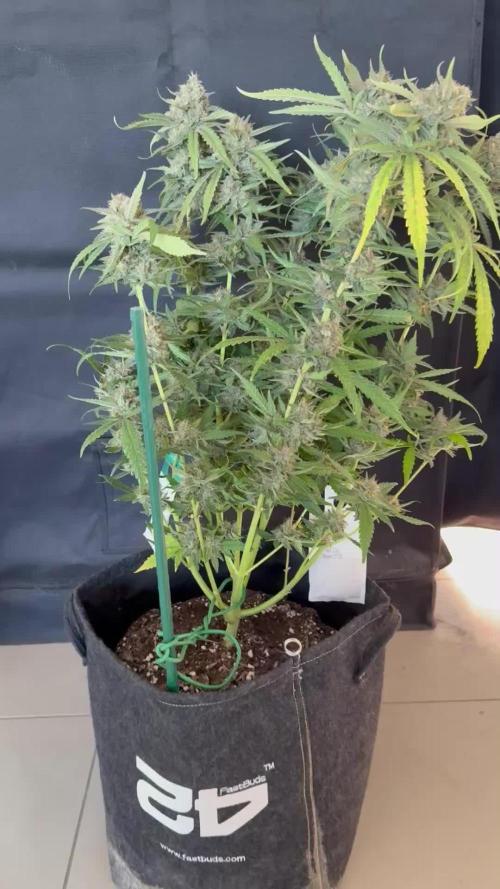
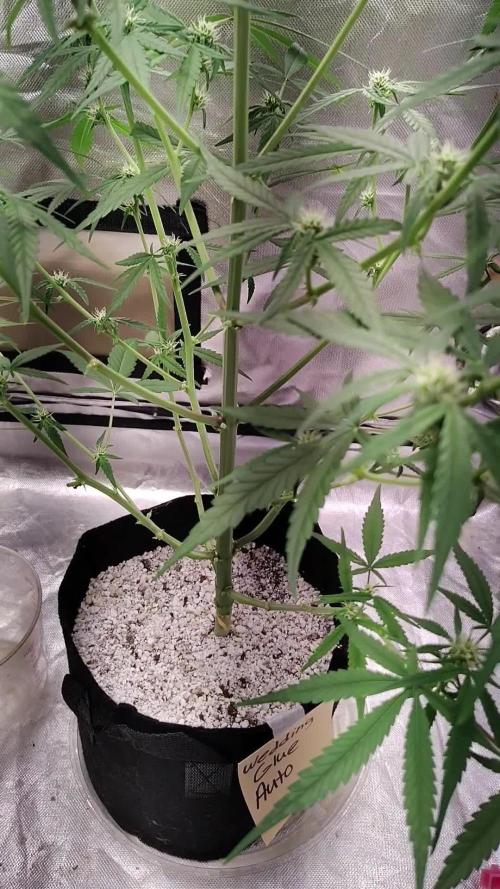
The ladies doin' good so far. Wedding Cake is startin' to build buds. I guess from now on it's a pleasure to watch 'em growin' up.
Likes
6
Share
Topped & Sun-Kissed ☀️✂️ This week, I finally made the call—she’s been topped! 🌿 After a bit of back and forth, I decided it was time to give her structure a little boost and open things up to more sunlight. The side shoots are now reaching out confidently, soaking up every bit of that warm summer glow. ☀️ She’s had a golden week of sunshine and handled it like a champ—strong, vibrant growth and no signs of stress post-topping. 💪 Here’s what went into her care routine this week: 🔸 Fed with BioBizz Grow, CalMag and Alg-a-Mic 🔸 Followed by some homebrewed compost tea two days later for that microbial boost 🔸 Two days after that, a fresh round of Effective Microorganisms to enrich the soil life 🔸 And every 3 days, a light misting of silica spray to keep her leaves strong and resilient I’m super happy with how she’s shaping up so far—great energy, lush color, and the new growth is coming in fast. Curious to see how she responds to the topping in the next week!
Likes
15
Share
@Uwish
Follow
So, I keep my EC around 1.9-2.0, that represents about 3ML/L of sensi bloom a and b I thought I had some big bud left, but no, I'm tempted to use it again, because as much as I'm a fan of Advanced Nutrients, the price and the volume of fertilizer to use in their systems make them a money pit. So I'm thinking of using Athena for the RDWC and keep AN for my drip system and coco. To replace I think of the booster PK of Athena which is applicable from the 21 -th day of bloom. For the LEDS, I went to 70% intensity, or 1000 ppfd. All good, I will go to 80% MAX recommendation of SANlight without c0² in week 3. I put a first net, I placed about 1 apex per square and I will now let it grow, I don't "knit". I will install a second net at the 21 -th day of flowering which will be used as a stake.
Likes
18
Share
Broke a branch this week pretty upset about it was a large branch. Other than that everything is going well slight deficiencies here and there just gotta watch and correct them. We should jump into flower here in 3-5 weeks i will do my final trims in roughly 2 weeks 🤙🏻
Likes
6
Share
Estamos en la última semana para dos de las cuatro variedades, así que a partir de este momento, eliminamos Bio Flores. Añadiremos al bidón de riego Canna Flush, que nos va a ayudar a lavar bien nuestras raíces, eliminando restos de sales y nutrientes. Buscamos que las plantas gasten sus reservas de las hojas, que poco a poco veremos como pierden verdor, eliminando clorofila, sobre todo las más bajas. Canna Flush - 20ml por cada 10 litros de agua. Bajamos la potencia de nuestros balastros a 600w.
Likes
9
Share
@rhodes68
Follow
9/4 Day 135 of the grow, wow 20 weeks Plants doing well all depends on weather now I guess 9/4 Keeping tabs from here out in terms of day of flower, total grow length has no bearing. Poly Day 55 of Flower 9-14 days remain Zona Day 45 of Flower 19-24 days remain 9/7 Re-adding Big Bloom (Fox Farms) to nuet mix, plants seem to be missing it and I agree. Once a week at 3 tps/gal
Processing
Likes
2
Share
Ya estoy de vuelta, hay errores con la página al subir los vídeos pero es igual, los intentaré subir otro rato si no suben ya. Estas misty gorilla auto tienen un ritmo frenético , estoy con la modalidad LST , y la verdad que con esta variedad es muy recomendable. Regulo el ph en 6,2 la temperatura no sube de 26 grados y la humedad oscila el 50%. Están bajo un CFL de 250w. Estas autos están siendo alimentadas con la gama completa de AgroBeta. Sin zambeza y sin AgroBeta esto no es posible así que gracias 🙏. Un saludo fumetillas.
Likes
2
Share
"You will know them by their fruits" 46-47 days from germination, she fills the canopy herself, and the apical dominance is broken. It's not all about the amount of light, but the ratio too, as this will dictate growth through the ratio of phytohormones. In order for correct bud development, there needs to be a correct ratio of RGB. Different wavelengths have different penetration depths. When one grows using top-down lighting, only the entire canopy is limited to 2-3 layers of leaf, meaning there will only be correct bud development in those layers, regardless of getting 45DLI. The biomass potential of a plant is linked to root mass. Generally, when a plant reaches its maximum biomass, you can help to chop off parts of the plant that are in less than efficient areas of the plant (low light). So that it can create new biomass growing towards the light. Strength is the maximum potential, and power is the rate of conversion. You can have the biggest veg period of 18 weeks, and it means nothing, as soon as you start flower, the chronological clock starts ticking, the only metric that matters to bud size is how much energy you convert each cycle, not by how long it took you to build the framework. Each leaf is like a satellite receiver attached to an antenna called a stem; each leaf removed lowers the energetic potential of conversion. Not saying you cannot defoliate for a reason, only that you should have one, and at the right time. Don't defoliate 30+% on autoflowers or 4 weeks into the flower period and expect an increase in yields; it doesn't work like that. There is certainly room for dictating growth patterns and clearing out overcrowded nodes, but it needs to be done in veg because once that timer starts and buds start growing, it's all just energy conversion. Most grows I barely defoliate at all in a 4x4 because with side lighting, turning a 2d canopy penetration into a 3d, even lower buds are 90% the quality and density of top ones. The rate of photosynthesis and the ultimate density of lower buds aren't just about the sheer number of photons PPFD. The specific ratio of R:G:B dictates canopy penetration and drives different photochemical reactions. The Electron Transport Rate (ETR) measures the speed at which electrons are driven through Photosystem II (PSII) during photosynthesis. The ratio of Red, Green, and Blue (RGB) light heavily dictates this rate. Plant leaves continuously perform cellular respiration regardless of the time of day, using energy and oxygen to fuel essential metabolic maintenance. If you over-defoliate, the remaining canopy may be unable to produce enough net sugars during the day to offset the constant respiratory demands of the plant. Must balance fixation with assimilation; there's no point in capturing 45 DLI if you only convert 20% every cycle due to an extreme lack of respiratory capacity to perform cellular oxidative phosphorylation. A crinkle-cut French fry has more surface area. When it cooks, it has a higher capacity for energy transfer/conversion, which is what makes it slightly crispier than a regular straight-cut French fry when it comes out of the oven. You can have a 4x4 canopy or a 4x4x4 canopy. Oversimplified, but you get the idea, yes, we know that side lights are not as effective at absorption from the sides or underneath, but it's not about DLI, it's never been just about efficiency, it's about the penetration ratios of RGB that drive ETR of/photosynthesis and trigger correct bud development. The size of each bud is its own ability to perform the ETR required for its own personal growth, and bud development is dictated by the ratio of RGB. It drives localized growth and acts as a regulatory switch for that development. Turgor pressure is another very important factor in understanding if you want big buds, for it is the "steam engine" that dictates the rate of bud expansion. Simply, never going to happen playing it safe metabolically at ambient 75F. Because buds have less chlorophyll, they do not suffer from the same photosynthetic shutdown that over-exposed, light-stressed leaves do. They can soak up direct light energy to swell in density and size. Their tolerance to intense light is heavily limited by the temperature and humidity, but if you can control those temps and keep the rot away, buds have a much, much higher tolerance to high light than leaves. Beneficial to hammer with high light before trichomes appear. Balancing this with trichome maturity is key for rich terpene and flavonoid profiles, want it just right, somewhere in the middle, not too much, not too little. Find cannabis plants can defoliate themselves come harvest, given the right signals. Every last ounce of potential is recycled into buds by the plant itself (senseceance), given you can keep the level of conversion high enough to prompt a need to do so. Get the canopy @ optimal PPFD range, 45-55DLI, then let the plant "stretch" the stems into a "PPFD range much higher, one that leaves don't like to grow in, but buds thrive in. What is optimal for a bud is different than what is optimal for a leaf photosynthetically. Genes provide the blueprint, but the environment dictates how, when, and if those genes are expressed. Must first signal the condition to increase the expression you want to exist through stress and response, cause and effect. A well-buffered CEC medium prevents extreme nutrient swings, allowing plants to maximize their dedicated genetic expression. A plant is either genetically expressing "growing" or "recycling" genes based on its nutrient starvation level in the medium. Constantly toggling between "growing" and "recycling" hormonal states creates a futile cycle that wastes valuable metabolic energy. Plants rely on sophisticated biochemical switches to manage this trade-off, and prevent rapid fluctuations that disrupt that balance. This energy inefficiency is a recognized biological challenge. Plants avoid this costly "flip-flopping" by using hierarchical master regulators (like the TOR and SnRK1 protein kinases) that act as strict molecular switches. These networks enforce cellular commitment to either growth or survival, preventing mixed signals. This is something that was missing from previous grows. Under nutrient-rich conditions, TOR promotes protein synthesis, cell division, and structural expansion. Under starvation, TOR is inhibited and SnRK1 is activated. This triggers autophagy—where the plant breaks down old macromolecules and organelles to scavenge and reallocate essential nutrients to critical sinks. "What's the point in flushing?" The core idea behind a PK booster is to deliver a massive, concentrated surge of P&K exactly when buds are swelling in conjunction with a N starvation. Because these are short, targeted windows, the nutrients must be highly bioavailable so the plant can process them immediately. As soon as you go "organic," that's out the window. Much slower release, uncontrolled, very difficult to "spike". to cause the ratio that will initiate a response. High-volume PK spikes rely strictly on the immediate uptake capabilities of mineral fertilisers. Making it far less efficient in organic/living soil setups. When you use organic nutrients, it changes the dynamic with which the plant delivers and trades its nutrients; organic is always releasing new nutrients into the immediate EC. This prevents a lot of autophagic responses from occurring due to a constant stream of new nutrients into the immediate medium's EC. This can prevent nutrient starvation signalling. PK boost is essentially just N starvation, triggering an autophagic response. Concentrated ratio of P&K while tapering off the Nitrogen base. To the plant, the sudden drop in Nitrogen registers as a severe environmental stressor—essentially, the beginning of starvation protocols. She aggressively strips nutrients and proteins from older leaves and vegetative structures and shuttles them directly to the developing flowers and fruit. Ta daaa. Call it a PK booster and sell it. Nothing to do with the P and K itself, it's the ratio immediately available in the medium triggering a nutrient recycling mechanism within the plant itself; all the "booster" sells is the trigger to the signal. Very difficult to initiate a response when organic nutes are doing their thing. It takes 4x5x more water significantly to leach or wash ammonia out than it does nitrates. This alone will prevent flushing from having its normal impact. I'll be manipulating the C:N ratio in the medium instead. One autophagic response has multiple potential signal triggers. Nutrient starvation is not an option. Well, it is, just it's going to be manipulated Nitrogen starvation through Excess Carbon, instead of starving the medium entirely(EC).