The Grow Awards 2026 🏆
Likes
20
Share
@MrWolfe
Follow
These lights are a bit hot so I’m gonna upgrade to my Luxx 645s for the rest of this run.
Likes
16
Share
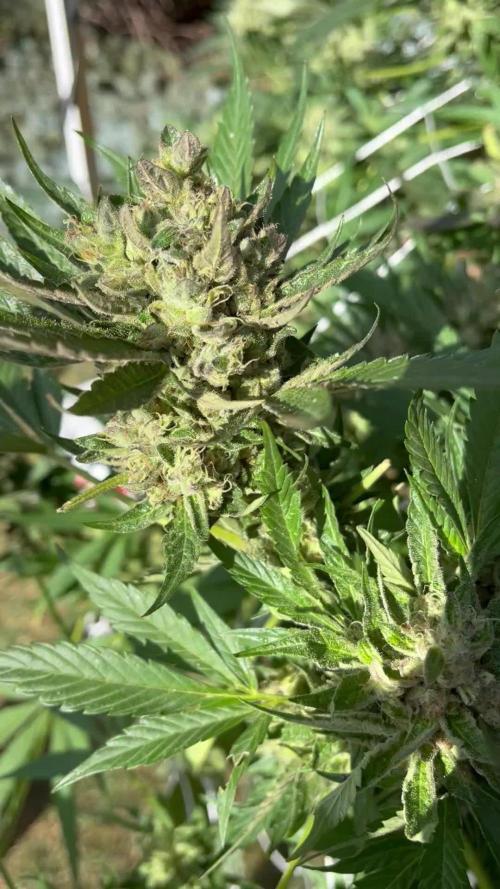
My earliest ever outdoor grow, got planted on 1st of march outdoor with 4 other strains, wich all died because of the temperature that time at night( sometimes -1). This little beauty managed to survive that and went in to flower as small as she was, the buds didnt got as big as i hoped for bud im happy with the result. Buds smell super much like forest fruit or berries and also bit peppery. The color of the buds is amazing
Likes
11
Share
@Krisis
Follow
01/24/25. Start week 8 veg I messed around with this girl a lot the past week. I could see she had plenty of branching and bud sites but most of them were hiding. I used some lst clips to move things around and get more exposed. She was watered yesterday with calmag and her next watering will be with a feeding. She’s drinking about a half gallon every 2-3 day currently. She’ll be getting flipped soon. Would have already done it but one of the friends had been a straggler and trying to get her right. 02/26/25- did some more last minute training and cleaned up around her nether regions and got rid of lower growth 02/27/25- watered/fed half a gallon Also added video. That about covers it. Thanks for lookin. ✌️
Likes
6
Share
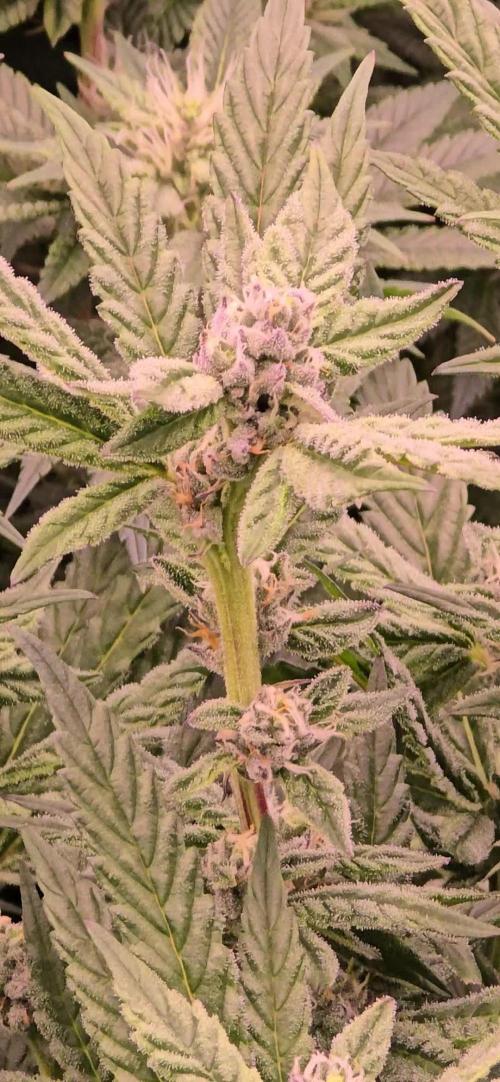
06.11.2025 Last week was really busy for me, but it was not because of this beautiful couple of Agent Orange. The male moved to the window and is developing very nice. She, the female Agent, stayed in the tent and went on with her stretch. I took off many leaves and am trying to keep her inner circle exposed to the light. So happy to watch them grow 🌸 09.11.2025 Oh, she is sooo beautiful and yellow (!) flowers are appearing. I'm flashed by her stunning beauty, observing these little yellow spots showing in the centers of her flowers. This is such an surprising effect, that you wouldn't believe it if not seeing it with your own eyes. Impressive! 💜
Likes
32
Share
05.04. Day 26 under 12 h . Flower 1. Gut.. 06.04. Das wars mit Bioweed. Ade meine guten Vorsätze. Ab heute bug free weed. Spidermites free. Chemie war im Einsatz. Minimalste berechnete Menge. 08.04 oh, diese Stille im Zelt. Nix fliegt zirpt summt herum. (bumm bumm ). Sieht doch gut aus. 11.04. 16 h Licht ab jetzt. Und, Day 31 flower 7. Sehr schöne Entwicklung, wie ich finde.
Likes
17
Share
This grow looks a lot larger then what it is, gorilla zkittlez came out light and fluffy but still a solid 9.1 oz yeild in a 4x4 tent sharing the space with girlscout cookies She grew a little rough at the start during veg but once she got back to health she really took off Heavy feeder she would always drink more and be lighter green then the girlscout cookies Had a reveg mishapp around week 3 and 4 in flower which caused her to stretch a lot, none the less she still stacked up on some colas Due to heat and too much light the buds turned out really fluffy compared to girlacout cookies Buds are nice and frosty with lots of orange hairs tho Smelling like lemon peels and gummy Candy with a hint of that earthy smell Harvested on day 77 she was at the end of week 10, hunger her up in the basement where temps were about 70-73 and humidity around 55% stable for 5 days Trimmed off all the fan leaves and some sugar leaves to aid in the drying process Was low on stash and wanted to harvest instead of buying more Finally have enough to keep me stocked up will next harvest! Just from one plant Still have the girlscout cookies to weigh up aswell and she had better buds None the less easy grow specially for the last 3-4 weeks as I ran out of nutrients I just gave them the odd watering ph to 6.0 but she got waterings as low as 5.5 and High as 7.1 and didn't effect the growth Although I could of gotten a larger yeild or denser buds with nutrients up untill the last week She didn't die nor slow down during the last few weeks and doubled in bud size pressing out nicely im sure ill be doing a lot of it with this bud
Processing
Likes
8
Share
Buenas noches familia, de nuevo actualizamos el diario, y acabamos la cuarta semana de floración, vaya brazos laterales que están tirando, se van a poner hermosas, se las ve sanas y vigorosas, nota mucho la forma sativa de sus hojas así que veremos lo que tardan en florecer. Ph controlado a 6,5 y humedad por debajo de 45% not bad las condiciones temperaturas mínimas de 20 y maximas de 27,5 Grados. Al atar las puntas los brazos tendieron a ir a la luz y gracias a eso la planta está tomando la forma de la esquina.
Likes
2
Share
@Mr_Prawn
Follow
Final de la sexta semana, corto la primera con 40 días. El resto están sacando los pelillos marrones, unas mas unas menos. Parece que falta poco, olor fuerte.
Likes
14
Share
Venga familia que ya viene la cosecha de estas Tropical Zmoothie de Seedstockers, que ganas que tenia ya de darles machetazo. No veas que pinta que tienen estas plantas. Las flores aparte se ven bien resinosas. a sido una genética con la que disfruté mucho cultivarla, es algo complicada cultivarla pero merece la pena si eres cultivador con experiencia no te será problema cosechar. Agrobeta: https://www.agrobeta.com/agrobetatiendaonline/36-abonos-canamo Mars hydro: Code discount: EL420 https://www.mars-hydro.com/ Hasta aquí es todo , espero que lo disfrutéis, buenos humos 💨💨.
Likes
17
Share
Welcome back growfessors to another episode of growfessor theatre! Week 5F begins, the ladies are looking good, but hungry!! Will continue to monitor through the week, as they are drying out the pro-mix HP medium quickly. Defoliation conducted on each lady. However LSD and Divine storm needed the most attention. Thanks for stopping by growfessors, tune in next week for another episode 👽🌳💚
Likes
20
Share
@Naujas
Follow
megaite doesn't look beautiful and happy, of course I didn't expect anything else, to be honest I didn't expect to go this far :) so as long as she lives I'm happy :)
Likes
10
Share
@Skuba
Follow
Hey everyone!!! Start of week five. Everything is starting to come along. Everything is gping fine in the garden. Still super cropping some of the branches on cc2 to keep it even. Added some open sesame to this weeks feed. 😎 cheers Update 11/15 hey everyone back with an update. Fed the girls this morning, and the first thing i noticed was the sweet aroma. 😁😁 these girls love water amd nutes i feed them about a gallon of water every 2 to 3 days. Lots of pistills starting to come in as well😁😁😁😁 i also lsted and leaf stripped as well! Cheers!✌️✌️
Processing
Likes
6
Share
@mRJ519
Follow
Watering/ feeding every 4 day's... Alternating feed and water... Keeping it simple
Likes
Comments
Share
The girls just keeps on Living life and growing more and more for each day😍 We Saw alot of good reviews on the autopot system so we thought we would try it out🙌🏼
Likes
17
Share
Que hay familia, actualizo la cuarta semana de floración de estas Runtz F1 automáticas de Zamnesia. Vaya liada de floración, me salió en este indoor una plaga de trips y los 5 ejemplares están picados, ya traté las plantas esta semana, añadí aceite de neem en la tierra, rocié un insecticida y añadí tiras azules, veremos esta próxima semana si ya erradique este inconveniente. Empiezo por supuesto abonando una pequeña cantidad de la gama Agrobeta. La temperatura está 25 grados y la humedad anda entorno al 50%. Riego cada 48 horas. Hasta aquí es todo estas próximas semanas veremos cómo van avanzando. Agrobeta: https://www.agrobeta.com/agrobetatiendaonline/36-abonos-canamo Mars hydro: Code discount: EL420 https://www.mars-hydro.com/ Os comento que tengo un descuento y para que compréis en la web de Zamnesia de un 20%, el código es ZAMMIGD2023 The discount 20% and the code is ZAMMIGD2023 https://www.zamnesia.com/ Hasta aquí es todo, buenos humos 💨💨💨.
Likes
52
Share
Lacewings seemed to have mostly killed themselves by flying into hot light fixtures. I may have left the UV on which was smart of me :) Done very little to combat if anything but make a sea of carcasses, on the bright side its good nutrition for the soil. Made a concoction of ethanol 70%, equal parts water, and cayenne pepper with a couple of squirts of dish soap. Took around an hour of good scrubbing the entire canopy. Worked a lot more effectively and way cheaper. Scorched earth right now, but it seems to have wiped them out almost entirely very pleased. Attempted a "Fudge I Missed" for the topping. So just time to wait and see how it goes. Question? If I attached a plant to two separate pots but it was connected by rootzone, one has a pH of 7.5 ish the other has 4.5. Would the Intelligence of the plant able to dictate each pot separately to uptake the nutrients best suited to pH or would it still try to draw nitrogen from a pot with a pH where nitrogen struggles to uptake? Food for stoner thought experiments! Another was on my mind. What happens when a plant gets too much light? Well, it burns and curls up leaves. That's the heat radiation, let's remove excess heat, now what? I've always read it's just bad, or not good, but when I look for an explanation on a deeper level it's just bad and you shouldn't do it. So I did. How much can a cannabis plant absorb, 40 moles in a day, ok I'll give it 60 moles. 80 nothing bad ever happened. The answer, finally. Oh great........more questions........ Reactive oxygen species (ROS) are molecules capable of independent existence, containing at least one oxygen atom and one or more unpaired electrons. "Sunlight is the essential source of energy for most photosynthetic organisms, yet sunlight in excess of the organism’s photosynthetic capacity can generate reactive oxygen species (ROS) that lead to cellular damage. To avoid damage, plants respond to high light (HL) by activating photophysical pathways that safely convert excess energy to heat, which is known as nonphotochemical quenching (NPQ) (Rochaix, 2014). While NPQ allows for healthy growth, it also limits the overall photosynthetic efficiency under many conditions. If NPQ were optimized for biomass, yields would improve dramatically, potentially by up to 30% (Kromdijk et al., 2016; Zhu et al., 2010). However, critical information to guide optimization is still lacking, including the molecular origin of NPQ and the mechanism of regulation." What I found most interesting was research pointing out that pH is linked to this defense mechanism. The organism can better facilitate "quenching" when oversaturated with light in a low pH. Now I Know during photosynthesis plants naturally produce exudates (chemicals that are secreted through their roots). Do they have the ability to alter pH themselves using these excretions? Or is that done by the beneficial bacteria? If I can prevent reactive oxygen species from causing damage by "too much light". The extra water needed to keep this level of burn cooled though, I must learn to crawl before I can run. Reactive oxygen species (ROS) are key signaling molecules that enable cells to rapidly respond to different stimuli. In plants, ROS plays a crucial role in abiotic and biotic stress sensing, integration of different environmental signals, and activation of stress-response networks, thus contributing to the establishment of defense mechanisms and plant resilience. Recent advances in the study of ROS signaling in plants include the identification of ROS receptors and key regulatory hubs that connect ROS signaling with other important stress-response signal transduction pathways and hormones, as well as new roles for ROS in organelle-to-organelle and cell-to-cell signaling. Our understanding of how ROS are regulated in cells by balancing production, scavenging, and transport has also increased. In this Review, we discuss these promising developments and how they might be used to increase plant resilience to environmental stress. Temperature stress is one of the major abiotic stresses that adversely affect agricultural productivity worldwide. Temperatures beyond a plant's physiological optimum can trigger significant physiological and biochemical perturbations, reducing plant growth and tolerance to stress. Improving a plant's tolerance to these temperature fluctuations requires a deep understanding of its responses to environmental change. To adapt to temperature fluctuations, plants tailor their acclimatory signal transduction events, specifically, cellular redox state, that are governed by plant hormones, reactive oxygen species (ROS) regulatory systems, and other molecular components. The role of ROS in plants as important signaling molecules during stress acclimation has recently been established. Here, hormone-triggered ROS produced by NADPH oxidases, feedback regulation, and integrated signaling events during temperature stress activate stress-response pathways and induce acclimation or defense mechanisms. At the other extreme, excess ROS accumulation, following temperature-induced oxidative stress, can have negative consequences on plant growth and stress acclimation. The excessive ROS is regulated by the ROS scavenging system, which subsequently promotes plant tolerance. All these signaling events, including crosstalk between hormones and ROS, modify the plant's transcriptomic, metabolomic, and biochemical states and promote plant acclimation, tolerance, and survival. Here, we provide a comprehensive review of the ROS, hormones, and their joint role in shaping a plant's responses to high and low temperatures, and we conclude by outlining hormone/ROS-regulated plant-responsive strategies for developing stress-tolerant crops to combat temperature changes. Onward upward for now. Next! Adenosine triphosphate (ATP) is an energy-carrying molecule known as "the energy currency of life" or "the fuel of life," because it's the universal energy source for all living cells.1 Every living organism consists of cells that rely on ATP for their energy needs. ATP is made by converting the food we eat into energy. It's an essential building block for all life forms. Without ATP, cells wouldn't have the fuel or power to perform functions necessary to stay alive, and they would eventually die. All forms of life rely on ATP to do the things they must do to survive.2 ATP is made of a nitrogen base (adenine) and a sugar molecule (ribose), which create adenosine, plus three phosphate molecules. If adenosine only has one phosphate molecule, it’s called adenosine monophosphate (AMP). If it has two phosphates, it’s called adenosine diphosphate (ADP). Although adenosine is a fundamental part of ATP, when it comes to providing energy to a cell and fueling cellular processes, the phosphate molecules are what really matter. The most energy-loaded composition for adenosine is ATP, which has three phosphates.3 ATP was first discovered in the 1920s. In 1929, Karl Lohmann—a German chemist studying muscle contractions—isolated what we now call adenosine triphosphate in a laboratory. At the time, Lohmann called ATP by a different name. It wasn't until a decade later, in 1939, that Nobel Prize–-winner Fritz Lipmann established that ATP is the universal carrier of energy in all living cells and coined the term "energy-rich phosphate bonds."45 Lipmann focused on phosphate bonds as the key to ATP being the universal energy source for all living cells, because adenosine triphosphate releases energy when one of its three phosphate bonds breaks off to form ADP. ATP is a high-energy molecule with three phosphate bonds; ADP is low-energy with only two phosphate bonds. The Twos and Threes of ATP and ADP Adenosine triphosphate (ATP) becomes adenosine diphosphate (ADP) when one of its three phosphate molecules breaks free and releases energy (“tri” means “three,” while “di” means “two”). Conversely, ADP becomes ATP when a phosphate molecule is added. As part of an ongoing energy cycle, ADP is constantly recycled back into ATP.3 Much like a rechargeable battery with a fluctuating state of charge, ATP represents a fully charged battery, and ADP represents a "low-power mode." Every time a fully charged ATP molecule loses a phosphate bond, it becomes ADP; energy is released via the process of ATP becoming ADP. On the flip side, when a phosphate bond is added, ADP becomes ATP. When ADP becomes ATP, what was previously a low-charged energy adenosine molecule (ADP) becomes fully charged ATP. This energy-creation and energy-depletion cycle happens time and time again, much like your smartphone battery can be recharged countless times during its lifespan. The human body uses molecules held in the fats, proteins, and carbohydrates we eat or drink as sources of energy to make ATP. This happens through a process called hydrolysis . After food is digested, it's synthesized into glucose, which is a form of sugar. Glucose is the main source of fuel that our cells' mitochondria use to convert caloric energy from food into ATP, which is an energy form that can be used by cells. ATP is made via a process called cellular respiration that occurs in the mitochondria of a cell. Mitochondria are tiny subunits within a cell that specialize in extracting energy from the foods we eat and converting it into ATP. Mitochondria can convert glucose into ATP via two different types of cellular respiration: Aerobic (with oxygen) Anaerobic (without oxygen) Aerobic cellular respiration transforms glucose into ATP in a three-step process, as follows: Step 1: Glycolysis Step 2: The Krebs cycle (also called the citric acid cycle) Step 3: Electron transport chain During glycolysis, glucose (i.e., sugar) from food sources is broken down into pyruvate molecules. This is followed by the Krebs cycle, which is an aerobic process that uses oxygen to finish breaking down sugar and harnesses energy into electron carriers that fuel the synthesis of ATP. Lastly, the electron transport chain (ETC) pumps positively charged protons that drive ATP production throughout the mitochondria’s inner membrane.2 ATP can also be produced without oxygen (i.e., anaerobic), which is something plants, algae, and some bacteria do by converting the energy held in sunlight into energy that can be used by a cell via photosynthesis. Anaerobic exercise means that your body is working out "without oxygen." Anaerobic glycolysis occurs in human cells when there isn't enough oxygen available during an anaerobic workout. If no oxygen is present during cellular respiration, pyruvate can't enter the Krebs cycle and is oxidized into lactic acid. In the absence of oxygen, lactic acid fermentation makes ATP anaerobically. The burning sensation you feel in your muscles when you're huffing and puffing during anaerobic high-intensity interval training (HIIT) that maxes out your aerobic capacity or during a strenuous weight-lifting workout is lactic acid, which is used to make ATP via anaerobic glycolysis. During aerobic exercise, mitochondria have enough oxygen to make ATP aerobically. However, when you're out of breath and your cells don’t have enough oxygen to perform cellular respiration aerobically, the process can still happen anaerobically, but it creates a temporary burning sensation in your skeletal muscles. Why ATP Is So Important? ATP is essential for life and makes it possible for us to do the things we do. Without ATP, cells wouldn't be able to use the energy held in food to fuel cellular processes, and an organism couldn't stay alive. As a real-world example, when a car runs out of gas and is parked on the side of the road, the only thing that will make the car drivable again is putting some gasoline back in the tank. For all living cells, ATP is like the gas in a car's fuel tank. Without ATP, cells wouldn't have a source of usable energy, and the organism would die. Eating a well-balanced diet and staying hydrated should give your body all the resources it needs to produce plenty of ATP. Although some athletes may slightly improve their performance by taking supplements or ergonomic aids designed to increase ATP production, it's debatable that oral adenosine triphosphate supplementation actually increases energy. An average cell in the human body uses about 10 million ATP molecules per second and can recycle all of its ATP in less than a minute. Over 24 hours, the human body turns over its weight in ATP. You can last weeks without food. You can last days without water. You can last minutes without oxygen. You can last 16 seconds at most without ATP. Food amounts to one-third of ATP production within the human body.