


@Mo_Powers
Follow
not much happened this week. there was a lot of sunshine. a few stormy days and some rain. she is still doing well and growing steadily. she gets some biobizz bio
-bloom now.



@Tweak
Follow
GG12 is putting out buds like crazy even though she’s quite small, I think I’ll still get a decent harvest from her. The Alien OG and Pineapple Express both had a few branches that needed supercropping to keep the canopy nice and even. Stretch looks over and the 3 not named GG12 are just starting to bud out. Girls are Only getting plain water and look super healthy. Excited to see what the next week brings. Thanks for stopping by and add my grow please.


@Metamorph
Follow
Hello again, dear growers! 🌱👋
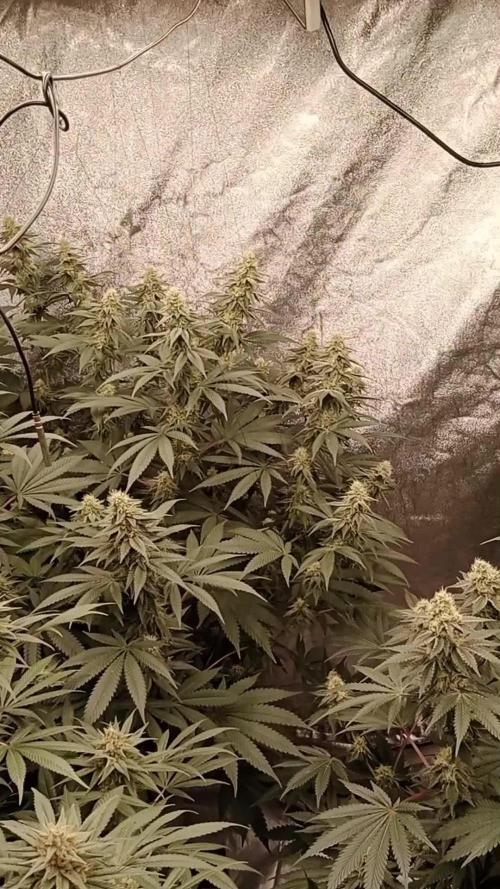
We’ve officially stepped into Week 10 of this wild and fragrant journey! Last week ended with a little makeover for the girls—I defoliated about 30-40% of the leaves again. ✂️ The Gorilla decided to keep me on my toes by showing some nutrient deficiencies on her leaves—guess she didn’t get enough food after the flush. 🍌🌿 (Lesson learned: don’t keep a Gorilla hungry!)
Now, let’s talk about Runtz! 😍 She’s an absolute queen—so photogenic that even my struggling phone can’t capture her real beauty. 📸✨ She’s forming into one giant, luscious bud, and her fragrance is something else entirely! 🕵️♂️ The carbon filter is fighting the good fight, but if the room isn’t aired out every 8-9 hours, a little aroma starts sneaking through.
But opening the tent… oh, my friends, that’s where the magic happens! 🌬️💫 The aroma is intoxicating—imagine diving headfirst into a field of flowers while bees whisper secrets in your ears. 🌺🐝 I just sit there, enchanted, savoring the smell, and staring at these beauties like a hypnotized gardener. Honestly, it’s hard to walk away. 😂
Here’s their menu for the week:
🍵 Feed: A+B 4ml/L, Micro Chum 1ml/L, Big Bud 2ml/L
📊 PPM: 1050 | pH: 5.8
💧 Runoff: PPM 1000 | pH 6.0-6.3
Now, for the not-so-great news…
I’m struggling with humidity levels—daytime sits around 65-77%, and at night, it can climb to a stubborn 80%. 🌫️ Temperature-wise, it’s 23-25°C during the day and drops to a cool 16-18°C at night. ❄️🔥
Despite the challenges, the endgame is near, and I’m savoring every moment of this grow! 🌟 🙌 Happy growing, everyone! 🌱🔥


@Psychopat_od_vedle
Follow
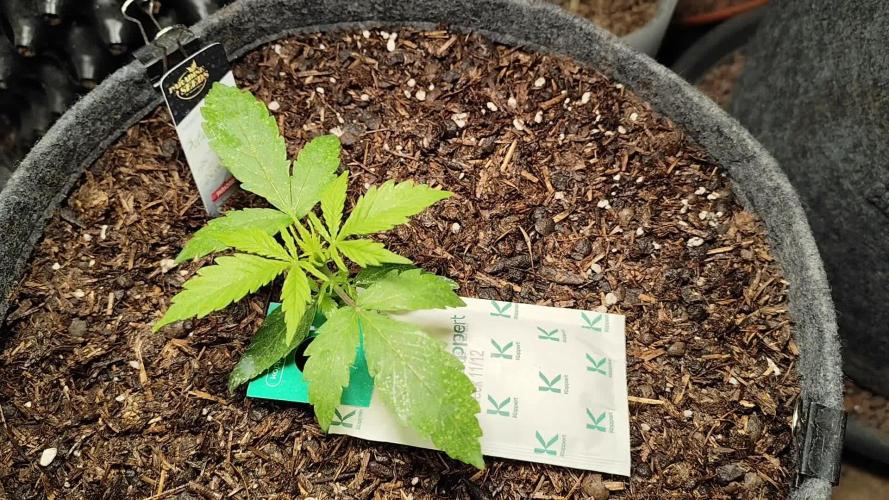
Zdarec bando máme tu 38 den a holky vypadají skvěle pH 6.1 vlhkost 55% jinak žádný problém nic tak doufám že to bude v pohodě až do konce.



@Growbody
Follow
Hallo und herzlich willkommen zu meinem neuen Grow mit der Auto Jack, Jacky White 6th Gen. von Paradise Seeds. Die "Eltern" sind Jacky White x Ruderalis, die "Großeltern" sind Jack Herer und White Widow. Sie ist dadurch eine 75% Sativa mit zitronig-fruchtigen Aromen, genau mein Ding. Es freut mich sehr, das mir die Samen in einer sehr schönen Verpackung freundlicherweise von Paradise Seeds zur Verfügung gestellt wurden. Das ist für mich der Ansporn, eine möglichst genaue Beschreibung des Growverlaufs aufzuzeichnen.
Die URL des Strains findet ihr hier:
https://www.paradise-seeds.com/de/product/auto-jack/
Für diesen Grow verwende ich den 15Liter WideVersion Stofftopf von ROOTiES, die Sonnenerde Bio Hanferde, den BioBizz Wurmhumus, Sonnenerdes Bio Faser, BIONOVA + zamnesias MonsterBud Mix Living Soil, zamnesias Smast Start und Plagrons Seedbooster Plus. Hat sich alles prima bewähert.
Tag 22: Die Auto Jack von Paradise Seeds hat die Raubmilben Amblyseus cucumeris bekommen und eine Florfliegenlarve tummelt sich auf ihr. 1,0 Liter Wasser.
Tag 24: 0,5 Liter Wasser.
Tag 26: 0,75 Liter Wasser.
Schön, dass du reingeschaut hast. Nächste Woche gehts weiter und ich freue mich, wenn du dabei bist 👋😎


@JKent19
Follow
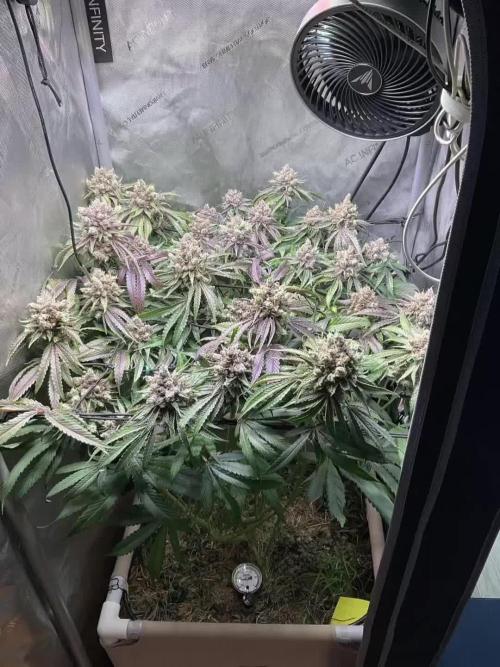
Swapped the plants this week as I realized I could use the 200w light to cover both the smaller plant and the lower canopy of the larger one more effectively. Hopefully this will allow sufficient light to cover more of the plants, as the lower canopy of the larger plant was 30 inches from the light! Now since I can lower the bigger light to accommodate the shorter plant, I can cover the left side of the bigger one, lowering the light to 23 inches, which is definitely better. The buds don't seem to be filling in quite as quickly this time but they are definitely making progress! I am guessing about another month, but who knows? I'm going to let them take their time and let me know when they're ready. Other than that was a pretty uneventful week, as I'm kind of coming into the final stretch I have stopped the lst and only trim the leaves that are blocking bud sites. They definitely appear more stressed than they have been, with a lot of bright purple stems connected to the leaves, but to me they look healthy enough to make it to the finish line!


@Tower84
Follow
Cherry Limeade Doja – Wochenupdate 🌱
Der Herbst schreitet bei der Cherry Limeade weiter voran 🍂. Einige Blätter zeigen mittlerweile wunderschöne violette und gelbe Farbtöne und auch die Buds selbst entwickeln zunehmend eine schöne Purple-Färbung 💜. Das gibt der Pflanze in der Endblüte wirklich einen tollen Look. Gleichzeitig geht der Wasserverbrauch langsam, aber deutlich zurück. In der vergangenen Woche lag er nur noch bei etwa 1,4 Litern pro Tag 💧.
Leider ist es mir nicht gelungen, die Temperaturen in der Endblüte noch deutlich zu senken. Bei eingeschalteter LED lagen wir im Durchschnitt bei etwa 27 °C 🌡️. Aber bei einem Spätsommer-Grow im Dachgeschoss lässt sich das ohne Klimatisierung eben nicht immer vermeiden. Gerade in Kombination mit dem Entfeuchter ist es schwierig, die Temperatur noch weiter herunterzubekommen. Damit muss ich bei einem solchen Setup einfach leben.
Am Freitag habe ich außerdem noch einmal 3 Liter Almicanna Flower Komposttee gegossen 🌸. Dieses Mal habe ich beim Brauen erstmals einen Aquarium-Heizstab verwendet und den Tee bei konstanten 21 °C gebraut 🌡️🫧.
Was die Pflanze und vor allem das Aroma betrifft, bin ich momentan etwas zwiegespalten 🤔. An manchen Tagen bin ich wirklich begeistert von ihr, an anderen bin ich doch etwas enttäuscht über den bisher eher unspektakulären Geruch. Sie riecht definitiv angenehm und hat eine schöne Zitrusnote, aber es ist kein Vergleich zu der unglaublichen Süße meiner Blueberry Pancakes oder dem extrem intensiven Aroma der linken Mentha de Croco 🌿.
Vielleicht ist es einfach eine Frage der Erwartung. Bei einer Cherry Limeade hatte ich mir ehrlich gesagt beim Öffnen des Zeltes eine richtige Kirschexplosion erhofft 🍒💥. Genau diese intensive Kirschnote ist bisher leider ausgeblieben. Für ein endgültiges Fazit ist es aber definitiv noch zu früh – vielleicht überrascht sie mich in den letzten Tagen und vor allem nach der Trocknung und Reifung noch.
Die Buds selbst sind dafür wirklich beeindruckend 🌸. Sie sind extrem dicht gewachsen, relativ groß, sehr harzig und mittlerweile teilweise wunderschön purple 💜. Ich bin deshalb trotz der bisherigen Enttäuschung beim Aroma sehr gespannt darauf, wie das Endergebnis aussehen und sich nach dem Curing entwickeln wird.
Ab heute reduziere ich die Lichtintensität auf 800 PPFD bzw. etwa 35 DLI 💡. Ich werde die Pflanze anschließend noch ungefähr 1,5 bis 2 Wochen ausreifen lassen. Unter dem Mikroskop konnte ich bisher noch keine bernsteinfarbenen Trichome entdecken 🔬. Mein Eindruck liegt momentan ungefähr bei 50:50 zwischen klaren und milchigen Trichomen. Es ist also definitiv noch etwas Zeit.
Jetzt geht es eigentlich nur noch darum, die letzten Wochen möglichst ruhig zu Ende zu bringen und abzuwarten, was die Cherry Limeade am Ende tatsächlich abliefert 😎🌱. Ich bin auf jeden Fall sehr gespannt auf das Endergebnis.
📊 Aktuelle Parameter:
💡 Licht: 900 PPFD / DLI 39 → 800 PPFD / DLI 35
🌡️ Temperatur: ca. 27 °C bei Licht an
💧 Luftfeuchtigkeit: 57 %
📈 VPD: 1,5 kPa
🌿 CO₂: Ø 740 ppm
💦 Wasserverbrauch: ca. 1,4 l/Tag
Cherry Limeade – Weekly Update 🌱
Autumn is progressing on the Cherry Limeade 🍂. Some of the leaves are now showing beautiful purple and yellow colors, and the buds themselves are also developing an increasingly beautiful purple coloration 💜. It gives the plant a really nice late-flower appearance. At the same time, water consumption is slowly but steadily decreasing. Last week, the plant was using only around 1.4 liters per day 💧.
Unfortunately, I wasn’t able to bring the temperatures down as much as I would have liked during late flower. With the LED on, temperatures averaged around 27 °C 🌡️. But with a late-summer grow in an attic, this simply isn’t always avoidable without air conditioning. Especially when running the dehumidifier, getting the temperature down any further is difficult. That’s just something I have to accept with this setup.
On Friday, I also gave her another 3 liters of Almicanna Flower Compost Tea 🌸. This time I used an aquarium heater while brewing and kept the temperature at around 21 °C 🌡️🫧.
When it comes to the plant itself, and especially the aroma, I’m currently a little torn 🤔. Some days I’m really impressed with her, while on other days I’m somewhat disappointed by how unspectacular the aroma still is. She definitely smells pleasant and has a nice citrus character, but it’s nowhere near the incredible sweetness of my Blueberry Pancakes or the extremely intense aroma of the left Mentha de Croco 🌿.
Maybe it’s simply a matter of expectations. With a Cherry Limeade, I honestly hoped for a massive cherry explosion every time I opened the tent 🍒💥. Unfortunately, that intense cherry note has not appeared so far. It’s definitely still too early for a final verdict, though – maybe she’ll surprise me during the final days, and especially after drying and curing.
The buds themselves are genuinely impressive 🌸. They have grown extremely dense, are relatively large, very resinous, and are now showing some beautiful purple coloration 💜. So despite being somewhat disappointed by the aroma so far, I’m still very curious to see what the final product will look and smell like after curing.
Starting today, I’m reducing the light intensity to 800 PPFD, which gives me around 35 DLI 💡. I’ll let the plant ripen for another roughly 1.5–2 weeks. Under the microscope, I haven’t seen any amber trichomes yet 🔬. My current estimate would be roughly 50:50 between clear and cloudy trichomes, so there is definitely still some time to go.
At this point, the goal is simply to keep things stable for the final weeks and see what the Cherry Limeade ultimately delivers 😎🌱. I’m definitely very curious about the final result.
📊 Current parameters:
💡 Light: 900 PPFD / DLI 39 → 800 PPFD / DLI 35
🌡️ Temperature: approx. 27 °C with lights on
💧 Humidity: 57%
📈 VPD: 1.5 kPa
🌿 CO₂: Avg. 740 ppm
💦 Water consumption: approx. 1.4 L/day




@Ultraviolet
Follow
Not particularly growing for speed or any dedicated reason this time round, just adding water and a abundande of positivity, gotta admit I do like the autoseed logo. Off we go again into the magical forest.
(Arthrospira platensis) cultivated in high-alkaline, mineral-rich water in Kailua-Kona, Hawaii. It is renowned for having a higher nutrient content, including more carotenoids and essential fats, compared to other spirulina brands. It is frequently cited as a "complete food" due to its dense concentration of proteins, vitamins, minerals, and pigments.
The nutritional profile of standard dried Spirulina platensis biomass. 3kg of spirulina powder has an approximate NPK ratio of 10-2-1 (or 10% Nitrogen, 2% Phosphorus, and 1% Potassium).
Here is the breakdown of the nutrient content for 3kg of powder:
Nitrogen (N): ~300g (10% of total mass)
Phosphorus (P): ~60g (roughly 2% of total mass)
Potassium (K): ~30g (roughly 1% of total mass)
3kg of spirulina powder is more than enough nitrogen for 4 cannabis plants in a 100-gallon pot—in fact, it is likely excessive and could cause severe nutrient burn or toxicity if not properly managed. Spirulina has a very high protein content (46% to 63% dry weight), which translates to a significant nitrogen source. It is often described as a 5-1-1 NPK fertilizer.
3kg (3000g) of powder in 100 gallons means 30g per gallon. General organic recommendations for potent amendments (like frass) are often around 1–3 tablespoons per gallon. 30g of powder is roughly 2-3 tablespoons, making this a very high-strength application rate if added all at once. Balance this with calcium/magnesium, and organic nutrient delivery in soil growing can lead to deficiencies in these nutrients.
Not all of that 100 gallon is used, so figuring out precise measurements was ballpark, but there is about 10kg of engineered biochar in that pot. Mostly in the top half. Ideally, I'd have 25kg in a full active 100-gallon, but......... don't mess with something that is not broken. Roots do not utilize the entire 100 gallons. This has been a couple of years of trial and error, mostly error. The amount of cations you can add in grams depends entirely on the specific cation exchange capacity (CEC) of your biochar and the type of cation being added. Biochar CEC values vary widely, typically ranging from 4 to over 300cmolc/kg. Multiple Biochars in use, ranging upwards of 100cmolc/km.
Different cations have different atomic weights
Potassium K+ 39.1g/mol.
Calcium Ca2+ 40.1g/mol.
Magnesium Mg2+ 24.3g/mol.
Nitrogen NH4+ 18.04g/mol.
You get more nitrogen bang for your buck. It all depends on the CEC of the biochar you use, but brrrrrrrrrr roughly I'm looking at 500-600 grams worth of elemental cation exchange capacity, give or take. That's just for the biochar alone. Elemental cation exchange capacity refers to the ability of materials—such as soil, minerals, and biochar to adsorb, hold, and release positively charged ions Ca2+, Mg2+, K+, Na+, Al3+, and Zn2+. This capacity is a critical measure of nutrient availability in soil and energy density in electrochemical systems.
Added calmag 2:1 to complement spirulina.
Calcium (Ca): Approximately 150g - 300g of elemental calcium.
Magnesium (Mg): Approximately 75g - 150g of elemental magnesium.
So long as pH stays in 6.3 to 6.7 ish, the plant will unlock hydrogen. Plants will be able to cycle CEC for their own needs. Hydrogen ion pumping (proton pumping) is a fundamental mechanism used by plant roots to facilitate the cycling of nutrients within a medium's Cation Exchange Capacity (CEC), directly increasing nutrient availability. A growing medium's Cation Exchange Capacity (CEC) does not contribute directly to Electrical Conductivity (EC). CEC represents potential nutrient storage, while EC represents active nutrients in the water/soil solution. A medium with a high CEC can hold many nutrients, but if there is no water present, the EC will be low.
98% of plant nutrient uptake comes directly from the soil solution.
2% of nutrient uptake is directly from soil particles.
Nutrients held on exchange sites (CEC) are not directly measured by EC until they are released into the soil solution through exchange with other ions (e.g., hydrogen ions from roots or fertilizer).
Plants source the H+ ions (protons) used in cation exchange primarily by exuding carbon sugars into the rhizosphere, then microorganisms perform root respiration, which reacts with soil water to form carbonic acid H2CO3 that dissociates into H+ and bicarbonate. Roots also actively pump out H+ ions directly to acidify the rhizosphere, plants trade hydrogen produced through metabolism for essential nutrients held by the soil.
In plant cells, the H+ (protons) used in proton pumping across the plasma membrane come primarily from the cytoplasm (cytosol). The protons are derived from internal cellular sources, including metabolic processes that release H+, and the regulation of intracellular pH homeostasis.
Distilled water is highly useful in managing the electrical conductivity (EC) of a growing medium by allowing for precise control over nutrient concentration and assisting in the mobilization of nutrients from the cation exchange capacity (CEC) into the active, plant-available nutrient solution.
Just add water & positive energy.
Potential hydrogen. pH. + - , potential charge balance for hydrogen.
So long as there is adequate oxygen in the soil and air and water moves at a decent interval, its practically impossible for the pH to skew in a soil that is taking in oxygen and releasing CO2 and nitrogen, I say practically, but meh, even with plenty of oxygen, the process of converting ammonium NH4+ to nitrate NO3- by bacteria releases hydrogen ions H+, which directly causes acidification (lowering pH). While water movement is necessary, consistent water moving through the soil can leach away basic cations Ca2+, Mg2+, K+, Na+, leaving behind acidic hydrogen and aluminum ions, causing pH to drop, especially in humid regions. High levels of CO2 in the soil (from intense respiration) dissolve in soil water to create carbonic acid, H2CO3, which lowers the pH. (barometric pumping removes that possibility) The pH in a cannabis cultivation environment, particularly in hydroponic or soilless setups, will often naturally drift towards acidic (lower pH) over time. Understand how to know when to lime the pH back up. Complex but critical. Once I understood this it helped ease the pain of understanding pH.
Base saturation directly reflects the percentage of CEC occupied by base cations. Generally, as base saturation increases, soil pH increases because fewer acidic cations, H+ and Al3,+ are present on the soil colloid surfaces.
At a pH of 7 or higher, the soil colloids are saturated with base cations, resulting in a base saturation of 90+%.
While many sources include Sodium Na+ as a base cation, some calculations focused specifically on plant nutrients (like in some nutrient management contexts) may focus solely on the "Big 3": Ca2+, Mg2+, and K+. However, in soil science and CEC (Cation Exchange Capacity) measurements, sodium is usually included in the definition of total base cations, making it the "Big 4" base cations.
At a pH around 5.5, soils often have a 45–55% base saturation, while a soil with a pH between 6.5 and 6.8 generally has an 80–90% base saturation.
Base saturation is considered a reliable, albeit complex, indicator of soil fertility and the degree of soil weathering, acting as a crucial metric in soil classification and management.
Once you take full control of the pH, so long as there is oxygen, and one keeps tabs on base saturation levels. Its near impossible for anything to go wrong. All you are essentially doing is adding water and waiting for any sign of deficiency. Not so much growing as eliminating the possibilities of things going sideways. Can't over or under water, can't skew pH, can't go anaerobic. Everything runs in optimal cycles, watering every 2 to 3 days or as required, depending on the rate of combined ET. A little warmer, a little drier, but never short on water. All the nutrients are already there in the medium, we still focus on the water, just not adding salts, but to mobilize nutrients held in the Cation Exchange Capacity (CEC) and move them into the active soil solution for plant uptake, the best supplements to add to water are fulvic acid, humic acid, or seaweed/kelp extract. Liquid solutions with high concentrations of essential trace elements. Distilled water has no alkalinity or minerals to help buffer or release nutrients. Adding these supplements turns the "empty" water into an active agent that forces nutrients off the CEC colloids into the solution for plant uptake.
When to water? When Electrical Conductivity of soil gets low. No water, no conductivity.


@North420Wolf
Follow
Very frosty buds the smell is going out of the house and I use carbon filters 😍 I can’t wait to smoke that shit , next week harvest soon new photos


@Ogchemst
Follow
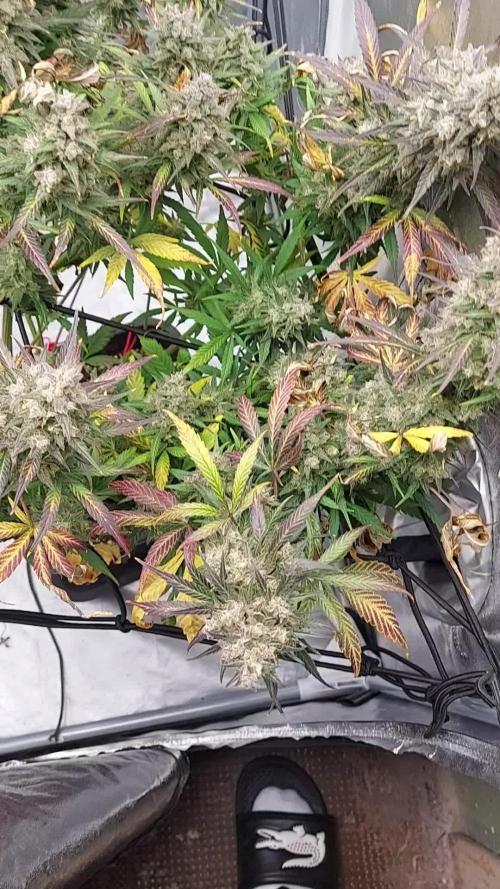
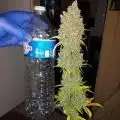
I have had to touch the a bud by accident and went to wipe my nose, omg the smell I have never smelled anything g this sweet fruity zkittlez with a nice balance of that gelato... my nose has a relationship with that buds as I love such fruity strains I can't imagine the taste mixed with gelato...
I like the bud formation alot.



@GrowGuy97
Follow
Day 56 ladies are really starting to get some massive buds, tent smells amazing! I can’t wait to see what this harvest looks like😍😍
Thanks for following & make sure to check back for daily updates friends! Happy growing✌️🏼🌱


@Oldwied
Follow
Holy Sunday
She is two weeks in flower and grows so vigours. Every Day I keep on tucking the branches under the strings.
The Screen is slowly filling up.
In 4 or 5 days I will stopp tucking.
Light Power: 80%
Day 53
Flower #8
Watered with 2,5L freshly brewed compost tea
Sprayed with freshly brewed compost tea
Day 56
Flower #11
Watered 2 L tap water


@eldruida_lamota
Follow
Venga familia, va la sexta semana de floración de estas Frosted Guava de Zamnesia.
Que color que sanas se ven como se nota que Agrobeta es de lo mejor, las niñas están de 10.
La humedad está en su punto, y por fin puedo controlar la temperatura en 22 grados.
Ph estable entre 6.2 y 6.5
Las flores están tricomando bien y desprenden aromas bastante llamativos.
Ya vamos viendo cómo progresan estas próximas semanas.
Os comento que tengo un descuento y para que compréis en la web de Zamnesia de un 20%, el código es ZAMMIGD2023
The discount 20% and the code is ZAMMIGD2023
https://www.zamnesia.com/
Mars hydro:
Code discount: EL420
https://www.mars-hydro.com/
Agrobeta:
https://www.agrobeta.com/agrobetatiendaonline/36-abonos-canamo
Hasta aquí es todo, buenos humos 💨💨💨


@HowtoBubatz
Follow
The plant is thriving as it enters its 11th week of flowering. The buds have developed beautifully, and they’re giving off a sweet, lemony aroma that fills the grow space.
It’s a scent that’s both refreshing and promising, making me excited for the final product.
At this stage, everything looks great, and I’ve decided to start flushing the plant with clear water only. This should help remove any residual nutrients and ensure a smoother, cleaner smoke. I’m planning to continue flushing for the next one to two weeks before harvesting.
I’m really looking forward to seeing how this plant turns out. The buds are dense and sticky, and if the smell is any indication, the end result should be amazing.
Can’t wait to see how she finishes!
