


Likes
Comments
Share


@pifflestikkz
Follow
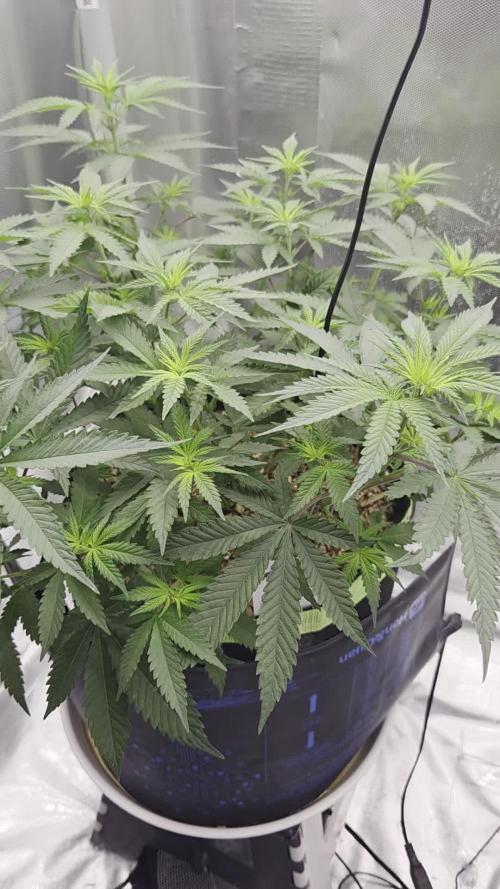
Day 121
31/08/24 Saturday
Feed today using de-chlorinated tap water pH 6 with Plagron products.
She is now settled, and now flipped. Like I said she has full roam now.
Video update, I'll get better pictures and videos when light is off ✌️💚
Day 123
02/09/24 Monday
De-chlorinated tap water pH 6 today with calmag.
Day 124
03/09/24 Tuesday
Feed again today using de-chlorinated tap water pH 6 with calmag.
Her pre flowering is in full now.
Day 126
05/09/24 Thursday
(End of week)
De-chlorinated tap water pH 6 only today full 5L no run off now. Will up to 6L next week.

Likes
6
Share


@MrGreen92
Follow
Good week of drying the conditions were perfect, because of the cold weather I could keep it at 16 degrees and 60% humidity but unfortunately I didn't have enough air flow on my back plant that was a chunky monkey and the biggest buds got moldy 😪 the rest seems ok it's been just the big heads got hit, lesson learnt

Likes
14
Share


@ao_grows1978
Follow
Week 7 of flower in the books and the Kush is in the home stretch. Pistils are all turning orange and buds are getting thick and resinous. She's got a nice citrusy smell and the colas are all swaying in the breeze. Shout out to Seedsman for these stable genetics. No deficiencies or issues that I had to fix along the way. Really happy I still have a couple more seeds left over.

Likes
3
Share


@MicroHidroGrow
Follow
Día 36.
Estamos en 6ta semana. Los esquejes se atrasaron debido a que han sido días muy fríos y no he logrado enraizarlos. Decidí poner el extractor de aire junto con la bomba de aire, así solamente se prende 15 minutos cada hora. Así estoy logrando temperaturas mayores a 24°C en el indoor y así voy a lograr el enraizado. La planta ya tiene un tamaño que ocupa casi todo el indoor. Pero lo importante es que la voy guiando y ya estoy proyectando como va a ir cada rama. El tamaño va a exceder lo que esperaba, pero aún así creo que si logro lo que tengo en mente, voy a sacar muy buenos resultados. Igual no me voy a arriesgar demasiado, así que si contando 10 días desde ahora, no logro que los esquejes enraicen, voy a pasar la madre a floración sola. Cómo pueden ver, las ramas están bastante gruesas, y el la ramificaciones van ganando su lugar cada una. Las raíces son demasiado grandes, aunque sé que voy a poder poner la planta en el sistema de arriba igual, aunque me voy a tener que ayudar de algo para meterlas. Es importante no utilizar las manos, ya que se pueden transmitir muchos hongos.
Voy a seguir actualizando e ir viendo que pasa. Pero ya estamos en los últimos días de crecimiento, haya o no esquejes. Incluso puede que ya pase la planta al indoor de arriba para darle mayor libertad de crecimiento. Esto me va a servir para tlmar en cuenta en la próxima camada que se vendrá. La idea de esto es hacer las cosas rápido, y no en gran tamaño. Pero siendo que ya estoy en el baile, no me queda otra que bailar.
Día 40
Los esquejes no estaban enraizando, así que decidí cambiarlos de lugar y los puse arriba de la luz, donde les da calor y luz tenue. Espero que ahora si agarren.
Y hoy fue el gran día, pasé la planta madre al módulo de arriba. Pero lo voy a dejar una semana más creciendo. De esa forma veo si los esquejes llegan a agarrar a tiempo. Y además tuve un problema en el trasplante. Primero que la planta se hizo más grande que lo esperado, y la raíz también. Cuando la pasé, hubo contacto de la raiz con prácticamente todo lo que había cerca. Sumado a que se enredó en el oxigenador, así que quedó una pidra difusora en la raíz.
Dado el alto riesgo de haberla contaminado con algún hongo, le puse una solución de agua con agua oxigenada, recirculando continuamente, para lavar las raices y de paso bajar el stress de teansplante. Mañana veremos cómo arranca el día.
En el aprendizaje me llevo que en la madre, es mejor hacer un corte en el primer nudo, o dejar las ramas del segundo y quitar las del primero. Y así que queden sólo dos ramas, para luego dejar a los esquejes en el medio. Eso planeo hacer con la próxima variedad.
Entre tanto ahora sólo me preocupa que la raíz no se haya contaminado en el traspaso. Ya en 8 días estaré pasando a floración si no hay esquejes. Si llegan a agarrar, habrá que dar unos días de crecimiento hasta que alcancen a la madre en altura. Pero ya está todo en definición. Ahora sólo queda esperar y seguir guiando a la planta. Ya tengo ganas de poner la próxima, pero falta bastante para eso. Tengo 10 semanas de flora, así que recién en 5 semanas voy a poner la nueva madre.
Likes
16
Share


@TechDCo
Follow
In the seventh week, I am preparing a detailed essay to explain my training method. I plan to increase the nutrient solution dosage to 35ml, including Warmcasts, seaweed, and a flower mix I concocted. Additionally, I will introduce 100% Gaba powder at half a teaspoon, mixed with water, to be administered at nighttime for the next two weeks. This natural chemical compound can help the plant relax and alleviate stress as it transitions into the pre-flowering stage and starts producing flowers. On the 11th of January, I completed the last defoliation procedure before the plant enters the pre-flowering stage in three days. I observed that the DLI (Daily Light Integral) reading is a bit high, and the light is positioned at the top. Therefore, I aim to adjust the light to achieve an ideal DLI range between 20-30. There is currently no CO2 supplementation in place. On the 12th of January, I eagerly await the pre-flowering stage and anticipate its onset in a few more days. It's time to initiate a 3-day mid-drying period.
A notable event on the 12th of January was the arrival and easy installation of the Spectrum King Sk600. The brightness of this new light is noticeably superior compared to the Budmasters. On the 13th of January, the plants experienced the first half-day under the SK600, and everything appears to be in good condition. Furthermore, I decided to move one of the vegetative plants, "Mango Skunk," into the flower tent on the same day. Additionally, there was a rearrangement of the lights in the flower tent, with the Spectrum King SK600 and Cropmaster Pro 1000 DIY being utilized. The readings for both lights were documented as follows: DLI - 197 u/mols, PPFD (Photosynthetic Photon Flux Density) - 3000 and up at 23 inches from the canopy, PPFD 2942 at 24 inches from the canopy.
I also applied blood fish and bone on topsoil and worked it in, using 2 cups of the mixture on the 14th of January. It was a relatively quiet day, and to lighten the growing mood, I took a quick video and uploaded some pictures of my dog Martina, showcasing her journey from a puppy. The bottom node leaves are significantly large, leading me to anticipate massive buds in the future. Late-night observations revealed that Pablo, a plant in the tent, may not have fully stretched to fill the available space, suggesting that it could be male. On the other hand, the forgotten haze cakes strain occupies a substantial portion of the tent, showcasing positive training outcomes.
On January 15, 2024, I removed the twist ties from the cola stalks to allow for better airflow and to support the unrestricted growth of the plants.
The following day, I took some photos to document the progress of the plants. It's always fascinating to visually track their development over time.
Also on January 16, a plant named "Freaky Pablo" displayed unusual characteristics, signaling that it might be a male plant. To prevent any potential pollination issues, I decided to remove "Freaky Pablo" from the grow space.
On the same day, I observed the presence of pre-flowers, indicating the beginning of the flowering stage. This marks an exciting phase in the growing process as the plants transition to a crucial stage of their life cycle.
During this time, I made some adjustments to the positioning of the "Mango Skunk" plant, initially moving it up to the top bed and then deciding to move it back to the bottom.
On January 18, I noted that the lights were turned on, marking the start of the flowering phase. This is a significant milestone in the plant's development as it shifts its focus from vegetative growth to flower production.
Additionally, I relocated a plant named "Spicy Temp" to the flower tent. This move ensures that all plants in the flowering stage are in the optimal environment for the next phase of their growth.
Overall, it appears that the grow operation is progressing well, and I am looking forward to witnessing how the plants continue to develop.
And finally, here's a joke for you: What did one plant say to the other? "Hey bud, how's it growing?"
I am not, because i am dead!


Likes
11
Share




Likes
8
Share


@medicalcannabelfast
Follow
Well it’s day 49 and this c4 is looking absolutely amazing :) , she is changing everyday and I can’t wait to taste her .
I think I’ll give her one last feed mid week then be water only until she ready ..


Likes
16
Share


@Foggedaboudit
Follow
The Sunset Sherbet influence in this pink phenotype is clearer by the day!



Likes
6
Share


@Roberts
Follow
Tangerine Band is growing great. I switched her light times yesterday to flowering times. She got a little defoliation today to help with stretching light. Everything is looking good. Thank you Exotic Seeds, Spider Farmer, and Athena nutrition. 🤜🏻🤛🏻🌱🌱🌱
Thank you grow diaries community for the 👇likes👇, follows, comments, and subscriptions on my YouTube channel👇.
❄️🌱🍻 Happy Growing 🌱🌱🌱
https://youtube.com/channel/UCAhN7yRzWLpcaRHhMIQ7X4g.

Likes
17
Share


@Budophile
Follow
Day1: Tent is getting a bit crowded so I had to flip the switch and let the stretching begin! Raised the lamps about 10cm to get some more spacing between the nodes and removed a lot of the leaf mass to promote the lower branches grow. Sunset Sherbet #1 had its newest growth tips turning a little yellow and I'm not sure yet is it overdose/deficiency/heat issue or just a little pH mishap from overwatering.. gave her a little less nutrients to see how it responds. Gonna wait a little more time between next watering to let the soil dry up a little better (saw a fungus gnat flying in the tent and I don't want those f*ckers to overpopulate.)
Day3: Some training, all seems fine
Day4: Raised the lamps a bit again, not sure if the other Sunset Sherbet and now OG Kush too is suffering from mild nutrient burn or light stress
Day6: My hydrohomie fucked up the Gelato#45 cuts I gave him so I took Peyote Critical as my next mother victim. Took 12 good sized shoots from below which I would've lollipopped anyways.. Hope she wont mind since I wasn't planning on defoliating/lollipopping this soon. Planning on training at around day 10 and 20 give or take and then I'll let them grow stress-free. Stretching ain't so crazy at least yet and the canopy is staying pretty much at the same height. Next defoliation/lollipopping I think I will remove all the bindings to avoid snapping the stems. All girls are now showing at least few pistils. Tried using the blooming leds on Viparspectra for two days and the temps are staying pretty much at 28C at most but switched back to just blues since not sure if there's a bit of light stress on SS/OGK. Will switch to full power when the stretching ends.


Likes
33
Share


@Rollex420
Follow
Here we go!
Day 1
Kosher cake 15-05-21
Today for her, is the first day under the light 🙌🏻
I hope she grows up healthy and strong.
I added a quarter of Biobizz's recommended dose of Root-Juice (1ml / L)
I start to give less, and then increase in the next few days so as not to be aggressive with the baby. 👶🌱
I will be uploading new updates soon!
Day 2 16-05-21
..There is not much to say, the plant continues to grow and seems to like his little house 😋
Day 3 17-05-21
The girl is loving her life! 🌱💚
today I added (1g/1L) of Micro-vita to the recipe, to ensure that it is able to assimilate better nutrients and it has beneficial bacteria and fungi available for the protection of roots and for general plants growth.
I also added a quarter of the prescribed dose of bio-heaven (0.5ml/1L) to start with the amino acids ..
we are still at the beginning but surely he had a great start!
see you at the next update! 😊
Happy growing to everyone! ☮️💚
Day 5 19-05-21
Looking great 😊
She’s growing fast..
I also added some cal-mag (0.8ml/1L)
To start the prevention of calcium and magnesium deficiencies.
Positive vibes to everyone! ☮️💚
Day 6 20-05-21
The little Kosher is doing well.
she’s almost close to have spent a week in the grow tent..
Now the hypothesis would be to leave her inside another week and then move her outside, I still have to decide where she will go but I have various options to choose from..
We will see what to do on the next week
☺️
As always, Happy growing! ☮️💚
Day 7
Today is the last day of the first week for Kosher Cake, she spent it well and without problems.
I added Biobizz Acti-vera to the recipe
(1ml / 1L) to be used in foliar solution by spraying it above and below the leaves of the seedling.
For now there is nothing more to say ..
Have a good weekend, relieve yourself and relax. Peace to all ☮️💚
Likes
27
Share


@LockDownGrow
Follow
well this lady has been a gem too work with , she really stretched out at flower growing from a rose into too a sun flower lol but not quiet as tall as her sister the cali snow ,
she has been no trouble at all so far no deficiency's at all , also her bud structure is forming nicely and again not too far behind the cali snow ,
but both plants have almost identical structures too each other until you rub your fingers on those sugar leaves and they tell you they are doing there own thing by the lush sent they leave you sniffing your fingers in delight , the cali snow has much more of a friuty smell than the GSC but they both smell delicious thats for sure
Likes
16
Share


@Chow_13
Follow
Germination day Friday Oct 7
Day 1 - placed in paper towel
Day 2 - nothing yet
Day 3 - both have a small tap root. Transplanted into there pots.
Day 4 - led dimmed to 50% and waiting.
Day 5 - And we have life!!! Both popped out.


Processing
Likes
5
Share


@Mr_nugs_lover_David
Follow
Beutiful hard diesel, she's growing super fast and looks like she's even happier after the transplant to her definitive 11l pot, let's see how this wonderful lady keeps developing, she's being fed with nothing but water since I grow using Florian's living organics (living soil blend) tomorrow this wonderful lady is gonna be flipped into flower finally.
As said this lady has been flipped into flower under the light schedule 12-12 on February 15th so now we're gonna se a beautiful stretch before actual flower starts

Likes
35
Share


@hornato420
Follow
Week 12 looks girl #1 is coming to a end. I haven’t over fed or over watered and she’s starting to get yellow leaves. I feed her one more time at the end of this week. Starting week 13 I’m going to start to flush her.
Her smell has gotten more intense this week also. She smells like sweet tropical citrus. Also she looks to be filling in more and her buds are starting to get a little dense. She definitely exceeded my expectations. I couldn’t have predicted from veg she would be this size.
Girl#2 unfortunately never started flower and she’s going get 12-12 after I harvest girl #1. I’ll start another diary for girl #2 when that time comes. I knew she would be long winded but this is just extreme 😂.
I know you experienced growers know this story very well, but for a rookie like me 😆 I’m pulling my hair out and punching the air with frustration 👊🤬🤯😁. This for me is a learning experience and I love the duality of this grow. I’ll know better next time I run into this time of issue.
Thank you for viewing my diary. I will be looking to possibly harvesting this girl in the next few weeks or sooner,