


Likes
Comments
Share


@nonick123
Follow
Día 101 (09/09) Riego con 500 / 1000 ml H2O pH 6,5
Parece que se ha parado un poco el amarilleamiento que subía tan rápidamente por las plantas!
Día 102 (10/09) Riego con 500 / 1000 ml H2O pH 6,5
Excepto LemonPaya, todas las plantas empiezan a llenarse de tricomas! 😍
Día 103 (11/09) Riego con 500 / 1000 ml H2O pH 6,5
Estoy emparanoiado con que la floración va lenta...
Día 104 (12/09) Los cogollos no se están formado correctamente... Algo pasa... Los pistilos tienen un extraño color verde y no engordan...
OnionOG #1 es la única que tiene un ritmo normal...
Riego con 250 / 500 ml porque las temperaturas empiezan a bajar a 25 ºC diurnos / 22 ºC nocturnos y está bajando el consumo de agua...
Día 105 (13/09) La deficiencia empeora... Solo se salvan OnionOG #1 y KS1 #2...
Día 106 (14/09) La deficiencia sigue empeorando... Solo se salvan OnionOG #1 y KS1 #2...
Día 107 (15/09) La floración se ha ido al traste! (Excepto OnionOG #1 y KS1 #2)
Tras preguntar a Lurpe, GD e IG concluyo que el super soil tiene un bloqueo de nutrientes
Debido al bloqueo, se ha detenido la floración en 4 de las 6 plantas
Siguiendo las recomendaciones de Lurpe, hago flush hasta que el agua de escorrentía tiene una EC 2,5 (1250 PPMs)
A ver si les da tiempo a recuperarse...
💦Nutrients by Lurpe Solutions - www.lurpenaturalsolutions.com
🌱Substrate PRO-MIX HP BACILLUS + MYCORRHIZAE - www.pthorticulture.com/en/products/pro-mix-hp-biostimulant-plus-mycorrhizae

Likes
165
Share


@SlowpokeFuegobud
Follow
🐟 🐠 🐙 🐡 🐟 🐠 🐙 🐡 🐟 🐠 🐙 🐡 🐟 🐠 🐙 🐡
Welcome to week 6, dear fish lovers! 💙
This week everything went really sleepy, we were doing a lot of oracle readings, but just for ourselves. We feel very illuminated now. Fish says: and happy! 💙
I still water every morning and evening. 💧 I can't believe I never forgot it, I didn't set an alarm for the fish, on purpose. Trust in the universe etc you know.. 😎
On day 38 I could see the first trichomes, wiii! 🎉
On day 42 I watered with BioEnhancer. 🐟
Thanks, growmies, for checking in! 💚 💚 💚 😘
Always remember, we are not our thoughts, nor are we our emotions, or experiences, we are limitless, immortal and divine souls making a 3D experience. 🙏 ❇️
____________________________________________________________________
Strain info:
Tropicana Cookies Auto is the perfect variety for growers of all levels, especially beginners as this strain performs very well outdoors and indoors, and can produce up to 500gr/m2 in 56-63 days without needing extra maintenance. Reaching up to 110cm, this strain grows fairly tall with medium-sized branching, showing its mixed heritage. Definitely the right choice for those with a high tolerance looking to get their hands on the strongest autoflowers out there. Thanks to the 27% THC, you can expect an extremely powerful and long-lasting high that’ll boost your mood and give you that extra push you need to start your days on the right foot. This variety offers the whole range of citrusy and woody flavors with a strong candy-sweet background that will keep you coming back for more and more.
Bud description
Tropicana Cookies Auto produces gorgeous dark purple flowers, so expect really dark buds with gorgeous hues of pink, purple and blue, and thick dark-orange hairs that get completely covered in resin by harvest time, giving them an almost shiny-white appearance.
This variety develops a typical Indica-like structure and very few sugar leaves that will make your trimming sessions a breeze. But make sure to store your trimmings as the gorgeous flowers reek of a mouth-watering blend of lemon peels, orange juice, and sandalwood that gives it almost a citrus candy-like flavor that makes for the most aromatic hash and extractions.Smoke report
Thanks to the 27% THC, Tropicana Cookies Auto’s effect starts with an energizing head rush that gets your mind up and running while leaving you in a nice calm state. As the Indica-dominant side kicks in, the powerful cerebral effect gradually moves downwards and hits your whole body with a deep relaxation that leaves you with a joyful stoney sensation that alleviates chronic pain while leaving you in an overall happy and positive state of mind.
It’s the perfect daytime and nighttime strain as it can boost your mood and enhance a night out with friends but can also quiet your mind as you get ready for a good night of sleep. No matter the scenario, expect a powerful high that lasts for hours on end.Plant appearance
Tropicana Cookies Auto reaches up to 110cm and develops a tall main cola with shorter side branches, typical of hybrid strains. You can expect a stocky yet tall main cola with medium-sized side branches and thin fan leaves that fade into a yellowish hue with a beautiful dark purple tint. Thanks to the excellent selection, this variety develops a short internodal spacing that makes the medium-sized flowers look like they’re growing stacked on top of each other. It’s the ideal choice for growers who want to get big yields without having to deal with huge plants, as this monster yielder can produce up to 150g per plant while growing relatively short.
Grow tips
This variety grows super dense buds so make sure to space out the branches by tying them down, this way you improve airflow which helps prevent mold and other pests. Tropicana Cookies auto reek of a delicious sweet and sour smell so make sure to flush thoroughly to enhance the aromas even more. This terpene heavyweight finishes with lots of resinous sugar leaves that make for fantastic hash and extractions so remember to have your trim bucket ready!Flavor
Tropicana Cookies Auto boasts remarkably sweet flavors that resemble a blend of lemon peels and fresh orange juice, with subtle floral undertones that make it the perfect choice for extractors looking for unique terpene profiles.
Expect an overall citrusy zest that’ll coat your whole mouth and leave a delicious tropical candy-like flavor aftertaste. The sweet and sour flavors get balanced out with a herbal background that gets stronger as you exhale and gradually opens up, bringing out the whole range of woody, floral, and spicy flavors, making it the perfect choice for the most flavorful extracts.
https://2fast4buds.com/seeds/tropicana-cookies-auto
_________________________________________________________________________________
SETUP:
80x80x180 cm Zelsius
240W Full Spectrum LED IR UV dimmable
DW240H-A6-HS
Heatsink color red
LED Chips:
512pcs SAMSUNG LM301H + 24pcs Osram 660nm + 8pcs Osram IR 730nm + 8pcs UV 385nm
Color mix: 2700K + 4000K
2,8umol/J
Driver HLG-240H-C2100B
Coverage: veg 5x3ft / flower 4x2ft
Product size: 628x205x68mm
Green Buzz Nutrients
Shouts go out to my sponsors @GreenBuzzNutrients, thanks so much for your support! ❤️
If anyone would like to try their amazing organic products, use code GD42025 for generous 25% discount (for orders of minimum 75€) ✨
https://greenbuzznutrients.com/
Mills Nutrients
Biobizz Lightmix
custom exhaust fan 320/270cm³/h
Carbon Active Granulate 240cm³/h
tab water pH 8 - EC 0,25 with Calmag to 0,5
Advanced Hydroponics pH minus Grow + Bloom to pH 6.2
🐟 🐠 🐙 🐡 🐟 🐠 🐙 🐡 🐟 🐠 🐙 🐡 🐟 🐠 🐙 🐡

Likes
6
Share


@ChewiestEndZa
Follow
Had to spray some medicine again as there was a few bite marks from spidermites. May not get rid of em but can keep them at a lower number until harvest otherwise I would love to get rid of em but don't know the likelihood of that happening.
Currently in the tent at 12/12 light schedule and have the lights running at night so cold of the night doesn't stunt any growth.

Likes
37
Share


@Master_weeda
Follow
Jour70 arrosage avec 2 litres d'eau ph6. 3
Jour72 arrosage avec 2 litres d'eau ph6.3
Jour75 arrosage avec 1 litre d'eau ph6.3

Likes
3
Share

@BeskarBuds
Follow
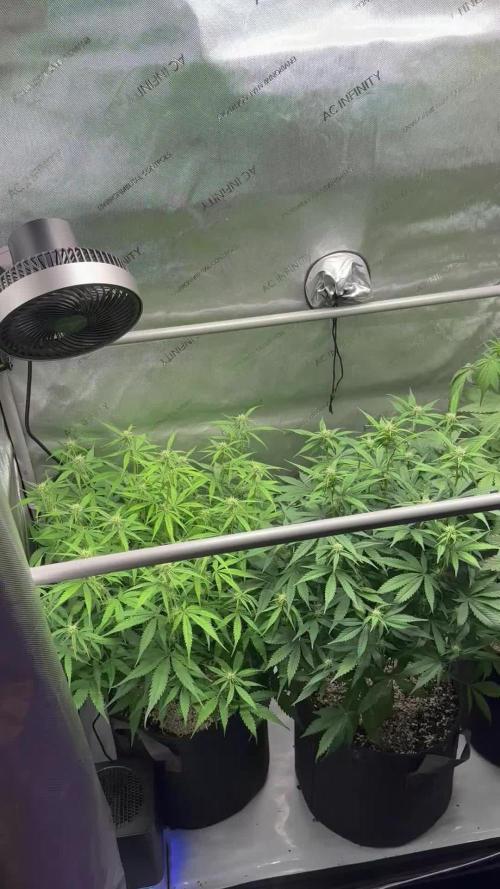
This Starwberry Gorilla Auto is getting huge on me just under 30 inches tall at this point and flowers are starting to come in beautifully. Little worried about high humidity right now but I just may need to get a better dehumidifier for the tent 💚
This is the way
Likes
119
Share


@JamMAKEcan
Follow
She has been terminated and is now drying.. Next report will give review
Have fun
Stay safe
Growers❤️💯💯
All the way babie


Likes
42
Share


@Ukfarmer420
Follow
Hi guys entering week 7 veg on the scrog grow of strawberry chemdawg og and blackberry moonrocks under the marshydro sp3000.
There very small considering there on week 7 🤔 but now i realised that my light has been on 25% 🤣🤣🤣 now its on 50% until nov 1st when I flip it.


Likes
51
Share

@nonick123
Follow
Día 85 (13/01) CBD Auto 20:1 #1 - Los cogollos se siguen formado y engordando. Muy sativa!
Es un poco misterio saber cuando estará lista!
Día 86 (14/01) CBD Auto 20:1 #1 - Cogollos engordando y poniendose duros!
Día 87 (15/01) CBD Auto 20:1 #1 - Se va la luz de mi casa durante 3,5 horas y la temperatura baja a 14,5 ºC... A ver como le afecta
Día 88 (16/01) CBD Auto 20:1 #1 - Retiro algunas hojas de abanico amarillas por senescencia. Los cogollos siguen engordando 😁
Día 89 (17/01) CBD Auto 20:1 #1 - Nunca tuve una Auto con tanto tiempo de vida. ¿Alguien tiene alguna idea de cuando acabará? 😵
Día 90 (18/01) CBD Auto 20:1 #1 - Busy day
Día 91 (19/01) CBD Auto 20:1 #1 - Muchas hojas de abanico amarillentas! Parece que se acerca la senescencia!
FastBuds 15% DISCOUNT code "NONICK" 2fast4buds.com @fast_buds_official_ @fastbuds.official
💦 BioTabs 15% DISCOUNT code "GDBT420" biotabs.nl/en/shop/ @biotabs_official
🌱Substrate PRO-MIX HP BACILLUS + MYCORRHIZAE @promixmitch @promixgrowers_unfiltered
💡2 x Mars Hydro FC1500 EVO Led Grow Light (2024 NEW FC 1500-EVO Samsung LM301H 150W LED) - https://marshydro.eu/products/fc1500-evo-led-grow-lights/ - https://www.amazon.de/dp/B0CSSGN5D8?ref=myi_title_dp


Likes
16
Share


@Naturalist
Follow
Runoff PPMs are at 876/pH 5.9 average last watering, so back in range
Gelatos are stretched to 32" now LSDs remain 24"
Gelato kolas are starting to show color.



Likes
15
Share


@Black_Widow
Follow
Привет садоводы
Четвертая неделя и пурпурный цветет
сегодня я полил ее простой водой , Bio Bloom и Fulvic
удалил некоторые испорченные листья в глубине куста
Проводишь пальцами по листьям и остается запах какойто лаванды , но в тоже время понимаешь , что пахнет виноградом , черным, изабелла сорт
Likes
42
Share

@Master_weeda
Follow
Bonjour à tous les padawans et les maîtres jedis
Cette plante est vraiment exceptionnelle! Elle représente la force et j'en suis fier 😍
La semaine 4 est déjà la ! Ma plante est saine le LST ce passe relativement bien je l'ajuste tout les jour je le combine avec la technique du pincage d'Apex cela me permettra d'avoir une canopé plus homogène donc une meilleure pénétration lumineuse et par conséquent un meilleur rendement.
Le pinçage est une pratique courante en horticulture.
Beaucoup de cultivateurs l'utilisent pour améliorer le rendement de leurs plantations cannabiques ou autres.
Il est souvent question de 'taille' des bourgeons apicaux.
Cette taille se pratique également mais il n'est plus alors, à proprement parler, question de pinçage.
A l'instar d'une taille, le pinçage va permettre de stimuler le développement des ramifications tout en préservant les sommités en vue de la floraison.
Il est très utile pour uniformiser une canopée.
Pour réaliser le pinçage, il vous suffit de presser 'fermement' la tige [entre le pouce et l'index] aux environs de l'apex jusqu'à sentir un léger 'crAck'.
Cela aura pour résultat d'endommager les vaisseaux impliqués dans la circulation de la sève [situés dans le pourtour de la tige], la tige conserve toutefois une certaine rigidité.
Pour obtenir le même résultat, il est également possible de vriller légèrement la tige sur elle-même.
L'interruption du circuit d'alimentation entre le ou les apex et le reste du plant va provoquer un déséquilibre hormonal qui aura pour conséquence le développement des ramifications antérieures au point de pinçage.
Jour 25 j'arrose mon pot normalement avec un quart de son volume en eau toujours avec un PH de 6.3 à cette eau j'ajoute 0.7 gramme de greenhouse feeding enhancer pour favoriser son développement racinaire.
Par la suite je n'aurai plus qu'à ajuster mon LST jusqu'au stretch et surveiller mon arrosage, Je pincerai mes apex suivant la pousse de la plante pour uniformiser la canopé.
Petit rappel de ce que est le LST et comment le pratiquer le plus efficacement possible:
Quand commencer à appliquer la technique LST
De nombreux cultivateurs commencent la manipulation dés que les plantes possèdent entre 3 et 6 nœuds ou une paire de feuilles. Durant cette première étape de la croissance, le tronc encore flexible est pliable sans risque qu’il ne se casse, même si au fur et à mesure du développement de la plante il sera de plus en plus difficile de le plier. Nous pouvons continuer à guider la croissance des branches durant toute la culture, même durant la floraison, ce qui pour cette étape représente un grand avantage face à la taille, qui n’est pas du tout recommandé une fois que la formation des têtes commence, cela stressera en effet la plante, ce qui aura pour effet de retarder la récolte.
Comment appliquer la technique de guidage LST
Si nous sommes prudents, la flexibilité naturelle des fibres du cannabis permet de plier leur tronc et branches avec une relative facilitée, même durant la floraison des plantes.
En utilisant une corde fine, nous pouvons accrocher la pointe de la plante à la base du pot par exemple ou à un tuteur que nous aurons planté dans le substrat. Nous plierons le tronc avec précaution et nous le fixerons avec la corde, à partir de là, nous pouvons augmenter progressivement la tension de la corde, chaque jour un peu plus, jusqu’à obtenir la position souhaitée. Soyez attentif à la réaction de la plante, essayez de ne pas appliquer trop de pression sur la corde et rappelez-vous que la flexibilité des branches peut varier d’une plante à l’autre.
Pour obtenir de meilleurs résultats, il suffit de suivre quelques règles simples. Pour commencer, nous devons choisir une corde fine mais pas trop pour ne pas blesser les troncs au fur et à mesure qu’ils grandissent et qu’ils deviennent plus gros.
Nous pouvons utiliser des crochets en plastique souple ou de n’importe quelle autre matière flexible pour éviter d’endommager les plantes. Spécialement en intérieur, utiliser des cordons en plastique de couleur (voir les diaries de @Silky) est très pratique pour voir facilement les accroches et faciliter le travail au milieu du réseau formés par les cordes, les tuteurs, les mailles ou les supports que nous aurons dans la culture. Bien entendu, en culture extérieure et surtout en guerilla nous ferons juste le contraire et nous utiliserons des matériaux de couleur qui n’attirent pas l’attention pour que notre jardin reste discret.
Pour stresser les plantes au minimum, la mieux est de réaliser ces manipulations le soir ou juste après que les lampes en intérieur s’éteignent, ce qui leur permettra de se remettre durant la nuit. Normalement, le jour suivant nous pourrons observer comme les pointes des branches que nous avons pliées se dressent de nouveau vers le haut à la recherche d’une source de lumière.
Je combine un pincage d'Apex (explications plus haut) au LST cela me permettra d'avoir une canopé plus homogène donc une meilleure pénétration lumineuse et par conséquent un meilleur rendement.
Que la force soit avec vous 💪

Likes
144
Share


@roro_204
Follow
I received the clones from An out of province breeder.
It reached me after three days of driving on the road with no light. Their future was not certain.
I didn’t think I would need that many fans for the clones because they are so tiny, I figured they didn’t need that much maintenance.
I was 100% wrong when I’m working with this many plants.
I ended up getting mild mildew on top of the soil on the first week because there was barely any air circulation.
At this point I didn’t have any Ventilation put up yet. And one fan on the floor. I ended up installing three fans in one room. No issues


Likes
21
Share


@TechDCo
Follow
23/04/2025
Lights On! Sprayed walls 6%HP/L sprayed Domes 0.05% HP/L
Pulled backwards MS with tape to try and shape her.
23/04/2025
Lights Off!
25/03/2025
Lights On!
Placed seedlings in the 5L starting cans.
Lights Off!
Check the VT me like the old me!
26/03/2025
Midday!
27/03/2025
Lights On!
28/03/2025
Lights Off!
30/03/2025
Lights On! Defolled!
Switch to flower in 4days. I need to setup the sativa tent in loft!
Midday! Increased light: 460watts they perked up and are praying!
- "If the truth perished, it'll still stand true that the truth perished"
Likes
15
Share


@SmokingTiki
Follow
This week was half sunny and half cloudy. I increased a bit the Bio-Bloom and the plant looks nice.
Likes
84
Share


@TragicTerps
Follow
Easy harvest single plant super dense and honestly it couldn't have gone smoother. I am debating removing the popcorn bud or revegging it... either way the main tops were the biggest buds I've harvested yet covering my entire palm.
I will be growing this in the future I won't log the grow however. This pheno I believe is one of a kind and I likely won't be as pleased with a second run.
The sungro#4 I grew in was excellent too and honestly I am seeing the relation between quality and the medium being used. I will be using this medium for a while.
Until the final dry weight is In, Happy Growing and Happy Toking!
-TRAGIC OUT-
Update water curing was the best end result and will be the way I cure all my flower.

Likes
74
Share


@JieGrow
Follow
These girls have been thriving and growing at a fast rate🐎😬 we started the girls on canna a&b on a feed - break - feed ratio using nutes with every feeding 😬
The girls got 5 nodes and I was going to wait till the 6th node appeared but decided to top just now, as you can see in the photo, this is where I cut making sure to leave some stalk in between the nodes just to make sure the new growth sites do not get damaged👌🏻
The reason we top is because by damaging the main stem, topping encourages the plant to spread energy growing many colas instead of just one ☝️... and you can never have enough colas😎
That’s all i can report this week guys! Hope you all had a wonderful week, I’ll see yous next time😎
Welcome to JIEGROW 😄
