Likes
Comments
Share
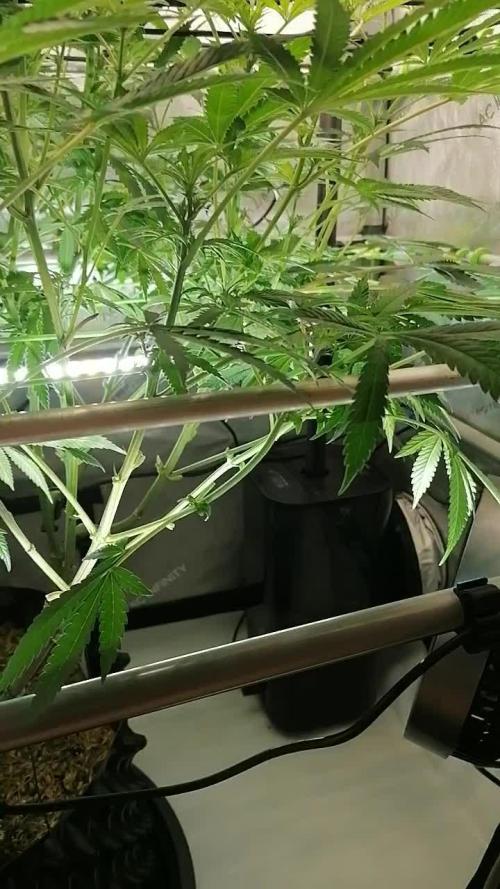
The double kush cake has gone through stress with a little bit of bleached leaves and red veins heat spots on the leaves all due to heat stress which has caused her to stunt So I have relocated her to her original spot as it is cooler. She is still growing under the light distance of 60cm. The double kush cake is receiving 100ml of fluids every three days she stands approximately 52cm from the soil.
Likes
4
Share
@Dirizhor
Follow
So I cut top colas last week. And managed to get some nice looking buds, still up to 30% of those afected by white mold. They dried up and mold is not growing in the buds, don't know if I still can dosomething with them? Smokycylin? Pinicidope? ))) maybe I canbake them in to gurme cookies? The rest of the plant as seen on this week videos was saved. It looks ready, smells like crazy, sticks like gorilla glue) Thera quite a share of amber trychoms, and even thos couple of self prodused ceeds look ripe. So I think it's time. My plan is to keep it over this weekend. Then give it a 24 hour of darkness and then chop chop. Should I try longer darkness period? 2 days, 3 days, more? Is it doing any good? If some one has experience please send me an advice. Thanks for reading Happy growing!
Likes
95
Share
@Canna96
Follow
Hey now, this week was a little rough for the Cream Mandarine auto, but it was my fault. I went out of town for 6 days and by the time I got back this morning, the EC had risen way too high due to evaporation in my reservoirs, and some of her leaves had little brown spots from the EC being too high. I could even see the spots on my live feed, but nothing I could do until I got back as I was seeing Phish down south. I flushed her this morning with about 2 gallons of water which dropped the EC of the runoff way back down to about .8, so I will resume normal feeding and see what happens. Other than than that she seems to be stacking buds very nicely and is developing a very nice smell. I believe she has another week or two to stack before she starts ripening. Next time I go away I'm going to start with the EC about .3 lower to compensate for evaporation. Thanks for stopping by, I hope everyone has a great weekend, be safe and blaze on!
Likes
28
Share
@Salgeezi
Follow
Ended up cutting all of the front left plant this week and majority of the back two plants. Guna let the lowers get some light for a few more days. Really noticing all the tiny ass buds. Hopefully I'll make something out of them. First run with a net and I just left way too many branches/bud sites for this size of plants they were. Buds look good though. Flushing last plant and will be cutting in a few days.
Likes
44
Share
@Mr_Pgrow
Follow
Another wonderful auto to run and what a terp monster she turned out to be. Every square inch of her was covered in trichomes. Her yield is impressive, Weighting in a 73g of flower and 23.9g of trim. Overall very pleased, some of the best stash I have grow.... so far !!!! Peace ✌️ Mr.PersonalGrow Follow me here https://www.theweedtube.com/user/Mr.PersonalGrow
Processing
Likes
12
Share
@Tazard
Follow
We have a very full tent! Taz’s jungle 😂🤣. Check out the purple purple photos from day 20!!! Everyone looks absolutely beautiful I’m hoping that the white critical will be ready in 4-5 weeks. She’s going to have some fat colas!
Likes
2
Share
Welcome to Veg Week 1 of Sensi Seeds Karate Kid I'm excited to share my grow journey with you from my Sensi Seeds Project . It's going to be an incredible ride, full of learning, growing, and connecting with fellow growers from all around the world! For this Project , I’ve chosen the Feminized Photo Strain Karate Kid : Here’s what I’m working with: • 🌱 Tent: 120x60x80 • 🧑‍🌾 Breeder Company: Sensi Seeds • 💧Strain Info : 25-33% • ⏳ Flowering Time: 8-10weeks
Likes
13
Share
@Canadian
Follow
I will continue to update once they are dry and ready for cure . I have cut down in jar everything the wait was 114 grams please consider that when it comes to my weight I wait until the main stem breaks with a loud crunch and the buds are really dry to the touch reason for it I have a very busy life and at the end of the day this is just a hobby so I cannot be opening those jars many times a day at most one in the morning and one in the night so I want to avoid mold on them so I push in a Boveda pack to keep them nice . I will update with flavours and other details once I try it I've I have been smoking a different strain that I will review today . After 4 weeks curing in jars the smoke it is very smooth very nice taste like tropical citrusy with a hint of skunk buds are very smelly and hybrid density to them very enjoyable to have . thank you for reading have a happy grow
Likes
30
Share
Very happy with this strain and pheno, amazing results. A great find ! She grew like a dream from start to finish. Pharma labs test results in at 24% thc. Bravo Serious seeds ! Great work as usual !
Processing
Likes
65
Share
She has been on 12/12 for 2 weeks now and starting to flower. She is one of the slower ones to transition but making progress. I raised the light a little to try to get some stretch on her for more open bud structure. Couldn't be happier with how these 6 girls are playing well together so far. Going to start them on some liquid Koolbloom next week. Nutrients per gallon .5 tsp maxibloom .25 tsp maxigro .5 tsp calimagic .25 tsp armor si .1 tsp 90/10 humic/fulvic acid.
Likes
52
Share
Lacewings seemed to have mostly killed themselves by flying into hot light fixtures. I may have left the UV on which was smart of me :) Done very little to combat if anything but make a sea of carcasses, on the bright side its good nutrition for the soil. Made a concoction of ethanol 70%, equal parts water, and cayenne pepper with a couple of squirts of dish soap. Took around an hour of good scrubbing the entire canopy. Worked a lot more effectively and way cheaper. Scorched earth right now, but it seems to have wiped them out almost entirely very pleased. Attempted a "Fudge I Missed" for the topping. So just time to wait and see how it goes. Question? If I attached a plant to two separate pots but it was connected by rootzone, one has a pH of 7.5 ish the other has 4.5. Would the Intelligence of the plant able to dictate each pot separately to uptake the nutrients best suited to pH or would it still try to draw nitrogen from a pot with a pH where nitrogen struggles to uptake? Food for stoner thought experiments! Another was on my mind. What happens when a plant gets too much light? Well, it burns and curls up leaves. That's the heat radiation, let's remove excess heat, now what? I've always read it's just bad, or not good, but when I look for an explanation on a deeper level it's just bad and you shouldn't do it. So I did. How much can a cannabis plant absorb, 40 moles in a day, ok I'll give it 60 moles. 80 nothing bad ever happened. The answer, finally. Oh great........more questions........ Reactive oxygen species (ROS) are molecules capable of independent existence, containing at least one oxygen atom and one or more unpaired electrons. "Sunlight is the essential source of energy for most photosynthetic organisms, yet sunlight in excess of the organism’s photosynthetic capacity can generate reactive oxygen species (ROS) that lead to cellular damage. To avoid damage, plants respond to high light (HL) by activating photophysical pathways that safely convert excess energy to heat, which is known as nonphotochemical quenching (NPQ) (Rochaix, 2014). While NPQ allows for healthy growth, it also limits the overall photosynthetic efficiency under many conditions. If NPQ were optimized for biomass, yields would improve dramatically, potentially by up to 30% (Kromdijk et al., 2016; Zhu et al., 2010). However, critical information to guide optimization is still lacking, including the molecular origin of NPQ and the mechanism of regulation." What I found most interesting was research pointing out that pH is linked to this defense mechanism. The organism can better facilitate "quenching" when oversaturated with light in a low pH. Now I Know during photosynthesis plants naturally produce exudates (chemicals that are secreted through their roots). Do they have the ability to alter pH themselves using these excretions? Or is that done by the beneficial bacteria? If I can prevent reactive oxygen species from causing damage by "too much light". The extra water needed to keep this level of burn cooled though, I must learn to crawl before I can run. Reactive oxygen species (ROS) are key signaling molecules that enable cells to rapidly respond to different stimuli. In plants, ROS plays a crucial role in abiotic and biotic stress sensing, integration of different environmental signals, and activation of stress-response networks, thus contributing to the establishment of defense mechanisms and plant resilience. Recent advances in the study of ROS signaling in plants include the identification of ROS receptors and key regulatory hubs that connect ROS signaling with other important stress-response signal transduction pathways and hormones, as well as new roles for ROS in organelle-to-organelle and cell-to-cell signaling. Our understanding of how ROS are regulated in cells by balancing production, scavenging, and transport has also increased. In this Review, we discuss these promising developments and how they might be used to increase plant resilience to environmental stress. Temperature stress is one of the major abiotic stresses that adversely affect agricultural productivity worldwide. Temperatures beyond a plant's physiological optimum can trigger significant physiological and biochemical perturbations, reducing plant growth and tolerance to stress. Improving a plant's tolerance to these temperature fluctuations requires a deep understanding of its responses to environmental change. To adapt to temperature fluctuations, plants tailor their acclimatory signal transduction events, specifically, cellular redox state, that are governed by plant hormones, reactive oxygen species (ROS) regulatory systems, and other molecular components. The role of ROS in plants as important signaling molecules during stress acclimation has recently been established. Here, hormone-triggered ROS produced by NADPH oxidases, feedback regulation, and integrated signaling events during temperature stress activate stress-response pathways and induce acclimation or defense mechanisms. At the other extreme, excess ROS accumulation, following temperature-induced oxidative stress, can have negative consequences on plant growth and stress acclimation. The excessive ROS is regulated by the ROS scavenging system, which subsequently promotes plant tolerance. All these signaling events, including crosstalk between hormones and ROS, modify the plant's transcriptomic, metabolomic, and biochemical states and promote plant acclimation, tolerance, and survival. Here, we provide a comprehensive review of the ROS, hormones, and their joint role in shaping a plant's responses to high and low temperatures, and we conclude by outlining hormone/ROS-regulated plant-responsive strategies for developing stress-tolerant crops to combat temperature changes. Onward upward for now. Next! Adenosine triphosphate (ATP) is an energy-carrying molecule known as "the energy currency of life" or "the fuel of life," because it's the universal energy source for all living cells.1 Every living organism consists of cells that rely on ATP for their energy needs. ATP is made by converting the food we eat into energy. It's an essential building block for all life forms. Without ATP, cells wouldn't have the fuel or power to perform functions necessary to stay alive, and they would eventually die. All forms of life rely on ATP to do the things they must do to survive.2 ATP is made of a nitrogen base (adenine) and a sugar molecule (ribose), which create adenosine, plus three phosphate molecules. If adenosine only has one phosphate molecule, it’s called adenosine monophosphate (AMP). If it has two phosphates, it’s called adenosine diphosphate (ADP). Although adenosine is a fundamental part of ATP, when it comes to providing energy to a cell and fueling cellular processes, the phosphate molecules are what really matter. The most energy-loaded composition for adenosine is ATP, which has three phosphates.3 ATP was first discovered in the 1920s. In 1929, Karl Lohmann—a German chemist studying muscle contractions—isolated what we now call adenosine triphosphate in a laboratory. At the time, Lohmann called ATP by a different name. It wasn't until a decade later, in 1939, that Nobel Prize–-winner Fritz Lipmann established that ATP is the universal carrier of energy in all living cells and coined the term "energy-rich phosphate bonds."45 Lipmann focused on phosphate bonds as the key to ATP being the universal energy source for all living cells, because adenosine triphosphate releases energy when one of its three phosphate bonds breaks off to form ADP. ATP is a high-energy molecule with three phosphate bonds; ADP is low-energy with only two phosphate bonds. The Twos and Threes of ATP and ADP Adenosine triphosphate (ATP) becomes adenosine diphosphate (ADP) when one of its three phosphate molecules breaks free and releases energy (“tri” means “three,” while “di” means “two”). Conversely, ADP becomes ATP when a phosphate molecule is added. As part of an ongoing energy cycle, ADP is constantly recycled back into ATP.3 Much like a rechargeable battery with a fluctuating state of charge, ATP represents a fully charged battery, and ADP represents a "low-power mode." Every time a fully charged ATP molecule loses a phosphate bond, it becomes ADP; energy is released via the process of ATP becoming ADP. On the flip side, when a phosphate bond is added, ADP becomes ATP. When ADP becomes ATP, what was previously a low-charged energy adenosine molecule (ADP) becomes fully charged ATP. This energy-creation and energy-depletion cycle happens time and time again, much like your smartphone battery can be recharged countless times during its lifespan. The human body uses molecules held in the fats, proteins, and carbohydrates we eat or drink as sources of energy to make ATP. This happens through a process called hydrolysis . After food is digested, it's synthesized into glucose, which is a form of sugar. Glucose is the main source of fuel that our cells' mitochondria use to convert caloric energy from food into ATP, which is an energy form that can be used by cells. ATP is made via a process called cellular respiration that occurs in the mitochondria of a cell. Mitochondria are tiny subunits within a cell that specialize in extracting energy from the foods we eat and converting it into ATP. Mitochondria can convert glucose into ATP via two different types of cellular respiration: Aerobic (with oxygen) Anaerobic (without oxygen) Aerobic cellular respiration transforms glucose into ATP in a three-step process, as follows: Step 1: Glycolysis Step 2: The Krebs cycle (also called the citric acid cycle) Step 3: Electron transport chain During glycolysis, glucose (i.e., sugar) from food sources is broken down into pyruvate molecules. This is followed by the Krebs cycle, which is an aerobic process that uses oxygen to finish breaking down sugar and harnesses energy into electron carriers that fuel the synthesis of ATP. Lastly, the electron transport chain (ETC) pumps positively charged protons that drive ATP production throughout the mitochondria’s inner membrane.2 ATP can also be produced without oxygen (i.e., anaerobic), which is something plants, algae, and some bacteria do by converting the energy held in sunlight into energy that can be used by a cell via photosynthesis. Anaerobic exercise means that your body is working out "without oxygen." Anaerobic glycolysis occurs in human cells when there isn't enough oxygen available during an anaerobic workout. If no oxygen is present during cellular respiration, pyruvate can't enter the Krebs cycle and is oxidized into lactic acid. In the absence of oxygen, lactic acid fermentation makes ATP anaerobically. The burning sensation you feel in your muscles when you're huffing and puffing during anaerobic high-intensity interval training (HIIT) that maxes out your aerobic capacity or during a strenuous weight-lifting workout is lactic acid, which is used to make ATP via anaerobic glycolysis. During aerobic exercise, mitochondria have enough oxygen to make ATP aerobically. However, when you're out of breath and your cells don’t have enough oxygen to perform cellular respiration aerobically, the process can still happen anaerobically, but it creates a temporary burning sensation in your skeletal muscles. Why ATP Is So Important? ATP is essential for life and makes it possible for us to do the things we do. Without ATP, cells wouldn't be able to use the energy held in food to fuel cellular processes, and an organism couldn't stay alive. As a real-world example, when a car runs out of gas and is parked on the side of the road, the only thing that will make the car drivable again is putting some gasoline back in the tank. For all living cells, ATP is like the gas in a car's fuel tank. Without ATP, cells wouldn't have a source of usable energy, and the organism would die. Eating a well-balanced diet and staying hydrated should give your body all the resources it needs to produce plenty of ATP. Although some athletes may slightly improve their performance by taking supplements or ergonomic aids designed to increase ATP production, it's debatable that oral adenosine triphosphate supplementation actually increases energy. An average cell in the human body uses about 10 million ATP molecules per second and can recycle all of its ATP in less than a minute. Over 24 hours, the human body turns over its weight in ATP. You can last weeks without food. You can last days without water. You can last minutes without oxygen. You can last 16 seconds at most without ATP. Food amounts to one-third of ATP production within the human body.
Likes
1
Share
So it's time to harvest Russian machine guns. The plants were high because we pulled them with a lamp and did not use LST. The final product was removed on the shelf of the refrigerator.00
Likes
Comments
Share
Vamos familia, actualizamos la cuarta semana de crecimiento de estas Sagrada amnesia de Seedstockers, salieron las 5 de 5, 100% ratio éxito. Aplicamos varios productos de Agrobeta, que son increíbles para aportar una buena alimentación a las plantas. Temperatura y humedad dentro de los rangos correctos dentro de la etapa de crecimiento. La tierra utilizada es al mix top crop, por cambiar. De 5 ejemplares seleccioné los 3 mejores para completar el indoor y trasplanté directamente a macetas de 7 litros y aplique tetra 9 vía foliar, se ven bien sanas las plantas, tienen un buen color y progresan a muy buen ritmo por el momento. Agrobeta: https://www.agrobeta.com/agrobetatiendaonline/36-abonos-canamo Hasta aquí todo, Buenos humos 💨💨💨
Likes
8
Share
@Dmon013
Follow
The last week before cutting, I still fertilized for the last week, I focused on the expressway sugar and the loading of carbohydrates well. Still No-till Living soil Microorganisms 💚
Likes
132
Share
Hi all👨‍🌾👋 Welcome to my another week update Hope everyone keeping well 🧑‍🌾 Week 5 Mar 1 - Mar 7 What a joyful grow. Both girls are almost like twins. Super healthy and strong. Girls are in pre-flower and going head to head in development. Not expecting them to grow super tall but time will show. Considering to let them grow freely and not installing scrog net. This idea may change in coming days. 2 waterings of 2.5 l on Mar 2+ foliar feeding and second in Mar 7. May take another week before first runoff experience. Continously leaves tucking. Girls are responding perfectly to feeding like also to my LST. I am very happy and excited of what's to come 😁🧑‍🌾 Wishing you all a wonderful rest of the week✨🍀 Much appreciate all your likes, follows and comments. 🙏💚❤️💜 Peace and love brothers and sisters 👨‍🌾✌️💚 Stay tuned for new week update soon Links https://2fast4buds.com/seeds/TROPICANA-COOKIES-AUTO https://www.biobizz.com/ https://fishheadfarms.com/
Likes
9
Share
Para ser la primera vez que cultivo no puedo quejarme, pero si alguien me pudiese ayudar
Likes
1
Share
6/24/25 she is frosty and stacking incredibly well. everything in my tent right now is exceeding any and all expectations and i feel blessed.