Likes
Comments
Share
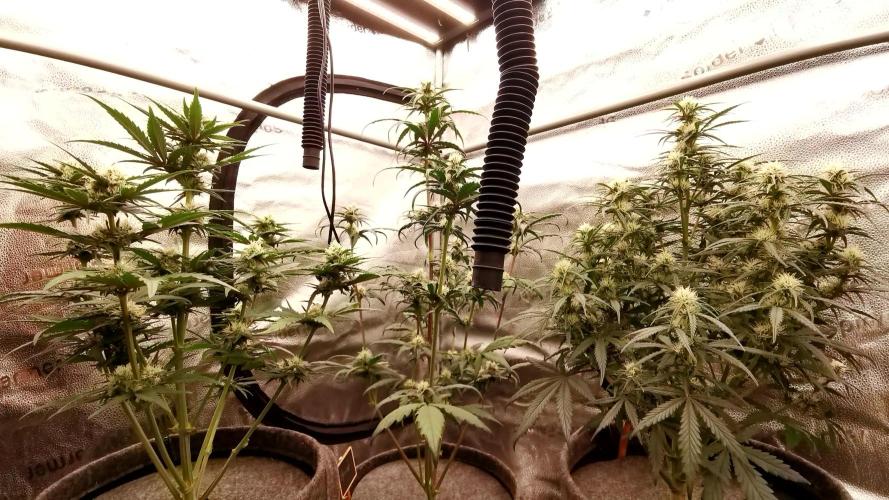
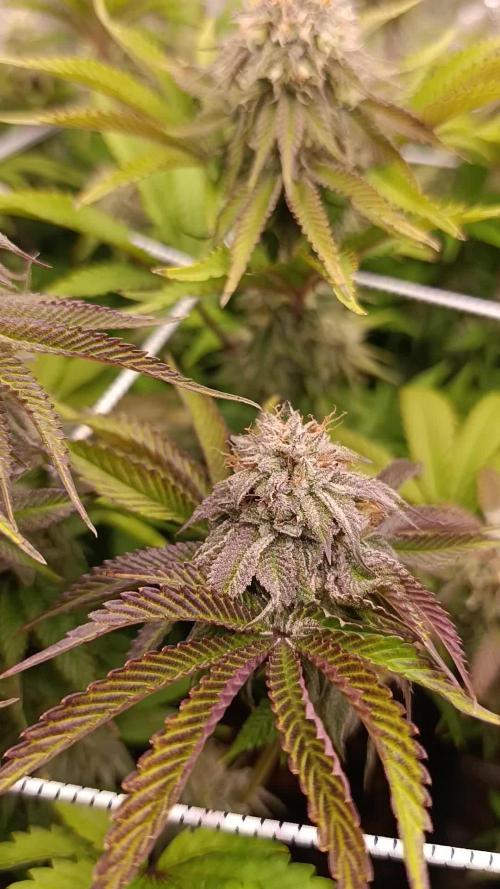
Rainbow belts are down and now it's just the landraces. Zed black is looking to show some toxicities from the flowering feed I use once a week. I definitely think it's an overfeed of nitrogen. In the future I'll keep note. Other than some minor tox the plants are doing great. Some foxtailing is beginning but so far nothing major Hash plants are chugging along perfectly fine. No toxicities or issues. Very easy plants to grow. A few of these are also giving me a really nice yield.
Likes
16
Share
Questa settimana ho bagnato al giorno 10 con un po di root per la stimolatura. Vediamo come procede , fino ad ora è tutto perfettamente sotto controllo . Ci vediamo tra 7 giorni ,pace e amore da un coltivatore 🇮🇹
Likes
38
Share
She’s got a lovely gassy sweet smell.
Likes
8
Share
@Dunk_Junk
Follow
She's doing OK, certainly not jumping up in height though.
Likes
1
Share
Likes
2
Share
We become aware at such times of man's wonderful ability to bring seemingly unrelated elements into harmonic balance, and receive a glimpse into a world where everything exists in conscious sympathetic attunement to everything else. When we listen to a piece of music that seems to strike a beautiful chord somewhere inside us, or view a painting that simply glows with harmonic awareness well executed, we probably do not spare much time to contemplate the wonderfully intricate combination of vibrations that our sensors make it possible for us to perceive. We tend to appreciate the relationship between the parts of something by an awareness of the harmony or dissonance of the whole. This ability enables us to say "what a beautiful house!" instead of "analysis has proven that this collection of building materials exhibits certain elements of harmonic proportion." While this ability to instinctively appreciate the beauty of true harmony has an important role to play in evolution, a more analytical understanding of the laws involved can be most useful. This is especially so if we wish to create works of art where each part exists in true harmony, not only with the other part of that particular whole, but with the universe within which the creator and the created exist. Everything vibrates. From the most dense matter to the most subtle cosmic rays, everything which our senses allow our thoughts to become aware of, can be specified in terms of wavelength or frequency of vibration. These two terms define the same thing, but from different points of view. The following are the approximate wavelengths of various energy carriers: Cosmic rays 0.000,000,001 mm Gamma rays 0.000,000,1 mm X rays 0.000,500 mm Ultraviolet rays 0.003 mm Visible light 0.006 mm Infrared 0.01 mm Sound waves 1 meter Radio waves 300 meters Violet light 400 nm to 450 nm Blue light 450 nm to 500 nm Green light 500 nm to 570 nm Yellow light 570 nm to 590 nm Orange light 590 nm to 610 nm Red light 610 to 700 nm 1 nanometer (nm) = 0.000,000,1 cm = 1/10,000,000 cm If a guitar string is plucked and we hear a sound, it is not too difficult for the human mind to associate this sound with the vibration of the guitar string. With color it is quite different. It is difficult for us to conceive that the color of a substance is not an inherent property of the substance itself, but an indication picked up by our senses of that substance's ability to absorb or reflect the light which happens to be shining on it at that moment. Neither the matter nor the light is colored. What happens is that the brain learns to differentiate between the frequencies reflected or transmitted by the substance the eyes are focused on. The same thing happens with sound. When we say "Oh! Listen, they're playing my favorite song," what we really mean is: "My brain has stored within it a particular pattern of frequencies. I have compared the new information being received with this stored pattern and have deduced the answer that the two patterns are similar within certain specified tolerances." The 'pleasure' involved could have something to do with our running the pre-recorded pattern at the same time, in 'sympathy' with the new pattern as it is received. The word sympathy describes very well our ability to appreciate color and sound. It also describes the reason behind certain elements of harmony. For instance, if a substance vibrating at 100 cycles per second (tone 1) is in the proximity of another substance vibrating at 200 cycles per second (tone 2), we could perceive, if we had the right equipment, a certain sympathetic relationship between the two. We will see from this that there is a uniform doubling of the first tone seen in the second. At various points along the waves, the two are the same in amplitude. At other points, they are at opposite poles to each other. This doubled frequency has more points of similarity to the original than any other frequency except the original itself. If the equipment we had available for measuring these two frequencies was a soundboard amplifier and a pair of ears, then we would hear what would sound to us like one tone. If we had the opportunity to hear one at a time, we would hear that although they sound the same, one is higher in pitch than the other. This characteristic of 'the same but different in pitch', musicians have called the octave. Any two tones produced where one has exactly doubled the frequency of the other is called an octave. Speaking in ratios, an octave would appear then as the ratio 2:1 or 1:2, depending on whether we are talking of an octave up or down. A single note produced by almost any instrument will contain more than one wavelength or frequency. It will have a dominant frequency, the wavelength of which we would call the note's 'fundamental' or 1st harmonic. It will also have a varying number of upper harmonics, gradually fading in intensity into infinity or silence. Natural harmonics always have the same pattern of intervals between them. The interval between the 1st and 2nd harmonic is a perfect octave; between the 2nd and 3rd a perfect fifth; between the 3rd and 4th a perfect 4th; and so on, the intervals becoming smaller and smaller until they lose any relationship with the western 12 tone scale as it exists at the moment. Just as an octave has certain elements of sympathy with its fundamental, so some intervals have been noted to be more perfectly in sympathy with the fundamental than others. The ratio of the 'perfect 5th' or interval of 7 semitones, as it occurs in the harmonic series, is 3:2 or 2:3, while that of the 'perfect fourth" is 4:3 or 3:4. All the tones in the western 12 tone scale can be expressed in terms of the ratio between the upper tone and its fundamental. This would seem to be an ideal way of generating a scale from any given fundamental and several attempts have been made to do this, the Pythagorean system being probably the most well known. Although when working with a single tone instrument playing on its own, the Pythagorean formula works wonderfully well, if we had several instruments tuned this way together and asked them to play almost any western music, we would find that at times they sounded quite out of tune to each other. The lack of flexibility of the various scale systems based on the harmonic series has led to what is known as the 'tempered' scale. This uses as its primary unit of interval the ratio of the octave or 2:1. It then proceeds to divide the interval between any fundamental and its upper octave into 12 smaller intervals by applying the ratio: two to the one-twelfth power, to one (21/12:1). This equals 1.059463094, so by multiplying any frequency by this number, we will obtain the tempered semitone next up from our fundamental. We will also find that any tone twelve semitones up from any other tone, in a scale generated in this way, will have exactly double the frequency. If we took the note middle C on a piano and halved the wavelength, we would have the note C one octave above. If we halved this, we would have the C above, and so on. However, within about 6 octaves, we would find that although a 'sound' was being produced, no human ear could perceive it. If we kept on going, halving and producing upper octaves of our fundamental C, we would proceed through the infrared band, into the visible light spectrum. If we happened to be outside during the day, we would, for one octave only, see the note C with our eyes. The next octave above would already be in the ultraviolet band, and outside the eye's sensitivity range. If we can think of color as being an indication of a substance's vibratory rate or wavelength, we may begin to see a relationship that could exist between the color and sound spectrums. The logical extension of what has so far been said is that there exists a scale in the color spectrum that corresponds exactly to the scale in the sound spectrum, each color tone being an octave of the equivalent note in the sound range. This is not the end of the story but only the beginning. If we can for the moment accept that any wavelength in one band has upper and lower octave stretching out to infinity, then the next question is 'fine, but what shall we use as our fundamental? A particular color? A particular sound frequency?' The musicians among us will probably say 'A 440'. This means that the note A should vibrate at 440 Hertz, or 440 times per second. They would tell us that this is standard pitch has been adopted by most orchestras around the world; pianos are tuned to it, instruments are constructed to formulas based on it, and so to them it would probably seem the most appropriate place to begin. Some of these musicians may know of the battle that is still raging with regards to this being the standard, but few would know why A = 440 Hz was chosen except that it worked when it was set to be a suitable compromise between the many different pitches in use at the time. 432 Hz is said to be mathematically consistent with the patterns of the universe. Studies reveal that 432 Hz tuning vibrates with the universe’s golden mean PHI and unifies the properties of light, time, space, matter, gravity, and magnetism with biology, the DNA code, and consciousness. When our atoms and DNA start to resonate in harmony with the spiraling pattern of nature, our sense of connection to nature is said to be magnified. Another interesting factor to consider is that the A=432 Hz tuning correlates with the color spectrum, while the A=440 Hz is off. Audiophiles have also stated that A = 432 Hz music seems to be non-local and can fill an entire room, whereas A=440 Hz can be perceived as directional or linear in sound propagation. Once you adopt the idea that sound (or vibration in general) can have an equalizing and harmonizing effect (as well as a disturbing effect), the science of harmony can be applied to bring greater harmony into one's life or tune to specific energies. There is a form of absolute and relative harmony. Absolute harmony can, for example, be determined by the tuning of an instrument. The ancients tuned their instruments at an A of 432 Hz instead of 440 Hz - and for a good reason. There are plenty of music examples on the internet that you can listen to in order to establish the difference for yourself. Attuning the instrument to 432 Hz results in a more relaxing sound, while 440 Hz slightly tenses up the body. This is because 440 Hz is out of tune with both macro and micro cosmos. On the contrary, 432 Hz is in tune. To give an example of how this is manifested microcosmically: our breath (0,3 Hz) and our pulse (1,2 Hz) relate to the frequency of the lower octave of an A of 432 Hz (108 Hz) as 1:360 and 1:90. It is interesting to note that 432 Hz was the standard pitch of many old instruments and that it was only recently (19th and 20th century) the standard pitch was increased. This was done in order to be able to play for bigger audiences. Bigger audiences (more bodies) absorb more of the lower frequencies, so the higher pitch was more likely to “cut through”. One of the oldest instruments of the world is the bell ensemble of Yi Zeng (dated 423 BC), tuned to a standard F4 of 345 Hz, which gives an A= 432 Hz. The frequency of 345 Hz is that of the platonic year! Similarly, many old organs are tuned in A=432 as well; for example, St. Peter’s Capella Gregoriana, St. Peter’s Capella Giulia, S. Maria Maggiore in Rome. Maria Renold’s book “Intervals Scales Tones and the Concert Pitch C=128 Hz” claims conclusive evidence that 440 Hz and raising concert pitch above scientific “C” Prime=128 Hz (Concert A=432 Hz) disassociates the connection of consciousness to the body and creates anti-social conditions in humanity. The difference between concert pitch A=440 Hz and Concert A=432 Hz is only 8 cycles per second, but it is a perceptible difference of awareness in the human consciousness experience of the dream we share called existence.
Likes
6
Share
@artems
Follow
Bad Guy has been through the wringer with me. First, there were issues with the mainlining, so I had to train just one branch. Then, there was nutrient burn, followed by underfeeding. But despite all my mishaps, the plant endured and grew big and strong! 🌿 It still maintains a distinct candy-like aroma, and I can't wait to give it a taste! Overall, it's been a learning experience, and despite the challenges, it's rewarding to see the plant thrive. 🌟 Looking forward to the harvest and enjoying the fruits of my labor! 🍬
Likes
3
Share
Good morning to all growers!! This has been another rewarding week for my eyes but the real satisfaction has yet to begin especially for my nome ;D! The plants are getting very large, the one with the bucket pot has responded very well, the one with the cardboard a little too well and is towering over the others, although the LST is struggling to keep it at bay... While the one with the tissue pot has answered a little badly but he is recovering slowly
Likes
45
Share
144v Lux in tenebris lucet. Aristotle said "It is the mark of an educated mind to be able to entertain a thought without accepting it." Those who are able to refrain from judgement long enough to genuinely research and weigh the evidence from all sides of a given subject are those most likely to arrive at the truth. Those who instantly resort to knee-jerk ridicule and continue to believe whatever they were first taught are those most easily deceived. Very high light intensity can slow vertical growth. She just doesn't want to grow vertically any longer; once the flower is initiated, that goes right out the window. Apical dominance is shattered; you now have every single stem fighting for survival against each other, with none given particular precedence over another. That is some stretch for a week, explosion. Doesn't matter if they are crowded now; there is space up ahead, and plant perception will fill every inch of available space. The divine intelligence that drives plant growth is far more efficient than any canopy I could make or spread myself. No defoliation. Sometimes you just need to give her what she needs to fill the space herself. All I do is guide the initial framework into the desired outcome, keep everything else flowing and in optimal parameters. Fast-growing leaves to have a lighter green color, sometimes appearing almost yellowish-green, because they haven't had time to produce much chlorophyll yet. New leaves are soft and pale, but they will gradually darken and become a deeper green as they mature and are exposed to light. Every morning, new lime green, with the micros supercharged, may be immobilizing nitrogen in the medium, magnesium was creeping in earlier, so I'll try to hold the line and see what progresses. The ratio of sugar leaves to buds is determined by a combination of hormonal signaling, nutrient availability, and genetics. Sugar levels act as a key signaling molecule, with high sugar availability influencing hormones like auxins and cytokinins to promote bud outgrowth, while nutrient deficiencies can limit development. Specific genes also play a critical role in leaf and bud initiation, expansion, and the overall balance of growth. Buds are like balloons! Need lots of pressure to blow up lots of balloons! Sugar balloons! Plant transpiration and turgor pressure are crucial for bud development because turgor pressure provides the cell expansion needed for growth, while transpiration creates a "pull" that draws water and nutrients up through the plant to fuel this process. High turgor pressure is essential for cells to grow and expand, allowing buds to open and young leaves to unfurl. Transpiration maintains this necessary turgor by driving a continuous flow of water from the soil up to the leaves, where it evaporates. No holding back, this is it, 4-5 weeks of all-out war! What we develop now will be all we have for the final 4-5 weeks. The carbon to nitrogen (C:N) ratio indicates how much carbon is in a substance relative to its nitrogen, affecting nitrogen availability in soil through microbial activity. A high C:N ratio (like in straw or corn residue) requires soil microbes to use a significant amount of nitrogen for decomposition, temporarily tying it up and making it unavailable to plants. A low C:N ratio results in a more rapid release of nitrogen for plant use. The carbon-to-sulfur C:S ratio in plant residue determines whether soil microbes will immobilize or mineralize sulfur (S) during decomposition. This affects the availability of sulfate SO42, the primary form of S that plants can absorb. Mineralization is the process by which microbes decompose organic matter and release excess nutrients, like sulfate, into the soil in an inorganic, plant-available form. Immobilization is the reverse process, where microbes absorb inorganic sulfate from the soil to meet their own nutritional needs, making it unavailable to plants. Glucose typically uses more oxygen than sucrose in a medium because it can be metabolized more directly, while sucrose must first be broken down into glucose and fructose, which can involve additional energy costs and a slower overall process. However, the efficiency of oxygen use can vary depending on the specific organism and conditions, as some bacteria, for instance, can use sucrose for a growth advantage under certain circumstances by producing exopolysaccharides that are more efficient at oxygen extrusion. Why glucose is generally more oxygen-efficient: •Glucose is a monosaccharide and can be used directly by many organisms in cellular respiration. •It does not require an initial enzymatic step to break it down before entering the metabolic pathway, unlike sucrose. •Due to its direct use, glucose can lead to a faster rate of oxygen consumption and carbon dioxide production in comparison to sucrose under typical aerobic conditions. Why sucrose might seem to use more oxygen in certain contexts: •When sucrose is metabolized, it is first broken down into glucose and fructose. This initial hydrolysis is an extra step that requires enzymes. •The fructose component is metabolized differently from glucose, and its specific metabolic pathway can affect the overall oxygen demand. •Some organisms may have regulatory mechanisms that lead to a higher initial oxygen demand when switching from glucose to sucrose, especially if the organisms have specific metabolic pathways that are optimized for sucrose. •While glucose may be used faster, sucrose might provide a growth advantage under certain oxygen-limited conditions due to the specific metabolic pathways and products it can generate. Seems my initial concept of sucrose was inaccurate. Really need to study up on all of this in the coming months. Take care. 9 To get the closest possible NPK ratio of 1-3-2 in 5 gallons of water: Add 2 tsp of the 7-4-5 Grow fertilizer Add 3 tsp of the 3-12-12 Bloom fertilizer Calcium can interact negatively with phosphorus and sulfur, add your Cal-Mag supplement to the water first if needed.
Likes
33
Share
Gorilla Auto - From seed to harvest Startling growth, they got very tall quickly. When I thought the vegetative state was about to end, they grew even taller. Beginning its flowering, I chose to research methods to optimize and circumvent its size as the dimensions of my set are not those indicated for a plant that has shown itself to be very fast to develop. After some research: I followed some techniques to essentially “get light evenly across the plant” Following nutrient feeding dosages recomended by manufacturers and get no trouble at all, it will grow undoubtedly to be a majestic plant to be harvested. I got the idea that if you have more light the expected results will undoubtedly be even better than what I got with the 100w One of the characteristics that I noticed that in just 3 weeks of growth we already smell the intense plant. With regard to the buds I picked and in my case undoubtedly the ones that got the most light I can describe that they were superb in appearance and smoking very tasty, the lower though smaller ones came out with a very close quality too. Undoubtedly, this plant is what we expect when we start planting, so much to see the growth and development over the weeks, at the time of its harvest feel that the results obtained are completely above expectations. : 0) Its aroma is very good and balanced, the trip even better! ; 0) Thank you all for your support & my special thanks to RQS for the motivation you gave me!
Likes
5
Share
@Ninjabuds
Follow
It’s day 27 from seed for all the plants in the photo sea of green. Let’s call it the battle of the strains summer 2025. All of the plants are starting to have visible differences. I’m already starting to tell witch plants are more sensitive than others.
Processing
Likes
1
Share
@Ferenc
Follow
Hi! In this diary I will grow 5 Sativa and Indica dominant Auto Feminized Strains: Sour Orange Auto Feminized Seeds (2 seeds.) By The Bakery Seed Co. Sour Orange Auto Feminized Seeds are a cross of the famous Sour Tangie and the Bakery’s in house Ruderalis. Also a 80% sativa dominant strain with 56 to 70 day flower period. Tested at 17% THC this genetic is highly stable and the Bakery are very happy with the results. This Auto Feminized seed can be cultivated indoors as well as outdoors but definitely prefers a slightly warmer climate to gain the best terpene profile possible. An uplifting effect with a sweet and sour aroma of tangerines. This auto flower seed is another great addition to the Bakery Seed Co’s Automatic Range Auto Critical Orange Punch Seeds By Dutch Passion. Auto Critical Orange Punch Seeds are Dutch Passions first Critical Autoflower. A cross of (Grandaddy Purps x Orange Bud) x XXL Auto Kritical Bilbo, creating an easy strain to cultivate. Expect a full life cycle of 75 days from sprout to harvest with impressive XXL yields. She thrives with 20 hours of light and can grow up to 70-100cm indoors. Certain phenotypes can flower for an extra week or so to gain the XXL yields! Sweet skunk aromas with a hint of rich Afghan hash. Sour Stomper Auto Feminized Seeds are an example of what careful selection can achieve with breeding. A fruity style pheno of the Sour Crack female crossed with the Grapestomper OG male from Gage Green then crossed with ruderalis by Mephisto. This 50/50 Indica Sativa hybrid has a great stretch contributing to large yields. Due to cooler conditions late in flower, this dense canopy can produce beautiful blues and purples. A great genetic for indoor and outdoor cultivation and all finished and ready to harvest in just 65 to 70 days. This hybrid is popular with extracts and has Grape aroma in bloom. Auto Lemon Zkittle Feminized Seeds are made from quality USA genetics. It is an Overall Highlife Cup Winner 2018!!! It has won 1st prize in Sativa category and also was awarded the Overall Highlife Winner Trophy. Lemon Zkittle Auto retains its high THC and yields even in automatic form. Due to the lineage, this hybrid is very simple to cultivate and a great choice for beginners. Fruit and skunk aromas combined with citrus flavors and long-lasting effects. 20 Hour light cycle is recommended as well as a minimum of 75 days from seed. Some phenos can take a week longer to produce the massive yields. Outdoors this variety can take up to 100 days from seed to harvest. With THC levels tested 21% as well as minimum yields of 400g/m2, this automatic hybrid is a great addition to Dutch Passion Automatic range. 24 hours light schedule, 90 percent humidity, trigger spray, no fertilization. 15th of August: Girls are ready for germination, tonight I will place the seeds to be in water at least for 12 hours :) 15th of August: I put the seeds in the water. 16 of August 2019: Seeds are placed between damp paper towel :) 17th of Augsut 2019: All good so far, They are ready to be planted tomorrow;) Day 1: They are in the soil. Hopefully they will come out soon :) 60W LED for 5 plants and the humidity is very high 98 percent. I give 5 ml water a day per plant and plus triggering to keep the humidity very high. All the holes are closed. Day 2: Non of them are out yet but I think by tomorrow it will happen:). Day 3: All out :) Day 5: Sour Stomper and Lemon Zkittle a bit slower but all of them grow nicely. Babies ❤️ Day 6: They are coming! Critical Orange Punch is growing very quick she is already 10 cm but the rest of them are 6-7 cm.
Likes
23
Share
The flower keeps on growing! I am excited for the next days. Today was the first day to use some nutrients in my water. I used Biobizz Grow, Bloom and Top Max like advised from Biobizz for Light Mix. I wonder if I should start to remove some of the bigger leafs… any recommendations from you guys? I am counting like at least 15 branches that are all on the same height… awesome!! What an even canopy. Some of the branches are on one side a bit lower though. Happy new year guys!! I just put in the net. I never used one before, as I only have outdoor experience. I am trying to bend down some of the higher branches with the net. Let’s see if it works out. Plant looked very good. But after I used the nutrients the plant looked a little bit more sad :( … maybe also nutrient lockout, because I have quite a big pot and usually with smaller pots I always watered the plant until the water ran out of it on the bottom.
Likes
37
Share
Last lap ! This is the biggest plant a grew, def
Likes
110
Share
@FoTwenny
Follow
⏹️⏹️⏹️⏹️⏹️⏹️⏹️⏹️ ⏭️ WEEK 7 - BLOOM ⏮️ ⏹️⏹️⏹️⏹️⏹️⏹️⏹️⏹️ ⏭️ Sept.19 - Sept. 25 ⏮️ ⏹️⏹️⏹️⏹️⏹️⏹️⏹️⏹️ 🙋‍♀️Fo' Twenny here!🙋‍♀️ Back with another update on our Grandaddy Purple cultivar from breeder Blimburn Seeds! It's week 7 and all is looking great! She is getting super frosty and starting to present some really nice purpling. She smells of fuel right now. She is incredibly resinous and frosty! She was great the first time I ran her, but she is on a whole other lever under these quantum boards! This is going to be some very potent medicine! Now on to the details! ________________________________ 9/20 - Day 44 of Bloom: 🚿FEED DAY!🚿 She received approximately 3.25 gallons of nutrient solution. Of 10 gallons mixed, 36 oz is divided by 3 autoflowers and the remainder of the solution was shared by 3 plants. 👩‍🔬NUTRIENT SOLUTION👩‍🔬 ⬇️Mixing Rundown⬇️ 12 oz tap H2O run through x2 KDF filters Start ppm 630 Start ph 7.8 .5 tsp/gal Fox Farm Gringo Rasta Cal-Mag 1.5 tsp/gal Fox Farm's BIG Bloom 1 tsp/gal Fox Farm's Grow Big 1 tsp/gal Fox Farm's Tiger Bloom .5 tsp/gal Fox Farm's Kelp Me Kelp You 1.5 tsp/gal Fox Farm's BEMBÉ .125 tsp/gal Fox Farm's Cha-Ching pH: 5.8 I always make sure pH is in the range of 6.0- 6.6 prior to adding any microbial innocclants. pH already in range, no adjustments needed. Add 5 tsp of pH up pH: 6.1 1 tsp/gal Grower's Choice Recharge .6 ml/gal Mammoth P. pH: 6.3 PPM: 1430 ________________________________ 9/23 - Day 47 of Bloom: Photoshoot and filming! 📸 Some light selective defoliation. 🌿 ________________________________ 9/25 - Day 49 of Bloom: I have been regularly checking the moisture 💦 level in my medium and she still isn't quite ready for her next watering. Based off where it's at now, I will plan to water tomorrow. _________________________________ Want to see all the strains I have running? Please check out my other diaries & give me a follow! Happy growing my friends! ☺️🌱 Thank you for stopping by my garden! Peace, ☮️✌️ Love, 💚🤟 & Frosty Nugs! ❄️🌲 - Fo' Twenny
Likes
12
Share
@gr3g4l
Follow
dia 3 volví a cortar un par de hojas más de arriba del todo . esta semana seguimos con el tratamiento anti araña roja con Solabiol como preventivo, no he visto ni una y así espero que siga siendo.