


Likes
Comments
Share


@R_atata
Follow
Erste Gehversuche Indoor. Living Soil aus Erde, Kompost und Perlit. Gegen Trauermücken wurden Nematoden gegossen. Von der Lemon Haze sind zwei Keimlinge kaputt gegangen. Der Dritte ist standhaft.
Auf in neue Sphären. 😀


Likes
21
Share


@3lementa1
Follow
The tops of the colas are recovering well from being burnt. One is probably going to foxtail. The others are kind of growing around the burnt parts. I don't think any more damage has happened since that first time.
Processing
Likes
9
Share


@JerMeds
Follow
Update: I made a Flowering feed guide for myself so I figured I would share it. I'm going to do a small flush on them soon to remove nutrient buildup. I'm sure it will help finished quality.
The first girl has been stretching all week. I have had to LST branches to keep her short. I hope she is done stretching but if not I will just keep tying branches down. She did make it too close to a light and it burned one of her buds. It did not cause any issues tho.
On the second girl I was tying down the main stem and damn near snapped it off. I freaked out and cried IRL. 😭
I braced the top broken half and taped it up then I gave her a large dose of Silica and Recharge to help her recover. Only the broken top of the main stem went a droopy for 4 days and she almost stopped growing.
She developed some rust spots on some of her fan leafs. I gave her Cal-Mag the second I saw the spots developing but they developed regardless.
My guess is that she used energy in her fan leafs to help her recover.
The good news is she looks fully recovered. 👊 I can feel a knot where the break is, very fast recovery for such a bad break. For sure this was my worst LTS accident to date. I will get a pictures of the break when I feel comfortable removing the tape.
I upgraded there lights with 2x 100w 3000k flood lights with the lens plate removed. I have had really good results with these lights in previous grows and they are thin so they fit perfectly.
I now have:
2x Castnoo 300s (really 100w)
1 Grow Star 150 UFO(really 70w)
2x Viugreum 100w 3000k thin flood lights (really 60w)
2x MAIICY 45w (really 30w)
That's a total of 450 true watts. 225w for each of these girls. Very bright inside. Maybe over kill?

Likes
5
Share


@Elmike
Follow
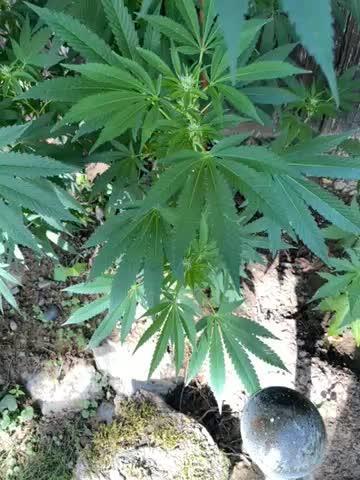
Une autres belles semaines de floraison pour mon bébé. Les fleurs ne sont pas les plus grosse que j'ai eu à se stade-ci. Par contre elle sont très compacte, collante et odorante se que j'aime bien ;) Les trichomes me laissent croire qu'elle sera prête à être récolté dans 20, 25


Likes
25
Share


@Grower_Of_Persia
Follow
my dry and cure style is this:
4 days of hanging upside down to get water activity lower to around 0.6 in 50% humidity and 26 C temp (i know its a little high but we are in a hot summer right now and i cant get it lower even with air conditioner) and then after 4 days of drying i remove leaves and stalks, trim buds and move them to jar for the rest of their life :D . and in the first 4 days of curing i open the jar door and let hem get some fresh air in the jar for about 5 minutes and close the jar door again, after 4 days of curing like that buds are smokable but they will get better as they getting cured about 1 month.
buds are one of the hardest as fucking rocks type of buds! very dense , compact , sticky , smelly , amazing at every aspect
growing stage was 60 days and flowering stage was 70 days total (harvested tops at day 63th)
the total weight of dry buds was : top buds 174 G + lower buds 55 G = 229 G
my overview of strain with details:
the seeds:
unfortunately i only got 1 seed cracked out of 5 so i will not know how much this genetic can get different but at least i got the chance to grow once of this wonderful strain
the plant :
in every stage you can ensure that you are dealing with a high level plant ,
she will get big so you have to control her height LST and SCROG highly recommended , will grow very well with tick stalks and big fan leaves , has good resistance for stress and will respond very well to stress trainings , she really has gorilla power in herself ,
fresh buds on plant :
buds are very compact and dense even from start , fresh blossoms smells like pineapple and mango , 2 different shades of sweet smells like you hold 2 junks of pineapple and mango in your hand and you smell them together, she is a trichome and resin factory , very very sticky , very oily , strong smell
dried buds:
very compact and dense , hard as rocks , has dark colors with purple hues inside it , it smells sweet
smoke :
very smooth and sweet like lollipop , pineapple , mango like , after 2 minutes it'll kick in and you'll get higher and higher with every breath , has a strange and especial high mind high mostly

Likes
55
Share


@Max1973
Follow
Day 44 - Put em in flower/bloom... 12/12... they are drinking alot.....
Day 47 - Decided to thin them out and defoliate ........ pics/vids....... (video are big files, need to pause, let em buffer)
Day 48 - Posted a pic, day after defoliation.
Day 50 - more pics, recovered from defoliation, and some pics of the beginnings of the flowering....... something interesting in the day 50 pics , is the color of the light spectrum...... it looks like a yellowy sunlight spectrum..... home made DIY LED..... 😎
Globe setup is working better,
10x click- 9w - 2700k - 8000 Lm
2x osram- 10.5w - 6400k - 2160 Lm
Lightpanel- 70w (600w) - 20x blue 6400k (2000Lm) - 38x red 2700k (4000 Lm)


Likes
7
Share


@Mr_nugs_lover_David
Follow
I've enjoyed a lot growing this plant, I had to deal at tje end of thr cycle with fungus gntas but she resisted without problems, each day the flowers stink more and more, amazing genetic, I would definitely like to keep on working with this genetic, it's a pleasure to smoke, I recomend you to grow her organically like I did snd you'll see!

Likes
7
Share


@Rele99
Follow
This past week has been a struggle. I keep my plants on the balcony during the day and in the grow box during night and I inspect every single of their leaves everytime I move them in or out. A few days ago I noticed some kind of microscopic egg on one of her flowers and then some sort of parasites under her leaves.
Since then: panic. I searched for the name of the parasite (acarus) and bought some neem oil which I applied manually on every leaf (to prevent it from going on the flowers) and onto the ground.
Since then the parasites are almost gone. But now she has these "sad" leaves, with their points bent down and the margins as well.. I've read different explanations, but I think in my it might be the high temperature and the overwatering, together with the dammed fungus flies. I'll keep going with the neem oil and diminish the water.
Apart from all this, her flowers are still growing and producing so much resin🤤

Likes
4
Share


@CanarianGrow92
Follow
Week 3 for the Apricot from our favorite autoflower company, of course fastbuds 420!
All looks quite good at the moment.
This week we gave bloom, root, silica, calmag amino, sugar shot, sticky fingers and bloom booster all from xpert nutrients!
Likes
14
Share


@Fildjoni
Follow
07.11
New flower week is here, for now all going good, still cant wait to see final product and how big and tick buds can be, but ride is joyfull and exciding.
Watering 1.3 l all 3 with nutrients and cal-mag, ph 6.2-6.5( i got ph meter without calibration fluid) but how much time i did mesuring i know how big ph is after i get water from tap [7.5-7.9(did mesuring 120 times minimum, before nutrients, after nutrients and after i add down if i need)] and yea, dont see much differnts on plants in few days without ph meter, but he is here in case, better check up,air flow is good , humidity good(above light zone 45-55%, down by plants 55-65%) and temp day 25°-27°,night 18°-24°.
I adjust pots every day 2 times minimum so every side get some correct light in all parts( maybe silly but i think its not anything bad to keep every side in some parts of day better lighted).
Wish me best for tomorrow i will need it, and them also in rest of the grow proces🍀💪🏻🍀🤞🏻🙏🏻
08.11
Today they was out to get some neem spray and see bit of light till weather is not bad, and to not spray in tent, better photos then last time i guess, they look happy and healty, today no watering i saw that soil is not dry
09.11
Today's subject..watering 1.3l pro plant with nutrients and cal mag, ph 6.2- 6.4.
How i see its good, going good and wish them best till end and more, weekend is here
10.11
Watering 1.3 l pro plant with cal mag and nutrients, ph 6-2-6.5
I saw some gold colors on end of the leafs
I think i forgot put down light intensity after spraying them with good amount of neem oil, i got some time to do it, and normal i am busy so, why not i guess
Hope its not some problems with plants, looks like burned a little not like sick and dry, and only top of leafs
Wish them bless and the best 🙏🏻🍀😋
11.11
Watering 1.4 l with nutrients and cal mag, ph 6.2-6.5
Plants looking good , still on big one bit of yellow color on leafs, hope it will go soon,
this 9 weeks was gone fast ,but this part like clock was stoped i wish till end good situation with them, good run, and all what they need🙏🏻🍀💚
12.11
I decide to try give them one day water with cal mag,ph 6.2, 1l to each of them,try to flash a little bit in hope that will help better recovery from damage, next time when i spray neem i will leave outside a bit dry and try to keep light intensity lower, bit of adjusting fen and vent, still recovering from burning down from light.. nervously waiting end😊😋😁💚🍀🙏🏻
13.11
Waterin 1.4l pro plant with cal mag and nutrients, ph 6.2-6.5
Smallest one chaching up with 2 bigger , realy happy how she turn tabels and cant wait to see how she will look on the end, plant are happy, good health with no problems, only that few of yelowing leafs that almost all had recoverd,like i said, realy happy with what i saw , now they have bit stronger smell(can feal it when i get in apartment, even if i put vent out i can taste it but ok, thats how should be, need to smell a little)
And from other stuff, today was first time snowing ❄️
Soo hard winter is in front of us, till then girls would be dryed and cured probably not 100% but enoguh to go outside, take a walk on cold and smoke one
Ladys stay hard till end and good 🍀🙏🏻💚❄️
P.S night temperature when lights are off is 15-17°[problem is with opened window becuse of vent,dont know what total resault of that would be(maybe i should let lights on night so i can have better temperature in tent, aka switch ciclus of light to be dark weil i work)] thoughts ?


Likes
14
Share


@BOMbolenath
Follow
Very easy plant to harvest, didn't have too much leaves, so very easy to take out fan leaves and prepare to dry.

Likes
32
Share


@MadeInGermany
Follow
Flowering day 19
since the time
change to 12/12.
Hey all together 😀.
This week she has developed beautifully ☺️.
I poured it 3 times with 1.2 l this week.
Tomorrow I will add the 2 g GHSC Powder Feeding Bio Bloom because the first blossoms are coming :-).
I checked all the leaves thoroughly for pests or diseases and everything is fine ☺️.
Next week I'll look at your roots as soon as the coconut is completely rooted.
As every week, the tent was cleaned and the entire technology checked.
The humidifier was also refilled every day 👍.
In the next few days I will remove the bottom shoots so that the energy doesn't end up being wasted in the small popcorn buds.
I wish you a lot of fun with the update.
Stay healthy 🙏🏻 and let it grow 🍀
You can buy this Strain at :
www.Zamnesia.com
Type:
Banana
☝️🏼
Genetics:
OG Kush x unkown
👍
Vega lamp:
2 x Todogrow Led
Quantum Board 100 W
💡
Bloom Lamp :
2 x Todogrow Led
Cxb 3590 COB 3500 K 205W
💡💡☝️🏼
Soil :
Canna Coco Professional +
☝️🏼
Fertilizer:
Green House Powder Feeding
☝️🏼🌱
Water:
Osmosis water mixed with normal water (24 hours stale that the chlorine evaporates) to 0.2 EC. Add Cal / Mag to 0.4 Ec Ph with Organic Ph - to 5.5 - 5.8 .


Likes
6
Share

@Rangaku
Follow
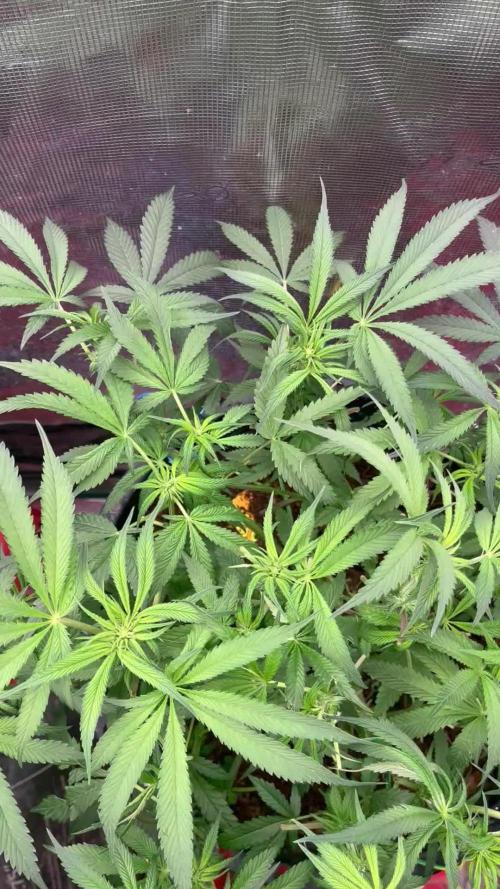
Good week of stretch, these plants hit every marker they should right on time couldn’t ask for anything more . Same same next week.

Likes
11
Share


@Emperor
Follow
I think I’m a little short on nitrogen, busy to fix the problem. Kings and Dj’s gold doing well, only have the problem with the Barney’s.
The color is not dark green but getting whiter. Curly top leaves but soft, not to dry not to whet. Start giving plagron alga bloom sinds today 25% more then the alga grow.


Likes
73
Share


@LazLow
Follow
Kinda a rough week, everyone. I’ve been battling the flu all week and my energy is zapped. So firstly I had been growing increasingly annoyed of leaf clawing. I addressed overwatering and started only watering every 4-5 days and the girls responded well. I researched defoliation as much as I could and gave it a go because the plants weren’t getting optimal light. Might’ve overdone it, I’m not sure. Then came lowering the screens to begin scrogging. I’ve read probably every forum and article and looked at dozens of diaries; but it feels like when I’m tying branches to the screen it’s just stacking them on other leaves and blocking more light. I hate my LED, it’s probably only good for one plant. But today one of the bulbs went out, brand new light. I decided to buy a 315w CMH Light should be here next week. Live and learn. Should have done a single plant grow. It’s a new week though it will all work out. 🍁

