




Likes
10
Share

@Ribemarti
Follow
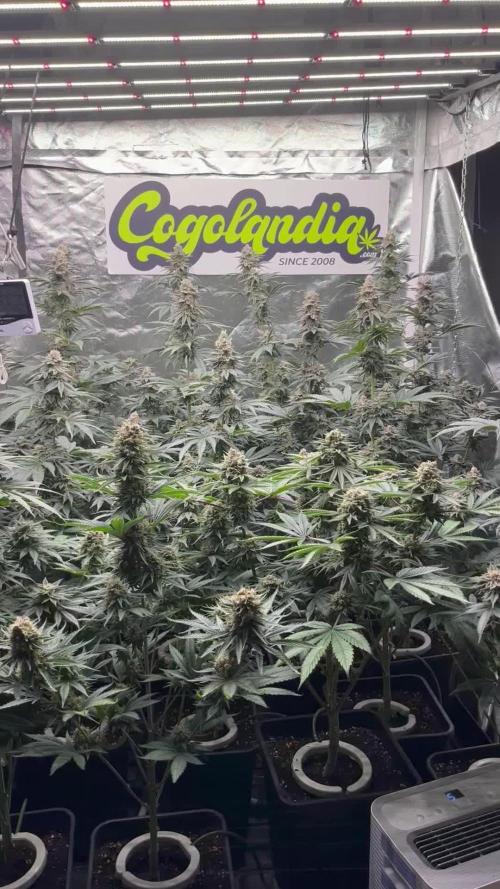
Dia 54 de floración, las plantas ya tienen el lavado de raíces echa de hace unos dias, el siguiente riego las rege con agua a 900 ms y ahora ya hasta el corte 400ms para que todos los nutrientes que le quedan en las hojas se los coma !!
En 3/4 dias ya se empezaran a cortar las plantas, todo el trabajo de estos meses ha dado unos frutos muy duros,pegajoso, y mucha olor a chicle afrutado muy fuerte,
La planta mas alta a medido 108 cm y la mas pequeña 60 cm y hasta aqui este cultivo, semana que viene estara todo en el secadero y veremos las nuevas variedades que se vienen y
ahora ya estamos preparando el proximo cultivo
Likes
85
Share


@420DeepGrow
Follow
Novena semana de floracion, se ha formado una linda cola, uniforme y compacta que continua cargándose de blanca resina 🤩.
Tiene un olor afrutado muy intenso.
Esta semana es la ultima con nutrientes, queda poco para ver el resultado final, estoy muy contento de este grow.
📅 Dia 57: Riego con nutrientes EC 1200, EC escurrida 1750
📅 Dia 58:
📅 Dia 59:
📅 Dia 60: Riego con nutrientes EC 1250 Ec escurrida 1650
📅 Dia 61: Riego con nutrientes EC 1200 EC escurrida 1750
📅 Dia 62: Riego con nutrientes EC 1300 EC escurrida 1850
📅 Dia 63: Penúltimo riego con nutrientes EC 1200, ha quedado una planta muy compacta

Likes
1
Share


Likes
11
Share

@GreenEldritchGardens
Follow
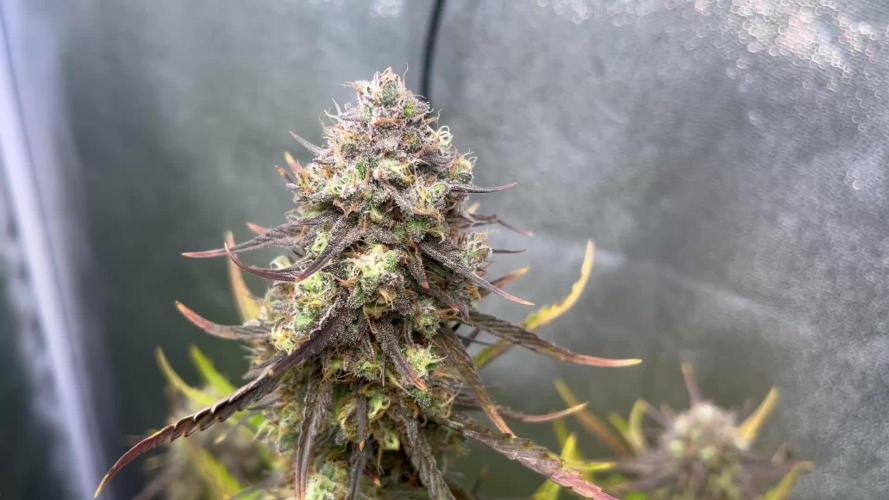
Purple intensifies on the top of the plant. What’s interesting is that even lower buds are quite fat and frosty, however the top did not got fattier as much in past week.
Looking at the trichomes it is not ready with some clean, some milky and rare oranges around. However harvest may come soon.
Smell continues tropical fruits with some funk, gelato funk
Likes
5
Share


@Pureleelove
Follow
This was an amazing experience for my first grow. Was super unsure of what I was going to yield, but I think 27 grams is a realistic harvest and Im looking forward to see if I can get bit larger of a yield on the next run. I want to try main-lining, see for better energy distribution and more equal bud growth. Also investment into a proper reflector and possibly enclosed space.
Note- I trimmed my plant the night before harvest morning. I removed than fan leaves to start, and then proceeded to trim the plant. I pulled out a lot of the leaves with no frost by hand. The sugar leaves had so much crystal on it I thought I would leave the smaller ones on the bud. I gave it a light trim, and used all the trim to make Isopropyl Alcahol (99%) based extract. Got about 1 gram from the run. I also had a nice little ball of finger charas from the trimming.
I harvested it in the morning at about 04:30 am before the light cycle triggered at 7am. She hung and dried for about a week, where I then chopped her into buds. She cured for 2 weeks before i started smoking.
Ask anything you want to know! Or if I can be more clear on any areas of the grow!
One Love!

Likes
6
Share


@SAC87
Follow
Hey Growers
Darkness days are upon us. They’re done and ready to sit for a couple days, then I’ll chop them. Things have gone really well and I’m happy with what I see. I’m thinking this will be a huge haul for a 4x4 tent. The buds are beasts with hard nugs and have that Kush fox tail characteristic. The stink is magical and the trichomes
are super gritty. The Cali Kush are so fat they’re laying down in the back. I’m very happy with the results.
Happy Growing 🌱


Likes
41
Share


@FrostyGardens
Follow
11/17/18
Beginning of week 4 of flower. Day 21-22 of flower. So far I am pretty happy with my results. O think I identified one sativa leaning phenotype, one indica, and also that grows slower then the rest. Although not entirely sure if its the environment that created these differences. As they further develop I may get some clues to this regard.
Black Magic soil seems to work great with no issues of burning or deficiencies whatsoever. Are far as smell its not very noticeable unless the plants are disturbed or pruned.
Decided to discontinue the Aerated teas. Im sure the ladies have plenty or microbes in the soil. The rest of this grow they will only be feed 3-12-12 bloom fert untill its time to start the flush.
Buds should really start to develop in the coming weeks so stay tuned. Also im already planning my next run which will be 10X different strains including this one. Another 5-6 weeks on this one. Shout out to ilovegrowingmarijuana.com for these beans.
11/24/18
End of week 4 and the buds are looking amazing. Nice and frosty already. Noticed slight yellowing on the tallest girl. I suspect my LED was a little too close. Increased distance.Other then that smooth sailing. The next 2 weeks they should really begin to develop and put on weight. Cant wait to see what these 4 beauties produce!

Likes
16
Share


Likes
2
Share


@Enki_Weed
Follow
This week was a quiet week to avoid disturbing the beginning of flowering. I think the deficiencies are under control and there's no worsening to fear. Nevertheless, I will need to remain vigilant. The plant is starting to smell.
Likes
26
Share


@pifflestikkz
Follow
Day 64
02/09/24 Monday
Feed today using de-chlorinated tap water pH 6 with calmag.
Day 66
04/09/24 Wednesday
De-chlorinated tap water pH 6 today only. Smell is really coming on strong now!!
Day 68
06/09/24 Friday
Feed again today using de-chlorinated tap water pH 6 only.
Day 69
07/09/24 Saturday
De-chlorinated tap water pH 6 only today.
Mould 😔🤦♂️
Absolutely gutted!! Had a very humid past 3 days, wet with no wind... 2 plants have suffered...
Auto Orange Bud has lost a side branch.
Auto critical orange punch has lost her main colar, and 2 sides, the yeild is going be to now be appalling, but this is due to environmental, not the seed or genetics, as far as they go this was one of the strongest and biggest in the group
Day 70
08/09/24 Sunday
(END of week)
Feed today using de-chlorinated tap water pH 6.
☠️ Auto critical orange punch 🍊👊
Had to remove completely, after isolating the rest of the greenhouse, mould persistently grew on her. The remaining plants after 2 days isolation have been moved indoor to finish underground 600w hps and a more controlled environment.


Likes
11
Share


@ElGrowLab
Follow
Unfortunately, I had to correct the first week of flowering as the last week of the growth phase because I didn't reset my timer and the lamp therefore ran at 18/6 for another 5 days
Some plants are a little lighter, some are a little darker, they all received about the same water I'm assuming it's phenos Otherwise they look really good and grow into the net. Each flower gets a field of the net
Celebrate well with your loved ones, I hope you had a nice Christmas and I wish everyone a good start into the new year


Likes
45
Share


Likes
9
Share


@All_our_small_plants
Follow
-Tag 61 Heute haben wir leider feststellen müssen das sie ein Zwitter ist und sehr viele Männliche Blüten entwickelt hat.
Zum Glück haben wir es rechtzeitig gemerkt, denn sie stand direkt neben unser Membrana die auch schon in der Blüte ist....
Schade das wir sie vernichten mussten und sie nicht probieren konnten

Likes
49
Share


@masterofsmeagol
Follow
8/8 Rained all night. Still raining today and the forecast says it will continue throughout the day until midnight. It's come down heavy at times but for the most part it's a rain that plants like. Defoliated a couple leaves but nothing really needed it. Without a trellis or my tarps up the grow bags seem to dry out incredibly fast so I need to watch that. It's also "toughened" up the plant wants. I've seen them blowing straight sideways and they were fine. I do need to find that four lined plant bug and spray BT after the rain. Plants lovedcthe nutes. I might feed a little later today or tomorrow. I've got a few things to do but I'll keep this updated.
Went over and defoliated ANYTHING that needed it and combed through every plant during a pause in the storm. Then I shook them all off and did a video. This is by far the healthiest crop I've grown! I think they can handle more nutes too so I'm going to up it next feed. Still seeing stptadoc chunks missing and random pillar damage. BT will handle it. It's just so minor I'm not even sure if it should be addressed that way. I've had pretty good luck just looking for them and picking them off.
8/9 Cannabis can grow an inch or two in a day and it definitely has been! The rain has finally stopped. I went and shook all my plants off. I'm going to check and see the last time I fed and try to get a feeding schedule created that won't cause lockout. That's been a problem in the past. I've defoliated a lot of leaves lately but EVERYTHING is looking amazing. Extremely healthy. I DO need to spray BT for the pillars and I need to move that one plant back. I keep forgetting to grab the little wheels I need to make a platform. There are other ways I could do it I guess. I'll keep this updated. No damage from the storm and I went through and defoliated before and after. Forgot to upload shit and now I'm back home with this shitty internet connection. I'm trying to upload this video but we'll see. It's at like 32%. I did a full workout and came back to find this at 77% lol. I need to remember to upload things when I'm not in the middle of the woods.
UPDATE: Checked on things and did a video. Need to feed, apply bt and secure individual branches before flowering increases
8/10 LOOKS to be a beautiful day. Growbags are heavy as hell and wet on the bottom. I ALMOST fed today and I still might. The pp in the 10 seems to have leeched a lot of nutes. That and a giant blueberry cheese are the only places I'm seeing a deficiency and I want to keep it simply. I also need to put a trellis up apply BT. also if I'm going to move things around I've got to do it before I put up flowering supports. It's harder to move stuff when it's wet. I'll keep this updated. The girls look fantastic.
UPDATE: Went and trellised two of my plants. I was going to feed today but decided to wait until the next time I water. I'm only seeing deficiencies on the phrple punch in the ten and the GIANT blueberry cheese that I watered the most. Bags were heavy as hell this morning but I bet I'll need to water tomorrow. We'll see. Hahaha wow. I'm trying to upload a video but even my tough as fuck plants might have some difficulty in torrential rains like this. Wow. That's all I can say. I'll either go check and shake them off tonight or if it keeps it up I'll wait until morning I guess. What a shit show
8/11 WOW. That's probably the hardest I've ever seen it rain. Got to the grow this morning and found NO damage. It's super sunny amd windy so the bags will probably dry out. I think it's suppised to rain again Sunday. I definitely haven't had to water that's for sure. Nothing was even bent over this morning. The blue cheese I didn't fim or top (I wanted to see gow it grew naturally) pop ka was bent down a little bit but not much considering the pounding it got. You can see on the videos. Since bags were saturated I didn't need to water before I fed. I fed 1.25 pints to every plant. I gave the fifty 2.5 pints and the purple punch in the 10 got closer to a pint. I want to start out slow with nutes as I'm nor seeing many deficiencies. I may fuck around today and put some more trellises up seeing this wind bur when flower comes I can just put my tarp up. I'll update as I go.
UPDATE: WENT BACK OVER BECAUSE THE WIND WAS WHIPPING LIKE CRAZY AND TREES WERE DOWN. I SANITIZED ALL MY TRELLISING AND HORIZONTALLY TRELLISED TWO 10TH PLANETS IN FRONT AND VERYICAL TRELLISED THE THIRD. HORIZONTAL TRELLISED THE PURPL WE PUNCH IN THE 10 AND VERTICAL TRELLISED THE BLUE CHEESE IN THE 50 AND THE 10TH PLANET IN THE MIDDLE OF THE CAGE. GLAD I GOT THIS DONE. NOW I JUST NEED TO SPRAY BT AND I'LL FEEL CAUGHT UP.
8/12 Got my supports up and ready now I've just got to find the time to give the girls an application of BT. I've done a pretty good job with manual removal thus far. Bags are over watered. It's Rained so hard and so often that the bags have stayed drenched. Luckily this ridiculous wind has been drying my grow bags out relatively fast. I'm hoping that will be the case today. They're starting to dry out but it's supposed to rain tonight and I think tomorrow. Bright and sunny right now. These are some resilient plants. They seemed to like the liquid kool bloom. I noticed (barely noticeable but I was looking for it) a SLIGHT color change at the very TIPS of a few leaves on a plant but not enough to consider it burn. I will monitor but I think ive got a pretty good feeding regimen. I plan to use as little as I can get away with. I'll keep this updated.
UPDATE: WENT TO CHECK ON PLANTS AS I GOT "THAT FEELING". EVERYTHING WAS LOOKING GREAT BUT THEN I WENT AND LIFTED MY DRY 22GALS OF SOIL AND COMPATED IT TO MY 20S AND LIKE I THOUGHT THE WIND HAD DRIED THEM OUT. I CANT BELIEVE HOW QUICK THEY DRY OUT. I GAVE EVERYTHING 1.5 GALLONS AT LEAST EXCEPT FOR THE 10 WHICH I GAVE A LITTLE LESS THAN A GALLON. I GAVE THE 50 A LITTLE OVER 2 GALLONS AND I DISNT NOTICE RUNOFF. I HAD MORE WATER MIXED UP IM THINKING I SHOULDVE GIVEN IT ANOTHER GALLON. OH WELL ITS SUPPISED TO RAIN A LITTLE TONIGHT AND THEN TOMORROW. I HAVEN'T WAYERED IN LIKE A WEEK SO I PROBABLY SHOULD'VE GIVEN THE WHOLE 2 GALLONS. THEY GOT DAMN CLOSE THOUGH.
8/13 Rained like hell last night. Oh course it did. Doesn't really matter though. I had to water. I thibk the last time "I" watered was lime a week ago. My bags were dry. Plants weren't drooping and they might've been ok but I've under-watered twice already to the point they drooped right over dead looking and I wasn't going to do that again. Plants seem to love the nutes I gave. Keeping the tarps off and allowing the wind through and having my bags on pallets has really saved me this year. Everyone else is bitching about the rain and lack of sun but things are going great for me knock on wood. I'm not 'in the ground' though so that probably has something to do with it. I just need to check my plants multiple times a day. These plants are getting massive. The cage is at least 8ft tall and the biggest one is about to the top now. Almost as wide too.
8/14 I forgot to write the entry but I uploaded some pics from this morning. They were wet from the storm but I went back over and took video that's like two and a half minutes plus I took some pictures. I pulled the cage out but I need to undue one of the lathes and pull it forward. I also need to apply BT. Plants seem to be aggressively flowering (some more than others) so it's a real exciting time. I went over this afternoon and everything looked fantastic. I'll try to upload a few pictures but the video will have to wait. Didn't rain today and my bags sry out quick so I'm sure they'll be fine even if it rains. I did notice that the two plants I watered most including the smallest container seem lighter in color. IT might hust be the transition to flower but u think I need to increase feed. On the 10th planet's they are green as can be and have that SLIGHT little almost unnoticeable part you really have to look for on the tips that means it's getting its nutes but it's not burnt. I believe I'm going to have to make feeding schedules for each strain

Processing
Likes
15
Share


@MG2009
Follow
07/08/2020
Powdery mildew has cleared up got bird poop on leaves now will clean, and defoliate as needed🙏
Red Sky clones do not take light stress well be on top of that shit with a timer! The first clone I took I put under 24 hour light (on purpose)sent out male flower at several nodes (collecting for Feminized project)
So no light stress, unless you need to!
Processing
Likes
12
Share


@NorthEuropeanGrower
Follow
Weather is getting a bit better this week. Almost no rain anymore and much more sun comparing to last week. Blueberry Ghost OG and Kali AK still don't want to start flowering, but they slowed down from growing taller at least, so there are hope of they to start flowering soon (hopefully).


Likes
148
Share


@BioBuds
Follow
An here we are. At the end of another cycle. The end of another year, and what a year it was. For Sunshine and me personally, it was a tough year, with our families sick on multiple occasions, life-threatening. We are very thankful for many things but most of all that all our parents are healthy again.
We wish your families are as fortunate in the coming year.
So we end this Gorilla's life with a swift cut of the scissors, after thanking her again for the companionship, the well-needed distraction, and all the love she has given me already.
I sometimes read that people won't go near their plants when they are angry or sad. Please do go to your plants when you are sad or angry!
They are millions of years old. They have been healers of animals and humans since they were around. Our emotions can not taint something so pure as the spirit of this plant.
She will heal us, give her life for us, sacrifice herself for our healing. She is all-powerful and all-knowing, there is nothing we mere humans can do, except disrespect her powers.
Bask in her glowing light, enjoy her soothing energy, her creative spark when you are in need of love, just don't smoke her at that time, for she will soothe you bit not give her treasures, she will seduce you.
Next to thanking Santa Maria for her healing, we would like to thank our friends here, all who shared their kind words, advice, and attention.
I had made a video to share my thanks on video, but every time I got very emotional. You guys have no idea how tough this year was.
The gorilla is real easy to clean and sticky and cristally. Its amazingly great to smoke!
So a special thanks to: @Sailormoonflowers for being a buddy to talk to, @JamMAKEcan for being there with ideas and always a lot of love, @Roberts for being an inspiration @Cannabeast and @LegendarySeedThumb for always checking out my grows, to all who I forgot who are always here to greet me! @Growdiaries for being an awesome site and community and last but not least: @MarsHydroLED for letting us try their SP-3000.
VERY HAPPY NEW YEAR XXX
We wish all of you freedom, love, happiness, but also the awareness to see many of us are still being repressed, with growing but also with our human rights.
Jah jah gave us life to live, so let us live brothers!
It is time the rastaman made a plan!
We are 99% loving people on this planet, we need no 1% to fuck it up with wars and strife.
We need to stop cooperating, peacefully resist. If you can buy local, ban exploiting multinationals.
Help your local businesses, help your neighbors, we need to wake up and stop funding this black stain on our planet.
Sell your stock in multinationals, invest in local businesses.
Buy local products, speak out when you get taxed higher than millionaires (and you are).
The day is coming my brothers and sisters. Soon a handful of CEO's will find out when billions are done with them.
For now thanks for everything!

Likes
8
Share


@CanarianGrow92
Follow
Last week of growing started, we will switch to flowering at the end of the week. Nothing special was done, simply water as all had seaweed and biogrow already, during flower we will only add some extra PK and some sugars and it should be more than enough!
