


Likes
Comments
Share


@ScouseCityLX
Follow
Week 6 of flower and once again, some excellent bulking going on here, I was happy with it.

Likes
14
Share


@Kush_queen
Follow
She is going to be flipped to 12/12 next week she is so ready for 12/12 🙏💪💚💜💚💪🤣💪💚💜

Likes
6
Share


@JackSkellington
Follow
sto facendo una fine di ciclo pessimo...pochi risultati dovuti a vari errori...
1 non aver misurato mai ph di acqua(fatto pochi giorni fa era a 8)
2cattiva irrigazione(temperatura acqua soprai 28 gradi)
3 una un uso scorretto dei fertilizzanti mai misurato niente..
4 arrivare ad agosto non e il massimo da me sto toccando punte di 30 gradi in su
5 stress termici sbalzi termici tempertura giorno e notte uguali 28/30 gradi non riesco a rinfrescare la stanza dove c'è grow


Likes
55
Share


@Roberts
Follow
Fruity Pebbles in Blue Planet nutes, is doing good. She started to show some deficiency signs in minor spots. I increased the feed for what I seen ptesent. Potassium and cal mag. She has been stretching good. I cleaned out some of the under side as well today. Everything should be good to go at this point. Thank you ILGM. 🤜🏻🤛🏻🌱🌱🌱
Thank you grow diaries community for the 👇likes👇, follows, comments, and subscriptions on my YouTube channel👇. ❄️🌱🍻
Happy Growing 🌱🌱🌱
https://youtube.com/channel/UCAhN7yRzWLpcaRHhMIQ7X4g


Likes
158
Share


@love_2_grow
Follow
D50.
The start of the third week of flower, and all is well in the tent.
She is very dense and super compact, and I think I need to defoliate her soon to increase airflow and prevent budrot.
------------------------------
D51.
I removed a few leaves to increase light penetration and airflow.
I also calibrated my Hygrometer since I've noticed lately that it seemed a bit off. Sure enough, it was off by 7%.
------------------------------
D54.
There's nothing to report as she is just doing her thing without any help from me.
I'm going out of town for a week, and she will be left to her own devices.
------------------------------

Likes
55
Share


@Hellishjam
Follow
so we're a day early here, but lots to do tomorrow! but anyways they got transplanted into a flowering super soil i made for the first time making one so i'll be keeping notes and how it does. going to veg for one week in the 3 gal pots and see how they look then i'm thinking i'm going to flip them so hopefully they take right off after getting the new home. soil mixture is
** for a 30 gal of soil**
9 gal of promix organic her and veg
9 gal of cow manure compost
9 gal of vulcanite pumice
6 cups of 2-8-4 gaia green
1.5 cups of mineralized phosphate gaia green
3 cups of basalt rock dust gaia green
1 cup of glacial rock dust gaia green
5 cups of kelp meal gaia green
this is all being tested for the first time so not sure this stuff might be a little to rich but we'll just have to wait and see i guess. i did use clonex mycorrhizae a tea spoon in each root ball. i was having heating issues, i first had the portable ac in the tent but it was always working to hard, so i put it outside the tent and it did a lot better. the room is now staying at 26 with the lights on, and my lights are also still plumbed into the duct work for the house so its still pumping hot air thru the house and it got hot in here today so once the light go out ill be plumbing into the window, so that should help a lot more. i was going to train the as why i put them on one side of the pot in the one gal but decided not to as i just want to see how this super soil is going to be like. i'm not wasting time training all all that other then a super crop here at some point but no tying them down as i once had in mind.
Likes
8
Share


@Alien98
Follow
This week I discovered some leaves on the bottom of my ladies turning yellow, so I decided to raise magnesium nutrients to 3ml/l,but I think it happens when the plant get closer to harvest. In the past week I saw the buds getting bigger and frostier so I think so far it's going well. From today, (day 49) I will introduce Big Bud and Carboload for one week, then one week of Overdrive and finally a week of flush. Hopefully great end-result and great yield too.
Day 52: Some Tricomes are turning into a Brown color so maybe I could harvest the first plant next week

Likes
2
Share


@MrGreen_theOG1978
Follow
Start of week 3 looking good starting to get frosty fan leaves which has never happened in my soil grows so this is very interesting. Definitely enjoying the ease of this system it's almost annoying how easy it is. And floraflex has been a dream of a fertilizer holds pH very well not chasing the pH constantly. All I do is top off 33% strength nutrient solution once a week, 33% strength silica calmag and hydroguard once a week then top off with just regular pH tap water. Water from my tap is 98 ppm so I'm not worried about getting a ro system.

Likes
2
Share


@fabialien
Follow
Semana sel 9 al 14 de septiembre 2024.
Vemos un desarollo bastante vigoroso en todas, esto también se puede adjudicar el hecho de la nutrición que han estádo llevando esta tanda se fem y regulares, la mandarine qué nació con apical va bastante bien.


Likes
14
Share


@Mr_nugs_lover_David
Follow
This lady has been Transplanted on day 39 since she was planted (may 10th) and I've prepared the 15L pot with the complete line of biotabs using 2 spoons of startrex for every 5L, sprinkled a couple of grams of mycotrex on the transplant hole before putting the plant and then I added 3 slow release tabs one biotab for every 5L of soil, so that's why in this case I added 3, after the Transplant was done I immediately watered the plant with 1ml/L of orgatrex and 1g/L of bactrex, I hope you guys enjoy my work this season!!

Likes
23
Share


@HideAndFly420
Follow
Day 43 (15 of flowering)
stopped top max. Added 2 ml more of bio grow, Let’s see what’s going to change.
Stretching is visible every day more. Now just waiting to big bud increasing.
Next week i’ll add Carbon Filter to ventilation set up.
I think other 6 weeks left.
Day 45, added Rhino skin, let’see next change.
Day 46, i think streching is finish. Now just waiting to get that bud big and fat.
Removed top max 4 days ago, and added 2 ml of rhino yesterday just to improve stem and branches, i added cause i tought to a nutrients déficience but at thé end after reading answers to my question i fixed air ventilation that was increasing too much the temperature in the up per side of the grow.
Soil Ph is 6,8.
Day 48, i just moved my ventilation that was causing some issue to the highest bud of orange. Rhino by adv increasing stem health is visible now and color are great. I think orange will take at least 2/3 weeks more than Blue dream auto
Any suggestion is accepted :)
Let’s go.
Likes
21
Share

@TickleToast
Follow
Not sure why but this diary won't allow me to do the smoke review :(
Weight:
Right: 173.1
Left: 193.6
Back: 182.5
Total: 549.2
~75g's of keif from the trimbin out of 8 plants,
and 12.6g's of Ice Bubble Hash out of the Vortex9 :D
~~~~~~~~~~
Purple Kush (Feminized Photoperiod)
(Sponsored By)
~Kannabia~
https://us.kannabia.com/feminized-cannabis-seeds/purple-kush
Hybrid: Purple Kush x Black Domina (Hindu Kush / Purple Afghani)
25% Sativa / 75% Indica
Flowering Time: 56-63 Days
23% THC
+0.5% CBD
~~~~~~~~~~
In-depth information regarding my day-to-day / common practice may be found on the front page of my profile (in the comments).
~~~
Breeders - my services are available!
I'm always keeping an eye out for great genetics to test and showcase.
Shoot me a message! :)
~~~
Questions & Feedback are welcomed, feel free to message me!
Thanks for stopping by growmies! 🤙🤙🤙🙏🙏🙏
~~~~~~~~~~

Likes
Comments
Share

@420DeepGrow
Follow
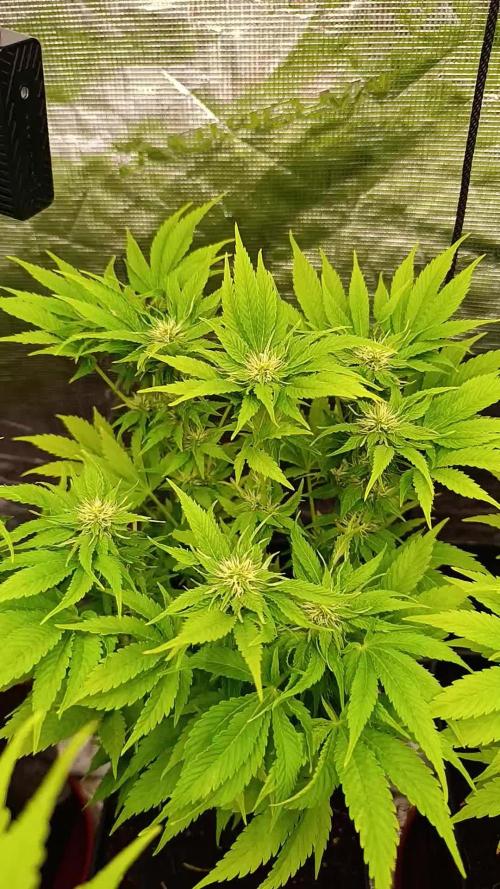
📆 Semana 5
Con el coco ya totalmente asentado, la EC se mantiene en 1.5–1.6 y el pH estable en 5.8–5.9, asegurando una absorción constante y raíces blancas y activas. La estructura queda definida y el crecimiento vertical es mínimo, confirmando la transición completa a producción floral.
Los erizos comienzan a compactarse y a ganar densidad visible en todas las puntas, con aumento progresivo de resina y uniformidad en la canopia. El color se mantiene funcional, ligeramente más claro pero equilibrado para esta fase.
Los aromas se intensifican y la energía se concentra claramente en el engorde inicial de los cogollos.
Seguimos creciendo fuerte 💪!

Likes
56
Share


@Prilyfe13
Follow
April 26, 2024 Day 71
It's a new week and the start of late flower. It was also cleaning day. Both reservoirs have been cleaned out and are freshly loaded with new water.
This week we are focusing on watering and nutrients. I may start to drop the dose until flush, over this week and the next.
The light power will also be gradually dropped down over the next 2 weeks. Not much this week, I think I'll drop the DLI down to 43 mol/m²/d in the middle of the week. Next week I'll drop it down to 38 mol/m²/d. It all depends on what the plants look like.
The plants are getting ready to hunker down and finish up. Both have decent sized buds and just need to finish swelling. I'd say another 2 weeks maybe? Flushing will start at some point over the next 2 weeks as well. Flushing won't be much of a big deal as it's just cleaning the reservoirs and running a week of Flawless Finish.
The environment is changing a bit as well. I dropped the day temp down to 75° and the night temps to 65° or lower. Not cold enough to cause stress, but enough to get some purple I hope. The humidity is sitting at 47% and I'll be leaving it there unless somehow I can get it to go lower. For now it's pretty solid at 47% and everything looks great, so no need to worry.
I'll be taking trichome pics every few days. One pic for each plant. No point in loading up the whole photo gallery with even more daily pics. Plus, the progression of trichomes isn't fast enough to really notice daily. So every 3 days should be fine.
Grow System Environment:
Temp: 74.2°
RH: 47.7%
VPD: 1.49 kPa
April 27, 2024
Nothing happening today. Both ladies were inspected with no issues. I snipped a single leaf off of Banana Purple Punch B. Just one. Blocking bud sites.
Banana Purple Punch A has some massive buds. About the size of golf balls. Maybe a bit smaller. They are still swelling and have a good 2 weeks left. Pistils are still mostly white, so that's a good sign for larger buds and more trichomes.
Banana Purple Punch B is looking wonderful as ever. She doesn't seem to be suffering any issues with nutrient burn unlike her sister plant. She's perfectly healthy and has very nice bud production. The buds aren't quite as big as Banana Purple Punch A, but still nice and sizeable.
The nutrient burn seems to have stopped for Banana Purple Punch A. So that's good. It should be perfectly fine now.
Lighting is staying the same for the next couple of days. Although, I may keep it the same for the rest of the week.
The environment is excellent now. It's raining today and the humidity is still at 47%. I did get it down to 44% for most of the afternoon yesterday, so I may be able to keep it down after the rain stops. Or just wait for the afternoon and see what happens. Either way, the humidity is now at 47% and the temp is at 76.8°. The VPD is at 1.57 kPa. A tiny bit high, but still well within range. Last night's temp was a little high at 69°. I'll have to drop the temp lower again to get that 65° sweet spot.
Grow System Environment:
Temp: 74.4°
RH: 45.7%
VPD: 1.55 kPa
April 28, 2024
Not much to do today. I mixed a new batch of nutrients for both plants. The only difference is that I cut the Overdrive in half down to 2 ml/gal. Neither plant needs it, but now it's mixed and ready to go. I may end up filling the reservoirs tonight as it stands. Or later this afternoon. I don't think they will last til tomorrow morning.
Both plants are putting off a wonderful aroma. I honestly can't describe it. Like sweet and kind of a hint of banana and a bit heady.
Trichome production is picking up quickly. The pistils are starting to turn orange as well. They are definitely in the late flowering stage.
I think I'll start dropping the nutrients for the next watering. And I'll drop the DLI down to 40 mol/m²/d tomorrow I think. Not much else to say about nutrients or lighting, so moving on to the environment.
It's a warm humid day out and raining off and on. My whole environment is wonky, with humidity being at 57% and the temp at 77°. I turned the AC on about an hour ago and the temp went down to 75°, and humidity up to 60%. I think I'll crank the AC all the way down. And hopefully get rid of the humidity with the temp being a bit lower than perfect.
Update: I ended up adding about a half gallon of plain water to both reservoirs. Just Incase I have nutrient lockout or something. They should go through that by tomorrow afternoon. Maybe late evening.
Grow System Environment:
Temp: 75.6°
RH: 52.8%
VPD: 1.39 kPa
April 29, 2024
No watering today. I'm still waiting for the plain water work it's way through. However, I did drop the light power.
Both ladies look great. Big buds, great scent and nice color. I'm not seeing any fade yet, but the nutrient burn is still there. I hope it will fix itself with the plain water. And then maybe fading will start. These two need a good 2 weeks or so before harvest.
The lighting, as I said, was changed today. I dropped the power down to 70% to get as close as possible to 40 mol/m²/d. I may have to drop it another 10%. I'm not too sure. I'll check the DLI again when I'm more awake. (I'm finally on my second cup of coffee. Lol) Looks good though. Just around where I want it to be.
But there are a lot of spots where the DLI is a bit high at 43 mol/m²/d. The tallest tops are also kind of high at 45 mol/m²/d. Again, I'll double check on a couple hours, but it should be fine.
The environment is wonky again today. The temp is fine, but the humidity is still high at 60% and I don't see a way to drop it again. Not with the current weather. Hopefully I can get it down with some heat. The AC method did not work. Well, it maybe will work tonight. I'll be dropping that bad boy down to 59° tonight and hopefully it will do what I need it to.
Grow System Environment:
Temp: 74.2°
RH: 59.8%
VPD: 1.15 kPa
April 30, 2024
Watering day. The reservoirs were both nearly empty and there was just enough space for a full gallon in each one. It's the normal nutrient dose with Overdrive being at 2 ml/gal.
These two plants are looking mighty fine. Excellent bud swelling and trichome production. I'm definitely going to be wet trimming them instead of my normal dry trim. I may leave the bods on the branches and do a partial wet trim, or I guess mostly wet trim.
They smell great! Very strong aroma now. I swear they smell like artificial grape. I can't describe it any other way. Grape and pungent. Awesome.
So far the light seems to be fine. No reaching or showing any signs of lack of lighting. They look pretty happy. Although, Banana Purple Punch A is a bit sad from nutrient burn. Banana Purple Punch B however didn't seem to have much of a problem with the burn.
The environment is still pretty wonky. High humidity again. I can control the temp pretty easily, but the humidity is another issue. It's currently sitting at 56% and I'm holding the temp at 76°.
Grow System Environment:
Temp: 75.5°
RH: 57.0%
VPD: 1.26 kPa
May 1, 2024
Not a whole lot going on today. No water needed, no light changes. I rotated both ladies 180° so now they are getting light on other sides. I'll leave them like this for the rest of the grow I think.
Banana Purple Punch A actually fits better in the new position. Less wall touching and about the same neighboring plant touching. I also removed 3 leaves. Ones that were misshapen from being crushed against the tent walls.
Banana Purple Punch B seems to fit a little better in the new position, mostly because of her sister plant. More room on the outside and a little less room inside. No leaves were removed today. I'll reserve that for the last 2 days of the grow cycle. Then I'll do a massive defoliation and then a wet trim.
It's humid here right now and I need the space. Otherwise I'd stick with dry trimming. But I can't hold up the tent for 3 more weeks. I have other plants getting ready to be planted in their final containers. Like a week for that, I might be able to squeeze a week and a half, but that's it. They will have a space, but the main tent is where they will need to be. Not a 2x2 dry tent. I'll work it how I need to I guess.
Anyway, both ladies look great! Trichome production is coming along nicely as well. They are very smelly now and I love it. They are also still packing on weight I think. Not a ton, but the buds are clearly getting denser now that some of the pistils are starting to turn orange. I'd say another 2 weeks on these two.
As I said, the lighting hasn't changed at all. Not for another few days to a week. Then it will have another power drop. Until then, we are staying at a DLI of 40 mol/m²/d. It's roughly 38 mol/m²/d on the outer part of the canopy.
The environment is STILL wonky. I cannot for the life of me get that damned humidity down at all. Not with a dehumidifier, not with the heat cranked, not with the AC cranked. I'll try my big dehumidifier in my room, but the humidity is like 49% and frankly I'd rather the room humidity stay there. Much easier to breathe. However, the humidity in the tent is suffering at 59% while the temp is hanging out still at 76°
Grow System Environment:
Temp: 75.2°
RH: 56.1%
VPD: 1.27 kPa
May 2, 2024
Not a lot going on today. No watering needed, no trimming, nothing.
I found a broken bud on Banana Purple Punch A. It must have been from when it was against the wall, or too close to the other plants and got stuck on a branch while I was rotating. Oh well. It's a lower bud, so not huge.
It's also the last day of the week and that means new videos!
For the rest of the grow, I'll be making weekly videos of the individual plants. So that will.be this week and the next 2 weeks or so.
Banana Purple Punch A looks great aside from that one broken bud. Her buds are fat and thick. Super dense from what I can see. I would like to note that the fade hasn't started yet, so we still have that 2 weeks left. Unless it starts in the next day or 2, I'll be banking on 2 weeks.
Banana Purple Punch B is still compact as ever, but her buds are getting fatter everyday and of all the plants in the tent, she has done the best with the nutrients. Very little burn and didn't seem to be bothered by it. Maybe I did something early on to have such a small plant, but still. I think I can bank on 2 oz from each plant. Maybe 3 oz. It's really nothing compared to previous grows, but as I said before, as long as it's fire, I'm happy.
Trichome production on both plants is fantastic. They are loaded from top to bottom. And building more and more everyday. There's still plenty of time left for there 2 as well. Most of the trichomes are clear with about 20% being cloudy and sparsely amber. That's another sign that they need another couple of weeks. Maybe slightly less.
I increased the light power yesterday back up to 80%. I think I was a bit early on the intensity drop, so I'll drop it again in a few days I think. Around mid week coming up. Now we are running a DLI of 43 mol/m²/d inside and 40 mol/m²/d on the outside.
The environment kinda fixed itself, but not to the ideal climate. It's still at 55% humidity. Better than 60%, but still not good enough. It needs to be below 50%. However, I can still control the temp and I have it at 74.5°. I'll turn it up a bit and see if I can clear out the last 5% of the humidity.
Grow System Environment:
Temp: 73.7°
RH: 55.2%
VPD: 1.24 kPa
Update: I added a couple test videos to see if they would upload. Success!
Likes
6
Share


@jaydee702
Follow
This strain is growing fast and flawless so far they are stretching alot more than expected and hope that stops soon running out of room after 4' tall wich is 5' tall from the tent floor was 2' only last week

Likes
32
Share

@TrickzGrowz
Follow
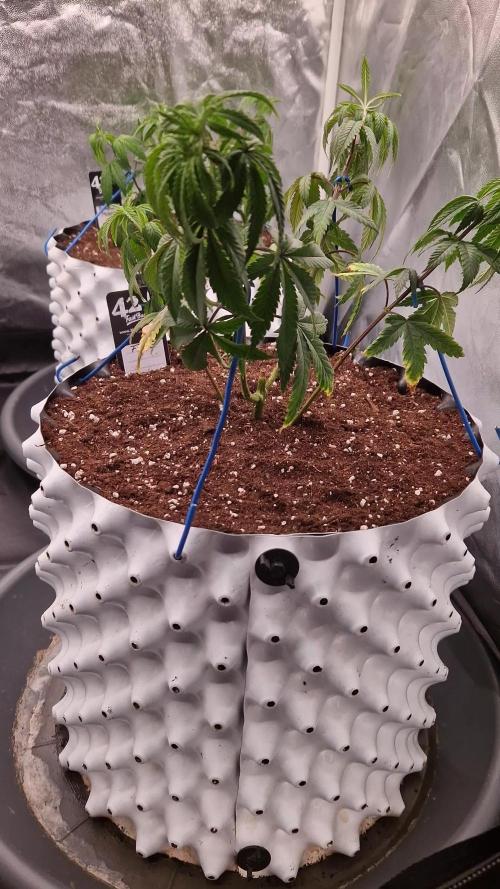
Servus Moin!
Die F025 bekommt jetzt endlich neue Schuhe. Sie hat langsam auch mega Nährstoffmangel und will endlich wieder was gescheites zu futtern.
Likes
7
Share


@Hommero75
Follow
The first 7 days were good the plant is growing nicely. She just got fed for the first time with Goldleaf feterlizer. I had to raise the light higher because she is a little sensitive to the light.
Likes
10
Share


@MG2009
Follow
12/15/202
looks good she is Starting to stretch above the leaves. Starting to smell mom turned out very potent even at 50 days flowering. This will hopefully be earlier because of Hydroponics.🙏
Likes
2
Share

@Chucky324
Follow
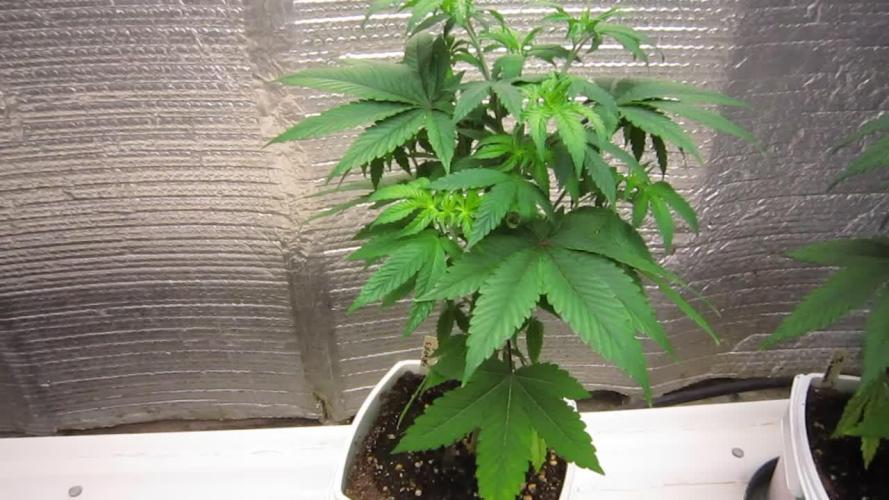
Hello This is the end of week 4 and the beginning of week 5 of veg.
They've got a change in venue. The other grow room. My original grow room. I've been growing in this grow room since 1996.
That would be going on... 😯... 30 years now,... if my finger counting is correct! 🤲🏻
It originally had white styrofoam on all the walls till I found out how flammable it was, then I switched to the reflective plastic in 1999.
The plants are doing good! Growing well! Having Fun! 😀
They are getting 1/2 strength food with each watering and the light is turned up to 40%
I'll repot them in a few weeks.
OK. Have Fun.
Chuck.