The Grow Awards 2026 🏆 









Likes
25
Share
@Elpicor
Follow
3rd week I started with biogrow, raise dimmer from 25 to 35, no LST they will grow wild.

Likes
19
Share
@GoldenWeedGrower
Follow
Legend
Timestamp: 📅
Measures: 🛠️
Water: 🌊
Actions: 💼
Thoughts: 🧠
Events: 🚀
________________________________
📅 D22/V20 - 14/09/23
🛠️ EC 0.8, pH 5.8
🌊
💼
🧠 CO2 Dispenser is working good, it should deliver some CO2 trough the pipe
🚀
________________________________
📅 D23/V21 - 15/09/23
🛠️
🌊
💼 Added some workers to bend her down
🧠
🚀
________________________________
📅 D24/V22 - 16/09/23
🛠️ EC raised up to 1.2, pH trend is down
🌊
💼
🧠 I'm going to change the water in the next days
🚀
________________________________
📅 D25/V23 - 17/09/23
🛠️
🌊
💼 New workers at work to let her stay down and down 💼 💼 💼
🧠 Now Capitan America and his bike is bending the main bud and the CO2 is provided by NASA 😋
🚀
________________________________
📅 D26/V24 - 18/09/23
🛠️ EC is 0.9 and pH is 6
🌊
💼 Added LST with men at work and made some defolation
🧠
🚀
________________________________
📅 D27/V25 - 19/09/23
🛠️ EC 0.9 pH 6.2
🌊
💼 LST and new bending
🧠
🚀
________________________________
📅 D28/V26 - 20/09/23
🛠️
🌊 RES Changed 💦💦💦
💼 Added very little bit of silica powder to the water
🧠 I let the plant absorb it along the night and changed the water again in the morning. It's the first time I add a silica to my grows, waiting to see what is going to happen 😉
🚀

Likes
3
Share
@sellem
Follow
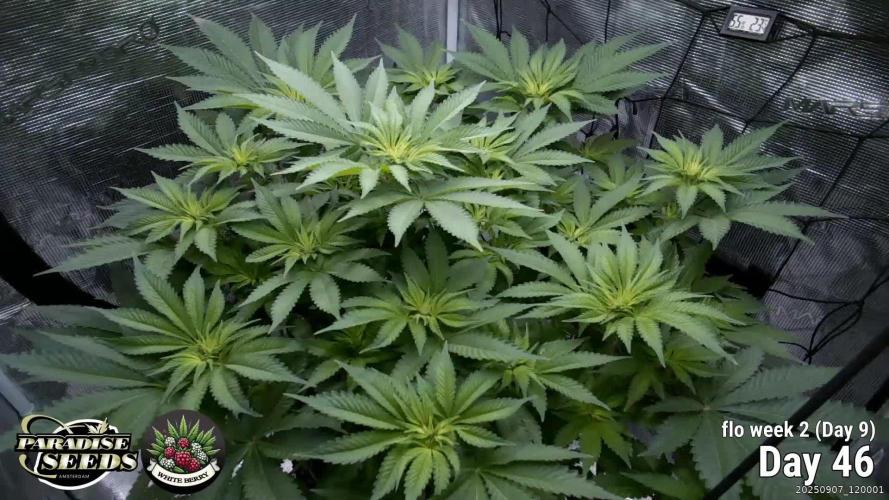
Week 2 of flower has come to an end. The tent is starting to get a bit of a smell now! really nice.
she is budding up alright. Fading out Terra Grow, last watering was 1 ml/L down from 5, and at the same time ramping up Terra Bloom now. Watering in Week 3 will consist purely of Terra Bloom 5ml/L, week 4 will se the addition of green sensation. Also no more Power Roots. I did however added one more dose of great white mycorhizzae again in the laster watering.
Watering is still 6L, around 6PH, every 3 Days with above mentioned nutrients.
I did try my hand at some lollipopping and some defoliation again. i removed everything in the bottom 1/4th of the plant.

Likes
40
Share


Likes
16
Share
@Ieiogrow94
Follow
Eccoci di nuovo qui!!!
Super eccitato per questa nuova collab con Khalifa Genetics, team davvero al top, che mi ha dato l’opportunità di testare questa nuova genetica e di condividere i progressi con tutti voi!!!
Come sempre partiamo nei bicchieri per poi travasare.. Questa volta verrà svolto tutto sotto la Lumatek Zeus 465 ProC, mi aspetto molto da questo ciclo!!
Pianta WOW, non ci sono parole per descrivere questa bellezza, davvero una delle migliori genetiche che abbia mai provato!!!
La consiglio a tutti ma occhio perchè la ccoltivazione richiede cura maggiore!!
.
Grazie a tutti per il supporto ❤️🍀🔥


Likes
19
Share
@buddhi_coop
Follow
This week was tricky. A lot of stress for both me & the plants. They were droopy & not drinking water. I had them in too small of containers so I transplanted them thinking that was the problem. They’re in 5 gallon grass root pots now. I topped them with craft blend & diatomaceous earth, rice hills as well. They’re in Build A Soil 3.0 now. I just fed them compost tea too. They seem to be doing better besides the short one in the back left.
Likes
15
Share
@Papablob
Follow
02/11 Elle se porte assez bien je pense. 😁👍
Merci encore à Divine Seeds pour toutes ces superbes souches. Que l'ont peut trouver là : Divine Seeds : https://divineseeds.net/


Likes
6
Share
@NiBaMeCa420
Follow
Sup y'all,
Another week with the bubblegun grow, we start to see the first signs of flowering which makes us very happy.
I did a lot of defoliation just before i shot the pictures so that a lot of the precious light can penetrate deep into the canopy so that the lower leaves get some light to.
Overall untill this point the grow is going great you can still see which one of the plants had a minor defect but they came along very nice that makes me happy.
No changes in the nutrients are made and the light is still hanging pretty high i strart lowering it somehere this week
That is pretty much what i can say right now
I hope you are all having an awesome week
Cheers,
Nibameca

Likes
26
Share
@darb35
Follow
Finally time has come to chop down plants 1&2.
They look ready and trichomes are mostly cloudy with some embers.
Both plants weight 750 grams as whole.
I would assume there is around 30-40 grams dry on each, but we would have to dry cure and than return with results.
3rd plant can probably go for another week, she looks like she can get her buds bigger, also still many many white pistils.
She is looking very promising with very long buds (:
3rd plant chopped after 1 week, weighs 500 grams wet as whole.
Joining the 2 other girls in the closet

Likes
117
Share
@StarLorr
Follow
Welcome to my autø Møøn Røck 1 Diary.
In this Diary:
Seeds: Sponsored by Ðivine Seeðs
Media: Pro~Mix HP *•ns
Nutrients: Remo Supercharged Kit *•ns
*•not sponsored
___________________________
Feeding:
Tue 22Oct: 2L Remo/Recharge pH'd 6.5
Thu 24Oct: 2L Remo/Recharge pH'd 6.5
Sun 27Oct: 2L Remo/Recharge pH'd 6.5
___________________________
Buds are fatting up.
Senescence occurring on lower leaves.
Had to jack her up on a pedestal as moon rock2 is hugging all the lights😄
___________________________
Thanks for stopping by, likes and comments are appreciated!👊🏻😎
Keep on growin!
Keep on tokin!!!
😙💨💨💨💨💨
Likes
27
Share
@RDWCGrowing
Follow
5/23/2023
Week 7- Day 1 of Flower (Day 110 overall) (Day 49 of Flower)
There was a couple of small super small sucker buds on the lower stocks that needed to be cleaned off but that was it. Just watching them Flower!!
5/24/2023
Week 7- Day 2 of Flower (Day 111 overall)
Tucked a few fan leaves below lower buds but didn't see any blatant offenders that needed to be removed. I typically do start my checks in Week 8 but since this is a new strain I decided to go ahead and do a Trichome check just to see what was what.. Just as I thought nothing but clear glassy Trichomes. I will check again in one week....
5/25/2023
Week 7- Day 3 of Flower (Day 112 overall)
Just letting them grow today!! Smell is getting stronger I would say it is a hint of Pine and a heavier fruity smell.
5/26/2023
Week 7- Day 4 of Flower (Day 113 overall)
I did Nothing but took some pics and I enjoyed it!!!! It is nice to be able to just sit back and watch them on auto pilot.. :-) Tomorrow Water Change Day!!
5/27/2023
Week 7- Day 5 of Flower (Day 114 overall)
I admit it.. I had to defoliate a little bit.. I looked in while changing the water today and there were just a couple blatant offenders blocking the light from lower bud sites and those leaves they just had to go. Other than that I changed the water and this week is where I drop everything and start preparing them for this last phase of the grow. Loving a few of these buds they are starting to beef out very nicely.
I added 36 gallons
Mammoth Silica = .5Mil/Gal= 18Mil
Root DRIP = 1Mil/Gal= 36Mil
CalMag= .5Mil/Gal= 18Mil
FloraMicro = 3.8Mil/Gal= 137Mil
FloraGro= 2.8Mil/Gal= 100Mil
FLoraBloom= 4.6Mil/Gal= 166Mil
LiquidKoolBloom= 2.5Mil/Gal= 90Mil
TPS SIGNAL= 4.0Mil/Gal= 144Mil
ORCA = .5Mil/Gal= 18Mil
Water Temp= 70.1
Tent Temp= 76
Humidity =64 ** I have two dehumidifiers running on Ink bird controllers to try and keep the humidity down, In late in flower I like to keep the humidity above 45 but below 60.
5/28/2023
Week 7- Day 6 of Flower (Day 115 overall)
Opened the back of the tent today and boy did she need some defoliation love in the back. Other than that I took off a few little sucker buds trying to form. I did start to setup my Dry space as well as did a Trichome Check today and the brown tips are coming in nicely.
5/29/2023
Week 7- Day 7 of Flower (Day 116 overall)
Found a few baby sucker buds trying to form so I removed them. Other than that I am enjoying watching her mature.
I also started my Reverse of the Clone I took 6 weeks ago in Apr from #3. I am uploading footage of the reversing process for your viewing pleasure.

Likes
16
Share
@Ultraviolet
Follow
Seedling managing 93F 30%RH, around 20 DLI. Vpd is in the 3's. No I don't recommend.
Signum Magnum.
"A great sign appeared in the sky
a woman clothed with the sun
with the moon under her feet
and on her head a crown of twelve stars.
Sing ye to the Lord a new canticle:
because He has done wonderful things.
Glory to the Father, and to the Son, and to the Holy Spirit
As it was in the beginning, and now, and ever shall be, world without end."
The plant nutrient nitrogen exists in forms with both positive and negative charges. Ammonium (NH4+)(immobile in soil)(Cation) has a positive charge, while nitrate (NO3-) (highly mobile in soil)(Anion)has a negative charge. Nitrogen is unique among plant nutrients in that it can exist in both positively charged (ammonium, NH₄⁺) and negatively charged (nitrate, NO₃⁻) forms in the soil. This makes it a special nutrient. In that it is responsible for providing balance for reactionary trade offs when it comes to ph. Because ph itself in the medium will always slowly drift towards acidicity, such is nature. 80% of nitrogen should be nitrate and no more than 20% ammoniacal nitrogen.
Ca, mg, and K are the big 3 cations related to soil composition, pH & base saturation.
When nitrogen is in the form of ammonium, it can compete with calcium, magnesium, and potassium for absorption sites in the plant root. This competition can lead to a reduction in the uptake of these other essential nutrients. Nitrogen, particularly in its nitrate form (NO3-), can increase soil acidity, which can also affect the availability of calcium, magnesium, and potassium. The form of nitrogen applied (ammonium vs. nitrate) can influence its interactions with other nutrients. Ammonium nitrogen can have a more pronounced negative effect on the uptake of calcium, magnesium, and potassium compared to nitrate nitrogen.
Common forms of ammonium nitrogen include ammonium ion (NH4+), urea, and ammonium compounds like ammonium nitrate, ammonium sulfate, and ammonium phosphate.
Common forms of nitrate nitrogen include potassium nitrate (KNO3), sodium nitrate (NaNO3), calcium nitrate (Ca(NO3)2), and ammonium nitrate (NH4NO3).
Phosphorus is an essential plant nutrient, and its availability in the soil is strongly linked to the presence of oxygen. Plants primarily absorb phosphorus as phosphate (PO4), and oxygen is a key component of this molecule. Furthermore, the availability of phosphorus in the soil can be impacted by factors like soil aeration and temperature, which in turn affect the oxygen supply to the roots.
Phosphorus uptake in plants is most critical during the early stages of growth, particularly within the first few weeks of plant development.
Young plants actively growing tissues have a high demand for phosphorus. They may absorb up to 75% of their total phosphorus requirements within the first few weeks of vegetative growth, with up to 51% of uptake happening overnight, primarily in the first few hours or early nightfall.
⑨Anaerobic root respiration, or respiration without oxygen, is detrimental to plants because it's less efficient and produces toxic byproducts, leading to reduced energy production, nutrient uptake issues, and ultimately, root damage and plant stress.
⑨Anaerobic respiration, unlike aerobic respiration, doesn't utilize oxygen as the final electron acceptor in the electron transport chain. This results in a significant drop in the amount of energy (ATP) produced, which is necessary for various plant functions, including growth, nutrient uptake, and maintenance of cellular processes.
⑨In the absence of oxygen, plants produce byproducts like ethanol and lactic acid during anaerobic fermentation. These byproducts can be toxic to the roots and inhibit their function,
⑨When oxygen is depleted in a medium, the pH tends to decrease (become more acidic) due to the production of metabolic byproducts. This is particularly relevant in biological systems where aerobic respiration relies on oxygen as the final electron acceptor.
⑨When oxygen is scarce, plants may switch to anaerobic respiration. This process produces carbon dioxide (CO2) as a byproduct.
⑨CO2 dissolves in water to form carbonic acid (H2CO3). This acid lowers the pH of the medium, making it more acidic.
⑨Anaerobic conditions can impair a plant's ability to regulate its internal pH, leading to a drop in cytoplasmic pH and potentially cellular acidosis.
⑨The change in pH can also affect the availability of certain nutrients to the plant, as pH influences the solubility of micronutrients like iron, manganese, zinc, copper, and boron.
⑨The lack of oxygen in the plant medium leads to a decrease in pH due to the production of carbon dioxide during anaerobic respiration and impaired pH regulation within the plant.
In plant cells, cellular acidosis, a drop in the internal pH of the cytosol, is a significant stress response, particularly during conditions like flooding or hypoxia. This acidification can be triggered by a decrease in oxygen levels, leading to the production of metabolic byproducts like lactic acid and CO2. The plant's ability to tolerate and recover from these conditions depends on its cellular mechanisms to regulate pH and mitigate the effects of acidosis. When plants are subjected to low oxygen environments, such as those experienced during flooding, anaerobic metabolism, which produces lactic acid and ethanol, becomes the primary source of energy. This can lead to a build-up of these acidic metabolites in the cytosol, causing a drop in pH.
OXYGEN
Atomic oxygen (single oxygen atom, O) is the lightest form of oxygen, as it has the lowest mass of the oxygen molecules. Oxygen also exists as a diatomic molecule (O2) and an allotrope called ozone (O3), which have higher masses due to the number of oxygen atoms combined.
Atomic Oxygen (O):
This refers to a single oxygen atom, which is the most fundamental form of oxygen.
Molecular Oxygen (O2):
This is the common form of oxygen we breathe, consisting of two oxygen atoms bonded together.
Ozone (O3):
This is an allotrope of oxygen, meaning it's a different form of the same element, consisting of three oxygen atoms bonded together.
Since atomic oxygen has the fewest oxygen atoms, it naturally has the lowest mass compared to O2 or O3.
Ozone (O3) Lifespan:
Ozone has a relatively long lifespan in the stratosphere, particularly at lower altitudes. For example, at 32 km in the middle latitudes during spring, ozone has a lifetime of about 2 months.
Oxygen (O) Lifespan:
Atomic oxygen, on the other hand, has a much shorter lifespan. At the same altitude, its lifetime is about 4/100ths of a second.
Ozone-Oxygen Cycle:
The ozone-oxygen cycle involves the rapid exchange between atomic oxygen (O) and ozone (O3). UV radiation can split molecular oxygen (O2) into atomic oxygen (O), which then reacts with O2 to form ozone (O3). Ozone can also be photolyzed by UV radiation, creating atomic oxygen again, which can then react with O3 to reform O2.
Dominant Form:
The partitioning of odd oxygen (Ox) between ozone and atomic oxygen favors ozone in the lower stratosphere. This means that a much larger proportion of odd oxygen exists as ozone than as atomic oxygen, especially in the lower stratosphere.
Recombination:
Atomic oxygen has a high energy and reactivity. When it encounters another oxygen atom, they can combine to form O2. This process releases energy, contributing to the heating of the atmosphere.
Ozone Formation:
Atomic oxygen can also react with molecular oxygen (O2) to form ozone (O3). Ozone plays a significant role in absorbing harmful UV radiation.
Other Reactions:
Atomic oxygen can react with various other molecules in the atmosphere, like nitrogen (N2), water (H2O), and carbon dioxide (CO2), forming different compounds.
UV light below 240nm (peak 185nm) creates ozone (O₃) through a process called photolysis, where UV light breaks down dioxygen molecules (O₂) into single atomic oxygen atoms (O). These single oxygen atoms then react with other oxygen molecules to form ozone (O₃). Specifically, UV-C light with wavelengths shorter than 240 nm can cause this photolysis.
UV light with wavelengths between 240-280 nm, (peak 254 nm) breaks down ozone (O₃) into dioxygen molecules (O₂) and atomic oxygen atoms (O). 280nm does not have the energy potential to break apart the stable bond of (O₂) into enough (O) to make (O₃)
At ground level, atomic oxygen (single oxygen atoms) has a very short lifespan. This is because it's highly reactive and quickly combines with other molecules to form stable diatomic oxygen (O2) or other compounds. While the exact timeframe varies depending on the specific circumstances, its lifespan is typically measured in nanoseconds or picoseconds.
Likes
46
Share
@Wastent91
Follow
Ragazzi benvenuti!!! Questa settimana è andato tutto bene! La ragazza sta crescendo davvero bene,le foglie sono raddoppiate di dimensione ma soprattutto i fiori stanno apparendo da tutte le parti si stanno ingrassando bene e inizia a sentire un odore di spezie ! Non ho mai provato la varietà rutz ma tutti mi dicono che ha un gusto e una potenza formidabili! Mi aspetto una gran bella ragazza che produrrà un erba bella potente ! Un bel esperimento reso possibile grazie a Mars Hydro luce spettacolare e Sweet seeds che non si smentisce mai in fatto di genetica! Complimenti! Buon 420 a tutti!!
Processing
Likes
3
Share
@Canadian_Bud
Follow
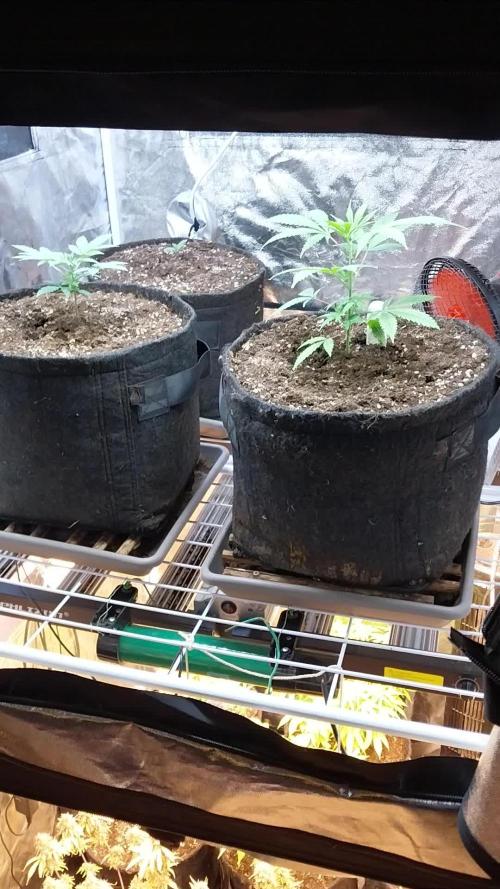
Week 3 and is she growing, the root mass inside is growing rapidly and a lovely white, almost finished the Scrog unit and I am hoping to have it done this weekend if the welding goes good. just changed up the nutrition with 6 gallons and took 1hr for the change over. and still doing some topping. As it looks in my pipe bowl I see a big yield in the near future.😎💪
Likes
32
Share
@MadeInGermany
Follow
Info:
Unfortunately, I had to find out that my account is used for fake pages in social media.
I am only active here on growdiaries.
I am not on facebook instagram twitter etc All accounts except this one are fake.
Flowering day 50
since time change
to 12/12 h.
Hey guys :-)
the little lady got really nice buds :-)
They smell very tasty. Harvesting takes place in the next 12-16 days.
Was poured 2 times with 1.2 l.
Everything was kept clean.
Stay healthy 🙏🏻
You can buy this Strain at :
https://www.zamnesia.com/de/5165-zamnesia-seeds-kalini-asia-feminisiert.html
Type:
Kalini Asia
☝️🏼
Genetics:
Black Domina x Purple Kush
👍
Vega lamp:
2 x Todogrow Led
Quantum Board 100 W
💡
Bloom Lamp :
2 x Todogrow Led
Cxb 3590 COB 3500 K 205W
💡💡☝️🏼
Soil :
Canna Coco Professional +
☝️🏼
Fertilizer:
Green House Powder Feeding
☝️🏼🌱
Water:
Osmosis water mixed with normal water (24 hours stale that the chlorine evaporates) to 0.2 EC. Add Cal / Mag to 0.4 Ec Ph with Organic Ph - to 5.5 - 5.8 .
