


Likes
Comments
Share


@Theia
Follow
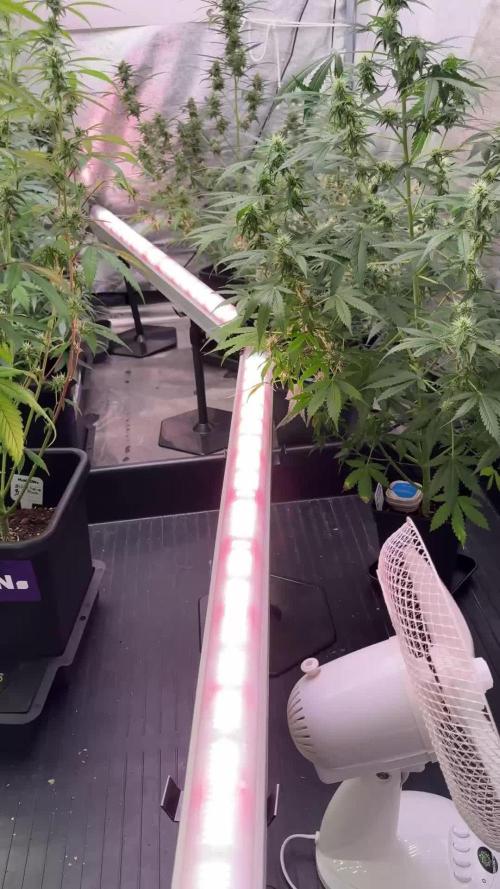
I have spent the week bending and tightening all the bondage straps to maintain the even canopy I'm after and allow for maximum footprint. I expect during this week she will get a net slung over her as I am running out of pot circumference to keep using ties. I need to work it all outwards now .
She got a spray of boom boom spray this week after the heaviest HST session. It's a
Foliar biostimulant that helps the plant recover from stress.. mixed 100ml to 0.5ml of boom spray and applied at lights on
Still feeding just plain untreated tap water. About 1l a day ATM.
Lights are at 60% and environmental figures are spot on.
This is a super healthy plant . I am very very impressed with biotabs as a product. So easy ..

Likes
Comments
Share

@DogDoctorOfficial
Follow
🌿 Frosted Guava Auto by Zamnesia | Pheno B | Week 9
❄️ Dark, Frosty & Moving Fast
Welcome back to another chapter of the 8×8 Adventure!
And this girl...
She's shining. 💚
Every phenotype has something that makes it recognizable.
Something that, after enough weeks of watching them develop, becomes part of their identity.
With Frosted Guava Pheno B, I think I've finally found hers.
That green.
That incredibly deep, rich, dark green.
It's one of the first things I notice every time I look at her.
She's not the tallest plant in the room.
She's not trying to become the biggest.
But she has developed into a beautiful, compact, extremely healthy-looking flowering plant with an appearance that is becoming increasingly difficult to ignore.
And right now?
She's moving.
She's developing quickly.
The flowers are progressing.
The resin is becoming more obvious.
And the whole plant looks like she's very happy with the direction she's taking.
So this week...
the spotlight belongs to her.
🌱 The 8×8 Adventure
For anyone discovering this diary for the first time, welcome to the 8×8 Adventure.
Twelve plants.
Different genetics and phenotypes.
One growing environment.
One general philosophy.
And an awful lot of personality.
The project is being run under a 12/12 light schedule from seed, allowing each plant to reveal its natural architecture without giving them an extended traditional vegetative period.
And this is exactly why I love documenting individual phenotypes.
Because even when plants share the same genetic line, they don't necessarily tell the same story.
Some stretch.
Some stay compact.
Some build enormous central flowers.
Some distribute their flowers differently.
Some become monsters.
Some become elegant.
And some...
become very, very dark green Frosted Guavas. 😂💚
🌿 Look at That Green
Let's start with the obvious.
Look at her foliage.
That colour is beautiful.
Deep.
Dark.
Rich.
Healthy-looking.
The leaves have become one of the defining visual characteristics of this phenotype.
And when you put that dark foliage next to the developing flowers, the contrast is fantastic.
The white pistils stand out.
The developing resin catches the light.
The flowers appear almost brighter because they're surrounded by that deep green background.
It's a beautiful combination.
And I honestly really like this plant.
There are plants you admire because they're enormous.
There are plants you admire because they're unusual.
And then there are plants where you simply look at them and think:
"Damn... that's a beautiful plant."
Frosted Guava Pheno B is becoming one of those for me.
🌸 The Flowers Are Moving Fast
The biggest difference I'm noticing this week is the speed of development.
She's moving.
The flowers are becoming increasingly defined, with more structure appearing throughout the developing buds.
The calyxes are becoming more obvious.
The pistils are still beautifully prominent.
And the resin continues making its presence known.
Looking through the photographs, you can see how much is happening across the plant.
She's not sitting still.
She's building.
And that's exactly what I want to see at this stage.
There is still plenty of development ahead, but the direction is becoming increasingly clear.
She's a flower builder.
And she's getting on with the job.
❄️ Frosted Guava Is Starting to Look Frosted
The name continues making more sense every week.
The flowers are carrying increasingly visible resin, particularly around the developing calyxes and sugar leaves.
And when you get close with the camera...
that's when this plant really becomes interesting.
The individual flowers have so much detail.
White pistils crossing over one another.
Calyxes stacking and expanding.
Tiny sugar leaves surrounding the developing structures.
And that little sparkle beginning to appear everywhere.
This is exactly why I love photographing these plants.
From a distance, they're simply beautiful flowering plants.
Up close...
they become another world.
👀 A Little Foxtailing?
I can see a little bit of foxtailing beginning to appear in some of the flowers.
And honestly?
I'm not losing sleep over it. 😂
It's there.
I'm seeing it.
I'm documenting it.
But I'm also looking at the entire plant.
And the entire plant looks fantastic.
The flowers are developing.
The foliage is beautiful.
The structure is healthy-looking.
The plant is progressing quickly.
So I'm not going to turn one characteristic into the entire story of the plant.
This is phenotype observation.
Sometimes a plant shows you a particular expression.
You document it.
You watch how it develops.
And you let the plant finish telling you what that expression means.
For now...
I'm simply curious.
Let's see where she takes it.
✂️ After Last Week's Cleanup
Last week we gave her a selective cleanup.
We removed foliage that had become unnecessary, opened some areas of the canopy and cleaned some of the lower growth.
And importantly, we didn't try to strip everything.
There was no reason to.
Healthy leaves remained.
The productive structure remained.
And now we're watching how she responds.
This week, I'm not looking to chase her with the scissors again.
She's doing exactly what I want her to do:
grow.
The cleanup has been done.
The room has been cleaned.
The canopy has been organized.
Now we let the plant work.
Sometimes the best intervention after making a change...
is to stop intervening and observe the result.
🌿 Small Plant. Absolutely Not a Small Plant.
One thing that continues to amuse me about this phenotype is the difference between her physical size and her personality.
At approximately 108 cm, she's considerably more compact than some of the other girls in the room.
But she doesn't feel small.
She has presence.
She has flowers.
She has structure.
And she's becoming increasingly impressive every week.
That's another lesson the 8×8 keeps teaching me.
Height doesn't tell you everything.
A shorter plant can still have an enormous personality.
A compact plant can still produce an impressive flowering structure.
And a plant doesn't need to reach the ceiling to deserve the spotlight.
Frosted Guava Pheno B certainly doesn't.
☀️ Eating Photons
The lighting environment continues to provide plenty of energy for this stage.
The Future of Grow Black Series LED remains the main overhead light source, with Lumiflora contributing additional illumination into the lower canopy.
And this girl is clearly making use of what she's receiving.
Light goes in.
The plant does its biological magic.
And week after week...
we see the result.
More structure.
More flowers.
More resin.
More development.
This is one of the reasons I love having different phenotypes in the same room.
You can give them essentially the same environment...
and then watch how differently they use it.
Frosted Guava Pheno B has found her own rhythm.
And I really like her rhythm.
💧 Feeding & Environment
The feeding program remains consistent with the flowering strategy:
🌱 Plagron Terra Bloom — 2.2 ml/L
🌿 Plagron Power Buds — 1 ml/L
✨ Plagron Green Sensation — 1 ml/L
🍯 Plagron Sugar Royal — 1 ml/L
⚗️ pH adjustment as required
Current recorded parameters:
🌸 Flowering: Week 9
📏 Height: 108 cm
💡 Light schedule: 12/12
🌡️ Day temperature: 29°C
🌙 Night temperature: 25°C
💧 Relative humidity: 72%
⚗️ pH: 6.0
⚡ Recorded EC/TDS: ~2.0
🌡️ Solution temperature: 25°C
🌱 Substrate temperature: 26°C
🌬️ CO₂: 639 ppm
? Pot size: 15 L
💦 Watering: approximately 1.2 L per plant / 24h
At this point in the cycle, stability remains the priority.
The plant is moving well.
The flowers are developing.
The foliage remains remarkably dark and vigorous.
So there is no reason to start changing things simply for the sake of changing them.
🌬️ Keeping an Eye on the Canopy
With flowering progressing and the canopy continuing to develop, airflow and environmental consistency remain important.
This is another reason I liked the cleanup we performed last week.
Not because fewer leaves automatically means a better plant.
It doesn't.
But because thoughtful canopy management can help keep the structure organized as the flowers continue developing.
And now that she's cleaned up?
I'm happy to leave her alone.
Let the remaining leaves work.
Let the flowers develop.
Let the plant show us what she wants to become.
📸 This Week's Gallery
I think this week's gallery really captures her personality.
The full-plant photographs show the structure.
The closer photographs show the flowers.
And the macro-style views reveal the details that make this phenotype special.
The deep green foliage.
The white pistils.
The developing calyxes.
The increasing resin.
And those little signs of foxtailing appearing here and there.
Everything together creates a plant that looks very much like herself now.
And that's something I love about reaching this stage of a grow.
Earlier in the cycle, you're asking:
"What is this plant going to be?"
Eventually you stop asking.
You start saying:
"Ah... this is who she is."
And I think we're getting there with Frosted Guava Pheno B.
🔬 Phenotype Spotlight — The Dark Green Girl
If I had to describe her in a few words right now:
Compact.
Dark green.
Frosty.
Fast.
Beautiful.
That's her.
Her sister has her own personality.
The other Frosted Guava phenotypes have their own expressions.
But this girl?
She's becoming very easy to recognize.
And that's the beauty of phenotype hunting.
You're not necessarily looking for one "perfect" plant.
You're looking for differences.
You're looking for expressions.
You're looking for those little characteristics that make one plant stand out from another.
And sometimes...
you find a phenotype whose biggest characteristic is simply that you really, really enjoy looking at her.
That's Frosted Guava B for me.
🔭 Looking Ahead
Now I'm very curious.
Because she's moving quickly.
The flowers are developing beautifully.
The resin is increasing.
The structure is becoming more defined.
And that little bit of foxtailing gives us another characteristic to watch.
Will it continue?
Will it settle?
Will the flowers simply keep stacking and swelling around it?
We'll see.
I'm not going to write the ending yet.
That's the plant's job.
For now, I'm just going to keep watching.
Keep documenting.
Keep photographing.
And keep letting this beautiful girl show us what she has.
💚 Final Thoughts — She Deserves the Spotlight
Frosted Guava Pheno B started this adventure as the smaller, quieter sister.
And look at her now.
She's still compact.
She's still different.
But quiet?
Not anymore.
She's shining.
That deep, deep green foliage is absolutely beautiful.
The flowers are moving quickly.
The calyxes are developing.
The white pistils are everywhere.
The frost is increasing.
And the whole plant has developed an identity of its own.
Yes, I can see a little foxtailing.
And no...
I don't mind. 😂
Because overall?
She's outstanding.
She's healthy-looking.
She's balanced.
She's beautiful.
And she's giving me exactly what I love most about this project:
something interesting to watch.
Every week she gives me another little detail.
Another change.
Another reason to stop and look.
And that's what the 8×8 Adventure is all about.
Not just growing plants.
Watching plants become themselves.
Frosted Guava Pheno B is doing exactly that.
And I have to admit...
I really like who she's becoming.
So let's keep watching.
Let's keep photographing.
Let's keep learning.
And most importantly...
let's let this dark green beauty shine. 💚❄️🌿
🙏 Thank You
A huge thank you to Zamnesia for these beautiful genetics.
Thank you to Plagron for supporting the flowering program.
Thank you to Future of Grow LED for the main lighting driving the garden.
Thank you to Lumiflora for adding the under-canopy dimension to this experiment.
Thank you to TrolMaster for helping maintain the environment behind the scenes.
And, of course, thank you to everyone following the 8×8 Adventure on GrowDiaries.
Every comment.
Every question.
Every observation.
Every grower following along.
It all makes this project more enjoyable.
Frosted Guava Pheno B may not be the biggest girl in the room...
But she's certainly becoming one of the girls I enjoy watching the most.
Deep green.
Beautiful flowers.
A little frost.
A little foxtailing.
And a whole lot of personality.
Let's see where she goes from here.
Growers Love & Happy Growing! 🌱💚❄️


Likes
12
Share


@Mr420
Follow
Day 67 plant is stretching and very healthy. Branches are thick and strong.
Day 68 nothing to report all good. Video for d68 didn't take pics.
Day 69 refilled refill tank 920ppm ph'd 6.2 plant is so healthy and getting big.
Day 70 plant is nice and green and healthy nothing new.
Day 71 all is good.
Day 72 plant will get defolited tomorrow nothing new today.
Day 73 defolited plant seems to be doing great after defoliation looking and healthy and happy.

Likes
10
Share


@Minuteman_Organics
Follow
A few of the zed blacks hermed..spreading pollen into the flower tent. Already seeing some seeds develop. It is what it is. I should have done a better job checking on them. I kept the Zed blacks that only had a couple flowers on the bottom but tossed anything that had flowers growing up the majority of the plant. Some of the most famous strains in the world were self pollinated so I don't have issues with a couple male flowers. They're just trying to improve their fitness as nature intended.
The plants are doing very well. A few of the bottom leaves are dying which is normal...senecense! Sucking up those nutrients. I've been liquid feeding using the fish, seaweed, humate and recharge.
I have saved the males and they are trying to reveg. Still popping out a few flowers which I'm cutting off. 1 rainbow belt. 1 zed black. 3 hash plants
The hash plants are smelling incredible. Definitely a few keepers mixed in here. Maybe 3/7. Hopefully the quality of the flower backs it up.
Zed blacks have 2/3 I'm interested in. One is very very low yield. Unless its a really high quality plant I'm gonna toss it
Rainbow belts are both smelling ridiculous. Super frosty. Good yield. One is slightly more frosted than the other. The zkittles pheno has pure Skittles smell with a little lemon cleaner chem to back it up. Probably my keeper!

Likes
36
Share


@Xpie77
Follow
Nothing much, now the flowering started I've changed from P20 phosphore to pk13/14 ~ 2 ml a liter.

Likes
56
Share


@Master_weeda
Follow
Bonjour à tous les padawans et maîtres jedis
Jour84 arrosage avec 2 litres d'eau ph6.3
Jour86 arrosage avec 2. 5litres d'eau ph6.3
Jour89 arrosage avec 2 litres d'eau ph6.3
LE MEILLEUR MOMENT POUR RINCER SON CANNABIS
Le rinçage commence en général deux semaines avant la récolte. Si le plant a une période de floraison de huit semaines, le rinçage doit commencer six semaines après le début de la période de floraison. Il est préférable de regarder de près les trichomes sur le plant pour déterminer quand votre cannabis est prêt à être récolter. Si les petits trichomes commencent juste à passer d’une couleur transparente à une teinte laiteuse et blanche, c’est une bonne indication que les plants peuvent commencer à être rincés. Il faut s’arranger pour que la majorité des trichomes aient changé vers la couleur désirée pour la récolte après deux semaines – ça devient plus facile à faire avec l’expérience, alors accrochez-vous !
Le rinçage peut également être un bon moyen de remettre à zéro la terre quand un plant est toujours en phase de croissance végétative. Parfois, un cultivateur suralimente par accident son cannabis, ce qui provoque un changement de couleur et un flétrissement du bout des feuilles. Ceci est appelé une « brûlure par nutriments ». Rincer la terre peut éliminer les nutriments excédentaires, ce qui aide à résoudre le problème. Cependant, c’est une mesure drastique à ce stade de la culture, alors assurez-vous que le problème soit bien une brûlure par nutriments et non quelque chose d’autre.
Le rinçage ne concerne pas que le moment de la récolte. Cette technique peut aussi être mise en place durant la phase de croissance afin de débarrasser le sol des nutriments. Bien évidemment, les nutriments permettent à votre plante de rester en bonne santé et vous assurent des rendements maximaux, mais une trop grande quantité peut causer une accumulation et un état statique durant lequel la plante ne peut plus y accéder.
Le blocage des nutriments peut être causé par une accumulation saline ou des niveaux de pH incorrects. Ces deux causes peuvent être résolues par un rinçage de votre plante à l’eau claire. Les fluides viendront pousser les nutriments en dehors du substrat et le débarrasseront de l’accumulation, permettant ainsi aux racines de pouvoir accéder à nouveau aux nutriments.
EMPÊCHER LE BLOCAGE D'ABSORPTION DES NUTRIMENTS AVANT QU’IL NE POSE PROBLÈME
Au mieux, le blocage des nutriments peut être un problème, au pire, il peut être un vrai désastre. Comme le dit l’adage, il vaut mieux prévenir que guérir. Il vaut mieux prendre de l’avant pour empêcher le blocage des nutriments plutôt que de s’y atteler lorsque c’est trop tard.
Empêcher le blocage des nutriments peut se faire par le biais d’un rinçage de routine. En rinçant vos plantes une fois avant la floraison et une fois au milieu de cette dernière, vous minimiserez l’accumulation de nutriments.
LES ENZYMES À LA RESCOUSSE
Après le rinçage pour contrer l’accumulation ou le blocage des nutriments, vous remarquerez peut-être que vos plantes ont une apparence vert foncé, c’est le signe d’un excès de nutriments. Dans ce cas, certains cultivateurs choisissent d’ajouter une formule riche en enzymes à leur substrat.
Au cas où vous auriez oublié vos cours de biologie, les enzymes sont des protéines qui catalysent les réactions. Elles aident à rincer le substrat en décomposant l’amidon, les glucides et les nutriments. Il existe sur le marché toute une variété de produits qui contiennent des formules d’enzymes très efficaces.
Si l’eau ne suffit pas à vos plantes, ces petites protéines ne feront qu’une bouchée de l’accumulation de nutriments !
COMMENT BIEN RINCER SON CANNABIS
Rincer votre plant de cannabis est un processus simple. À chaque fois que vous apporteriez normalement des nutriments, vous rincez à la place. De l’eau du robinet non traitée est tout ce dont vous avez besoin pour rincer, assurez-vous juste que son pH est sans danger pour le cannabis. La plupart de l’eau de puits a un pH sain et ne nécessite pas de traitement, mais s’il est nécessaire de traiter l’eau de rinçage pour avoir un pH adapté, faites-le. Les ajustements du pH seront donc la seule chose à considérer.
Inonder la terre avec autant d’eau fraîche qu’elle puisse contenir. Laissez l’eau durant quelques minutes pour qu’elle puisse absorber les nutriments, puis inondez la terre encore pour rincer les nutriments loin du plant. Si vous cultivez en intérieur dans des pots, notez la couleur de l’eau qui s’échappe du fond des pots. Elle sera tâchée et aura une couleur sale. C’est à cette étape qu’un appareil de mesure des TDS (Total des Solides Dissous) est utile. Si vous récupérez et mesurez le TDS de l’eau « évacuée », elle devrait avoir un taux de 1300ppm, ce qui est assez élevé. Il est important de rincer le plant jusqu’à ce que total baisse à un niveau de 50ppm, ou du moins qu’il s’approche du TDS de l’eau fraîche que vous utilisez pour rincer le plant. La couleur de l’eau d’évacuation va s’éclaircir et apparaîtra plus propre. Vous devez tirer autant que possible de minéraux dissous du plant.
Comment et Quand Rincer les Plants de Cannabis
Rincer les plants de cannabis avant la récolte peut faire la différence entre les meilleurs têtes ou la plus rude pour la gorge. Cette petite tâche est simple et facile à faire. Ajoutez juste de l’eau ! Attention car le moment du rinçage joue un rôle critique.
Le b.a.-ba du rinçage de ses plants de cannabis.
Sommaire:
1. Qu’est-ce que le rinçage ?
2. Le meilleur moment pour rincer son cannabis
3. Empêcher le blocage d'absorption des nutriments avant qu’il ne pose problème
4. Les enzymes à la rescousse
5. Comment bien rincer son cannabis
6. Comment rincer ses plantes en hydroponie
7. Les résultats du rinçage de son cannabis
8. Quand éviter de rincer son cannabis
Vous avez enfin fini vos cultures et vous vous retrouvez avec un magnifique plant couvert de super têtes, maintenant sèches, vous avez fait le curing et vous êtes prêt à fumer – et pourtant quelque chose ne va pas. La weed semble ne pas vouloir se consumer et quand vous tirez une bouffée, c’est comme si on vous avait donné un coup de poing dans les poumons et vous toussez en craignant pour votre vie ! Le goût est rude et décevant. Si c’est une situation que vous avez vécue, il y a des chances pour que vos plants n’aient pas été rincés correctement avant la récolte.
Cette fumée bien loin d’être agréable est provoquée par la présence dans le plant des nutriments et minéraux utilisés lors de la culture, ce qui altère la façon dont le plant se consume. Rincer le plant élimine ces nutriments restants, ce qui améliore la qualité des sensations. Heureusement, le rinçage des plants de cannabis se fait facilement et sans effort, et cela vous permet de produire des têtes douces et délicieuses en un rien de temps.
ARTICLE LIÉ
Comment Utiliser les Nutriments pour Cannabis
QU’EST-CE QUE LE RINÇAGE ?
L’acte de rincer un plant implique d’utiliser de l’eau pour éliminer tout nutriment présent dans la terre. Une grande quantité d’eau est passée à travers la terre et drainée sur une base régulière. Tous les minéraux et nutriments présents dans la terre sont rincés avec le temps avec l’eau, ce qui laisse une terre propre.
Mais pourquoi vouloir éliminer tous les minéraux de la terre ? N’est-ce pas mauvais pour la récolte ? En fait, cela aide à la récolte de manière significative. Quand les nutriments sont éliminés de la terre, ceci force le plant de cannabis à utiliser tous les nutriments toujours présents dans le plant. C’est comme pour le corps humain. Quand on consomme beaucoup d’aliments, ce que nous n’utilisons pas est transformé en graisses. Dans les situations extrêmes où la nourriture est rare, le corps s’appuie sur cette graisse stockée pour tirer de l’énergie.
Comme rincer force le cannabis à utiliser tous les nutriments restants dans le plant, aucun ne devrait rester et altérer les têtes récoltées. Cependant, si vous le faites trop tôt, cela peut nuire à la santé du plant, le moment est donc clé.
LE MEILLEUR MOMENT POUR RINCER SON CANNABIS
Le rinçage commence en général deux semaines avant la récolte. Si le plant a une période de floraison de huit semaines, le rinçage doit commencer six semaines après le début de la période de floraison. Il est préférable de regarder de près les trichomes sur le plant pour déterminer quand votre cannabis est prêt à être récolter. Si les petits trichomes commencent juste à passer d’une couleur transparente à une teinte laiteuse et blanche, c’est une bonne indication que les plants peuvent commencer à être rincés. Il faut s’arranger pour que la majorité des trichomes aient changé vers la couleur désirée pour la récolte après deux semaines – ça devient plus facile à faire avec l’expérience, alors accrochez-vous !
Le rinçage peut également être un bon moyen de remettre à zéro la terre quand un plant est toujours en phase de croissance végétative. Parfois, un cultivateur suralimente par accident son cannabis, ce qui provoque un changement de couleur et un flétrissement du bout des feuilles. Ceci est appelé une « brûlure par nutriments ». Rincer la terre peut éliminer les nutriments excédentaires, ce qui aide à résoudre le problème. Cependant, c’est une mesure drastique à ce stade de la culture, alors assurez-vous que le problème soit bien une brûlure par nutriments et non quelque chose d’autre.
Flushing
Le rinçage ne concerne pas que le moment de la récolte. Cette technique peut aussi être mise en place durant la phase de croissance afin de débarrasser le sol des nutriments. Bien évidemment, les nutriments permettent à votre plante de rester en bonne santé et vous assurent des rendements maximaux, mais une trop grande quantité peut causer une accumulation et un état statique durant lequel la plante ne peut plus y accéder.
Le blocage des nutriments peut être causé par une accumulation saline ou des niveaux de pH incorrects. Ces deux causes peuvent être résolues par un rinçage de votre plante à l’eau claire. Les fluides viendront pousser les nutriments en dehors du substrat et le débarrasseront de l’accumulation, permettant ainsi aux racines de pouvoir accéder à nouveau aux nutriments.
EMPÊCHER LE BLOCAGE D'ABSORPTION DES NUTRIMENTS AVANT QU’IL NE POSE PROBLÈME
Au mieux, le blocage des nutriments peut être un problème, au pire, il peut être un vrai désastre. Comme le dit l’adage, il vaut mieux prévenir que guérir. Il vaut mieux prendre de l’avant pour empêcher le blocage des nutriments plutôt que de s’y atteler lorsque c’est trop tard.
Empêcher le blocage des nutriments peut se faire par le biais d’un rinçage de routine. En rinçant vos plantes une fois avant la floraison et une fois au milieu de cette dernière, vous minimiserez l’accumulation de nutriments.
LES ENZYMES À LA RESCOUSSE
Après le rinçage pour contrer l’accumulation ou le blocage des nutriments, vous remarquerez peut-être que vos plantes ont une apparence vert foncé, c’est le signe d’un excès de nutriments. Dans ce cas, certains cultivateurs choisissent d’ajouter une formule riche en enzymes à leur substrat.
Au cas où vous auriez oublié vos cours de biologie, les enzymes sont des protéines qui catalysent les réactions. Elles aident à rincer le substrat en décomposant l’amidon, les glucides et les nutriments. Il existe sur le marché toute une variété de produits qui contiennent des formules d’enzymes très efficaces.
Si l’eau ne suffit pas à vos plantes, ces petites protéines ne feront qu’une bouchée de l’accumulation de nutriments !
Comment et Quand Rincer les Plants de Cannabis
COMMENT BIEN RINCER SON CANNABIS
Rincer votre plant de cannabis est un processus simple. À chaque fois que vous apporteriez normalement des nutriments, vous rincez à la place. De l’eau du robinet non traitée est tout ce dont vous avez besoin pour rincer, assurez-vous juste que son pH est sans danger pour le cannabis. La plupart de l’eau de puits a un pH sain et ne nécessite pas de traitement, mais s’il est nécessaire de traiter l’eau de rinçage pour avoir un pH adapté, faites-le. Les ajustements du pH seront donc la seule chose à considérer.
Inonder la terre avec autant d’eau fraîche qu’elle puisse contenir. Laissez l’eau durant quelques minutes pour qu’elle puisse absorber les nutriments, puis inondez la terre encore pour rincer les nutriments loin du plant. Si vous cultivez en intérieur dans des pots, notez la couleur de l’eau qui s’échappe du fond des pots. Elle sera tâchée et aura une couleur sale. C’est à cette étape qu’un appareil de mesure des TDS (Total des Solides Dissous) est utile. Si vous récupérez et mesurez le TDS de l’eau « évacuée », elle devrait avoir un taux de 1300ppm, ce qui est assez élevé. Il est important de rincer le plant jusqu’à ce que total baisse à un niveau de 50ppm, ou du moins qu’il s’approche du TDS de l’eau fraîche que vous utilisez pour rincer le plant. La couleur de l’eau d’évacuation va s’éclaircir et apparaîtra plus propre. Vous devez tirer autant que possible de minéraux dissous du plant.
COMMENT RINCER SES PLANTES EN HYDROPONIE
Le rinçage des plantes en hydroponie est bien plus simple que de se débarrasser des nutriments en terre. Les cultivateurs en hydroponie pourront simplement drainer leur système et le remplacer par une eau au pH neutre.
Le rinçage des plantes en hydroponie est aussi un processus bien plus court. Une fois que la réserve d’eau aura été modifiée, les plantes en hydro n’auront pas accès aux nutriments externes. Pour cette raison, un rinçage de deux jours suffira.
LES RÉSULTATS DU RINÇAGE DE SON CANNABIS
Après la récolte des têtes, prenez du temps pour bien faire le curing pour atteindre le potentiel le plus élevé. Un affinage correct par curing permet de réduire encore plus le côté rude des têtes, en éliminant des choses comme un excès de chlorophylle. Vous serez étonné de voir la différence que ce petite effort peut avoir sur votre produit. Tout votre travail se sentira dans la première bouffée de cette weed douce comme de la soie, qui caresse la gorge comme du miel. Le plus doux de la nature. Vous pouvez donc améliorer la qualité de votre cannabis en ajoutant juste de l’eau !
QUAND ÉVITER DE RINCER SES PLANTES
Le seul moment où nous recommandons d’éviter le rinçage de son cannabis est lorsque l’on travaille avec une terre biologique amendée ou un super soil. Ces substrats ont été développés avec précaution afin d’héberger des micro-organismes bienfaisants tels que des bactéries ou des champignons. Cette délicate biodiversité pourrait être éliminée et endommagée par le rinçage.
Une fois de plus, l’absence de rinçage ne devrait pas poser de soucis, car aucun nutriment externe ou synthétique n’aura été ajouté au substrat. À la place, les plantes comptent sur les micro-organismes pour décomposer la matière organique et la livrer aux racines.
May the force be with you 💪



Likes
91
Share


@FrontRowAG_BrianG
Follow
GREEN HOUSE SEED CO
⭐️SUPER LEMON HAZE PRE 2008⭐️
I am not sponsored by any company…I just like the shit I like.
NUTRIENTS USED THIS WEEK—
Front Row AG Part A 2.9g per gallon
Front Row AG Part B 2.0g per gallon
Front Row AG Phoszyme .4g per gallon
Front Row AG Bloom 2.3g per gallon
Front Row AG CleanUp .15g per gallon
Room is pretty much set it and forget it this week. Feed timer goes off for 90 seconds 15 minutes after lights on and 40 seconds 3 hours before lights off.
Temp 82 degrees/ leaf temp 78/ humidity 55%/ PAR 1400/ CO2 1500ppm/ VPD 1.3-1.4
Colas have doubled in size since last week. I constantly find myself removing fan leaves that block lower bud sights. There is massive oil secreting from these plants. Supercharged lemon scent is left on your hands when defoliating 😎.
End of the week will be an important task. The plants will once again be allowed to dry all the way out…to the point of oh shit that’s dry substrate. Then I will flush the plants with 1.0EC mixture of Canna PK13/14 and CalMag. Then boost the EC feedings for the last 3 weeks.
Thanks for all the likes and comments. See you next week.
Likes
5
Share


@Rizza78
Follow
Going to do some dark time before the flip. Should boost the phytochrome A before starting the 12/12 schedule. Opened up some new growth with the stress clips. Time to flower for my first time! I’m very excited to learn this stage! Any comments please add thanks all!


Likes
7
Share


@Kayotic
Follow
Outside
* More rain, little cooler temps
* Grew an inch or two
* Both looking femael , but not 100% sure
* CalMag, Fish Plant Food, Liquid Seaweed
Inside
* Stretched to 38 inches! Onlyb6binches from the light
* RAW Potassium Power, Kelp Meal, Dr. Earth Flower Girl
L
Likes
11
Share


@Beastmode1502
Follow
The flower stretch was crazy, love the progress. I don't know why people don't like advanced nutrients. Doing well for me


Likes
27
Share


@Theia
Follow
Wow. This girl is huge and beautiful. She is on track and just does her thing.
Feeding at 1.8 to 1.9ec. more pk seems to be doing this lady the world of good. She is hungry and takes it with joy
There's not much to say really. She's gonna yeild well I think. Only concern is space. I've trained them all to be more vertical than wide but still I'm concerned about having enough light coverage without squashing them all up. I personally don't like to do this as it messes with my airflow through the canopy.
Other then that all good.
Thanks for passing.
Grow well 🌿💚🌿🙏🏼


Likes
4
Share


@MistyThicket
Follow
Transplanted into final 5 gal. fabric pits. with LOTS of good root growth. Bottom half of pots are homebrew super soil, with the top half being mix of HPCC promix and worm castings. More to come!
Likes
4
Share


@CheeRz
Follow
Our journey is slowly coming to an end. Both Gelatos have developed well, and I'm looking forward to testing them soon. The smell in the box is mind blowing 💚💚💚.

Likes
11
Share


@HappyWeedy
Follow
Already started flushing 2 small Banana Kushes💕 3rd BK is being flushed <3 SENDING LOVE

Likes
37
Share


@kakanero
Follow
I am very satisfied with the course and I hope it will continue to be successful!! :) Do you have any comments?
