The Grow Awards 2026 🏆 









Likes
Comments
Share
@Ultraviolet
Follow
I have always thought the actions of men the best interpreters of their thoughts.
Seedling managing 93F 30%RH, around 20 DLI. Vpd is in the 3's. No I don't recommend.
Germination date is May 22nd, 80 days auto would be August 10.
Color change from 24th to 25th, that's the roots penetrating the recycled paper pot and into the high-carbon soil.
The plant nutrient nitrogen exists in forms with both positive and negative charges. Ammonium (NH4+)(immobile in soil)(Cation) has a positive charge, while nitrate (NO3-) (highly mobile in soil)(Anion)has a negative charge. Nitrogen is unique among plant nutrients in that it can exist in both positively charged (ammonium, NH₄⁺) and negatively charged (nitrate, NO₃⁻) forms in the soil. This makes it a special nutrient. In that it is responsible for providing balance for reactionary trade offs when it comes to ph. Because ph itself in the medium will always slowly drift towards acidicity, such is nature. 80% of nitrogen should be nitrate and no more than 20% ammoniacal nitrogen.
Ca, mg, and K are the big 3 cations related to soil composition, pH & base saturation.
When nitrogen is in the form of ammonium, it can compete with calcium, magnesium, and potassium for absorption sites in the plant root. This competition can lead to a reduction in the uptake of these other essential nutrients. Nitrogen, particularly in its nitrate form (NO3-), can increase soil acidity, which can also affect the availability of calcium, magnesium, and potassium. The form of nitrogen applied (ammonium vs. nitrate) can influence its interactions with other nutrients. Ammonium nitrogen can have a more pronounced negative effect on the uptake of calcium, magnesium, and potassium compared to nitrate nitrogen.
Nitrate (NO3-):
This is the form of nitrogen most easily absorbed by plants. It's also the most mobile in the soil, meaning it can be easily leached away by water.
Ammonium (NH4+):
This form of nitrogen is less mobile and is held more tightly by soil particles. It needs to be converted to nitrate by soil bacteria before plants can readily use it. Factors like soil temperature, moisture, and pH influence the conversion of ammonium to nitrate and the overall availability of nitrogen.
The ideal pH for the conversion of ammonium (NH4+) to nitrate (NO3-) through nitrification is typically between 6.5 and 9.0, with the optimal range being above 7.5 and below 8.5. This process is carried out by bacteria and is sensitive to pH levels, with acidic conditions being particularly unfavorable.
nitrification, the process of converting ammonium (NH4+) to nitrate (NO3-), typically leads to a decrease in pH. This is because the process releases hydrogen ions (H+), which increase the acidity of the solution and lower the pH.
Common forms of ammonium nitrogen include ammonium ion (NH4+), urea, and ammonium compounds like ammonium nitrate, ammonium sulfate, and ammonium phosphate.
Common forms of nitrate nitrogen include potassium nitrate (KNO3), sodium nitrate (NaNO3), calcium nitrate (Ca(NO3)2), and ammonium nitrate (NH4NO3).
Phosphorus & Oxygen.
Phosphorus is an essential plant nutrient, and its availability in the soil is strongly linked to the presence of oxygen. Plants primarily absorb phosphorus as phosphate (PO4), and oxygen is a key component of this molecule. Furthermore, the availability of phosphorus in the soil can be impacted by factors like soil aeration and temperature, which in turn affect the oxygen supply to the roots. Phosphorus uptake in plants is most critical during the early stages of growth, particularly within the first few weeks of plant development. Young plants actively growing tissues have a high demand for phosphorus. They may absorb up to 75% of their total phosphorus requirements within the first few weeks of vegetative growth, with up to 51% of uptake happening overnight, primarily in the first few hours of nightfall. (Controlled comditions) but worth noting.
Anaerobic root respiration, or respiration without oxygen, is detrimental to plants because it's less efficient and produces toxic byproducts, leading to reduced energy production, nutrient uptake issues, and ultimately, root damage and plant stress. Anaerobic respiration, unlike aerobic respiration, doesn't utilize oxygen as the final electron acceptor in the electron transport chain. This results in a significant drop in the amount of energy (ATP) produced, which is necessary for various plant functions, including growth, nutrient uptake, and maintenance of cellular processes. In the absence of oxygen, plants produce byproducts like ethanol and lactic acid during anaerobic fermentation. These byproducts can be toxic to the roots and inhibit their function, When oxygen is depleted in a medium, the pH tends to decrease (become more acidic) due to the production of metabolic byproducts. This is particularly relevant in biological systems where aerobic respiration relies on oxygen as the final electron acceptor. When oxygen is scarce, plants may switch to anaerobic respiration. This process produces carbon dioxide (CO2) as a byproduct.CO2 dissolves in water to form carbonic acid (H2CO3). This acid lowers the pH of the medium, making it more acidic. Anaerobic conditions can impair a plant's ability to regulate its internal pH, leading to a drop in cytoplasmic pH and potentially cellular acidosis. The change in pH can also affect the availability of certain nutrients to the plant, as pH influences the solubility of micronutrients like iron, manganese, zinc, copper, and boron.
The lack of oxygen in the plant medium leads to a decrease in pH due to the production of carbon dioxide during anaerobic respiration and impaired pH regulation within the plant. In plant cells, cellular acidosis, a drop in the internal pH of the cytosol, is a significant stress response, particularly during conditions like flooding or hypoxia. This acidification can be triggered by a decrease in oxygen levels, leading to the production of metabolic byproducts like lactic acid and CO2. The plant's ability to tolerate and recover from these conditions depends on its cellular mechanisms to regulate pH and mitigate the effects of acidosis. When plants are subjected to low oxygen environments, such as those experienced during flooding, anaerobic metabolism, which produces lactic acid and ethanol, becomes the primary source of energy. This can lead to a build-up of these acidic metabolites in the cytosol, causing a drop in pH. Critical to understand if you ask me.
Oxygen & Ozone, and its relation to Ultraviolet light.
Atomic oxygen (single oxygen atom, O) is the lightest form of oxygen, as it has the lowest mass of the oxygen molecules. Oxygen also exists as a diatomic molecule (O2) and an allotrope called ozone (O3), which have higher masses due to the number of oxygen atoms combined.
Atomic Oxygen (O):
This refers to a single oxygen atom, which is the most fundamental form of oxygen.
Molecular Oxygen (O2):
This is the common form of oxygen we breathe, consisting of two oxygen atoms bonded together.
Ozone (O3):
This is an allotrope of oxygen, meaning it's a different form of the same element, consisting of three oxygen atoms bonded together.
Since atomic oxygen has the fewest oxygen atoms, it naturally has the lowest mass compared to O2 or O3.
Ozone (O3) Lifespan:
Ozone has a relatively long lifespan in the stratosphere, particularly at lower altitudes. For example, at 32 km in the middle latitudes during spring, ozone has a lifetime of about 2 months.
Oxygen (O) Lifespan:
Atomic oxygen, on the other hand, has a much shorter lifespan. At the same altitude, its lifetime is about 4/100ths of a second.
Ozone-Oxygen Cycle:
The ozone-oxygen cycle involves the rapid exchange between atomic oxygen (O) and ozone (O3). UV radiation can split molecular oxygen (O2) into atomic oxygen (O), which then reacts with O2 to form ozone (O3). Ozone can also be photolyzed by UV radiation, creating atomic oxygen again, which can then react with O3 to reform O2.
Dominant Form:
The partitioning of odd oxygen (Ox) between ozone and atomic oxygen favors ozone in the lower stratosphere. This means that a much larger proportion of odd oxygen exists as ozone than as atomic oxygen, especially in the lower stratosphere.
Recombination:
Atomic oxygen has a high energy and reactivity. When it encounters another oxygen atom, they can combine to form O2. This process releases energy, contributing to the heating of the atmosphere.
Ozone Formation:
Atomic oxygen can also react with molecular oxygen (O2) to form ozone (O3). Ozone plays a significant role in absorbing harmful UV radiation.
Other Reactions:
Atomic oxygen can react with various other molecules in the atmosphere, like nitrogen (N2), water (H2O), and carbon dioxide (CO2), forming different compounds.
UV light below 240nm (peak 185nm) creates ozone (O₃) through a process called photolysis, where UV light breaks down dioxygen molecules (O₂) into single atomic oxygen atoms (O). These single oxygen atoms then react with other oxygen molecules to form ozone (O₃). Specifically, UV-C light with wavelengths shorter than 240 nm can cause this photolysis.
UV light with wavelengths between 240-280 nm, (peak 254 nm) breaks down ozone (O₃) into dioxygen molecules (O₂) and atomic oxygen atoms (O). 280nm does not have the energy potential to break apart the stable bond of (O₂) into enough (O) to make (O₃)
At ground level, atomic oxygen (single oxygen atoms) has a very short lifespan. This is because it's highly reactive and quickly combines with other molecules to form stable diatomic oxygen (O2) or other compounds. While the exact timeframe varies depending on the specific circumstances, its lifespan is typically measured in nanoseconds or picoseconds.


Likes
27
Share
@richsanfarmorganic
Follow
* Video 1
Cut off cloning 35 DAY
* Video 2
In flower 2 week
60 day
Miss you P'santipap
By richsanfarmorganic100%
Likes
24
Share
@PrairieFrostGrow
Follow
Week 7 Veg - January 16/21 to 22/21 *****
Week 7 will be their last week being able to take them out of the tent😟 SCROG netting going in on the weekend ahead. Not really a lot to report this week as the girls are doing well and I am just wanting their side branches to grow longer to help filling in the canopy anyway. Performed more LST this week and bending over the branches daily. Didn’t do any HST this week, will once the net is in and I have a better visual of how the branches need to bend.
They have come a long ways over the last 2 weeks when you look back at pictures. They have filled out with more side branching and other than battling a little purple striping on the main stems they seem pretty happy. Leaf colour is good and should be in good shape for the flip soon. Will go through all of week 8 before flipping so hopefully week 9 will be transition week and week 10 the start of flower.......have to get through next week first though😀👍
Switching over to tap water again. I have been struggling with calcium and magnesium deficiencies on all grows for the last year. I can’t seem to get the right amount added back to the RO water I use in all feedings. So running with straight water again now. Ppm coming out is 325 so I will work with that. Going to explore my own RO system in the house rather than bottled water, a system that adds back calcium, magnesium, and iron. It’s been flowing okay for the first week and will continue on for now. Using RO water I have been feeding full strength on the nutrients and have been working on backing them down a bit to compensate for the starting point of 325 now.
They have continued to be fed once a week roughly and supplemented with calmag and microbes.
Little more detail.......
Jan 16/21, Day 43 Veg
- 3L each of full line at full strength in RO water
- 1150ppm and 5.8pH given to the girls
- didn’t add any other nutes other than IPP line.
Jan 17/21, Day 44 Veg
- dry out day
- pulled down all the girls again tonight to train them outwards.
-
Jan 18/21, Day 45 Veg
- 3L for each girl today with tap water and CalMag @ 1ml, Microbes @ 2ml, Nature’s Candy @ 1.5ml
- 700ppm and 5.7pH is what that works out to.
- have to use a considerable amount of pH down to adjust the tap water, over 6ml in 16L
Jan 19/21, Day 46 Veg
- measured the girls today, GSCHB Is 12” tall. They were topped already😀
- dry out day for the girls.
- pulled two large fan leaves from her. They were just getting the way too much of lower branches light.
Jan 20/21, Day 47 Veg
- 2.5L each with plain tap water
- 295ppm and 5.8pH.
- all the girls are looking big and bushy today.......they are ready for flip soon.
Jan 21/21, Day 48 Veg
- dry out day for the girls.
Jan 22/21, Day 49 Veg
- pulled all the girls down again......repeating the same LST each day manually rather than tying down for now.
- this should be water day but leaving for today as I am going to lolipop the lower branches and a heavier leaf stripping tomorrow.
- will feed tomorrow as they will benefit more.
Very solid week ETS......the girls are taking off and expect to see lots of leaves popping out over the next couple of weeks😀👍
Work on the side branching to come up higher closer to the tops next week.......continue tap water and give a feed with Epsom Salts new week
Likes
2
Share
@Gram_Solo
Follow
Week 2
Think there's still signs of overwatering from solo cups being dodgy, the leaves were turning abit yellow
I have transplanted into 5 gallon now and they should be getting air, will let it dry out for a few days before watering again.
Should see leaf colour healing now

Likes
6
Share
@Ganjaghostuk
Follow
Has about 5/6 days flush now another week then chop time, looks and smells incredible


Likes
3
Share
@UnkleSkunk
Follow
we are almost at the end ..
the colors change, the shortcomings are felt but the peaks are of very considerable size
the trichomes are all milky, expect a little amber
I had to further modify the vase due to the very small size .... it always fell


Likes
8
Share
@OG_NordGrow
Follow
Das Wetter ist leider sehr wechselhaft. Heute müssen die Damen kämpfen mit dem Wind.
Lemon cherry Cookies ist den anderen voraus.
Papaya Cookies und Guava Auto sind relativ gleich auf.
Strawberry Banana braucht noch ihre Zeit
Likes
28
Share


Likes
29
Share
@GTools
Follow
I've been waiting for at least some trichomes to turn amber. I prefer to harvest when there are at least a few amber. I took the PL2 3 days before the PL1. Flushed them for a week only

Processing
Likes
14
Share
@The_Dude
Follow
Day 20 of Flower
Flowers already nice and frosty.
Last of the Bat guano. Going to use Biocanna BioFlores.
Going to hit her with 8ml/l and then 4ml/l after that.
Very faint discoloring on a couple of leaves.


Likes
117
Share
@PEAKYPLANTERS
Follow
hi to all, brothers and masters of weed.
my queens are really strong !!!
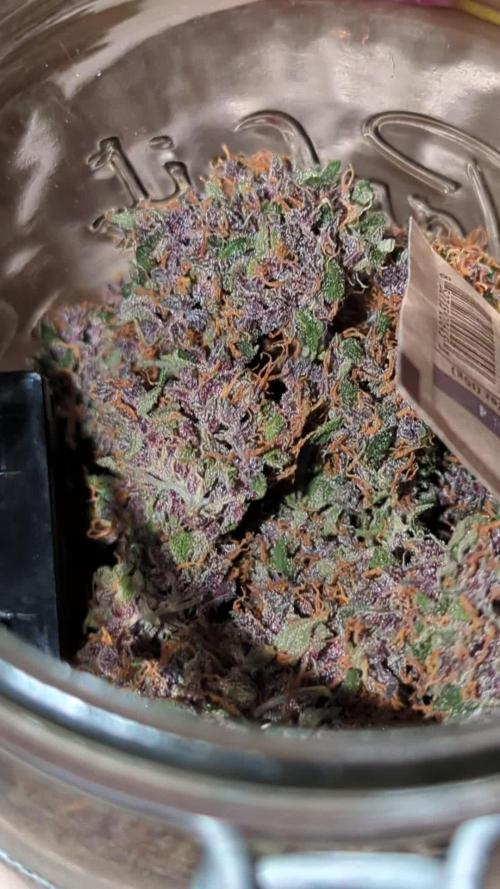
I started with the flushing for these little girls who have started to turn purple .... the smell is very strong and it is really AMAZING
The buds are literally covered with powerful glue that just touching them release a strong and pleasant smell .... I think I will not throw anything from the waste because every corner of the plant is covered with sparkling and powerful trichomes with which I hope to make good hashish
I leave you wishing you a happy and abundant harvest for all of you
see you around
Likes
3
Share
@PineappleMuffinMan
Follow
Big thicc buds. Hard to imagine what these will look like at the end in about 3 more weeks. Used twine over the last few weeks to individually tie up about 15-20 branches to the three stakes I put in. A trellis would’ve helped a lot, but she’s sharing a room with plants earlier in flower now, which is why I decided not to use one a few weeks back.


Likes
74
Share
@Ferenc
Follow
Day 64, 22nd of November 2021:
Hi there! Here we go..... so basically pistils are appearing stronger this is the 2nd weeks since they started producing pre flowers.
The plants getting a bit light might be some air circulation problem? However they look good and of course closer to the end the gettin' older so the leaves also die.
Set up and timing is the same since flower season started.
ViparSpectra XS2000 is on full power which is 240W so 100% capacity.
Ventilation: 12 hours period when the lamp is on it switches 1 hour on and after one hour off mostly to keep the temperature and of course because of fresh air flow. When the lamp is off it switches on in every 2 hours for 15 min at the same time with the extraction fan.
The extraction fan is on 12 hours when the lamp is, and then it switches on in every 2 hours for 30 min.
That's all a bit more water for them from today also. Humidity quite the same approx 50%, temperature as well approx 26-27 Celsius.
Fertilization remains the same since last week, the BioBizz family raised up to be 2ml/L each so it is like 2ml/L of BioGrow, 2ml/L of BioBloom, 2ml/L of TopMax... see the ratio above.
The schedule of the fertilization has not changed happnes 2x a week except epsom salt just 1x a week.


Likes
6
Share
@GERGrowDesigns
Follow
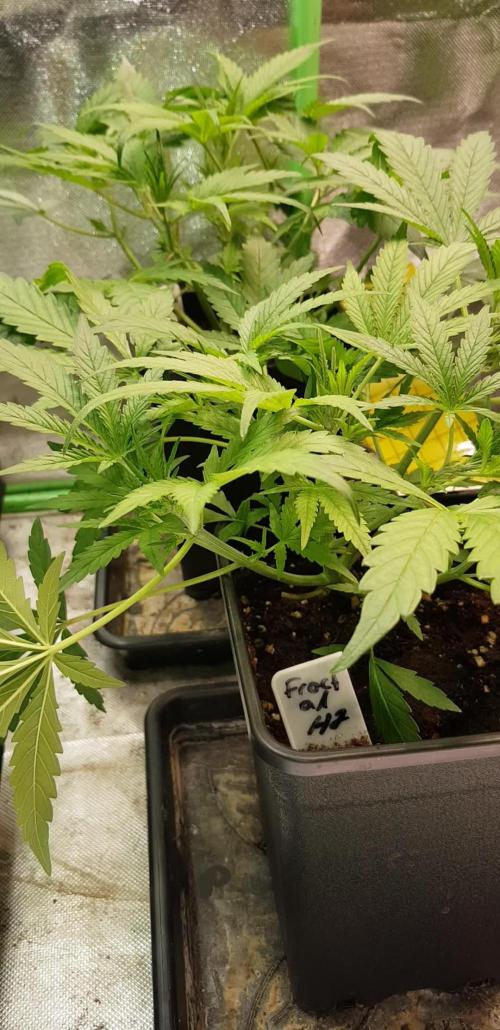
Welcome to Veg Week 3 of Divine Seeds Auto Fractal
I'm excited to share my grow journey with you all as part of the Divine Seeds Autoflowering Competition 2025. It's going to be an incredible ride, full of learning, growing, and connecting with fellow growers from all around the world!
For this competition, I’ve chosen the Feminized Automatic strain: Auto Fractal
Here’s what I’m working with:
• 🌱 Tent: 120x60x80
• 🧑🌾 Breeder Company: Divine Seeds
• 💧 Humidity Range: 50
• ⏳ Flowering Time: 60 Days
• Strain Info: 23%THC
• 🌡️ Temperature: 26
• 🍵 Pot Size: 0.5l
• Nutrient Brand: Narcos
• ⚡ Lights : 200W x 2
A huge thank you to Divine Seeds for allowing me to be a part of this amazing competition and Sponsoring the Strains. Big thanks for supporting the grower community worldwide! Your genetics and passion speak for themselves!
I would truly appreciate every bit of feedback, help, questions, or discussions – and of course, your likes and interactions mean the world to me as I try to stand out in this exciting competition!
Let’s grow together – and don’t forget to stop by again to see the latest updates!
Happy growing!
Stay lifted and stay curious!
Peace & Buds!