


Likes
Comments
Share


@Roberts
Follow
Hindu Kush isn't doing so great. I changed the solution 2 days ago. I am hopeful that it fixes it. She will likely be getting switched out into another room so the bigger plants can flower and not get too big on me. So she will be a long grow if she makes it. Thanks again Spider Farmer, Athena, and Divine Seeds. 🤜🏻🤛🏻🌱🌱🌱
Thank you grow diaries community for the 👇likes👇, follows, comments, and subscriptions on my YouTube channel👇.
❄️🌱🍻 Happy Growing 🌱🌱🌱
https://youtube.com/channel/UCAhN7yRzWLpcaRHhMIQ7X4g.

Likes
15
Share


@HighOhioAn
Follow
And that completes my grow for my FastBuds420 grow Truly was a fun and exhilarating experience learned a lot about each, and every strain would absolutely grow each and one of them again, but photos are in the future. Can’t wait to get my hands on a pack of those fast.buds Photo.

Likes
1
Share

@CheeRz
Follow
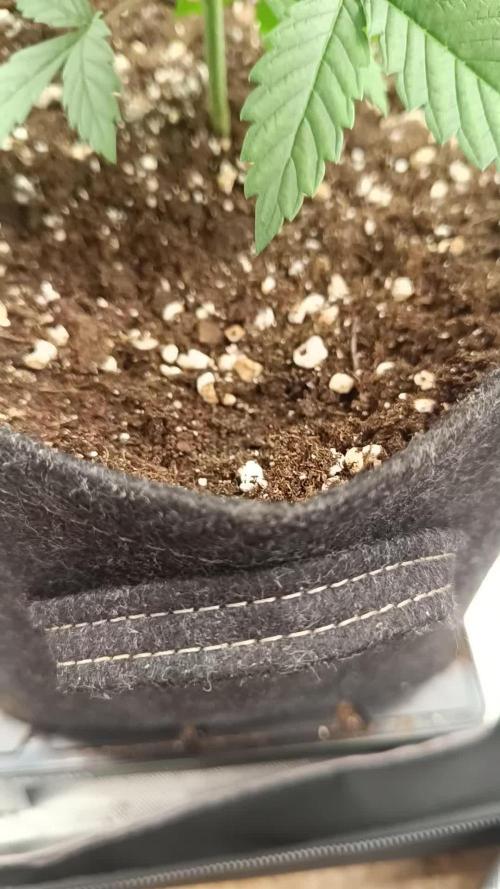
It's week three of Vegi, and all three Lemon Ladies are developing very nicely. They should be ready to flower in about 14 days. 💚💚💚☀️☀️☀️

Likes
22
Share


@Slobasian
Follow
You walk into the back yard and it’s a straight face punch of smells. Looking like some indoor rn moved all plants to safer place in case storm hits so now I atleast have a wind break


Likes
60
Share


@Clutch
Follow
Welcome to final week for this very fun grow 😊
We are 4 weeks later and I'm happy to say the buds have improved very well.
They all look fantastic and very frosty. I did a 10 day dry in a growing tent with a fan on and a much needed carbon filter 😂
The buds went in the curing jar a bit moisty but very close to perfect. I opened the jars 3 or 4 times daily the first week and it was okay. After that some moisture fighters and I cut the last sugarleaves to perfection.
After 3 weeks they are cured fantastic.
I have around 80 grams from 2 plants but one gave 75g and the other 5g 😂 Jack 1 was a very small plant and her sister Jack 2 is the biggest girl I ever grew with 1m 10.
The taste is spicy and herbal and the smoke is very smooth. Leaves a nice aftertaste on the tongue. A spicy hint, bit woody and skunky too
Effects are great. More focus and motivation an very uplifting. Puts a big smile on your face... but if I smoke a big one or 2 I'm also very relaxed and pretty hungry. This strain is made for chilling out, gaming, watch movies/Shows whitout a too hard couchlock. I never was about to fall asleep or too stoned.
Think its also perfect for when u smoke on a festival.
I'm happy with the outcome. It's my best grow so far and for my first autoflowers I'm convinced on this kind of plants. Will defenitly grow this one again .
The Northern Lights suffered from budrot and was thrown away. Not gonna review it and give bad ratings. Was my fault and I already have a new free seed from RQS when I ordered something. It was an NL 😁 that's a sign for a revenge round haha
Thanks a lot for following
See u next year for my next outdoor grow. I'm already having some nice ideas for that 😉
Happy growing friends.

Likes
1
Share


@bigsmoke42069
Follow
Week 7 of flowering 10/30/24
Changed nutrients to fit week 7
Buds are getting even bigger and thicker.
Last week PH drop happened again a couple of days after the major flush.
PH in rootzone is getting lower every day.
Runoff still at 10-20%, so no salt buldup, EC same as intake or litttle higher.
Flushed again with FloraKleen and watered with TriPart Micro, Grow, Bloom with CalMag.
Bought Potassium Bicarbonate and Calcium Carbonate as suggested by "Aqua Man", to buffer coco in the future. (https://www.thcfarmer.com/threads/ph-dropping-from-5-8-to-3-9-overnight-what-is-causing-this.87011/post-2329509)
changed nutes on 11/2/24, to FinalPart at 1.3 EC.
Checking runoff PH and EC daily.


Likes
16
Share


@4Twentygrows
Follow
I started using fox farm liquid nutrients as a supplemental fertilizer along with Dr Earth. I too dressed with Hapoy Frog Soil conditioner and added Cal Mag for the first time. I made up a foliage spray from fox farm’s big bloom and it seems to be working great. My plants are loving life.


Likes
1
Share


@Chubbs
Follow
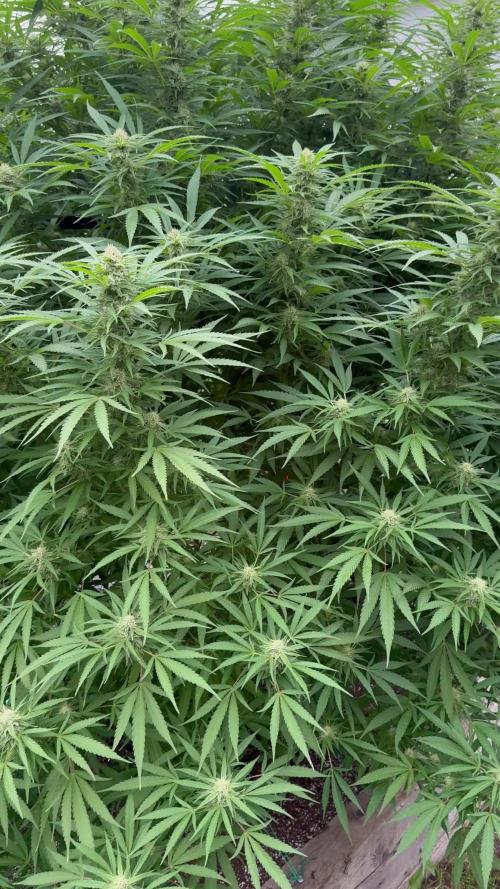
What up Fam,
Week 1 update on these beautiful little ladies. So far germination was a dream, and now they're starting to get there first set of leafs which is cool to see. I did do my first hand watering the other day and probably fed a little to early as I'm seeing a couple burt tips on the leafs. Or it could have been spraying ipm which I've had to do every 3 days since planting. One of my bags of soil where infested with Fungus knats so been trying to get rid of them without being to evasive. All in all though glad to start the first run in the new room and get it all dialed in. Happy Growing.
Likes
65
Share


@Deranged420
Follow
Day 64 - See below.
#1 - Just Flushing at this point & watching tricomes. i think her top half is almost done. I suck at tricomes pics. She is a lot bigger than photos can portray.
#2 - Lol. Whatever.
Day 65 - See Below. (Sorry No Pics For Today)....
#1 - Left alone but rotated.
#2 - Staked up some low hanging fruit, some white hairs forming. Gave 17oz of water...
Day 66 - See Below.
#1 - Cut some leaves off and she is in her final resting sleep. Harvest is tomorrow AM if she looks good.
#2 - Getting a 1500W dropped on her tomorrow.
Day 67 - See Below.
#1 - Looks done enough so she got cut down (60 grams wet). She is hanging in her final resting place.
Day 68 - See Below.
Only updates on #1 from here on out. She is day 2 of drying.
#2 - Updates are done cause she’s is a bust unless 1500w can turn her around (doubtful).

Likes
7
Share

@Fabroking
Follow
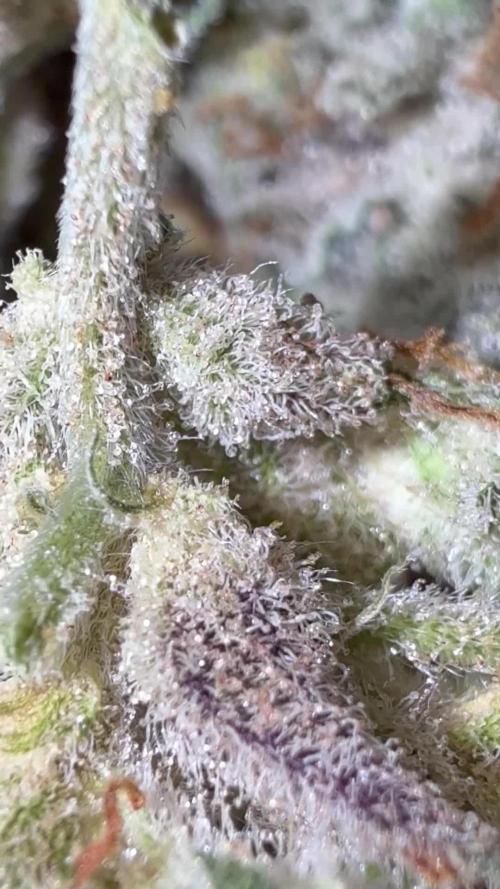
Genetica davvero valida come già detto merita un posto nella coltivazione di tutti almeno una volta, penso sopratutto che quando farò estrazione avrò bella soddisfazione data la quantità di resina e terpeni che hanno sprigionato

Likes
16
Share


@Oimjr
Follow
So far, so good. I used a but of koolbloom. I'm pretty new to this, so I don't know of it will help. But here goes. Not much longer I think. May e a few more weeks.
Water change on 3/9. 4 gal well water 1 tsp maxi bloom 1 tsp Kool bloom ph to 5.8. Looking good!
Likes
42
Share


@Ganjagrandaddy
Follow
Day 14 Flowering: hi all. We have had another very happy week growing with these ladies from Zamnesia. The size and shapes that they are now formed into look so like cabbages with nice thick , green and bushy branching in all of the pots now. Training has been a battle with them pulling the legs overnight and needing re staking further out to keep them flatter. The canopy itself is forming up nice now with the strongest tips being the ones hitting the top now. Once stretch has done, I will be defoliating to feed the lowers that are dying to get involved with the thick supporting secondary branches everywhere.
All 3 of the Amnesia haze are thick leaved, monster fanned and chunky stemmed beasts. I am glad I trained them lower as the growth could have easily become a concern in heights for sure. The huge cabbages that have been created now are perfect for a strip out soon to get light to the stems as much as possible
#1 Amnesia haze f.i.m girl is by far the thickest Bush. She does have a really nice crown on her too with some serious side growth fighting out of the shadows and creating their own mini plants it seems. It will be good to get to what is her actual contenders as she is so thick with growth , it is hard to tell how many mains will be joining the fun.
#2 Is also a great size to work with and will produce some nice yield
#3 is a similar size to #1 and has been easy to work with too they have been lifting the pegs easily as they grow each day now so I will be using wire soon to secure them for the final push.
Both of the Girl scouts cookies are very productive with growing tips. #1 is a slightly different pheno i think and has a slight darker green to her too. Growing in a nice thicket so far but has been pegged along the way too. Her sister #2 is totally different in her structure with an absolute flurry of bud sites dude to the training out of her throughout. She is like a mini manifold of sorts with all that usual popcorn rubbish being able to share more light. I dont expect huge colas with this and from her general limb thickness but i think she will be filled with decent medium sized nugs. They do both need a defol soon to really give all the nodes a chance go shine. I am planning to do some this week and the last bits at around 21 f. All told they are really looking like a great yield already so with a little more training before I let them get on with it , could be the best run yet !!
UPDATE######
Day 15 and i did a defol today. This will allow all those growing tips to find the light. Next few days will be interesting as they recover and get busy.


Processing
Likes
25
Share


@AsNoriu
Follow
Day 85. First Diesel down. This was the most Colourfull plant in all year, sad that it was triggered by light shock, still she was always praying, drinking water fast and loved life. Smells so fruity and fresh.
Day 86. Other run pushes me to chop them earlier, but taste qualities i will get anyway, so Last to Chop is choped ;)


Likes
260
Share


@SlowpokeFuegobud
Follow
🐒 🍌 🌴🐒 🍌 🌴🐒 🍌 🌴🐒 🍌 🌴🐒 🍌 🌴🐒 🍌 🌴🐒 🍌 🌴
Welcome to week 7!! 😘
DAY 46
Watered with 2ml grow, 3ml bloom, 2ml roots, je 4ml humics + growzyme + 3ml bigfruits 💧
DAY 46
Watered with 2ml grow, 3ml bloom, 2ml roots, each 4ml humics + growzyme + 3ml bigfruits 💧
DAY 47
Moved to new tent 🎉
LED 320W 75% and 70cm distance 💡
DAY 49
Watered with 1ml grow, 2ml bloom, 2ml more pk, 2ml humics, 3ml growzyme + bigfruits, ¼ TL epsom salts (4L water EC 0.7) 💧
Defoliated a bit, they seem not 100% happy. I switched the nutes 2 weeks ago, and the new schedule advices to feed only every second watering, well, they hated that! 😅
Now they received a decent amount of epsoms into the feeding solution, I also kept the Grow Liquid AND added the MorePK (also containing N), hehehe..
Next morning I opened the tent frightened.. but I see the green returning to the leaves and they are standing in the right angle according to my instructions. 😎
We will try to keep them there. 😜
A lot has been growing on in my grow paradise. 😎
The Monkeys moved to another palace, they love it there! 🐒 🐒 🍌 :confetti:
I can't see trichomes yet, but stretch seems to be done. ✌️
Thanks, my growmies for visiting and reading and commenting, I love reading your comments! Mwah! 😘
Thank you, @Kannabia, for sponsoring this grow, aaaaand for the amazing gift pack! 😍 I hope to make you proud! 🧡
Special shouts out to my fantastic sponsor @GreenBuzzNutrients! Thank you for trusting me with your awesome products, I'm a longtime fan! 💚 🙏 Green + juicy growmie hugs to my Greenbuzzers!! 😘
Grower Love everybody!!!11 💚 💚💚💚💚💚💚💚
Wishes do come true, they just take a lot of time sometimes.. ✨
If you wish to try Green Buzz Nutrients, there's a 25% discount code hidden down there in the week comment somewhere.. 😎
__________________________________________________________________
https://www.kannabia.com/en/feminized-cannabis-seeds/monkey-grease
Monkey Grease
At Kannabia Seeds we have put all our effort into bringing out our own feminized Monkey Grease, a cross between Monkey Grease x White Widow, focusing above all on giving it its own personality in flavor and aroma (frankly unmistakable).
Its own personality
At Kannabia Seeds we have put all our effort into bringing out our own feminized Monkey Grease, a cross between Monkey Grease x White Widow, focusing above all on giving it its own personality in flavor and aroma (frankly unmistakable) and, of course, in Highly demanded characteristics, such as high resistance to diseases and pests, and adaptability to all types of growing conditions, making it close and easy to grow to the widest possible range of growers. The result is a really powerful and versatile indica-sativa marijuana seed, with a powerful relaxing effect, ideal for those moments when you want to disconnect from the madding crowd.
Cultivation of Monkey Grease
Which cultivation method would be most appropriate for this variety? Good question… and one that is easy to answer. Its versatility and adaptability make it a true all-rounder, with remarkably uniform results, whether you choose SOG, SCROG, hydroponics or guerrilla growing. Moreover, we invite you to experiment and play, varying the techniques from moment to moment, and to draw your own conclusions. We are convinced that in all cases, apart from minor variations, the results will always be optimal, giving remarkable yields and in a short time.
Attention should be paid to its high bud production, which can be fat, dense and heavy, although its sturdy branches are able to bear heavy loads without major problems. If you are a fan of extractions, our Monkey Grease is also optimal, given its high production of caramelised resin.
If it is already amazingly productive indoors, this variety excels on its own merits outdoors, where it can easily reach 200 cm in height, and can reach between 700 and 800 grams per plant.
It is therefore an easy and grateful plant, which demands little from its gardeners, making do with simple basic care, and with little or no propensity to develop diseases or mildew, or to attract pests (despite its striking aroma!).
Taste and effect of Monkey Grease
Our Monkey Grease stands out first and foremost because of its powerful, strong smell, which is hard to camouflage. A penetrating aroma that unfolds, in a balanced way, on the palate in the form of a wide range of spicy and sweet flavours, reminiscent of wild honey, nougat and cinnamon, and distant notes of milk chocolate. A delicious treat to be savoured calmly, without haste, as a preamble to its pleasant effect: extremely relaxing and narcotic, powerful, ideal for meditation and moments of introspection and meditation.
Don’t be in a hurry with Monkey Grease. It can be your perfect ally to treat those stress and anxiety problems, but for that you must let yourself go, surrender to its charms, especially if you are inexperienced.
________________________________________________________
Setup:
140x70x200 cm Spiderfarmer tent
2x Monkey 16W fans (not oscillating)
1x box fan 50W oscillating (on lowest level)
LED
Full Spectrum 320W AGLEX AGL-320W-MA
5,6 kg
foldable, dimmable
864 pieces Samsung LH301H
864umol/s
2,7umol/J
full spectrum white + RED 660nm + IR 740nm
wavelength range 380-780nm
covering 3x4ft
Green Buzz Nutrients https://greenbuzzliquids.com/
❗ Use code GD42025 for generous 25% discount (for orders of minimum 75€) 💚
Plagron Growmix
Can Lite Filter 125/ 400cm³/h
PrimaKlima exhaust EC 125-400/240 cm³/h
tab water pH 8 - EC 0,25 with Calmag to 0,5
Advanced Hydroponics pH minus Grow + Bloom to pH 6.2 💧
🐒 🍌 🌴🐒 🍌 🌴🐒 🍌 🌴🐒 🍌 🌴🐒 🍌 🌴🐒 🍌 🌴🐒 🍌 🌴

Likes
52
Share


@Ultraviolet
Follow
Once again she passes my expectations, late to the show with trichome production. I'm surprised there is purple on the bud, maybe Purpinator does work. I thought I could see hints under the grow lights and thought my eyes were deceiving me, I was just being hopeful. But nah 2 of the 3(under the UV) have developed a beautiful tone of purple. I was never going to bother with a deep freeze but maybe the whole bud will change given conditions, that would be something, fingers crossed. 🤔 was a little skeptical that reducing temps humidity would change density, but it does, buds are solid something I've not been able to achieve before.
Rule of thumb is never to surpass 60% RH in the flowering phase and try to progressively reduce it down to 40% in the last 2–3 weeks before harvest. The plant will react as it seeks to protect its flowers, responding by producing denser buds and a higher concentration of resin. Cannabis plants are sensitive to sudden temperature changes, especially in the flowering stage. Extreme heat or cold can impact bud density and overall yields. In nature as a defense mechanism from cold, the plant sensing sudden dips in temperature will attempt to remove the pockets of air within the bud, it achieves this by compacting itself in doing so to better protect itself from cold snaps which are normally indicators in nature that worse weather is on the way.
Terpene levels are the highest just before the sun comes out. Ideally, you want as many terpenes present in your plants as possible when you harvest. Cannabis plants soak up the sun during the day and produce resin and other goodies at night. The plant is at its emptiest from "harvest undesirables" so to speak right before the lights on. Boiling cannabis roots during harvesting slows down the drying process. When you boil cannabis roots, it shocks the plant, closing the stomata on the leaves. This prevents massive moisture loss through the leaves, leaving only the floral clusters actively losing moisture at a reduced pace. I've always run a strict 60/60 and it took almost twice as long to dry to a snap than previous grows where I didn't boil for what it's worth.
Chlorophyll is good for the plant but not for you. When you harvest the buds, even after you flush them, if you flush them, they’re still filled with chlorophyll. Freshly cut buds are greener than dried buds because they still contain loads of chlorophyll. However, when rushed through the drying process, the buds dry but retain some chlorophyll, and when you smoke it, you will taste it. Chlorophyll-filled buds are smokable, but they aren’t clean. Slow drying gives the buds enough time and favorable conditions to lose the chlorophyll and sugars, giving you a smoother smoke. How the plant disposes of the chlorophyll and sugars by a process of chemically breaking them down and attaching the decomposed matter once small enough to water molecules which then evaporate back into the ether. Time must be given to the process to break down the chlorophyll and sugars. Think of it like optimizing the environment for decay.
All the nutrients it could ever need are in abundance, it eats nutrients based on its demand for growth, which is dictated primarily by available light.
Plant growth and geographic distribution (where the plant can grow) are greatly affected by the environment. If any environmental factor is less than ideal, it limits a plant's growth and/or distribution. For example, only plants adapted to limited amounts of water can live in deserts. Either directly or indirectly, most plant problems are caused by environmental stress. In some cases, poor environmental conditions (e.g., too little water) damage a plant directly. In other cases, environmental stress weakens a plant and makes it more susceptible to disease or insect attack. Environmental factors that affect plant growth include light, temperature, water, humidity, and nutrition. It's important to understand how these factors affect plant growth and development. With a basic understanding of these factors, you may be able to manipulate plants to meet your needs, whether for increased leaf, flower, or fruit production. By recognizing the roles of these factors, you'll also be better able to diagnose plant problems caused by environmental stress.
Water and humidity
*Most growing plants contain about 90 percent water. Water plays many roles in plants. It is:*
A primary component in photosynthesis and respiration
Responsible for turgor pressure in cells (Like the air in an inflated balloon, water is responsible for the fullness and firmness of plant tissue. Turgor is needed to maintain cell shape and ensure cell growth.)
A solvent for minerals and carbohydrates moving through the plant
Responsible for cooling leaves as it evaporates from leaf tissue during transpiration
A regulator of stomatal opening and closing, thus controlling transpiration and, to some degree, photosynthesis
The source of pressure to move roots through the soil
The medium in which most biochemical reactions take place
Relative humidity is the ratio of water vapor in the air to the amount of water the air could hold at the current temperature and pressure. Warm air can hold more water vapor than cold air. Relative humidity (RH) is expressed by the following equation:
RH = water in air ÷ water air could hold (at constant temperature and pressure)
The relative humidity is given as a percent. For example, if a pound of air at 75°F could hold 4 grams of water vapor, and there are only 3 grams of water in the air, then the relative humidity (RH) is:
3 ÷ 4 = 0.75 = 75%
Water vapor moves from an area of high relative humidity to one of low relative humidity. The greater the difference in humidity, the faster water moves. This factor is important because the rate of water movement directly affects a plant's transpiration rate.
The relative humidity in the air spaces between leaf cells approaches 100 percent. When a stoma opens, water vapor inside the leaf rushes out into the surrounding air (Figure 2), and a bubble of high humidity forms around the stoma. By saturating this small area of air, the bubble reduces the difference in relative humidity between the air spaces within the leaf and the air adjacent to the leaf. As a result, transpiration slows down.
If the wind blows the humidity bubble away, however, transpiration increases. Thus, transpiration usually is at its peak on hot, dry, windy days. On the other hand, transpiration generally is quite slow when temperatures are cool, humidity is high, and there is no wind.
Hot, dry conditions generally occur during the summer, which partially explains why plants wilt quickly in the summer. If a constant supply of water is not available to be absorbed by the roots and moved to the leaves, turgor pressure is lost and leaves go limp.
Plant Nutrition
Plant nutrition often is confused with fertilization. Plant nutrition refers to a plant's need for and use of basic chemical elements. Fertilization is the term used when these materials are added to the environment around a plant. A lot must happen before a chemical element in a fertilizer can be used by a plant.
Plants need 17 elements for normal growth. Three of them--carbon, hydrogen, and oxygen--are found in air and water. The rest are found in the soil.
Six soil elements are called macronutrients because they are used in relatively large amounts by plants. They are nitrogen, potassium, magnesium, calcium, phosphorus, and sulfur.
Eight other soil elements are used in much smaller amounts and are called micronutrients or trace elements. They are iron, zinc, molybdenum, manganese, boron, copper, cobalt, and chlorine. They make up less than 1% of total but are none the less vital.
Most of the nutrients a plant needs are dissolved in water and then absorbed by its roots. In fact, 98 percent are absorbed from the soil-water solution, and only about 2 percent are actually extracted from soil particles.
Fertilizers
Fertilizers are materials containing plant nutrients that are added to the environment around a plant. Generally, they are added to the water or soil, but some can be sprayed on leaves. This method is called foliar fertilization. It should be done carefully with a dilute solution because a high fertilizer concentration can injure leaf cells. The nutrient, however, does need to pass through the thin layer of wax (cutin) on the leaf surface.
It is to be noted applying a immobile nutrient via foliar application it will remain immobile within the leaf it was absorbed through.
Fertilizers are not plant food! Plants produce their own food from water, carbon dioxide, and solar energy through photosynthesis. This food (sugars and carbohydrates) is combined with plant nutrients to produce proteins, enzymes, vitamins, and other elements essential to growth.
Nutrient absorption
Anything that reduces or stops sugar production in leaves can lower nutrient absorption. Thus, if a plant is under stress because of low light or extreme temperatures, nutrient deficiency may develop.
A plant's developmental stage or rate of growth also may affect the amount of nutrients absorbed. Many plants have a rest (dormant) period during part of the year. During this time, few nutrients are absorbed. Plants also may absorb different nutrients as flower buds begin to develop than they do during periods of rapid vegetative growth.
432 Hz is said to be mathematically consistent with the patterns of the universe. Studies reveal that 432 Hz tuning vibrates with the universe’s golden mean PHI and unifies the properties of light, time, space, matter, gravity and magnetism with biology, the DNA code and consciousness. When our atoms and DNA start to resonate in harmony with the spiraling pattern of nature, our sense of connection to nature is said to be magnified.
Another interesting factor to consider is that the A=432 Hz tuning correlates with the color spectrum while the A=440 Hz is off.
Audiophiles have also stated that A = 432 Hz music seems to be non-local and can fill an entire room, whereas A=440 Hz can be perceived as directional or linear in sound propagation.
Once you adopt the idea that sound (or vibration in general) can have an equalizing and harmonizing effect (as well as a disturbing effect), the science of harmony can be applied to bring greater harmony into ones life or a tune to specific energies. There is a form of absolute and of relative harmony. Absolute harmony can for example be determined by the tuning of an instrument. The ancients tuned their instruments at an A of 432 Hz instead of 440 Hz - and for a good reason. There are plenty of music examples on the internet that you can listen to in order to establish the difference for yourself. Attuning the instrument to 432 Hz results in a more relaxing sound, while 440 Hz slightly tenses up to body. This is because 440 Hz is out of tune with both macro and micro cosmos. On the contrary, 432 Hz is in tune. To give an example of how this is manifested micro cosmically: our breath (0,3 Hz) and our pulse (1,2 Hz) relate to the frequency of the lower octave of an A of 432 Hz (108 Hz) as 1:360 and 1:90.
It is interesting to note that 432 Hz was the standard pitch of many old instruments, and that it was only recently (19th and 20th century) the standard pitch was increased. This was done in order to be able to play for bigger audiences. Bigger audiences (more bodies) absorb more of the lower frequencies, so the higher pitch was more likely to “cut through”. One of the oldest instruments of the world is the bell ensemble of Yi Zeng (dated 423 BC), tuned to a standard F4 of 345 Hz which gives an A= 432 Hz. The frequency of 345 Hz is that of the platonic year! Similarly many old organs are tuned in an A=432 as well; for example: St. Peter’s Capella Gregoriana, St. Peter’s Capella Giulia, S. Maria Maggiore in Rome.
Maria Renold’s book “Intervals Scales Tones and the Concert Pitch C=128 Hz” claims conclusive evidence that 440 Hz and raising concert pitch above scientific “C” Prime=128 Hz (Concert A=432 Hz) disassociates the connection of consciousness to the body and creates anti-social conditions in humanity.
The difference between concert pitch A=440 Hz and Concert A=432 Hz is only 8 cycles per second, but it is a perceptible difference of awareness in the human consciousness experience of the dream we share called existence.


Likes
119
Share


@PEAKYPLANTERS
Follow
Hi guys, Welcome back to Queen Peaky!
Let's wait a few more weeks to develop branches strong enough to support huge buds 😉Or at least that's what we hope 🤗
Let us know if you like the contents in the comments 👽