The Grow Awards 2026 🏆 













Likes
Comments
Share
@Nugget_head88
Follow
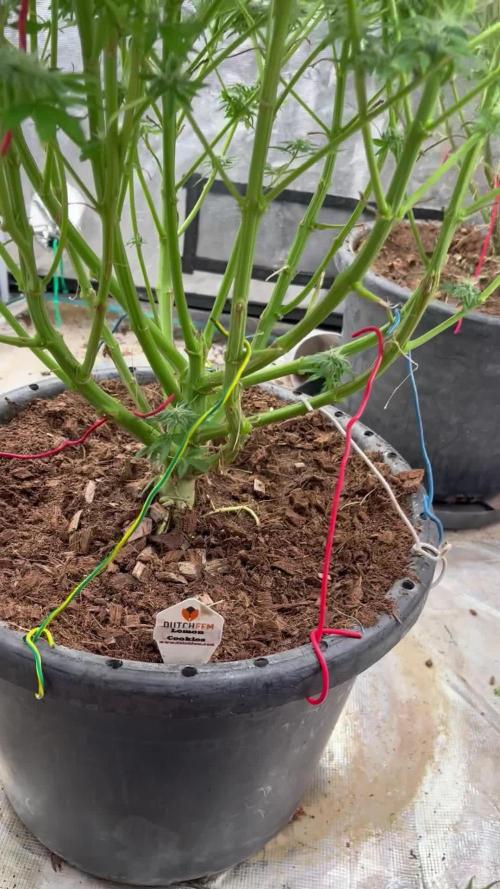
02/06/2025, start of week 3, decided to do a bit of LST (tied down main stem) let's see how she responds.
Reduced humidity by around 8% to increase leaf VPD to between 0.7 and 1.0 kpa, and lowered the light a little more, increasing to around 300 PPFD for this week.
Hoping to see a bit of a rush of growth once she recovers from the LST as I expect flowering will start in the next 2 weeks and need her to fill out a.s.a.p
Update 04/06/2025, Looks like I should have probably waited for the next node to stretch a little and then tied her down as I could have brought the top full level with the the other shoots and perhaps encourage better branching as this particular girl doesn't seem to be very branchy, this may change though, will probably have to bend her again but time it better so I can actually tie round the very top instead of one node down and hopefully then encourage some real branching and filling out.
Another lesson learned for this rookie.
Update: 06/06/2025, fed at 1.2 ec ph 6.2.
Update 08/08/2025, end of week, should have waited at least a couple more days to water, she looks over watered, not terrible though and looking better this morning than yesterday morning, will make sure she is properly dry next time.

Likes
2
Share
@FlowerForYou
Follow
13/06/25: Last week of these autos in the grow box, weather is clearing up and they will move outside soon! The Plan to give them a little jumpstart in the early veg is coming together nicely and they took the repotting like nothing at all!
14/06/25: vigorous growth. 3 days since repot; and i can already see roots at the drainage holes, insane!
17/06/25: Started hardening off by putting the plants outside in the evening (6 - 8pm) ☀️
18/06/25: Hardening off from 4 -8pm, and I could already see the first pistils at the top nodes...tbh honest I hoped to get a few more days or even an extra week of veg but stretch is already incoming! 😔 I directly Repotted to ~13 L per plant and put some extra perlite into the final soil so I can get some decent roots on these ladies! I guess we learn as we grow
19/06/25: Today they got direct Sun from 2 - 6 pm and will stay outdoors from now on!
Likes
30
Share
@CanadianFillmore
Follow
Another week in the books, one maybe 2 more to go, if the weather holds and humidity doesn't go crazy. Since grow diaries doesn't support more than 32 weeks, it's a bit of a pain to track the rest of this grow. Still I will post updates.

Processing
Likes
15
Share
@Deli_Weed
Follow
Ya casi por finalizar 😃 estoy muy emocionado por el resultado final, todo pinta bien 👌🏻💯 se puede mejorar aún más pero estoy conforme con el resultado de esta planta 🌱
Esta semana fui bajando la ec poco a poco hasta llegar a pura agua, la semana que viene será de puro flush 🚿 ya para cosechar 🤩


Likes
11
Share


Likes
6
Share
@Mraady
Follow
It was my first grow but thanku to everyone who helped me it was outstanding thanks again

Likes
8
Share
@HowtoBubatz
Follow
The plants are now putting all their energy into bud production, and it’s really starting to show!🌱
Both are developing bigger and bigger buds, and the smell is becoming more intense every day.
#2 has an insanely large main bud, completely covered in trichomes.
The aroma is very hazy, deep, and complex. it’s going to be interesting to see how it develops in the coming weeks.
#1, on the other hand, continues to impress with its tropical, sweet, and pineapple-like scent, and its buds are also swelling up beautifully!
Everything is going exactly as it should—excited to see how much more they’ll bulk up in the next weeks!💚
Likes
18
Share
@Canadian
Follow
This one has been delightful to grow full of buds everywhere with very little Fan leafs can't wait to cure and tested.
I have cut down in jar everything the wait was 97 grams please consider that when they comes to my scale weight i wait until the main stem breaks with a loud crunch and the buds are really dry to the touch reason for it I have a very busy life and at the end of the day this is just a hobby so I cannot be opening those jars many times a day at most one in the morning and one in night so I want to avoid mold on them.so I push in a Boveda pack to keep them nice
Thank you for reading I will update the other details when ready have a happy grow.


Likes
47
Share
@Ultraviolet
Follow
The cannabis strain Grape Guava can be a purple strain, depending on its specific phenotype and genetic makeup. While not all phenotypes of Grape Guava are purple, some variations, such as the Zatix Grape Guava, are noted for their striking purple appearance due to the genetic expression of anthocyanin pigments.
https://www.youtube.com/watch?v=cKdVmdoKJ5k
In a garden of green, Grape Guava gleams,
With its fruity aroma, enchanting dreams.
Clusters of grapes, guava's sweetness ignite,
A strain so divine, in purple and white.
Euphoria whispers, a lush fruity haze,
Grape Guava's embrace, a tranquil daze.
Off and away.@1400ppm. The increased CO2 allows plants to thrive at higher temperatures, which in turn necessitates higher humidity to maintain the ideal VPD for healthy growth and transpiration. 80F -5F = 75F LST with 70% RH = 0.72 kPa. Higher temperatures and humidity promote rapid growth, nutrient uptake, and photosynthesis while maintaining a lower stress level. Temperature influences the rate of enzymatic reactions involved in aerobic respiration. Enzymes, such as those involved in glycolysis, the Krebs cycle, and the electron transport chain, work most efficiently at an optimal temperature range. In low temperatures, enzymatic activity will slow down, thus reducing the rate of aerobic respiration. In high temperatures, enzymes can become denatured, thus impairing their function and stopping the process of aerobic respiration. Glucose is the primary fuel for aerobic respiration. The rate of aerobic respiration increases with the availability of glucose, as it is the starting point for glycolysis. If glucose levels are low, cells may rely on alternative energy sources such as fatty acids or amino acids , but these processes may yield less ATP or be less efficient. To determine this effect, carbon dioxide volume was measured (as carbon dioxide is an output of aerobic respiration)
18/6 with the 6 being IR. The near infrared (IR-a) borders around 700nm up to 1400nm @ photon par flux density of 1.8 instead of darkness, keeping temps overnight a neat 77F-80F.
Think of my tent as a lung. What goes in must come out. When the rate of air going out exceeds the amount of air coming in, it creates a negative pressure. Tent concaves (bends in). If set up correctly, your RH will begin to drop slowly to the desired level you set, and the extraction turns off when it reaches desired% RH. The plant, as it performs cellular respiration, will always be releasing more water into the air, so the RH% of the tent overnight will always increase, so long as oxidative phosphorylation is occurring. As soon as the RH% creeps back up to 55%, the extraction turns back on, over and over. This creates a strong pressure differential which will work wonders on your grow. Replicating high and low-pressure fronts in nature. Critical for oxygen diffusion at the critical time of peak cellular respiratory function..
Moisture will not transfer from a saturated atmosphere to another if that air is already at or above its saturation point, meaning the air can't hold any more water vapor. Once I understood that water is produced as a by product during cellular respiration, specifically at the very end of the electron transport chain (ETC) where electrons are finally transferred to molecular oxygen, the higher the RH of the air, the more resistance there is for more moisture to be added to that environment, and effects the ease with which it does so. But none of that water comes from the pot; it's pulled from the air. If you run high daytime RH, your medium/pot is 100% reliant on transpirational root pull to move water. ZERO evaporation happens across the atmosphere if the tent air has high RH%, the medium cannot release its water through evaporation. Once a canopy develops, light no longer slowly wicks and evaporates from the topsoil. The Soil-Plant-Atmosphere Continuum (SPAC) describes the continuous pathway and process of water movement, driven by a gradient in water potential, from the soil, through the plant's roots, stem, and leaves, and finally evaporating into the atmosphere through transpiration. There is evaporation, there is transpiration, and then there is evapotranspiration; Evapotranspiration (ET) is the combined total of two processes: evaporation (water lost directly from soil and surface water into the atmosphere) and transpiration (water released from plants to the atmosphere through their leaves). Evapotranspiration represents the total amount of water that moves from the medium into the air. There is no such thing as a medium with too much water, only a medium that retains too much for too long.
The water must always flow efficiently from one atmosphere(Medium) to another(Air) in a timely manner. Moisture is a critical factor for bacterial growth and decay. Dictating how long it's allowed to sit in any one location for any given period is a key preferred control. To ensure a net reduction in a bacterial population, the rate of removal (ET) must exceed the rate of bacterial growth (decay rate), which is often modeled as a growth rate for the specific bacterium under the given conditions. By optimizing daytime VPD, we also optimize conditions for bacterial growth to explode exponentially above 77°F.. If water is allowed to sit in a medium without an escape within a timeframe, nothing good will happen. IF High RH is maintained overnight as well as during the day, placing 100% of water movement at the behest of daytime transpiration, roots can only pull where they can reach, and if soil is compressed above a certain point, moisture will become trapped in a medium with no way of moving day or night. This will begin the countdown for decay to take hold. When water stagnates in a medium, it loses oxygen, creating anaerobic conditions that foster the growth of harmful microorganisms like bacteria and fungi, which can produce toxins and disease vectors.
Thigmomorphogenesis, the process by which plants respond to mechanical stimuli like touch by altering their growth and development, results in significant morphological changes to improve survival against mechanical perturbations. This complex response involves sensing touch and initiating physiological and genetic responses, leading to changes in form and structure over days or weeks. The process is triggered by physical forces such as wind, rain, or touch. Plants adapt to these stimuli by changing their shape and structure, which may include slower growth, thickened stems, or altered leaf development. Plants possess sophisticated mechanisms to detect even subtle mechanical stimuli and initiate responses. A variety of molecules, including calcium ions, jasmonates, ethylene, and nitric oxide, are involved in signaling these mechanical inputs. Touch can induce the expression of genes that encode proteins for calcium sensing, cell wall modification, and defense mechanisms. A plant exposed to constant wind may become shorter and sturdier. A plant that is touched frequently might grow more slowly to conserve energy and develop thicker cell walls. These changes increase a plant's resilience and ability to survive in harsh environments.
Let's get Thiggy with it.
Likes
2
Share
@potatolord111
Follow
The last one started to bloom now. I started LST with my topped flower and startet to change my nutrients from grow to bloom.
The weather was realy bad here. I think they had 3 days outdoor, the other days where just to cold.
The smallest one looks realy bad. I think about getting it out and making space for a new one.
Processing
Likes
20
Share
@Cannibalgardens
Follow
This plant started off normal but my soil is a little hot and the light is intense and can't raise any higher right now ..That being said she germinated fine 18/h water then paper towel method . She sprouted in 1 day then was put in soil and again 1 day later she was out. Besides bleaching her she has been growing fine and in optimistic about the grow and her genetics this will be my second grow with this strain . She was so good I couldn't wait to start another one ,this girl will be 100% organic and I'm excited to watch her grow cheers canna family. ..
Likes
5
Share
@Lazuli
Follow
I flowered during a heatwave so lights were dimmed a half week.. other then that everything was good. Humidity was between 45-60% all way trough flower. I really love this pheno smells very blueberry
Likes
5
Share
@Rangaku
Follow
Love this lemon strain , starting to get some nice colour and phatting up real nice . 2 weeks to go. Legendary genetics

Likes
44
Share
@wolfvb
Follow
The second weeks starts and the ladies are doing great, the Pineapple Express is a beast she is growing really well.
The blue cheese and the white runtz are also doing okay, I would not compare them with the her though.
They been really easy to take care of so far.
Let’s see how this will go on the next days.


Likes
10
Share
@TeesTrees
Follow
Day 43 - I have started LST as this plant i know won't grow much in height, im gonna use it to teach myself techniques/perfect a technique. I hope ive done a decent job of it. Excited to see what happens over next few days.
Day 44 - im very proud of my little plant. It looks so strong after the first day of LST. Definitely surprised with the results.
Day 45 - Plant seems to be adjusting just fine to LST i do keep checking it. There is a bit of leaves overcrowding to pne side. I will probably have to move if i can!
Day 46 - I'm thinking if i need to do more LST or just leave it now to grow.
Day 47 - the plant is really starting to woden out and stretch as well. I need to see when it will flower it looks like it might do soon.
Day 48 - The plant looks well. I believe she has started to flower so i really have to get my fan and filter asap.
Day 49 - She defo started flowing and i just bent ome stem to allow more space between each other ;But they looks really good. Also entering another competition can't win if you don't partake.

Likes
3
Share
@French__flair
Follow
Suivre les conseils semaine 1.
Une fois que les plantes ont colonisées le pot de 1L, les rempoter dans des pots de 3L (qu'on va arroser avec 3L). Cela doit prendre 4 à 7 jours en moyenne.
Surveiller l'aspect des plantes, les pointes des feuilles. Observer le haut et le bas. La couleur de la plante doit être uniforme entre chaque partie sinon c'est qu'elle a un manque ou un excès. Le plus souvent étant donné les engrais complet que nous utilisons il s'agit d'un excès. Dans ce cas il suffira simplement de faire un arrosage à l'eau au lieu de l'engrais et de reprendre les engrais à plus faible dose.
Les tiges sont un bonne indicateur de la santé des plantes, hors génétique spécifique, elles doivent être verte et tendre, pas dur.
On continue la FIM et la taille de certaines feuilles qui peuvent être gênante.