






Likes
32
Share


@Ganjagrandaddy
Follow
Day 28 flowering: Hi all. The mango girls are continuing to swell with lots of fresh pistils and looking nice and crispy too. They are all beginning to smell so sweet of the mango that they take their name from. A real subtle smell that I haven't had before in a strain . The 3 older plants have been stripped out a littlenand some of their big fans removed for airflow but I did not go too aggressive on them as I did not want to slow them down too much
They are not too tall and would easily train even lower for a stealth grow. The buds themselves are a nice thickness and show some promise to join up in the coming weeks for mini donkey dicks.( sorry for the term but easiest verbal to visual cue.lol)
I initially thought the node spacing on a few was a little wide but seeing how they are forming , this is less of a concern.
the #4 at her day 21 is looking ok but her pot had feed pellets used as the nutes and she may be too overfed. I will use just water for her future feeds now.
I am very impressed with how easy these are growing and with very little effort needed from me now beside waterings. I am hoping by keeping so much of the leaf intact that it doesn't stop the development within the deeper canopy. There are some really nicely forming buds in there so airflow is a vital concern now they can only get even fatter from here lol
be safe and well.

Likes
39
Share


@J_diaz420
Follow
El día 19 de floración se hace poda de brotes bajos y una pequeña defoliación de hojas de abanico 👍

Processing
Likes
4
Share


@Ogbangbang2981
Follow
I never thought I'd say it but i think when it comes to my indoor C4 vs my outdoor C4 Indoor takes the prize, I mean that's only for now lets see what happens in the upcoming weeks. I'm sticking to my bat turd mix and all sun, I shift her around during the heavy showers, yea it rains out here. I don't feed no store bought nutrients all from nature same goes for my indoor ... if you look closely you'll see that I lst her it's only because of her mutation.

Likes
25
Share


@I_Identify_As_A_Dan
Follow
Week 6 of flower for Lemon Orange by greenhouseseedco
1 of the phenos has a bad sulfur deficiency which was too far gone for me to fix so shes lost most of her fan leaves unfortunately.
My favourite pheno is starting to fade a little purple, while the buds just look as good as they could.
The 2 slower phenos likely still have 2/3 weeks on them to go while the quick pheno ill be harvesting this weekend coming at week 7
Looking a little sad as i had took these before their water time.

Likes
16
Share

@Bncgrower
Follow
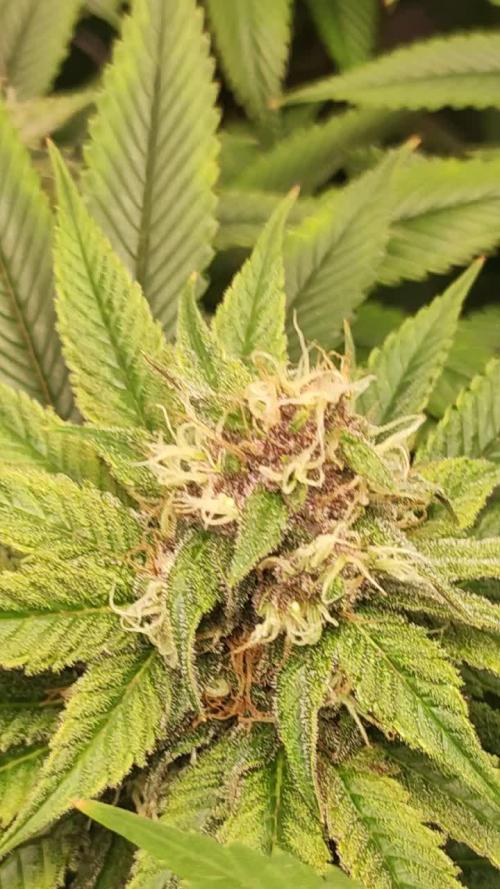
Following the plan, we've reached the end of week 12. Apparently, everything is fine with this girl and all the others, nothing to worry about. This girl in particular already has a very pleasant smell, excellent bud structure, and beautiful color. Looking forward to the next few weeks! ✌️🌱🌿🍁
Happy growing, everyone!

Likes
36
Share


@gottagrowsometime
Follow
Welcome to my 1st fem soil grow: Drop a like so I can visit your grows if you'd like, regardless thank you for your interest .
1st soil photo in the ground. Will be a few days before she shows leafs as I only waited till she showed about 2mm of tap root and she got planted 3/4 of AN inch down and soil lightly folded over and sprayed her with 100ml of mix with 1.5ml/L x3 400ppm. La Sirena is the only nutrient here that changes the EC. 1 5ML adds around 300+ppm to 78ppm water so. I decided to give this girl .5 more as she's going to be in the ground longer and has a long veg life. I'll be running her on TERRA POWERS full 19 line up. For this 1 I'll be following there chart as a guideline for nutrients and when to apply. As for the dose, that will be down to me. But if it's 2ml/L or whatever it is. It'll be getting that in 1L mix a week, (meaning she'll be fed exactly the ml/L as her total feed of that nutrient for the week. So this plant as she'll only be getting fed by ML not by many ml/L mix.) So when she's young her ml/L dose will be low as she'll have to take in a L of her or a high 2ml/500ml she'll be fed on a nutrient ML basis only.
2/5/22 VD1 Popped her head up. Can't wait for this 1, I've also got her in DWC Which is about 12hrs ahead. Have started on a light diet. 555ppm
4/5/22 I decided to go against the chart and give La Calavera for the root stim, I know we are a few days in but I'll wait until 2.5 weeks and stop the La Calavera.
6/5/22 So, it's begun. I've created a negative pressure environment, 1st time, let's see if it makes an impact. On wk 3 onwards I'll be running the intake extraction for 5mins every 30mins and I'll have 2 co2 bags up. If the RH becomes a problem or temp I'll put the extraction/intake back on 100% of the time. The extraction fan/intake is set at a ratio of 2 to 1. (100% extraction 50% intake) making a negative pressure environment, best way to show you have done this, the walls in your tent should bow in lightly
Same Day. Okay, so this my last update. Going to run fans the same right up until flower and then I'll be sealing up my tent and adding 2 co2 bags. And will be adding a dehuimifier and setting at 45% And it checks every 30mins and if it's gone up it'll turn back on and bring down to 45 or set RH, so no co2 will escape. The temp will be bordering 30-33c and then when they go into their rest window they'll be transferred to to a negative pressure environment with low temps and 45-50%RH. I'll only be able to do this for the 3 weeks of pre flower. And maybe some more, it depends how hard the dehuimifier will be working, but i want dense buds and only way to improve that is by introducing Co2 and then a negative pressure cold environment for terps. Then I'll be putting them back into full negative pressure environment and the Co2 will be useless, again all depends how it's gonna affect my bottom line. That and I only have 2 intake fans. I'll be going into detail about my Co2 adventures the week before I'll be prepping them to be able to withstand high temps, so I'll gradually bring up the temps the last wk of veg 28c max and that way when I push it to 30-32c in pre flower she won't stress as much.
Thanks for reading this week, no more updates, just pics for remaining week.
gottagrowsometime
Likes
114
Share


@Natrona
Follow
Lemon Cake week 18
7/28 - 8/4-10
I am late for my outside ladies diaries updates. Life has been getting the best of me lately. I’ve been packing my daughter’s room and moving her things to her new home. For those that have followed my since my beginning here, Cancer left me with neuropathy and arthritis in my hands. I can no longer do my glass fusing or flame work. To close this chapter of my life, I’ve been inventorying glass, tools, equipment, molds and supplies to sell. The most stressful has been appealing Medicare claims and receiving the second denials on the same claims. They are the last payer of record so good luck getting any reimbursement you are entitled to.
My apologies to all of you for being so brief on your diaries and not providing many comments.
Photos are from 7/28- 8/9 for both weeks.
For my outside ladies, Opium, Auto Opium, Fractal, and Lemon Cake not much changed. They continue to live in sweltering conditions. Temps are in the upper 80-90s with humidity over 105. In addition to the heat, Hurricane Debby started up the coast but was downgraded to a tropical storm by the time it got to us. Expecting our normal thunderstorms, I waited til morning to bring the ladies inside.
Overnight, we had wind gusts of 25mph. Yeah, then I brought all gals into the house. The photo gals are strong and with thick stalks were able to withstand the winds.
I top dressed all ladies with Bloom Soil for organic fertilizer. Buds are fattening up, trichomes are minimal at this time but some fragrance is starting to be noticed.
Thanks for the visits, likes and comments, I appreciate all the plant love💚.
Have fun & love what you grow 💚
Sending you good vibes of love, light, and healing 💫
💫Natrona 💫


Likes
12
Share


@Elemental
Follow
======NOV 4 | DAY 22======
She is a bit different of predominat sativas, leaves are bigger.
Today I increase some humus and some peat.
======NOV 5 | DAY 23======
LST her today
======NOV 8 | DAY 26======
2 more LST HOOKS
======NOV 10 | DAY 28======
I hid some leaves below the main branches

Likes
3
Share


@danielsegovia
Follow
17.06.20 (28 DÍAS) Empezaron a salir los primeros pistilos y se está estirando bastante
23.06.20 (34 DÍAS) La Red Critical Auto empieza a mostrar sus primeros buds violetas.

Likes
28
Share


@MadeInGermany
Follow
Info:
Unfortunately, I had to find out that my account is used for fake pages in social media.
I am only active here on growdiaries.
I am not on facebook instagram twitter etc All accounts except this one are fake.
Have fun with the update.
Flowering day 40
since time change
to 12/12.
Hey everyone 😊.
It gets more beautiful from week to week 😍.
The buds are getting thicker and thicker and already smell very good :-).
The time has come when she no longer puts her strength into growth but into the flowers :-).
It was poured 3 times this week with 1.2 l each time.
When watering, there was 1 g of GHSC enhancer per liter of water as every 2 weeks 👍.
Of course, as always, the tent was cleaned every day and the humidifier refilled.
The complete filter system was also checked again.
I filled the tank with fresh osmosis water for the coming week.
I wish you all a nice week.
Stay healthy and let it grow 🙏🏻👍
You can buy this Strain at :
https://www.royalqueenseeds.de/feminisierte-hanfsamen/115-amnesia-haze.html
Type:
Amnesia Haze
☝️🏼
Genetics:
Original Amnesia Haze
👍
Vega lamp:
2 x Todogrow Led
Quantum Board 100 W
💡
Bloom Lamp :
2 x Todogrow Led
Cxb 3590 COB 3500 K 205W
💡💡☝️🏼
Soil :
Canna Coco Professional +
☝️🏼
Fertilizer:
Green House Powder Feeding
☝️🏼🌱
Water:
Osmosis water mixed with normal water (24 hours stale that the chlorine evaporates) to 0.2 EC. Add Cal / Mag to 0.4 Ec Ph with Organic Ph - to 5.5 - 5.8 .
Likes
32
Share
@ThatsmyGrow
Follow
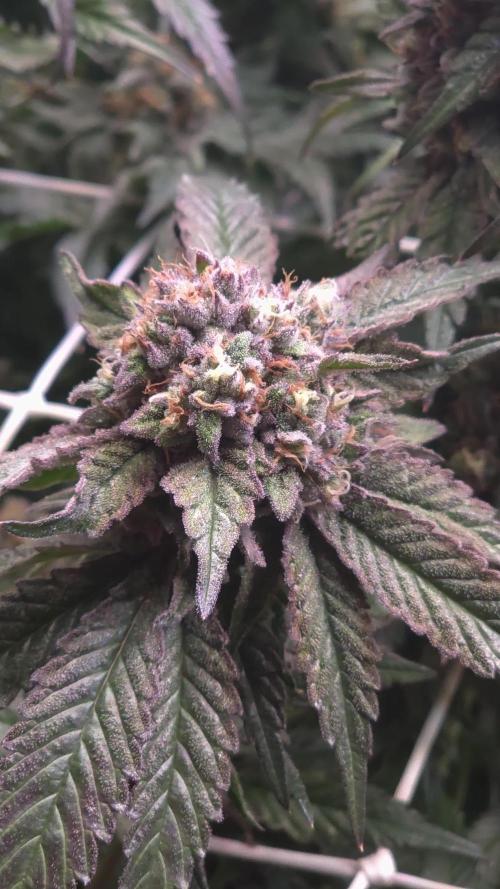
The final week is here, and the plants are now ready for harvest.
I flushed the plants and started preparing everything for the harvest. Looking back at the whole grow, I’m really happy with how everything developed.
The SCROG turned out beautifully, and the flowers have become absolutely stunning. They are dense, covered in frost and have developed an incredible aroma.
It’s always a great feeling to reach this point after watching the plants grow week after week. I’m really proud of how this run turned out and I can’t wait to see the final result after harvest and drying.
Now it’s time for the last step. Harvest time is coming!


Likes
1
Share


@kauilmayel1996
Follow
Me está gustando mucho como huele
Muy frutal
Estoy agradecido ya que las plantas resistieron y siguen creciendo
Revisando parámetros y limpiando
Alistando para el día de corte
Likes
15
Share


@Rebola
Follow
Since i put my filter the temperature ir a bit high, i think the extractor in not powerfull enough 😔
All 3 Sensi Skunk are 50cm tall, and starting to flower, Big Bug is 35 cm and only a few pistils..
I realized that i started to count day 1 when it was already day 5 or so.. but no problem 😁
I dont have a ph or ec meter (will be my next investment), i just have those drops for test ph,
And today when i finished mixing the nutes, i tested with those drops and it was to low, (orange color) so i had to take off 1/4 off the solution, and
add tap water, which has high ph and i manage to bring the ph up,(yellow color).
Hope they like this mix of waters and nutes i gave them 😆
13/06/2021
Day 27 (from seed) - 1.7L water+nutes
Day30 - 2L water
Day32 - 2L water + nutes
Big Bud is not looking good 😔 bottom yellow leaves and the upper leaves very pale.. growing very slow compared to the others.
Same water and nutes for all of them, so i dont know whats the issue. ☹️
Likes
25
Share


@pifflestikkz
Follow
Day 58
30/08/24 Friday
Feed today using de-chlorinated tap water pH 6 with Plagron products.
Day 60
01/09/24 Sunday
De-chlorinated tap water pH 6 with calmag today.
Picture update ✌️💚
Day 62
03/09/24 Tuesday


Likes
10
Share

@D4D3DHOMMIES
Follow
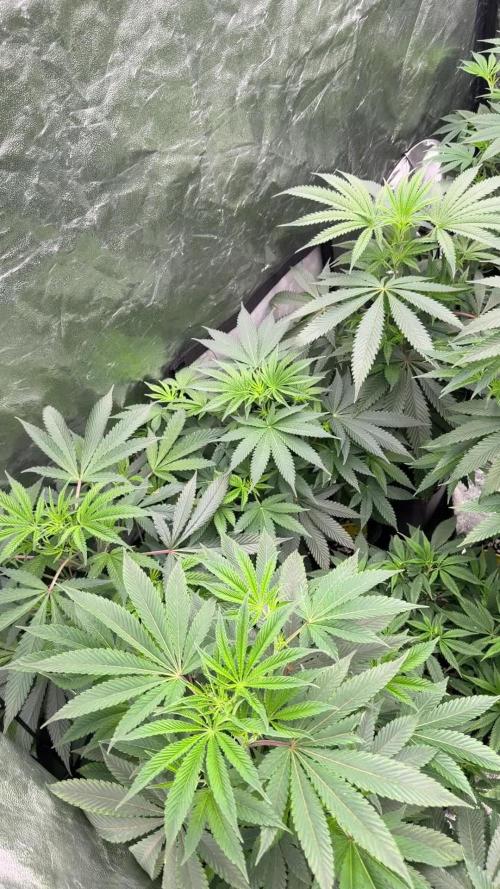
This week I finished the last clones, hoping to see some great phenotypes. I plan to keep the best ones, make a selection, and keep the best ones, then plant more to select the best and discard the rest. Next week, for flowering, I've raised my light to its maximum height (I don't use a filter inside the grow tent; I have the whole room under one filter) and to 50% power to give them a little extra boost these last few weeks and improve their growth. I love having the information on my phone to know what's happening with my babies at all times.

Likes
6
Share


@Green_Dream
Follow
This has been one of the easiest grows I had so far.
The feeding was the key. Amending with a ‘Grow’ amendment(rich in Nitrogen) and supplement with Bloom liquid nutrients.
Watering as often as possible and using RO water.
Even though I had a pest invasion the girls did great.


Likes
38
Share


@Green_Mountains
Follow
Another good week. Watered them twice. I'm not planning on feeding them again. A little defoliation. I definitely think they are in the last 2 weeks before harvest.
Still seeing some nutrient burn developing on the leaves. I don't think I watered enough through the whole grow! I'd love to hear opinions on this!
Took some videos of the buds with an iPhone 12 at 6X magnification. Decent quality!
Otherwise, still looking to successfully harvest these plants! Thinking about the next grow. Probably going to be Auto Strawberry Cheesecake and Auto Anesthesia.
Peace!