Likes
Comments
Share
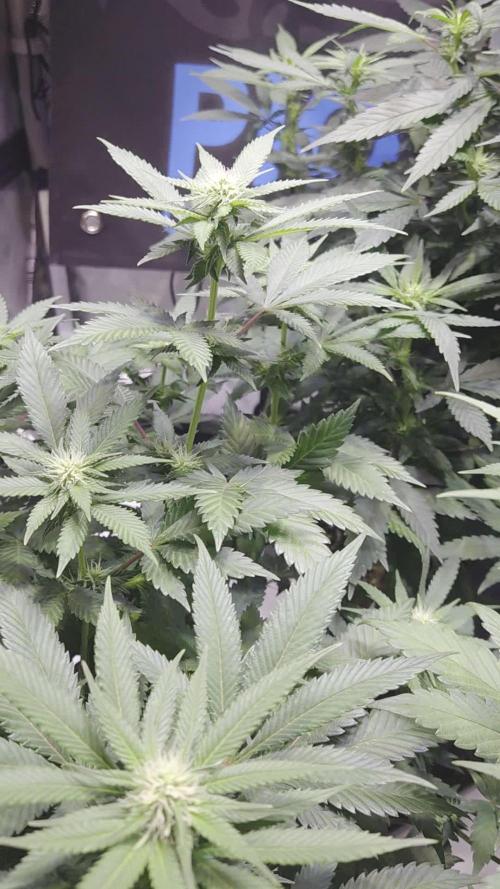
Right now the plant is doing good. She seems like she had slight deficiency on some of the fan leaves. I gave her good water of nutrients and recharge so she will be fine. Little budlets are everywhere. No purple yet. Was hoping I got a solid purple pheno. Well well see if she purps in the end. Stay tuned.
Likes
2
Share
We become aware at such times of man's wonderful ability to bring seemingly unrelated elements into harmonic balance, and receive a glimpse into a world where everything exists in conscious sympathetic attunement to everything else. When we listen to a piece of music that seems to strike a beautiful chord somewhere inside us, or view a painting that simply glows with harmonic awareness well executed, we probably do not spare much time to contemplate the wonderfully intricate combination of vibrations that our sensors make it possible for us to perceive. We tend to appreciate the relationship between the parts of something by an awareness of the harmony or dissonance of the whole. This ability enables us to say "what a beautiful house!" instead of "analysis has proven that this collection of building materials exhibits certain elements of harmonic proportion." While this ability to instinctively appreciate the beauty of true harmony has an important role to play in evolution, a more analytical understanding of the laws involved can be most useful. This is especially so if we wish to create works of art where each part exists in true harmony, not only with the other part of that particular whole, but with the universe within which the creator and the created exist. Everything vibrates. From the most dense matter to the most subtle cosmic rays, everything which our senses allow our thoughts to become aware of, can be specified in terms of wavelength or frequency of vibration. These two terms define the same thing, but from different points of view. The following are the approximate wavelengths of various energy carriers: Cosmic rays 0.000,000,001 mm Gamma rays 0.000,000,1 mm X rays 0.000,500 mm Ultraviolet rays 0.003 mm Visible light 0.006 mm Infrared 0.01 mm Sound waves 1 meter Radio waves 300 meters Violet light 400 nm to 450 nm Blue light 450 nm to 500 nm Green light 500 nm to 570 nm Yellow light 570 nm to 590 nm Orange light 590 nm to 610 nm Red light 610 to 700 nm 1 nanometer (nm) = 0.000,000,1 cm = 1/10,000,000 cm If a guitar string is plucked and we hear a sound, it is not too difficult for the human mind to associate this sound with the vibration of the guitar string. With color it is quite different. It is difficult for us to conceive that the color of a substance is not an inherent property of the substance itself, but an indication picked up by our senses of that substance's ability to absorb or reflect the light which happens to be shining on it at that moment. Neither the matter nor the light is colored. What happens is that the brain learns to differentiate between the frequencies reflected or transmitted by the substance the eyes are focused on. The same thing happens with sound. When we say "Oh! Listen, they're playing my favorite song," what we really mean is: "My brain has stored within it a particular pattern of frequencies. I have compared the new information being received with this stored pattern and have deduced the answer that the two patterns are similar within certain specified tolerances." The 'pleasure' involved could have something to do with our running the pre-recorded pattern at the same time, in 'sympathy' with the new pattern as it is received. The word sympathy describes very well our ability to appreciate color and sound. It also describes the reason behind certain elements of harmony. For instance, if a substance vibrating at 100 cycles per second (tone 1) is in the proximity of another substance vibrating at 200 cycles per second (tone 2), we could perceive, if we had the right equipment, a certain sympathetic relationship between the two. We will see from this that there is a uniform doubling of the first tone seen in the second. At various points along the waves, the two are the same in amplitude. At other points, they are at opposite poles to each other. This doubled frequency has more points of similarity to the original than any other frequency except the original itself. If the equipment we had available for measuring these two frequencies was a soundboard amplifier and a pair of ears, then we would hear what would sound to us like one tone. If we had the opportunity to hear one at a time, we would hear that although they sound the same, one is higher in pitch than the other. This characteristic of 'the same but different in pitch', musicians have called the octave. Any two tones produced where one has exactly doubled the frequency of the other is called an octave. Speaking in ratios, an octave would appear then as the ratio 2:1 or 1:2, depending on whether we are talking of an octave up or down. A single note produced by almost any instrument will contain more than one wavelength or frequency. It will have a dominant frequency, the wavelength of which we would call the note's 'fundamental' or 1st harmonic. It will also have a varying number of upper harmonics, gradually fading in intensity into infinity or silence. Natural harmonics always have the same pattern of intervals between them. The interval between the 1st and 2nd harmonic is a perfect octave; between the 2nd and 3rd a perfect fifth; between the 3rd and 4th a perfect 4th; and so on, the intervals becoming smaller and smaller until they lose any relationship with the western 12 tone scale as it exists at the moment. Just as an octave has certain elements of sympathy with its fundamental, so some intervals have been noted to be more perfectly in sympathy with the fundamental than others. The ratio of the 'perfect 5th' or interval of 7 semitones, as it occurs in the harmonic series, is 3:2 or 2:3, while that of the 'perfect fourth" is 4:3 or 3:4. All the tones in the western 12 tone scale can be expressed in terms of the ratio between the upper tone and its fundamental. This would seem to be an ideal way of generating a scale from any given fundamental and several attempts have been made to do this, the Pythagorean system being probably the most well known. Although when working with a single tone instrument playing on its own, the Pythagorean formula works wonderfully well, if we had several instruments tuned this way together and asked them to play almost any western music, we would find that at times they sounded quite out of tune to each other. The lack of flexibility of the various scale systems based on the harmonic series has led to what is known as the 'tempered' scale. This uses as its primary unit of interval the ratio of the octave or 2:1. It then proceeds to divide the interval between any fundamental and its upper octave into 12 smaller intervals by applying the ratio: two to the one-twelfth power, to one (21/12:1). This equals 1.059463094, so by multiplying any frequency by this number, we will obtain the tempered semitone next up from our fundamental. We will also find that any tone twelve semitones up from any other tone, in a scale generated in this way, will have exactly double the frequency. If we took the note middle C on a piano and halved the wavelength, we would have the note C one octave above. If we halved this, we would have the C above, and so on. However, within about 6 octaves, we would find that although a 'sound' was being produced, no human ear could perceive it. If we kept on going, halving and producing upper octaves of our fundamental C, we would proceed through the infrared band, into the visible light spectrum. If we happened to be outside during the day, we would, for one octave only, see the note C with our eyes. The next octave above would already be in the ultraviolet band, and outside the eye's sensitivity range. If we can think of color as being an indication of a substance's vibratory rate or wavelength, we may begin to see a relationship that could exist between the color and sound spectrums. The logical extension of what has so far been said is that there exists a scale in the color spectrum that corresponds exactly to the scale in the sound spectrum, each color tone being an octave of the equivalent note in the sound range. This is not the end of the story but only the beginning. If we can for the moment accept that any wavelength in one band has upper and lower octave stretching out to infinity, then the next question is 'fine, but what shall we use as our fundamental? A particular color? A particular sound frequency?' The musicians among us will probably say 'A 440'. This means that the note A should vibrate at 440 Hertz, or 440 times per second. They would tell us that this is standard pitch has been adopted by most orchestras around the world; pianos are tuned to it, instruments are constructed to formulas based on it, and so to them it would probably seem the most appropriate place to begin. Some of these musicians may know of the battle that is still raging with regards to this being the standard, but few would know why A = 440 Hz was chosen except that it worked when it was set to be a suitable compromise between the many different pitches in use at the time. 432 Hz is said to be mathematically consistent with the patterns of the universe. Studies reveal that 432 Hz tuning vibrates with the universe’s golden mean PHI and unifies the properties of light, time, space, matter, gravity, and magnetism with biology, the DNA code, and consciousness. When our atoms and DNA start to resonate in harmony with the spiraling pattern of nature, our sense of connection to nature is said to be magnified. Another interesting factor to consider is that the A=432 Hz tuning correlates with the color spectrum, while the A=440 Hz is off. Audiophiles have also stated that A = 432 Hz music seems to be non-local and can fill an entire room, whereas A=440 Hz can be perceived as directional or linear in sound propagation. Once you adopt the idea that sound (or vibration in general) can have an equalizing and harmonizing effect (as well as a disturbing effect), the science of harmony can be applied to bring greater harmony into one's life or tune to specific energies. There is a form of absolute and relative harmony. Absolute harmony can, for example, be determined by the tuning of an instrument. The ancients tuned their instruments at an A of 432 Hz instead of 440 Hz - and for a good reason. There are plenty of music examples on the internet that you can listen to in order to establish the difference for yourself. Attuning the instrument to 432 Hz results in a more relaxing sound, while 440 Hz slightly tenses up the body. This is because 440 Hz is out of tune with both macro and micro cosmos. On the contrary, 432 Hz is in tune. To give an example of how this is manifested microcosmically: our breath (0,3 Hz) and our pulse (1,2 Hz) relate to the frequency of the lower octave of an A of 432 Hz (108 Hz) as 1:360 and 1:90. It is interesting to note that 432 Hz was the standard pitch of many old instruments and that it was only recently (19th and 20th century) the standard pitch was increased. This was done in order to be able to play for bigger audiences. Bigger audiences (more bodies) absorb more of the lower frequencies, so the higher pitch was more likely to “cut through”. One of the oldest instruments of the world is the bell ensemble of Yi Zeng (dated 423 BC), tuned to a standard F4 of 345 Hz, which gives an A= 432 Hz. The frequency of 345 Hz is that of the platonic year! Similarly, many old organs are tuned in A=432 as well; for example, St. Peter’s Capella Gregoriana, St. Peter’s Capella Giulia, S. Maria Maggiore in Rome. Maria Renold’s book “Intervals Scales Tones and the Concert Pitch C=128 Hz” claims conclusive evidence that 440 Hz and raising concert pitch above scientific “C” Prime=128 Hz (Concert A=432 Hz) disassociates the connection of consciousness to the body and creates anti-social conditions in humanity. The difference between concert pitch A=440 Hz and Concert A=432 Hz is only 8 cycles per second, but it is a perceptible difference of awareness in the human consciousness experience of the dream we share called existence.
Likes
2
Share
Likes
346
Share
@Canna96
Follow
Hey now! This week went very well. I feel like she is finally done growing, and just starting to thicken up and ripen. I did switch from the liquid koolbloom to the dry, and within 48 hours or so I really started noticing the weight of the colas start leaning towards the floor. I did support the main colas last week, but this week I noticed several of the smaller unsupported colas started drooping to the floor, so i added a few support lines. I am thinking maybe she has two or three weeks left. I am not a big believer in an all out flush, as I do not wish to stress her out even near the end. Rather, I am gradually weaning her off the nutes over the next 2-3 weeks. She is starting to get brown tips on almost every leaf so not sure if this is just her being near the end or a bigger issue?? Any advice please hit me up! I'm still struggling with humidity issues, but she seems to be ok! Thank you so much to everyone in this community for all the love, support, and help with my first grow. Thanks and blaze on!
Likes
26
Share
Plant 1 is ready the other two get another 12h and 24h in dark tent Taste fruity and berrys White Ash
Likes
4
Share
@Abelgrow
Follow
Day 1: Seeds placed in paper towel. Day 2: 5/6 sprouted roughly 1/8 of a inch. Day 3: placed seeds in 5 gallon fabric bags, with 2 gallons of water introduced beforehand (slight runoff from each) 5 of 6 seeds germinated very well, roots ~1/2 inch long before planting in soil, forgot to take a picture of the seeds before planting. Other seed ~1/8 inch. Day 4: Watered each plant with 1/3 gallon of water with Athena Grow(16ml/g) and Athena Core(10ml/g) at 9am with 6.7ph Day 5: Watered each plant with 1/3 gallon of 6.7 ph water(no nutrients) r at 9am, 4 of 6 plants sprouted Day 6: No water needed, plant 5 sprouted, plant 6 still not. Day 7: Watered each plant with 1/4 gallon of water with Athena Grow(16ml/g), Athena Core(10ml/g), Raw Silica(1/8 tsp) and Dextrose powder(1 tbsp.) Plant 5 lightly watered, Plant 6 not watered. Day 8: No water needed, Plant 6 taken out Day 9: No water needed, Plant 5 very weak compared to others.
Likes
18
Share
@TVance32
Follow
I was super anxious to get to grow my own weed. Came home to 5 of 6 sprouted. It took the other one nearly a week to come up.
Likes
34
Share
@Salokin
Follow
Hello Growmies, As we step into the eighth week of our Watermelon Candy F1 Hybrids' flowering stage, the dance of growth and aroma continues to enchant our senses. These delightful plants, sharing their space with Epic Buzz and Red Banana Pudding varieties, inch ever closer to the pinnacle of their bloom. The Watermelon Candy cultivars are flourishing with an undeniable zest, their foliar tapestry thick with the potential of what's to come. The air is thick with their intoxicatingly sweet scent, a testament to their namesake, and their buds are expanding with satisfying robustness. Plant #1 is maintaining its lead with a striking bud formation, clearly thriving in the consistent environment of the Tent-X system. Plant #2 and Plant #3 are not far behind, with each showing a wealth of budding sites and a sprawling canopy that speaks to a bountiful harvest ahead. Despite being under a 12/12 light cycle along with the photoperiod plants, which may limit their yield compared to a 20/4 cycle, these plants are putting on a splendid show. They continue to swell, their trichome-frosted buds promising a powerful and flavorful finale. Nutrition continues on a carefully scheduled five-day rotation, our blend of Alga Bloom, Sugar Royal, Power Roots, and Orca nurturing these beauties into their late flowering phase. The TrolMaster system diligently logs every parameter, ensuring our VPD and PPFD values are consistently optimized for peak performance. As the eighth week unfolds, we see the evidence of our meticulous care in the uniform health and structure of the plants. The internodal spaces remain tight, the stems sturdy, and the flowering sites increasingly impressive. With anticipation building for the harvest that lies ahead, we reflect on the journey so far. It's a path marked by shared knowledge and collective experience, all leading us toward what promises to be a remarkable culmination of our efforts. Stay lifted, Salokin
Likes
Comments
Share
@Kannisho
Follow
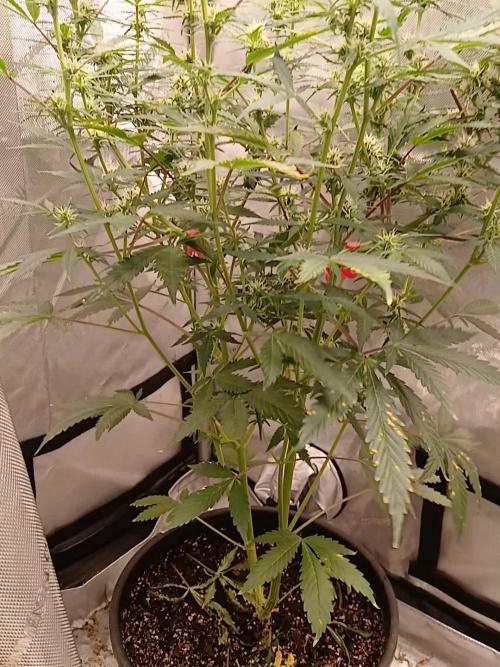
At this stage we are delighted with the development of these wonderful plants, and Colombia's #1 award-winning nutrition demonstrates its high standard.
Likes
16
Share
Semana 6 y media de estás nenas. El finde me fui a la playa y cuando llegue estaban muy decaídas y secas. Así que se estresaron un poco, y sufrieron una sobreferti por la misma acumulación de sales al secarse el sustrato. Le hicimos un apical a toda las nenas y hemos estado haciendo supercropping para darle fuerza a los brotes que están más abajo. Seguimos con los mismos métodos de riego, esta semana yo creo que cambiaremos de maceta a 3.5L para terminar en una de 11L o 20L vamos a ir viendo a medida que van creciendo.
Likes
10
Share
Day 51 today another three weeks to go possibly four got some weird blotches on the leaves not sure what they are apart from that all good smelling super fruity and pungent atm
Likes
5
Share
Transplant into a hydroponic recirculating deep water culture sustem
Likes
9
Share
@4F1M6
Follow
I started germination of 1 orange sherbert bean on 29/12/2020. I pre moistened my rockwool cubes with ph balanced water to 6.4. Made sure the plug was just damp and not soaked. Using a small wooden dowel I increased the size of the plugs pre made hole. Than I sowed my bean into the hole. Ripped off a small piece of rockwool and mulched it up. Lightly filled the hole in with the mulched rockwool. Than stuck the plug into a misted humidity dome, to complete germination. Shouldn't take anymore than 4-5 days to see a sprout. Once I see some cotlydon leaves bursting to the surface. I will get the plug planted into some 1 gallon pots. Plus get this lady situated into her home. Cant wait! Some Background information on history with Orange Sherbert. I have grown orange sherbert out 3 times and all times had the same result. A shorter extremely branchy robust plant. That dominated the room. Loves training and really ups yeilds doing so. She produces an amazing canopy... just a sea of daggers. Her huge chunky colas pack and amazing orange tangy aroma and just taste like heavenly candy! Barneys Farm hit the nail on the head with this variety! She tends to have a little higher demand for potassium mid flower than most varieties. So a bit heavier on the pk booster and she will be mighty happy! Just a fabulous strain to work with.
Likes
9
Share
Day 51-26 Fed 2 L till run off . She was thirsty from no feeding yesterday but humidity still fighting hard in the high 50s Day 52-27- Fed 1.5 L Starting to lower nutes Day 53-28- Fed 1.5L Day54-29 Fed 1.5L Day 55-30 Missed Day 56-31 Fed 2.5 L Day 57-32 None Day 58-33 Fed 2L Day 58-34 No feed Day 35 Feed2 L Day 59-36 In one Day60-37 Fed 2L Day 61-38 None Day. 62-39 Feed 3 L . 1st L plain ones water as no run off last few days Then fed 2L with nutes Day 63-40 None Day 64-41 None Day 65-42 Fed 2L Day 66-43 Nothing - starting to see fading I think . Might start flushing in next few days Day 67-44 Fed 2.5 L Say 68-45 None
Likes
19
Share
@Mo_Powers
Follow
the white widow plant is now to big for the greenhouse. let´s the how it will perform on the outside now. i just let it grow. only nutrient and no training or something.
Likes
61
Share
@Amaya
Follow
Оборвала веерные листья основного стебля чтобы дать больше воздухопроницаемости. Текущий NPK профиль такой: N90:P67:K149:Ca37,5:Mg45 Перевожу на цветение через пару дней.
Likes
35
Share
Flowering going really well now buds seems to be fattening up nicely and starting to smell a little now also, had no issues at all with these liberty upto now all grew well and not showed any signs of nute burn or anything suprised me really so fingers crossed for the next few weeks that i have no issues and get a nice harvest
Likes
6
Share
The girls come back inside when the weather is uncooperative. Indoor temp is around 70 and humidity around 60-65%. Otherwise pretty much the same as prior weeks.
Likes
17
Share
Really suffered in the summer with heat waves. Temps in the tent when the lights were on was going as high as 93⁰f (33.88⁰c). The buds have foxtailed as a result and I beleive I had pheno #1 hermy in its final days. 0 seeds found in both phenos so I got lucky. It flew through the veg stage, growing faster than the runtz muffin it was sharing the tent with. Flower period felt fast too, it was looking stacked already in week 5.
Likes
6
Share
Week 10 for Space Panda by Atlasseed, The roots on her are just insanely nice. She finally got her transplant into 25L of fairly good soil mix of biobizz light mix/coco mix + a good feed of @bokashibiochar + a feeding of BioGrow by greenhousefeeding I think a few days of adjusting and she will start to explode.
Likes
1
Share
So at this point this plant is my mad scientist project. I have clones it, super cropped it, and now I’m main lining it. I’m surprised it’s still alive but I guess it’s good I pulled so many clones. Looking forward to seeing how it heals and what it does on the rebound