The Grow Awards 2026 🏆
Likes
Comments
Share
@Nillenium
Follow
Am 16. Tag wurde die Dame getoppt und am Ende der Woche habe ich mit dem 1. LST begonnen.
Likes
10
Share
Blüten werden inzwischen sehr Harzig und der Duft nimmt zu. Dem Giesswasser wird täglich 1:10 Jauche zugegen. Zu dem jedes zweite Gießen Pro Sugar von Grow Pro ein Kohlenhydrat Blütedünger(von der Mary Jane ein Tester). Zu dem gibt es ein bis zweimal in der Woche Seafeed Xtra von envii. Die ersten Blätter haben sich unten entfernt daher gebe ich gerade wieder Stickstoff zu den Pflanzen. Auch wenn es nur noch diese Woche war danach nur noch Blütedünger. Zu dem habe ich Basilikum gepflanzt, Dill, Ringelblume und Koriander gesäat am Anfang der Woche und zum Ende noch Lupine und Rot Klee.
Likes
121
Share
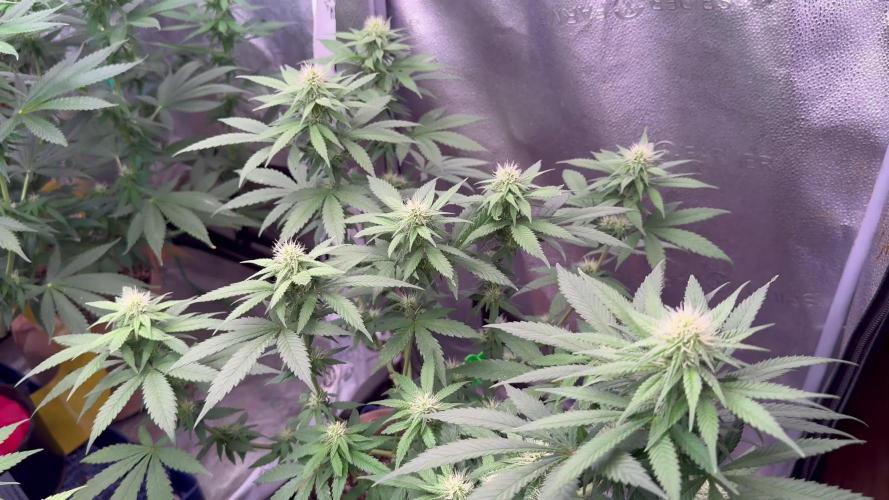
Day 31 F and I’m cutting the extra P supplement, from now on they will take it only from my NPK all in one liquid base, im increasing K to help them in this final fattening etc . The trichomes department is evolving quite fast and beautifully, and with them popping all over, so are the fragrances with are starting to jump out and putting my carbon filter to work, but still with it once the grow tent is open the sweet smells mixed with a touch of a kind of skunk citrus pop out and make a strong presence in the surrounding air . have a great weekend you all 💚💚💚, thank you for reading my diaries 🙌🙌🙌🙏🙏🙏💚💚💚growers love and keep tuned 💚💚💚 Day 34 F under MARSHYDRO TSW-2000 And the trichomes department… 🤩🤩🤩 man are they popping all over like crazy, thank you MARSHYDRO fir your spectrum quality, no doubt that my girls are loving it 🙏🙏🙏🙌🙌🙌💚💚💚 Day 34 and the time to take one hour to the light schedule and bring it to a total of 11 hour day time, this will help them mature faster and will also give them and extra hour every night to put the defensive mechanism working and produce and with it comes more trichomes, there for … 🤩💚💚💚 happy holidays to you all, growers love and stay tuned, new week is almost starting and I don’t know about you guys, but I’m pretty exited to see How are this girls gona evolve, collor, density, etc etc 😅😅😅 💚💚💚🙌🙌🙌🙌🙏🙏🙏 thank you all for supporting and reading my diaries 🙌🙌🙌🙏🙏🙏💚💚💚 And with and enormous honneur and pleasure that i start collaborating with MARSHYDRO, they wore kind enough and send me a 4x4 grow tent and a TSW2000 for me to do tests and reviews, i got to admit the quality on the materials, the easy assembling, the user manual, even the art detail that came with a bunch of cool stickers, are plus things that can not go unnoticed 🙏💚 Thanks Marshydro for so many details 🙌😉 i will try and post them all in here, but you can follow me on my instagram account https://instagram.com/dogdoctorofficial for every day updates , videos giveaways etc, or in my youtube channel- https://youtube.com/channel/UCR7ta4DKLFMg2xxTMr2cpIg keep tuned 💚💚💚 Thank you MARSHYDRO for having faith in my love for growing , lets make magic together 🙏🙏🙏 Genetics - Cookies Fam genetics - 3x SunsetSherbet Grow tent - MARSHYDRO 4x4 Ligth - MARSHYDRO TSW 2000 @ 100% Food - HAPTUS HOLLAND Filter - vanguard hydroponics Falcon Filters Extraction - 2 x vanguard hydroponics 280m3h Extraction control - SMSCOM Smart MK2 All i grow is medicine for myself, for me and for my best friend with is me 😆 nothing to sell, so don’t even ask 😅💚💚💚 All info and full product details can be find in can find @ https://www.mars-hydro.com/grow-tent https://www.mars-hydro.com/led-grow-light/mars-ts-series-led-grow-light/mars-tsw-2000-led-full-spectrum-hydroponic-led-grow-light https://marshydro.eu/ DISCOUNT CODE - DOGDOCTOR 💚💚💚🙏🙏🙏💚💚💚 https://marshydroau.com/ https://aptus-holland.com/ More info and updates @ https://growdiaries.com/grower/dogdoctor https://instagram.com/dogdoctorofficial https://youtube.com/channel/UCR7ta4DKLFMg2xxTMr2cpIg 💚💚💚Growers love to you all 💚💚💚
Likes
11
Share
@Bud_vista
Follow
We entered week 10 now. She will need about one more week until I will chop her :) Until now, everything went fine and she’s smelling fantastic. I’m in love with this plant, she’s just beaut
Likes
10
Share
@Weedzoks
Follow
Premiers pistils le 9ème jour de floraison
Likes
47
Share
What's in the soil? What's not in the soil would be an easier question to answer. 16-18 DLI @ the minute. +++ as she grows. Probably not recommended, but to get to where it needs to be, I need to start now. Vegetative @1400ppm 0.8–1.2 kPa 80–86°F (26.7–30°C) 65–75%, LST Day 10, Fim'd Day 11 CEC (Cation Exchange Capacity): This is a measure of a soil's ability to hold and exchange positively charged nutrients, like calcium, magnesium, and potassium. Soils with high CEC (more clay and organic matter) have more negative charges that attract and hold these essential nutrients, preventing them from leaching away. Biochar is highly efficient at increasing cation exchange capacity (CEC) compared to many other amendments. Biochar's high CEC potential stems from its negatively charged functional groups, and studies show it can increase CEC by over 90%. Amendments like compost also increase CEC but are often more prone to rapid biodegradation, which can make biochar's effect more long-lasting. biochar acts as a long-lasting Cation Exchange Capacity (CEC) enhancer because its porous, carbon-rich structure provides sites for nutrients to bind to, effectively improving nutrient retention in soil without relying on the short-term benefits of fresh organic matter like compost or manure. Biochar's stability means these benefits last much longer than those from traditional organic amendments, making it a sustainable way to improve soil fertility, water retention, and structure over time. Needs to be charged first, similar to Coco, or it will immobilize cations, but at a much higher ratio. a high cation exchange capacity (CEC) results in a high buffer protection, meaning the soil can better resist changes in pH and nutrient availability. This is because a high CEC soil has more negatively charged sites to hold onto essential positively charged nutrients, like calcium and magnesium, and to buffer against acid ions, such as hydrogen. EC (Electrical Conductivity): This measures the amount of soluble salts in the soil. High EC levels indicate a high concentration of dissolved salts and can be a sign of potential salinity issues that can harm plants. The stored cations associated with a medium's cation exchange capacity (CEC) do not directly contribute to a real-time electrical conductivity (EC) reading. A real-time EC measurement reflects only the concentration of free, dissolved salt ions in the water solution within the medium. 98% of a plants nutrients comes directly from the water solution. 2% come directly from soil particles. CEC is a mediums storage capacity for cations. These stored cations do not contribute to a mediums EC directly. Electrical Conductivity (EC) does not measure salt ions adsorbed (stored) onto a Cation Exchange Capacity (CEC) site, as EC measures the conductivity of ions in solution within a soil or water sample, not those held on soil particles. A medium releases stored cations to water by ion exchange, where a new, more desirable ion from the water solution temporarily displaces the stored cation from the medium's surface, a process also seen in plants absorbing nutrients via mass flow. For example, in water softeners, sodium ions are released from resin beads to bond with the medium's surface, displacing calcium and magnesium ions which then enter the water. This same principle applies when plants take up nutrients from the soil solution: the cations are released from the soil particles into the water in response to a concentration equilibrium, and then moved to the root surface via mass flow. An example of ion exchange within the context of Cation Exchange Capacity (CEC) is a soil particle with a negative charge attracting and holding positively charged nutrient ions, like potassium (K+) or calcium (Ca2+), and then exchanging them for other positive ions present in the soil solution. For instance, a negatively charged clay particle in soil can hold a K+ ion and later release it to a plant's roots when a different cation, such as calcium (Ca2+), is abundant and replaces the potassium. This process of holding and swapping positively charged ions is fundamental to soil fertility, as it provides plants with essential nutrients. Negative charges on soil particles: Soil particles, particularly clay and organic matter, have negatively charged surfaces due to their chemical structure. Attraction of cations: These negative charges attract and hold positively charged ions, or cations, such as: Potassium (K+) Calcium (Ca2+) Magnesium (Mg2+) Sodium (Na+) Ammonium (NH4+) Plant roots excrete hydrogen ions (H+) through the action of proton pumps embedded in the root cell membranes, which use ATP (energy) to actively transport H+ ions from inside the root cell into the surrounding soil. This process lowers the pH of the soil, which helps to make certain mineral nutrients, such as iron, more available for uptake by the plant. Mechanism of H+ Excretion Proton Pumps: Root cells contain specialized proteins called proton pumps (H+-ATPases) in their cell membranes. Active Transport: These proton pumps use energy from ATP to actively move H+ ions from the cytoplasm of the root cell into the soil, against their concentration gradient. Role in pH Regulation: This active excretion of H+ is a major way plants regulate their internal cytoplasmic pH. Nutrient Availability: The resulting decrease in soil pH makes certain essential mineral nutrients, like iron, more soluble and available for the root cells to absorb. Ion Exchange: The H+ ions also displace positively charged mineral cations from the soil particles, making them available for uptake. Iron Uptake: In response to iron deficiency stress, plants enhance H+ excretion and reductant release to lower the pH and convert Fe3+ to the more available form Fe2+. The altered pH can influence the activity and composition of beneficial microbes in the soil. The H+ gradient created by the proton pumps can also be used for other vital cell functions, such as ATP synthesis and the transport of other solutes. The hydrogen ions (H+) excreted during photosynthesis come from the splitting of water molecules. This splitting, called photolysis, occurs in Photosystem II to replace the electrons used in the light-dependent reactions. The released hydrogen ions are then pumped into the thylakoid lumen, creating a proton gradient that drives ATP synthesis. Plants release hydrogen ions (H+) from their roots into the soil, a process that occurs in conjunction with nutrient uptake and photosynthesis. These H+ ions compete with mineral cations for the negatively charged sites on soil particles, a phenomenon known as cation exchange. By displacing beneficial mineral cations, the excreted H+ ions make these nutrients available for the plant to absorb, which can also lower the soil pH and indirectly affect its Cation Exchange Capacity (CEC) by altering the pool of exchangeable cations in the soil solution. Plants use proton (H+) exudation, driven by the H+-ATPase enzyme, to release H+ ions into the soil, creating a more acidic rhizosphere, which enhances nutrient availability and influences nutrient cycling processes. This acidification mobilizes insoluble nutrients like iron (Fe) by breaking them down, while also facilitating the activity of beneficial microbes involved in the nutrient cycle. Therefore, H+ exudation is a critical plant strategy for nutrient acquisition and management, allowing plants to improve their access to essential elements from the soil. A lack of water splitting during photosynthesis can affect iron uptake because the resulting energy imbalance disrupts the plant's ability to produce ATP and NADPH, which are crucial for overall photosynthetic energy conversion and can trigger a deficiency in iron homeostasis pathways. While photosynthesis uses hydrogen ions produced from water splitting for the Calvin cycle, not to create a hydrogen gas deficiency, the overall process is sensitive to nutrient availability, and iron is essential for chloroplast function. In photosynthesis, water is split to provide electrons to replace those lost in Photosystem II, which is triggered by light absorption. These electrons then travel along a transport chain to generate ATP (energy currency) and NADPH (reducing power). Carbon Fixation: The generated ATP and NADPH are then used to convert carbon dioxide into carbohydrates in the Calvin cycle. Impaired water splitting (via water in or out) breaks the chain reaction of photosynthesis. This leads to an imbalance in ATP and NADPH levels, which disrupts the Calvin cycle and overall energy production in the plant. Plants require a sufficient supply of essential mineral elements like iron for photosynthesis. Iron is vital for chlorophyll formation and plays a crucial role in electron transport within the chloroplasts. The complex relationship between nutrient status and photosynthesis is evident when iron deficiency can be reverted by depleting other micronutrients like manganese. This highlights how nutrient homeostasis influences photosynthetic function. A lack of adequate energy and reducing power from photosynthesis, which is directly linked to water splitting, can trigger complex adaptive responses in the plant's iron uptake and distribution systems. Plants possess receptors called transceptors that can directly detect specific nutrient concentrations in the soil or within the plant's tissues. These receptors trigger signaling pathways, sometimes involving calcium influx or changes in protein complex activity, that then influence nutrient uptake by the roots. Plants use this information to make long-term adjustments, such as Increasing root biomass to explore more soil for nutrients. Modifying metabolic pathways to make better use of available resources. Adjusting the rate of nutrient transport into the roots. That's why I keep a high EC. Abundance resonates Abundance.
Likes
4
Share
D16: Week 3! :D Weak smell D19: Watered 500 ml each! D21: Watered 500 ml each I top again Lemon for the 2nd time ;) Almost 4 weeks, I'm super excited
Likes
26
Share
@OGbros
Follow
Ciao a tutti, il giorno 65 ho sostituito tutta la soluzione dei vasi. Dopo aver tirato via tutto ho aggiunto 20 litri d'acqua di rubinetto con 2ml/l di flora kleen (GHE). Non ho aggiustato il pH (che nella mia zona è superiore al 7.5 per l'acqua di rubinetto) tanto non ci sono sali disciolti da assorbire. Tra pochi giorni ci sarà la raccolta, sarà un'impresa pulire tutte quelle cime... PS le foto scattate il giorno 66 sono state fatte con un altro telefono
Likes
25
Share
@Roberts
Follow
Melon Gum is doing good. She is starting to stretch. She should start shooting pustils out soon. Everything is going well. Thank you Pure Instinto, Spider Farmer, and Athena nutrition. 🤜🏻🤛🏻🌱🌱🌱 Thank you grow diaries community for the 👇likes👇, follows, comments, and subscriptions on my YouTube channel👇. ❄️🌱🍻 Happy Growing 🌱🌱🌱 https://youtube.com/channel/UCAhN7yRzWLpcaRHhMIQ7X4g.
Likes
14
Share
@Dunk_Junk
Follow
Wow she's doing great this week. Grew another 20cm. Totally out of headroom now. She's going to yield a lot in a few weeks 😎
Likes
45
Share
I am happy with the outcome of this grow. This was my first time growing autoflowers and ILGM genetics. Total wet weight was 1301 grams Total dry weight 8.5 oz These plants are very hardy and grow tall very quickly with the tallest plant reaching 4 ft tall. Each plant grew very different bud structures which resulted in some very dense and very fluffy buds. If you are looking for a very uniform growing plant with dense buds you may need to look for another strain. The smell from these buds are strong and amazing. I would describe the smell as fruity glue with rubber. I am overall very pleased with how this grow went and I cant wait to grow some more!
Likes
17
Share
Beautifully looking buds with certain purple tones showing off in some pistils and also in some leafs, very good sweet fragrance coming from the flowrs, smells just like the other 2 aks420 I'm growing, looks like it's a very stable strain! Very recomended 👨‍🌾😋🌸 stay tuned guys! 💯🧡💚
Likes
10
Share
Plants are doing well, The 84" inch tent is a must if your not training or topping. I removed all the sacks that appeared last week and I haven't seen anymore show up so fingers cross, I check daily. Bigger tent also helps with heat control as the air has more room to rise. Hope you all like the pictures, I started to take videos as they provide more detail with less work.
Likes
27
Share
Hello Diary. The first week of vegetation is behind me and for now everything is fine. The temperature and humidity are satisfactory so I did not put the humidifier again. I started adding BioBizz on a schedule for the first week but I didn’t water another Haze Berry with that which is a week late. He still only gets water. Let’s take a look at this week’s review. 24/09/2020 - Day 1. Photography. Haze Berry Auto # 1 has an official first day. I mean by the first day when the plant gets the other two leaves. Then it is no longer sprout. Haze Berry Auto #1 - 8 cm Haze Berry Auto #2 - 4 cm Temp / Humidity on the farm - 26.3 degrees and 54% humidity. 26/09/2020 - Day 3. Watering. First feeding. I regulated p.H. at 6.1 and added BioBizz's Root-Juice - 4ml / L, Bio-Heaven 2ml / L and Acti-Vera 2ml / L. Each plant received a liter of water, but Haze Berry # 2 received only water without BioBizz, since it is still too small :). Temp / Humidity on the farm - 24.9 degrees and 45% humidity. 29/09/2020 - Day 6. Watering. p.H. is regulated to 6.3 and I added BioBizz on a schedule for the first week. Like three days earlier. This time I watered with 1.5 lit. Temp / Humidity on the farm - 24.2 degrees and 45% humidity. 30/09/2020 - Day 7. Photography. The first week is officially behind us. Haze Berry # 1 is progressing nicely while the other is a week late. It will be interesting to constantly monitor both plants given this age lag. Haze Berry Auto # 1 - 12 cm - Day 7. Temp / Humidity on the farm - 24.7 degrees and 48% humidity. What to say for the end of the first week except that the second Haze is a week late, but it doesn’t matter, I’ll have an interesting situation to compare, everything else is great. I am pleased with how the plants are progressing and I will try to please them as best I can. See you next week.
Likes
9
Share
@Chubbs
Follow
What up fam, weekly update on these gorgeous girls. They're showing preflowers now which I'm definitely happy as that means the stretch is almost over. Now time to see them fatten up. I got two definitive phenos, one that's way more bushy and the other is way taller. Over all I couldn't be happier with how they've grown. Happy
Likes
8
Share
@CanOli95
Follow
In this week, not a lot has changed. The lady is ripening and starts thickening it's buds. The weather has been bit colder, not a single day above 30°C. She is still packed with enough nutrients. No need to add more , since I can't see any signs of deficiency. Maybe I will add some low level K next week and some calmag, just to be sure.
Likes
14
Share
Venga familia que ya viene la cosecha de estas Punch Pie de RoyalQueenSeeds , que ganas que tenia ya de darles machetazo. No veas que pinta que tienen estas plantas. Las flores aparte se ven bien resinosas. a sido una genética con la que disfruté mucho cultivarla, es algo complicada cultivarla pero merece la pena si eres cultivador con experiencia no te será problema cosechar. Agrobeta: https://www.agrobeta.com/agrobetatiendaonline/36-abonos-canamo Mars hydro: Code discount: EL420 https://www.mars-hydro.com/ Hasta aquí es todo , espero que lo disfrutéis, buenos humos 💨💨.
Likes
9
Share