


Likes
Comments
Share


@GrowBro1981
Follow
Halli, Hallo, Hallöle liebe Growfreunde 🤗🤗,
Heute ist BT 18 und ich habe heute mal entlaubt und ganz leicht gelollipoppt. Ich wollte nicht zuviel lollipoppen, da ich denke dass die Sanlight Lampen eine sehr gute Tiefenwirkung haben, vorallem weil die aüßeren schräg hängen und der Lichtstrahl sich quasi kreuzt. Die Entwicklung in dieser Woche war, genauso wie die letzten Wochen, sehr entspannt. Alles ist gut verlaufen und der stretch lässt sich jetzt auch endlich sehen. Die Gorilla Zkittlez ist leder nicht mehr viel gewachsen und die Sweet ZZ lässt auch zu wünschen übrig zwecks stretch, aber was solls, lecker ist es auf jedenfall


Likes
4
Share


@blaze_fpv
Follow
I came back to the fridge after 6 days and stretch was running massively.
They grew like 20cm in 6 days
I changed my climate to:
27° C 60% rlf in order to adapt to early flower
Day and Night same
45% light about 580ppfd
Still running the water in a circle.
Adjusted the scrog a bit in order to fill the space more
They eat like 1100ppm CO2 an hour 😎
__________________
Update: last 2 videos show day 8 of flower ,🤙🏼
Decided to give them a heavy defoliation due to it being a closed loop system and them emitting tons of humidity.
So far so nice 🏼

Processing
Likes
2
Share


@Sundown
Follow
This lady is getting real big, i wish i had induce her to flower 1 week before, but shit happens :) HST to deal with it :P
Never had a Blue Dream Pheno with so many sativa %,
I'm sorry about the quality of pics and videos but my phone sucks, i promisse some good bud porn with better quality for the next weeks :p

Likes
19
Share


@bobtheblob
Follow
It was sometimes hard to understand her, and I feel like I failed a nutrition plan several times.

Likes
Comments
Share


@Uneasy
Follow
one of the plants could not stand the heat any longer. I cut almost all of its branches, I will cut it completely. Others struggle with the heat, but there's nothing I can do.

Likes
228
Share


@StarLorr
Follow
Welcome to my Pablø Ęscøbar diary.
In this diary:
Seeds: sponsored by Ðivine Șeeds
Media: Promix HP
Nutrients: Advanced Nutrients, Diablo Nutrients.
Light and Weather: Şun☀️and Mother Earth.🌎
___________________________
Feeding:
Tue 09Jul: 6L nutrients pH'd 6.5
Sat 13Jul: 10L water not pH'd
Sun 14Jul: 8L water not pH'd
Mon 15Jul: 10L water not pH'd
*please note that most water only feedings are 2L at the time throughout the day in bottom saucer*
___________________________
Another beautiful week, besides Wednesday's flood😅 it poured so much rain that my Tuesday morning feeding got flushed out and was in the bottom saucer Thursday morning😳😂that was a first for me.
All is good with my Ðivine Ladies, just me anxious to see them buds coming out.
______________________________
Thanks for stopping by, likes and comments are appreciated!👊🏻😎
Keep on growin!
Keep on tokin!!!
😙💨💨💨💨💨

Likes
4
Share


@Ryno1990
Follow
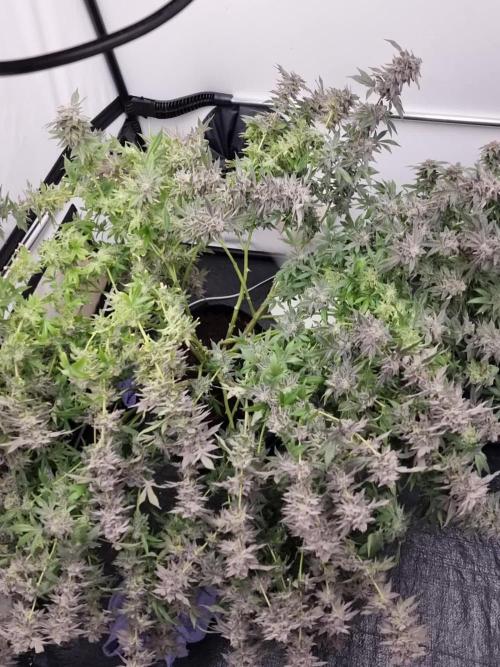
Week 11 for this beautiful girl here was amazing she's been plumping up her buds very nicely an covering them with trichromes she's been performing awesome since start and deffinetly bigger then I thought she was going to get Atlas seeds did an amazing job breeding this strain
Likes
2
Share

@LittleBigTrees
Follow
This week they were ready for harvest.
one went into a drying rack the other was hung upside down to dry
Likes
18
Share


@Stonyways
Follow
relaxing and enjoying the show
almost at max watts
SPIDER FARMER SF2000 is now maxed out at 207w , 16"-18" from the plants and I will need to keep up with pruning to allow more air flow and more light to penetrate deeper into the plant.
2, 6" oscillating fans on 100%, may be on low or just one stationary but at this point in the grow air flow is a MUST, specially for the thick, dense vegetation of the OG Kush.
trying my hardest to stick with the 4" ventalation til the end of the grow. Right now I have to replace the exhaust ducting due to tiny pin holes leaking more than a bit of light.
Likes
3
Share


@CadillacGreen_420
Follow
I’ve almost reached the end of this journey. My caution has kept me one step behind, but it has paid off in terms of scent and aroma. I think the harvest window will open a bit later — probably at the end of next week. For now, I’m not seeing any amber trichomes.
This first experience with RQS F1 genetics has been very positive so far. The plants have always been strong, vigorous, and full of life. Everything went smoothly. They stayed compact in size but were productive and very consistent in expressing their phenotype.
Milky Way has also proven to be an excellent variety — it has developed trichomes that look like the bristles of a brush.
Likes
55
Share


@Ultraviolet
Follow
What's in the soil? What's not in the soil would be an easier question to answer. 16-18 DLI @ the minute. +++ as she grows.
Probably not recommended, but to get to where it needs to be, I need to start now.
Vegetative @1400ppm 0.8–1.2 kPa 80–86°F (26.7–30°C) 65–75%, LST Day 10, Fim'd Day 11
CEC (Cation Exchange Capacity):
This is a measure of a soil's ability to hold and exchange positively charged nutrients, like calcium, magnesium, and potassium. Soils with high CEC (more clay and organic matter) have more negative charges that attract and hold these essential nutrients, preventing them from leaching away.
Biochar is highly efficient at increasing cation exchange capacity (CEC) compared to many other amendments. Biochar's high CEC potential stems from its negatively charged functional groups, and studies show it can increase CEC by over 90%. Amendments like compost also increase CEC but are often more prone to rapid biodegradation, which can make biochar's effect more long-lasting. biochar acts as a long-lasting Cation Exchange Capacity (CEC) enhancer because its porous, carbon-rich structure provides sites for nutrients to bind to, effectively improving nutrient retention in soil without relying on the short-term benefits of fresh organic matter like compost or manure. Biochar's stability means these benefits last much longer than those from traditional organic amendments, making it a sustainable way to improve soil fertility, water retention, and structure over time. Needs to be charged first, similar to Coco, or it will immobilize cations, but at a much higher ratio.
a high cation exchange capacity (CEC) results in a high buffer protection, meaning the soil can better resist changes in pH and nutrient availability. This is because a high CEC soil has more negatively charged sites to hold onto essential positively charged nutrients, like calcium and magnesium, and to buffer against acid ions, such as hydrogen.
EC (Electrical Conductivity):
This measures the amount of soluble salts in the soil. High EC levels indicate a high concentration of dissolved salts and can be a sign of potential salinity issues that can harm plants.
The stored cations associated with a medium's cation exchange capacity (CEC) do not directly contribute to a real-time electrical conductivity (EC) reading. A real-time EC measurement reflects only the concentration of free, dissolved salt ions in the water solution within the medium.
98% of a plants nutrients comes directly from the water solution.
2% come directly from soil particles.
CEC is a mediums storage capacity for cations. These stored cations do not contribute to a mediums EC directly.
Electrical Conductivity (EC) does not measure salt ions adsorbed (stored) onto a Cation Exchange Capacity (CEC) site, as EC measures the conductivity of ions in solution within a soil or water sample, not those held on soil particles.
A medium releases stored cations to water by ion exchange, where a new, more desirable ion from the water solution temporarily displaces the stored cation from the medium's surface, a process also seen in plants absorbing nutrients via mass flow. For example, in water softeners, sodium ions are released from resin beads to bond with the medium's surface, displacing calcium and magnesium ions which then enter the water. This same principle applies when plants take up nutrients from the soil solution: the cations are released from the soil particles into the water in response to a concentration equilibrium, and then moved to the root surface via mass flow.
An example of ion exchange within the context of Cation Exchange Capacity (CEC) is a soil particle with a negative charge attracting and holding positively charged nutrient ions, like potassium (K+) or calcium (Ca2+), and then exchanging them for other positive ions present in the soil solution. For instance, a negatively charged clay particle in soil can hold a K+ ion and later release it to a plant's roots when a different cation, such as calcium (Ca2+), is abundant and replaces the potassium. This process of holding and swapping positively charged ions is fundamental to soil fertility, as it provides plants with essential nutrients.
Negative charges on soil particles: Soil particles, particularly clay and organic matter, have negatively charged surfaces due to their chemical structure.
Attraction of cations: These negative charges attract and hold positively charged ions, or cations, such as:
Potassium (K+)
Calcium (Ca2+)
Magnesium (Mg2+)
Sodium (Na+)
Ammonium (NH4+)
Plant roots excrete hydrogen ions (H+) through the action of proton pumps embedded in the root cell membranes, which use ATP (energy) to actively transport H+ ions from inside the root cell into the surrounding soil. This process lowers the pH of the soil, which helps to make certain mineral nutrients, such as iron, more available for uptake by the plant.
Mechanism of H+ Excretion
Proton Pumps: Root cells contain specialized proteins called proton pumps (H+-ATPases) in their cell membranes.
Active Transport: These proton pumps use energy from ATP to actively move H+ ions from the cytoplasm of the root cell into the soil, against their concentration gradient.
Role in pH Regulation: This active excretion of H+ is a major way plants regulate their internal cytoplasmic pH.
Nutrient Availability: The resulting decrease in soil pH makes certain essential mineral nutrients, like iron, more soluble and available for the root cells to absorb.
Ion Exchange: The H+ ions also displace positively charged mineral cations from the soil particles, making them available for uptake.
Iron Uptake: In response to iron deficiency stress, plants enhance H+ excretion and reductant release to lower the pH and convert Fe3+ to the more available form Fe2+. The altered pH can influence the activity and composition of beneficial microbes in the soil. The H+ gradient created by the proton pumps can also be used for other vital cell functions, such as ATP synthesis and the transport of other solutes. The hydrogen ions (H+) excreted during photosynthesis come from the splitting of water molecules. This splitting, called photolysis, occurs in Photosystem II to replace the electrons used in the light-dependent reactions. The released hydrogen ions are then pumped into the thylakoid lumen, creating a proton gradient that drives ATP synthesis.
Plants release hydrogen ions (H+) from their roots into the soil, a process that occurs in conjunction with nutrient uptake and photosynthesis. These H+ ions compete with mineral cations for the negatively charged sites on soil particles, a phenomenon known as cation exchange. By displacing beneficial mineral cations, the excreted H+ ions make these nutrients available for the plant to absorb, which can also lower the soil pH and indirectly affect its Cation Exchange Capacity (CEC) by altering the pool of exchangeable cations in the soil solution.
Plants use proton (H+) exudation, driven by the H+-ATPase enzyme, to release H+ ions into the soil, creating a more acidic rhizosphere, which enhances nutrient availability and influences nutrient cycling processes. This acidification mobilizes insoluble nutrients like iron (Fe) by breaking them down, while also facilitating the activity of beneficial microbes involved in the nutrient cycle. Therefore, H+ exudation is a critical plant strategy for nutrient acquisition and management, allowing plants to improve their access to essential elements from the soil.
A lack of water splitting during photosynthesis can affect iron uptake because the resulting energy imbalance disrupts the plant's ability to produce ATP and NADPH, which are crucial for overall photosynthetic energy conversion and can trigger a deficiency in iron homeostasis pathways. While photosynthesis uses hydrogen ions produced from water splitting for the Calvin cycle, not to create a hydrogen gas deficiency, the overall process is sensitive to nutrient availability, and iron is essential for chloroplast function.
In photosynthesis, water is split to provide electrons to replace those lost in Photosystem II, which is triggered by light absorption. These electrons then travel along a transport chain to generate ATP (energy currency) and NADPH (reducing power). Carbon Fixation: The generated ATP and NADPH are then used to convert carbon dioxide into carbohydrates in the Calvin cycle. Impaired water splitting (via water in or out) breaks the chain reaction of photosynthesis. This leads to an imbalance in ATP and NADPH levels, which disrupts the Calvin cycle and overall energy production in the plant. Plants require a sufficient supply of essential mineral elements like iron for photosynthesis. Iron is vital for chlorophyll formation and plays a crucial role in electron transport within the chloroplasts. The complex relationship between nutrient status and photosynthesis is evident when iron deficiency can be reverted by depleting other micronutrients like manganese. This highlights how nutrient homeostasis influences photosynthetic function. A lack of adequate energy and reducing power from photosynthesis, which is directly linked to water splitting, can trigger complex adaptive responses in the plant's iron uptake and distribution systems.
Plants possess receptors called transceptors that can directly detect specific nutrient concentrations in the soil or within the plant's tissues. These receptors trigger signaling pathways, sometimes involving calcium influx or changes in protein complex activity, that then influence nutrient uptake by the roots. Plants use this information to make long-term adjustments, such as Increasing root biomass to explore more soil for nutrients. Modifying metabolic pathways to make better use of available resources. Adjusting the rate of nutrient transport into the roots. That's why I keep a high EC. Abundance resonates Abundance.
Likes
13
Share


@Dunk_Junk
Follow
She only grew 8cm this week. The stretch is slowing down a lot now.
She's doing well. Nothing else to the report as I'm just letting her do her own thing.
Still loving her Sativa-like leaves!! 😍 They are as thin as a blade!
For nutrients I'm using 15g of 20-20-20 powder mixed with 10L of water. Also added 4ml/L of both Cannazym and Terpinator. This brings it to around 1600ppm including ~300ppm for my clean water.
Timelapse Sequence:
*** Blue Dream ***
Auto Jack
Pineapple Express
CBD Compassion
*** BLue Dream ***
Auto Jack
Pineapple Express
CBD Compassion

Likes
18
Share


@UnitedStrainsGermany
Follow
Diese Woche wurde die Apple Strudel defoliert und Pound Cake etwas weniger . Man merkt das die Pound Cake 2 Wochen weiter ist anhand der Blüten Bildung. Sagenhaft das Pound Cake auto nur Leitungswasser ohne PH bekommt wegen ihrem Dopesoil. Echt gamechanger !es macht mir so Spass. Heute 31.01.2025 wurden nightshoots von Pound cake auto hinzugefügt!!🤞🏼🤞🏼🧑🏼🌾🔥💚🧑🏼🌾
Likes
3
Share


@CalGonJim
Follow
1/12 4:14AM MONDAY!!!!!!!! CBG IS GOOD!1 LOWERD THE WATTAGE, EFFICIENCY IS GOOD. GREAT WHITE MYCO HAS INCREASED UPTAKE AND AND!!!! PHOTOSYNTHESIS EFFICIENCY ......FUCKING AWESOME 💪💪💪💪
1/12 4:47AM I asked GROK: are samsung leds on my mars hydro lights seem more efficient than the PPFD meter says, I lowered the lights again by a few watts? Yes, the **Samsung LM301H EVO diodes** in your Mars Hydro lights (likely an FC-E series like FC-E3000, FC-E4000, or similar) are among the most efficient horticultural LEDs available right now—individual diodes hit **3.14 μmol/J** efficacy, pushing the whole fixture to around **2.85–2.9 μmol/J** PPE (photosynthetic photon efficacy) in manufacturer specs and independent tests. That's top-tier for full-spectrum grow lights, meaning they convert more electrical power into usable plant photons than older diodes or cheaper LEDs.
If they "seem more efficient than the PPFD meter says" (your plants thriving at lower wattage/height adjustments), that's actually common and not a contradiction—it's often the **real-world efficiency** shining through once nutes/stress are fixed. Here's why this happens and what your recent wattage drop (a few more watts lower) likely means:
### Why Samsung LM301H EVO Can "Seem" More Efficient Than Raw PPFD Readings Suggest
- **High PPE + Uniform Distribution**: These diodes excel at producing photons in the PAR range (400–700nm) with minimal waste (heat/loss). Mars Hydro FC-EVOs achieve strong average PPFD (e.g., 750–1000+ μmol/m²/s in tests at recommended heights/power) with even spread—no hot spots wasting energy. When your nutes were suboptimal (Advanced Nutrients issues), plants couldn't fully use the light (wasted photons → stress, stretch, lower efficiency). Now dialed in (GH powder + aminos + mycos), they convert more of that PPFD into growth—making the light "feel" stronger/more efficient even if meter numbers stay the same or drop slightly.
- **Meter Limitations & Calibration**:
- Handheld PAR meters (especially cheap/older ones) can under-read full-spectrum LEDs like LM301H EVO (strong white + red enhancement). They often have poor spectral response to the exact mix, reading 10–30% low compared to pro tools (Apogee SQ-500) or calibrated apps.
- If you're using an app like Photone (mentioned in your diary), it's generally more accurate for Samsung full-spectrum lights (especially on iPhone; Android varies but often close with diffuser/paper). Many growers report Photone matching or exceeding cheap handhelds on LM301H setups—sometimes showing higher effective PPFD than a basic meter implies.
- Bottom line: Your plants are the ultimate meter. Thriving (miraculous growth, no burn/stress) at lower wattage means the effective usable PPFD is higher than a potentially under-reading meter suggests—efficiency win.
### Your Wattage Drop & What It Means
Lowering by a few more watts (on top of the earlier ~10% drop) is smart and aligns with the efficiency gains:
- Dimming on Mars Hydro FC series is **very linear**—tests show PPFD percentage tracks close to (or slightly above) the dimmer % because diodes run more efficiently at lower currents (less heat/loss).
- Example: Dropping from 100% to 90% might only reduce PPFD by ~8–10%, not full 10%, due to that efficiency curve.
- Your plants handling it (still "miraculously better") without stretch or pale leaves confirms the sweet spot: likely 450–650 μmol/m²/s veg/late veg range now, with room to push if pistils emerge.
- Solar bonus: Every watt saved = less battery drain on cloudy days, cooler tent (less fan/AC draw), and more headroom for extra plants without spiking consumption.
**Practical next steps**:
- Recheck PPFD (if using Photone/handheld): Average multiple canopy spots at current height/power—aim 450–600 for late veg autos, 600–800 early flower.
- Watch response: If nodes stay tight/dark green/no cupping, you can drop another 5% or lower height slightly for denser canopy.
- Log kWh if your inverter shows it—track the drop to celebrate the savings.
- If meter still "under-says" vs. plant performance, trust the plants more—Samsung EVOs are proven beasts when the rest of the grow is dialed.
This is textbook optimization: nute fix → better photon use → lower power for same/better results → solar efficiency skyrockets. You're building a truly lean system. How low are you at now (e.g., 70–75W total?)? Any pistils or new growth explosions today? Keep the momentum—it's paying off big. 🥊🍌👨🔬🚨🌞
1/13/26 7:47AM BRUTAL WEEK FOR THE MOP AND BUCKET GUYS AT MUDRUROS COMPOUND
1/13, 11:22 AM banana purple punch auto RF three is doing really great. I haven’t really needed to do anything. I decided not to top. I didn’t want to do anything except light stress training. I think she’s gonna turn out just great. Her stock is one of the thickest. She’s just perfect.😍😍😍
Likes
12
Share


@Eaegifts
Follow
Buds could be bigger but I’m not complaining, their doing great on my add back method. Starting to stack and plump up now.
Processing
Likes
32
Share

@Dunk_Junk
Follow
So she sprung up during the week!!
Lets see what she does. I'm in need of a sativa strain at the mo.


Likes
9
Share


@stacksfarms
Follow
Trasplantamos de 3 a 5 litros de fibra de coco, instalamos el goteo Netadrip y pasamos a floracion


Likes
107
Share


@Afterglow
Follow
Всем привет.
Все-таки решил в начале недели перевести на 12 часов и, в принципе, оказалось очень вовремя. Оно еще подрастет сантиметров на 15 к пику цветения и расстояние до лампы будет прям идеальное.
Помимо этого удалил много веток на нижних этажах, чтобы всё шло в основные, а не в мелкую поросль. Так и получилось, растение начало активно утолщать основные ветки и стало еще расти вширь.
Листья чувствуют себя очень хорошо, ни единого намека на передозировку или дефицит. Есть небольшой профицит азота, но его совсем чуть чуть. Старые листья, где начался некроз от чрезмерной освещенности, чувствуют себя отлично, некроз прекратился, а листья позеленели и работают на все 146%.
Листья стали расти с 11 лепестками. Воды пьет по 2 литра в сутки, корневая разивлась очень хорошо. Нам 35 дней и мо скоро станем еще красивей и будем радовать бутонами цветов.
Всю неделю подпитывал 700PPM удобрениями на вегу. Следующею неделю буду комбинировать вегу и цветение.
Спасибо, что заглянули. Всем огромной удачи!

Likes
19
Share


@adam_pawloski87
Follow
This week went real well! All 5 of the Twenty20 Ogreberry Autos and the 1 Fastbuds Bruce Banner have successfully germinated and sprouted up from the soil!! This upcoming week we will start giving these girls a heavy feeding of nutrients PH d at 6.5 an see how they react , most likely will love it!! Temperature an humidity has been on point, through out the day we reach 70-75 degrees an a nice humidity of 65%which is always nice ! Hope you all enjoy an keep them eyes peeled for next week !! Peace, love, an positive vibes to all you Growmies out there! If any questions please feel free to ask , more then happy to help! Cheers everybody to another great grow!!!
