


Likes
Comments
Share


@Greenkush420
Follow
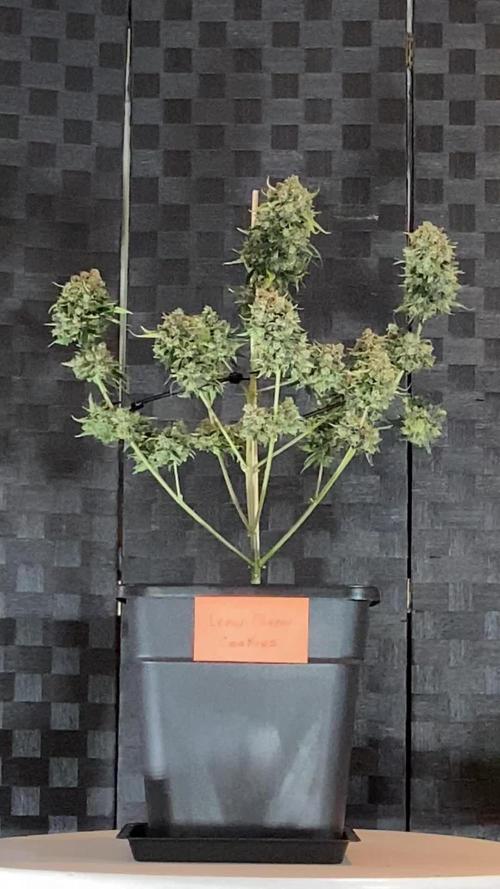
Cosechamos la blue mazar, cogollos muy resinosos y un gran olor, y también muy compactos, esperando que se seque para probarla y ver qué cantidad de gramos hemos sacado



Likes
4
Share


Processing
Likes
26
Share


@Dunk_Junk
Follow
Day 98 - she is still flowering! This week a few stems have bent over, I've had to support them before they break. I can see her going another 3 weeks easy....... I hope she yields A LOT 😋😍

Likes
24
Share


@Alpha_Green
Follow
Strong baby!
Lady Jealousy was in the vegetative phase for 7 weeks and is now in her 4th week of flowering - wow, that's really remarkable!
No automatic before, was like her.
She has an irrepressible will to live and is tremendously motivated to deliver!
Sour Jealousy means a lot of passion and diligence, but also assured quality and reliability.
Let's look forward with excitement.
PK is on the way…
Take care & bee 🐝 positive!
Alpha_Green
Likes
17
Share


@Widukindz
Follow
Everything is going well for this early growth, looking forward to repotting in auto Pot and trying to have a beautiful pink phenotype!
Likes
31
Share


@Mrs_Larimar
Follow
2022-09-17
Plants would need just a few Days longer.
But Weather changed drasticly to lots of Rain and Cold.
So i cut alot of the Topbuds, to give the rest of the Plant more ventilation
and some buds were leaning out under the Roof and were getting wet.
I only found 2 small spots of Mold.
The rest of the Plant gets harvested next Wednesday, or if i see Mold.
But normally Plants are well covered and have place to get airflow now
But those Buds are superthick, and airflow is not to gurantee
well thats outdoor growing.
But iam very Pleased, and in common Honey cream is ready to get harvest.
I just hope for 4-5 more Days of Sun- and dry Weather.
The Plant smells superlovely, flowery and sweet

Likes
28
Share


@PrairieFrostGrow
Follow
*
************** Week 6 - May 16 to 22, 2020 - Days 36 to 42 from germination ****************
*
Calling this week a flower week but it is certainly more of transition week.
Been battling a busy life along with pH issues this grow. Starting to get both under control😃 Not sure what is up with the pH but running through some 5.5pH feeds to help keep it in mid to low 6 range. She started to feed more this week, her pot drying out quicker. Wanting to get the pH in line as I want to be giving her 6.1 feeds right now.
This girl has stayed in the fabric pot while two other girls were transplanted to plastic pots to help with the pH. I suspect the issue is around these fabric pots?? I have cut two large slits in the bottom of the pot to let the excess moisture run out easily and not allow it to sit in the bottom. It felt like there was some slowness in grow at the middle of the week so reviewed the fresh air and ensure circulation is flowing properly.
She is really wide in structure and slower growing vertically. By the end of the week she was looking wonderful for the end of flower. Her size is perfect and will be starting a stretch soon. She has been getting silica so its time to get her branches pulled out while they still bend easily. LST was done in the middle of the week.
Started the introduction of Rezin and Terpinator now to her feed.
Little more detail.......
May 16/20 - Day 36
- 2L feed - Velokelp, Rezin @ 2ml, Sensyzime, Liquid Weight @ 1ml, Massive @ 3ml, Dual Fuel @ 1ml
- 1000ppm and 4.5pH.
- She took all the feed today without runoff. She is getting hungry
- she is taking her time perking up.
- funny,,,,,,she looks like LST has been done to her but its just her growth
May 17/20 - Day 37
- 2L feed - Piranha, Voodoo, Dual Fuel @ 1.5ml Rezin, L. Weight, CalMag @ 1ml Massive @ 2.5ml
- 1050ppm and 5.5 pH going in.
- She seems to be forming a good root ball......it takes over two lites to get runoff now.
- still working on her buds....pistols are there.
- Pulled a couple of the large fan leaves at second node from the top....blocking too much light now.
May 18/20 - Day 38
- 3L feed - Piranha, Voodoo, Dual Fuel, Rezin, L. Weight, Vitathrive @ 1.5ml Massive @ 3ml
- 850ppm and 5.7pH
- run off numbers: 490ppm and 6.1pH ———- perfect!!
- LST done today and side branches pulled down.
May 19/20 - Day 39
- Dry out day
- standing up today and reacted well to stripping and training yesterday
May 20/20 - Day 40
- 2L feed - CalMag, Sensyzime, Rhino @ 1.5ml Dual Fuel @ 1ml = 650ppm and pH 6.1
- Pots were light today when lifted so she is eating well, also the slit in the bottom of the pot helps to dry out faster
Many 21/20 - Day 41
- 1.5L feed - Rezin and Terpinator @ 1.5ml = 160ppm and 5.7pH
- she is doing good, just not going crazy....hmmmmm
- increased fan speed to ensure good circulation
May 22/20 - Day 42
- dry out day
- she is trying to set her buds but they still are not quite there
- She’s a wide girl.....LST working
- She darker but not a big concern.
So we are at the end of week 6. I sure don’t see her being done in two weeks......suspect will be looking at 70 day range at least.
Likes
20
Share

@TrickzGrowz
Follow
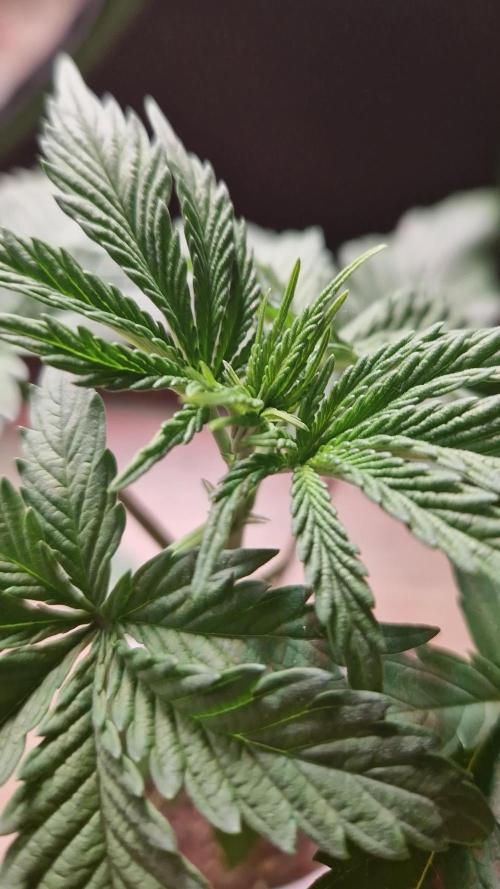
Sie wird langsam echt zu groß und deshalb wird sie heute getoppt, damit auch die unteren Triebe zoch ziehen können. Ich möchte mich auf 4 Haupttriebe konzentrieren.
Likes
9
Share


@GoldenWeedGrower
Follow
D08 - 02/10 - 4 girls of 5 are very close to the ScrOG net. I think I'm going to tied'em up tomorrow. I decided to wait to cut off the lower branches of the other girls because I need more time and I don't want a quick grow.
D09 - 03/10 - Still waiting
D10 - 04/10 - They are arrived. Made first LST to keep'em down...
D11 - 05/10 - continuing LST. Very strong girls !
D12 - 06/10 - I'm impressed how the mother plant is strong. So are the clones, just incredible.
D13 - 07/10 - Made a big defolation and topped the main branches. All the girls must remain down, else I'm going to have big issues !
D14 - 08/10 - Continuing LST under the SCROG. I cutted the secondary branch trying to do a main lining.The girls are very hard to manage, I think I'm go to double the scrog waiting to move them in the other room.
Likes
3
Share

@therealgrowmie
Follow
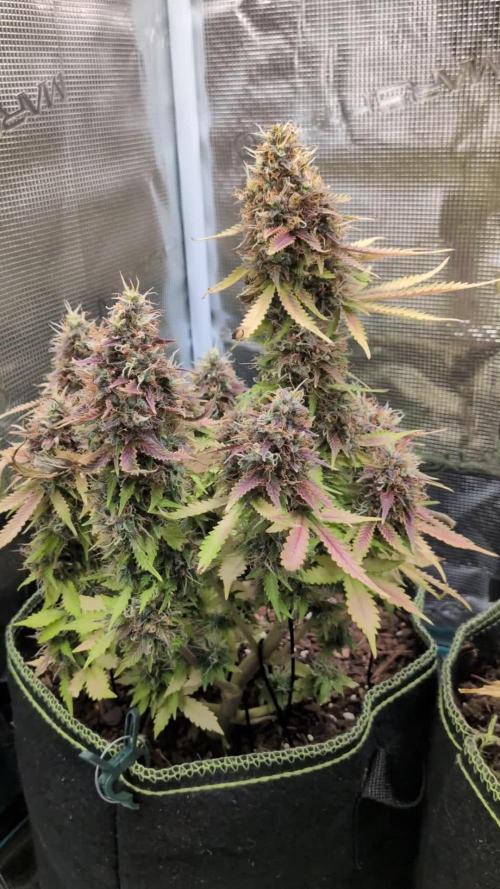
We’re now in the final stage of the grow. The plants are receiving plain water only, and we’re just watching and waiting for the right harvest window to open up.
Trichomes are still showing some clear heads, so I estimate we’ve got around 10 days left, give or take. That would bring us to a total of 14 weeks from sprout to harvest, which is definitely on the longer side for modern autoflowers — but every strain is different!
Leaves are fading fast, senescence is well underway, and everything is pointing towards the final phase. Now it’s all about patience, letting them finish strong to maximise flavour, smoothness, and yield.
---
Grow Conditions (still consistent):
💧 Watering: 1500ml every third day
🌱 Nutrients: None (flushing, previously BioBizz schedule)
💡 Light Intensity: ~1000 PPFD
🌡️ VPD: ~1.82 kPa
🌞 Temp: ~28°C
💦 RH: ~50%

Likes
74
Share


@Mr_Maes
Follow
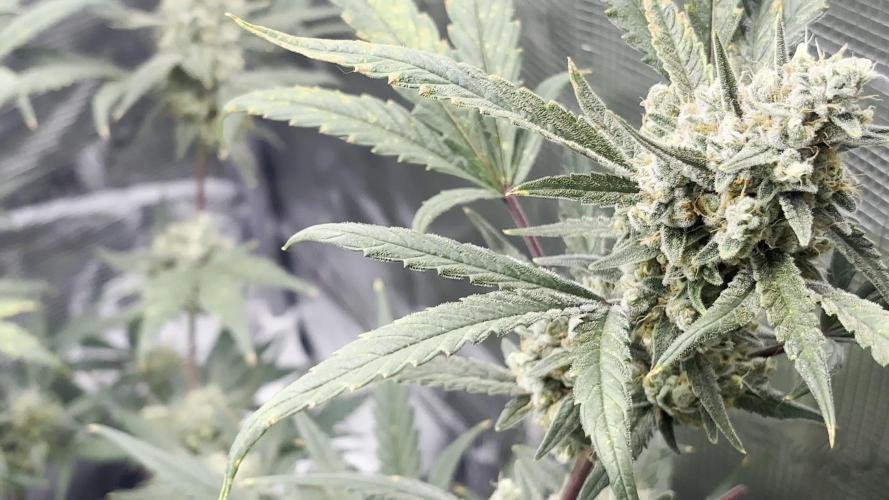
We are officially in full bloom. The have been enjoying 6-7 hours of sun light per day for about 4 days now, then brought back in under the cobs. The girls are all exploding with growth and stacking what I expect to be huge buds.


Processing
Likes
36
Share


@Island
Follow
Week 8 -
Dead line is coming, starting week 8 of flowering.
The routine is maintained, feeding only with water.
The pistils take on an orange color and some leaves change color.
Likes
Comments
Share

@smoking_hills9
Follow
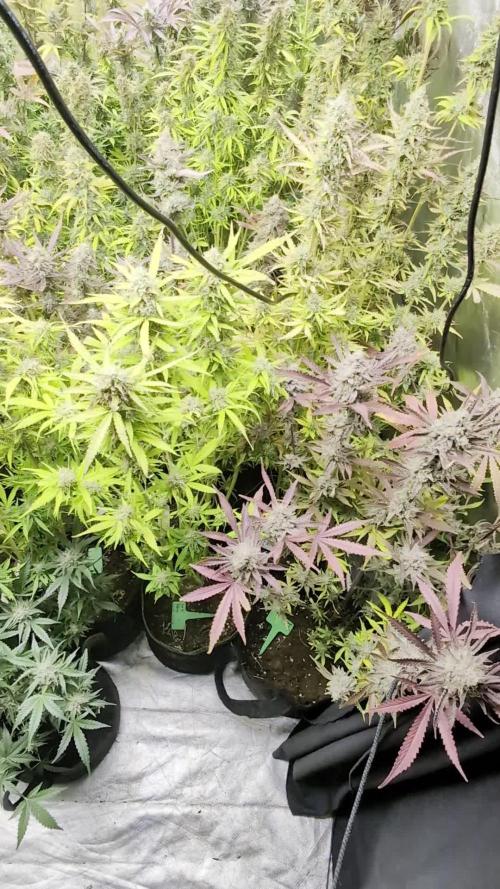
My favourite out of all GHS genetics from this grow. Just fucking WOW. Basically u can see everything yourself:) but u can't smell , and that's where this strain excell and gets 11 out of 10 in my rating. And of course super fat frosty buds , loads of them.

Likes
14
Share

@Kirsten
Follow
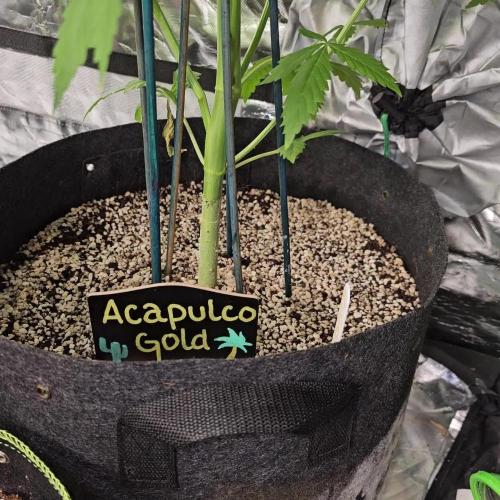
This week, the plant is feeding heavily and has grown well.
I super cropped the main stem to help with the plant becoming too tall. It has taken very well.
The plant was becoming very tall so I thought this would be something to try out.
Here's what I did this week.
18.7.25:
I watered with 2ltrs of dechlorinated water PH'd to 6.4, containing the following nutrients;
💜 2ml Ecothrive Trace
PH: 6.4
PPM: 365
22.7.25:
I watered with 3ltrs of dechlorinated water PH'd to 6.6 with;
💜 1 TSP Sea K
PH: 6.6
PPM: 485
25.7.25:
I watered with 2ltrs of dechlorinated water PH'd to 6.5, containing the following nutrients;
💜 2ml Ecothrive Trace
💜 1/4 TSP Ecothrive Biosys
PH: 6.5
PPM: 361
28.7.25:
I watered with 6.5ltrs of dechlorinated water PH'd to 6.0 with;
💜 7ml Trace
💜 1.5 TSP Ecothrive Biosys
PH: 6.0
PPM: 351
Thank you for checking in this week and hanging out in the comments 😁💚✌️🌱🙌

Processing
Likes
16
Share


@GreenCropsPT
Follow
Well they are pushing very good after my new led they answering very well they are not caring about the tea they just absorve it and ask for more


Likes
50
Share


@DogDoctorOfficial
Follow
Eternity Grow Cup - Week 9 Veg Update
We are stepping into Week 9 of vegetation, and things are getting exciting! The plants are thriving—compact, bushy, and growing beautifully. This week, we introduced a SCROG (Screen of Green) net, an essential tool for maximizing yield and optimizing plant structure. Let’s dive deep into the why and how of scrogging:
Why Install a SCROG Net Now?
Maximizes Light Exposure: The net allows even light distribution across all branches, ensuring every bud site gets the optimal amount of light.
Controls Plant Height: By guiding the branches through the net, we keep the canopy even and prevent excessive vertical growth.
Enhances Airflow & Reduces Mold Risks: Spreading the plant out increases air circulation, reducing humidity pockets and minimizing risks of mold and pests.
Increases Yield: More bud sites exposed to light mean higher-quality flowers and greater overall production.
For now, we’re still not using the under-canopy lights, though they will come into play soon. The ICL 300 is positioned strategically, and we will likely move them around as needed later. For now, the focus is on structuring the plants and ensuring they fill out the available space properly.
Optimizing Airflow - The Vortex Effect
Air circulation is crucial for plant health, and this week, we’ve optimized airflow by positioning the fans to create a vortex effect:
Fan Positioning: Each fan is placed at the tent corners, pointing in different directions, ensuring dynamic airflow instead of direct wind hitting the plants.
Benefits of a Vortex System:
Reduces hot spots and evenly distributes CO₂.
Strengthens stems by creating a natural resistance.
Prevents stagnant air, reducing mold and pest risks.
The extraction system is powered by an AeroFan, connected to the AeroFan Smart Remote FRC1, currently running at 60% speed. This setup efficiently manages humidity and temperature while maintaining optimal air exchange.
Current Environmental Conditions & Feeding
For now, we’re maintaining the same water schedule and nutrient regimen. The environmental conditions remain stable:
Temperature: Holding steady at ideal growth levels.
Relative Humidity: Balanced to encourage healthy transpiration.
PPFD (Photosynthetic Photon Flux Density): Kept at optimal levels to support vigorous vegetative growth.
CO₂ Levels: Elevated but within safe limits, promoting faster growth.
The plants are filling the space beautifully, but we know that the flip to flower is approaching soon! The next phase will depend on how fast they continue to spread, and adjustments will be made accordingly.
Closing Thoughts & What’s Next?
This week was all about structural optimization—ensuring proper airflow, training the plants with the SCROG net, and keeping everything in balance before the transition to flower. The upcoming weeks will be crucial, as we fine-tune the environment, possibly introduce the under-canopy lighting, and prepare for the flowering stage.
A huge thank you to our sponsors Aptus Holland, TrolMaster, CannaKan, Grove Bags, Ziggi Papers, and of course, Zamnesia, Plagron, and Grow Diaries for making the Eternity Cup possible. And to our incredible community—followers, supporters, and even the critics—we appreciate every single one of you!
Stay tuned for next week’s update, and don’t forget to follow along on YouTube and Instagram for exclusive content and behind-the-scenes looks! See you soon, and happy growing!
Let’s keep pushing forward, and best of luck to all the competitors—we’re all growing something incredible together. Until next time!
Genetics - Runtz https://www.zamnesia.com/6000-zamnesia-seeds-runtz-feminized.html
Nutrients - Plagron https://plagron.com/en/hobby
- Aptus Holland https://aptus-holland.com/
Controls - Trol Master https://www.trolmaster.eu/
LED - https://www.futureofgrow.com/en
LED - https://www.thinkgrowled.com
Soil - https://www.promixgardening.com/en
Germination - Cannakan https://cannakan.com/?srsltid=AfmBOopXr-inLXajXu3QFgKXCXXos4F1oEvScjMKIB5MR5dk8-GJ-F49
DOGDOCTOR 15% off
Smoking Papers - https://ziggioriginal.com/
Terpene saver - https://grovebags.com/
As always thank you all for stopping by, for the love and for it all , this journey of mine wold just not be the same without you guys, the love and support is very much appreciloved and i fell honored with you all in my life
With true love comes happiness Always believe in your self and always do things expecting nothing and with an open heart , be a giver and the universe will give back to you in ways you could not even imagine so
As always, this is shared for educational purposes, aiming to spread understanding and appreciation for this plant. The journey with nature is one of discovery, creativity, and respect. Let’s celebrate it responsibly and continue to learn and grow together!
Growers Love To you All 💚
#EternityGrowCup #RuntzHunt #GrowersLove #CannabisCommunity #AptusHolland #ProMixSoil #TrolMaster #Zamnesia #Plagron #ZiggiPapers #Grovebags

Likes
27
Share


@BelSun_420
Follow
Im loving this !😁
This week i Will remove some soil and expose the Roots . Think its timo for that

