


Likes
Comments
Share

@GoodTimesOrganics
Follow
Welcome Back!💚
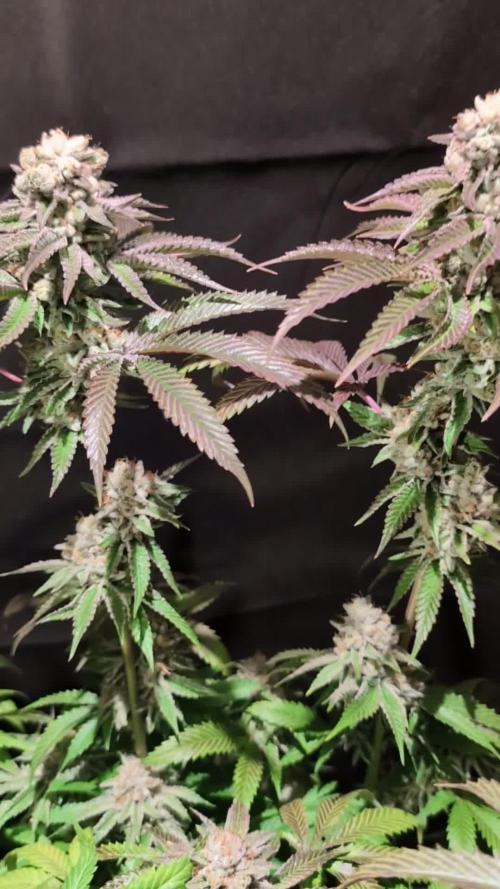
Die siebte Blütewoche ist nun vorbei und die finale Woche zieht ein. Sämtliche Trichome sind inzwischen milchig.
Die Pflanze hat eine eher schmale Blütenstruktur, bildet aber einen starken Trichomwald aus.
Es entwickelt sich ein süßes fruchtiges Aroma, mit starken Nuancen nach Kräutern.
Die Werte im Zelt sind durch den Regen und der steigenden Luftfeuchtigkeit nochmal etwas anders. Aber im Rahmen:
———————
🌞 Temp: 24°C
🌚 Temp: 20 °C
💨 RH: 56%
VPD: 0,98 kPa
😎PPFD: 830 mqm
———————
Stay Tuned! 💚

Likes
11
Share


@OrionSparkles
Follow
🐩
-Yá puestas a fotoperiodo 12/12.
-La planta más pequeña la trasplantè a maceta de 11L.
-Apliqué via foliar la primera dosis de Delta 9;via foliar,5ml x1L.
🤙🏻Todo super.

Likes
18
Share


@DogDoctorOfficial
Follow
Seedsman Seeds Germination Report - Run 01: The White OG Journey
Kickoff to Germination: The Start of Something Great!
Welcome to the beginning of this adventure with The White OG feminized seeds from Seedsman Seeds. Excitement is in the air as we’re searching for strong, resilient plants, and this journey has all the best tools and tips. Starting with five seeds, we’re aiming for a solid beginning and maximum potential. Let’s explore every step in detail to make this grow as robust as it can be!
Germination Process: Tools of the Trade
TheCannaKan: The Ultimate Germination Gadget
I’m thrilled to share my love for TheCannaKan, a little germination wonder! This tool is essential for any grower who wants to start their seeds with precision and care. I noticed rapid results in just 24 hours, with the seeds showing signs of life. At about 32 hours, I transferred them to the Root Riots, which brings us to the next exciting stage.
Why I Love TheCannaKan:
• Quick Results: Seeds sprouted rapidly, minimizing wait time.
• Consistency: Keeps moisture levels optimal for uniform germination.
• User-Friendly: Simple yet effective for both new and experienced growers.
Root Riots and Their Role in Root Development
After sprouting, I placed the seedlings into Root Riot cubes under a dome. Root Riots are fantastic for stabilizing young plants, providing an airy and nutrient-friendly environment that promotes robust root growth from the start.
Benefits of Root Riots:
• Root Aeration: Soft yet structured, these cubes support root expansion.
• Moisture Retention: Holds just the right amount of water for growing seedlings.
• Enhanced Root Health: The cubes are ideal for preventing damping-off and ensuring healthy, white roots.
Nutrients to Kickstart Growth: Aptus Holland Regulator and Startbooster
To give the seedlings a perfect start, I added Aptus Holland’s Regulator and Startbooster (1ml/L each). This mix promotes early root and stem strength, giving seedlings the ability to absorb light and nutrients more efficiently.
• Aptus Regulator: Enhances plant resilience, aids in nutrient absorption, and promotes early vitality.
• Aptus Startbooster: Adds a balanced mix of growth hormones and nutrients that are ideal for the early stages, encouraging healthy roots and faster seedling growth.
Light and Environment: Future of Grow FOG LED with TrolMaster Tent X Controller
I’m using a Future of Grow (FOG) LED at 600W, but keeping it dimmed down to around 200 PPFD. This setting is controlled by the TrolMaster Tent X Controller to give the plants the perfect start without overwhelming them with intense light. Controlled lighting helps seedlings to develop without stress, encouraging healthy growth and internode spacing.
Shoutouts:
• Future of Grow LED: High-quality, efficient LED light that adapts well to seedling and veg stages.
• TrolMaster Tent X Controller: Reliable and intuitive control over light, humidity, and more. Perfect for a hands-off, efficient environment setup.
Observations: One Seedling Takes the Lead
At the end of this germination stage, it looks like one seedling has emerged as the strongest, while the others may need a few more days. Patience and observation are key; some seeds naturally take a bit more time to sprout. I’ll keep monitoring these with hope, allowing each seedling its own rhythm.
Grower’s Notes and Tips
• Consistency Matters: Germination is all about steady conditions—consistent moisture, gentle nutrients, and stable lighting make all the difference.
• Document Everything: Keeping a log of each step (like this one!) helps track growth patterns and provides valuable insights for future grows.
• Stay Positive and Patient: Not every seed will sprout at the same rate. Trust the process and remember each plant is unique.
Community Shoutouts
Thank you to everyone who makes this process smoother and inspiring—TrolMaster, Aptus Holland, Future of Grow, and Seedsman Seeds for amazing genetics and tools, as well as the growers’ community who share insights, tips, and encouragement along the way.
Next Steps
Now that we’re through germination, we’ll move into the early growth phase. I’ll keep documenting the lighting adjustments, nutrient changes, and growth patterns of each plant, especially that eager seedling leading the way!
Growers Love, and here’s to a strong start for the future of this grow! 🌱
DISCOUNT CODE - SeedsmanSeeds - DOGDOCTOR 10% off
As always thank you all for stopping by, for the love and for it all , this journey of mine wold just not be the same without you guys, the love and support is very much appreciated and i fell honored and so joyful with you all in my life 🙏
With true love comes happiness 💚🙏 Always believe in your self and always do things expecting nothing and with an open heart , be a giver and the universe will give back to you in ways you could not even imagine so 💚
Friendly reminder all you see here is pure research and for educational purposes only
💚Growers Love To you All and remember to keep that smile big and alive 💚

Likes
2
Share


@GroloCup
Follow
Pre flowering has begun and she's all bent up to take advantage of the stretch and see if we can improve the yields of this micro grow. She's definitely strong and becoming increasingly gassy as well. I told ya the good times were coming soon and here they are.

Processing
Likes
13
Share


@kevgrow
Follow
Hey Growers, end of week 12 from seed
Not much has changed this week, its been a slow bud growth. I feel it still needs to grow thicker, 2-3 weeks before flushing
Smell is a bit stronger, hoping a sour flavor.
It been difficult trying to maintain a steady humidity level due to weather outside. I will consider buying a stronger humidifier for my next grow.
Trichomes are cloudy, no amber yet
Some of the leaves have yellow-orange tips, this happened after I changed ph meters, my old one broke so I had to purchased a different ph meter at my local hydroponics store.
Will keep you guys posted, see you next week
Likes
174
Share


@Roberts
Follow
She grew great till she got too heavy. Then had a heat issue at end. Smells amazing and cutting her down. Will post my YouTube harvest video when done. The Unit Farm UF4000, and UF2000 lights worked great. She was grown in a 5 gallon aPotforPot.com kit. Also worked great. Thank you Seedsman, aPotforPot.com, and Unit Farm. 🤜🤛🌱🌱🌱
Site won't let me upload video. It is on my YouTube channel. 👍
Thank you grow diaries community for the likes, follows, comments, and subscriptions on my YouTube channel. 🍻🌱👍 Happy Growing 🌱
https://youtube.com/channel/UCAhN7yRzWLpcaRHhMIQ7X4g
Likes
2
Share


@LoganatorDude
Follow
I absolutely love to watch them grow! Especially that moment they hit their first growth spurt.
I started with RO water that is remineralized for drinking purposes. The ppm is only 18! My tap is 156! So considering they don’t need much water, I’ve been stealing some of our drinking water. The RO water starts at pH of 7. After I add the nutrients, ppm of 249 @ pH of 5.8 while soil is still sweet @ pH of 7
I think my days are off as a new week begins on the last day of the previous week. I am going to leave that for consistency.
04/21 - Noticing some possible nutrient issues with the Fruity Pebbles for several days now. Going to see what she needs. Up front I’m thinking maybe just a super small amount of Amino Acids with a little Epsom Salt. Maybe she is struggling to access the nitrates from the neem cake. IF it’s a issues with nitrogen. We will see. Maybe she would benefit from some extra calcium?… Any ideas are greatly appreciated.
Day 22 and I am noticing how these girls have been burning up a lot of potassium lately, dealing with the wind and sun 💨 ☀️, getting pushed around all day.
I plant to top dress with some Kelp Meal pretty soon.
Day 24 -> 4/22/22- a quote from the weather on today’s red flag warning and dust storm warning.
“ HAZARD...Less than a quarter mile visibility with damaging wind in excess of 60 mph. SOURCE...Satellite imagery. IMPACT...Dangerous life-threatening travel.”
I’m keeping the girls inside today.
Day 26, I was planning to check the runoff on some of these girls, especially the fruity pebbles, however I messed that up as I also top dressed WAY too much of the seaweed bliss. So I flushed with plain RO water at pH of 7 until there was only slight coloration in the runoff. I didn’t check the runoff as a lot has changed with all that flushing. So next watering/feeding I will make sure I check the runoff on multiple plants.
So the seaweed bliss with its 17 on potassium, seems to be the most likely culprit for why there is a bronze-ish color on the inside of the new growth. Hopefully a foliar feed of Epsom salts can correct the problem. Inside tent, lights on LOW. Noticing similar pattern in all of them to a degree, most noticeable in the fruity pebbles.


Likes
40
Share


@Bread_n_Buds
Follow
What an adventure guys, we got to the end without even realizing it, as a famous Italian politician would say "they didn't see me coming", the F1 Hybrids can play this trick, they get to the end without you even realizing it.
They are damned, indeed blessedly faster, it is the flower that forms more quickly, it goes from hairs, to small buds, to mature buds in a truly record time. One plant finished in 59 days and the other in 65, and we are not talking about little grass produced, we are talking about at least 100 grams but also something more.
I tell you guys, try these F1s from Zamnesia, they are a rocket, as I was saying above of course you have to grow in ideal conditions or you have to try to get close to them, don't think of keeping the humidity at full blast during flowering and having good results. Don't think of overwatering and overfeeding and having good results. The plant must be observed, kept balanced and it is not easy at all. If you keep this balance, look at the color of the leaves and pay attention to the basic parameters, you will really harvest a lot of weed. Then if you want to grow as it comes, be careful, these plants are IDEAL FOR BEGINNERS. There is no better way to get easy, good and fast results than growing an F1 of Zamnesia.
The resin is 10 and praise, my gloves were full of charas from gloves in both harvests and smoked it is divine.
They were both harvested with the pistils more or less at 70% - 75% and the trichomes mixed: some amber, mostly cloudy and some transparent. Read the explanation of Zamnesia on instagram the best I have ever read if you want clarifications on the moment of harvest. My advice is NOT to let the plant go too far, maturity is fine but then the THC decays and even the Sativas become with physical effects. Therefore more mature on indicas and even a little less on sativas.
I can't wait to vape it.
Plagron's gruel gave us a lot of strength and vigor now we are simply in flsuh with Canna's product // Strain Description // If you were looking for a reliable, versatile and accessible strain, here it is. Blue Cheese F1 Automatic by Zamnesia Seeds uses F1 genetics to produce uniform, rewarding and easy-to-grow plants. This strain stays small, so you will have no problem finding a place to grow it. After just 10 weeks from seed, you can enjoy tasty buds with relaxing effects.
- Strain — Get a seed of this fantastic strain - https://www.zamnesia.io/it/10673-zamnesia-seeds-blue-cheese-f1-automatic.html
- Fully organic soil and fertilizers --- https://plagron.com buy at www.zamnesia.io
- Growbox and ventilation system --- https://www.secretjardin.com/
- Light — P2000 - https://www.viparspectra.com
- Music and sound --- I made my girls listen to 432hz frequencies and black music from www.radionula.com
- Z --- You can find these seeds, much more from the world of cannabis, mushrooms and an incredible series of accessories and gadgets on the reference site not only mine but of many growers
---- https://www.zamnesia.com

Likes
25
Share


@XperencdGmanXG
Follow
Well these girls sure have grown since my last update. They are coming along nicely I will have to LST them hard or put them outside, This strain is a monster!.


Likes
10
Share


@nonick123
Follow
🚀 4 clones de Blueberry Pie F1 Fast seleccionados por @stacksfarmz - https://www.instagram.com/stacksfarmz/
🚀 Breeding by @seedsmangenetics - https://www.seedsman.com/eu-en/blueberry-pie-f1-fast-feminised-seeds-sman-blpi-fast-fem
💦 BioTabs 15% DISCOUNT code "GDBT420" biotabs.nl/en/shop/ @biotabs_official
🌱Substrate PRO-MIX HP BACILLUS + MYCORRHIZAE @promixmitch @promixgrowers_unfiltered
💡2 x Mars Hydro FC1500 EVO Led Grow Light (2024 NEW FC 1500-EVO Samsung LM301H 150W LED) - https://marshydro.eu/products/fc1500-evo-led-grow-lights/ - https://www.amazon.de/dp/B0CSSGN5D8?ref=myi_title_dp
Likes
6
Share


@Rko41
Follow
A part la frosty qui a fait un debut de Flo sorti de l’interieur les autres ont pursuivibleur croissance et commence leur stretch tous doucement


Likes
127
Share


@HAPPYWEEDS
Follow
Really big monster with big yield powder. Beauty green colors. She is very leafy so I recommend some defoliation. I will upload more details when it will be cured. Also I will upload smoke review and dry weigh.


Likes
42
Share


@Ganjagrandaddy
Follow
Day 42 FLOWERING: Good afternoon ( in the UK anyway) brownies. It has been a steady weeks bud building this week and outing imposters!. I have somehow managed to mix pits during the initial set up and have two ladies representing their opposite strains !!!!!. Doh
The girl scout cookie #2 is actually the #3 Amnesia Haze and the #3 is the Girls scout #2 . I have suspected it for a while but they have failed in their ploy to fool me and their ripening phases have given thwirbruse up. Seeing how similar the #3 was to the #1Girl Scout and how close they were in finishing to each other too , it was way more evident now that the #1Girls scout looks ready to come out for her dark period . She has finished very quickly and i am in no doubt she is done with most of her pistils being a golden orange now. She has many small clusters of buds but is not going to win any yield cups I dont think. She smells so sweet and edible though with a sticky feel too. Her leaves have a really beautiful fade too . So e very nice colours among the cannabalising. I dont think the # 2 will be far behind in her finish either with her pistils starting to orange up now.
Now that the #3 amnesia is correctly identified and in the right row , it is clear to see how they all look alike and are at the same stage in bud development. They are a 77 day (11 weeks) flowering period and are still in their bud building stage with a huge production in trichromes taking place too. Thet are so like Gorilla glue #4 in their look which can only be a good thing...
The #1 and 2 are bigger than the @3 purely due to the lst I did . They both have medium sized colas for info ar al of their mains so hopefully will have some donkey dick buds covered in frost around week 9-10. Bud porn ahead I think.
Normal feedings for these ladies for the upcoming weeks but the G.S.C are going to be fed with water a few days now to let them know its time!!!!. Be safe and red eyed folks. Until next time. tata
Likes
66
Share


@Hashy
Follow
Week 3
Light settings
18/6 on at 6.00am off 0.00am
Light power= 46% 109w
Radiator settings
LIghts on
Turn on if temp drops below 21.4c
Turn off if temp goes above 21.5c
Lights off
Turn on if temp drops below 19c
Turn off if temp goes above 19.1c
Humidifier settings
LIghts on
Turn on if humidity drops below 59.9%
Turn off if humidity goes above 60%
LIghts off
Turn on if humidity drops below 49.9%
Turn off if humidity goes above 50%
Extractor settings
temperature 24c with 1c steps
Humidity 62% with 2% steps
Max speed 8
Min speed 1
VPD aim 0.5-0.9
Wednesday 8/2/23 Day 15
5.00pm
Turn pots 90 deg
Thursday 9/2/23 Day 16
8.30pm
#1 Feed 1.5L Ec=1.06 Ph=6.4
Run 0.2L Ec=5.24 Ph=5.5
Moved
#1 to right
#1 Height= 10CM Dist= 60CM DLI=19.0
Friday 10/2/23 Day 17
Did nothing
#1 not quite kicked into gear yet
Saturday 11/2/23 Day 18
8.00pm
#1 moved to centre
#1 Height= 11CM Dist= 59CM DLI= 19.6
Extractor settings
temperature 25c with 1c steps
Humidity 62% with 2% steps
Max speed 8
Min speed 1
Sunday 12/2/23 Day 19
4.30pm
Leaf tuck all 3
#1 still small but managed to expose a few nodes.
8.30pm
removed humidifier and moved pots nearer centre of the tent.
A bit more leaf tucking.
Monday 13/2/23 Day 20
7.30pm
#1 Feed 2L Ec=1.04 Ph=6.5
Run 0.4L Ec=3.02 Ph=5.7
Tuesday 14/2/23 Day 21
#1 Height= 14CM Dist= 55CM DLI= 19.1
Round up for the week.
Again it's been a fairly productive week with the grow. Didn't quite hit my VPD target but I wasn't far from it. There is enough foliage that I managed to remove the humidifier from the tent.
#1 Wedding Cheesecake FF is where I'm expecting her to be at, she is smaller then the others but I'm sure they are just rapid in growth. I didn't top/fim this one when I did the others as I wanted her to catch up a bit in height 1st. Probably veg for 1 more week and switch to flower.
Power used for week
Light
(1.96+1.96+1.96+1.96+1.96+1.95+1.95)=13.7Kw
Extractor
(0.05+0.05+0.05+0.06+0.06+0.06+0.07)=0.4Kw
Fans
(0.31+0.30+0.30+0.30+0.3+0.31+0.39)=2.21Kw
Humid
(0.05+0.02+0.0+0.0+++)=0.07Kw
Radiator
(1.44+0.9+1.04+0.68+0.6+0.92+2.61)=8.19Kw
Total for the week=24.57Kw
Back in a week.
Thanks for stopping by.
Likes
2
Share


@I_Identify_As_A_Dan
Follow
Day 21
I think her extra day in the paper towel germinating while I waited for equipment to arrive, may of sent her straight into flower... shes throwing pistils everywhere.
Really jumped in side in 7 days 😂 Lets see how she looks in another 7 days.
Turned the auto-pots + air-domes on to get water and oxygen directly to the roots 3 days ago.
Feeding Cropsalt at 5.8ph, really enjoying it atm just look at their colour😍


Likes
2
Share


@Elhuertoandaluh
Follow
Hey huerteros pues asi va esta sativa dream que hoy hace su dia 46... y nos veas como esta desarollando! Seguimos aplicando LST ... para ir abriendo la planta y haciendo una buena estructura para cuando llegue la fase de floración!!
De momento solo regamos con agua y cada 10-15 dias añadimos microbes!
El sustrato es All mix de biobizz y ya viene prefertilizado asi que por nutrientes no sera y la planta asi lo demuestro con ese verde tan vivo!
Esperemos que todo siga igual... iremos subiendo contenido asiduamente todas las semanas!
Saludos desde el sur 🇪🇸
